


Most portfolio lifecycles look fine on a slide and fall apart in operation. The reason isn't that the stages are wrong. It's that the stages are drawn as boxes with arrows, and the actual work — who produces what, what evidence proves a stage is done, where the handoff goes, how long it's allowed to sit, and how it reconciles back to finance — lives in people's heads or scattered across email threads.
When a portfolio is small, that gap is survivable. Someone remembers who signed off on the business case. Someone knows the real forecast versus the one in the deck. But the whole thing runs on tribal memory, and tribal memory doesn't scale past a few dozen projects.
This is a systems view of the operational portfolio lifecycle for PMOs. Not a definition of what a lifecycle is — you already know that — but how the parts actually connect, where the seams tear under load, and how to build a lifecycle where every stage produces enforceable evidence, routes to the next owner automatically, and closes the loop with finance and audit instead of leaving a mess for quarter-end.
The real problem: stages without connective tissue
Walk into most PMOs and you'll find they have a lifecycle. Intake, business case, funding, delivery, close, benefits. The stages exist. What's missing is the connective tissue — the rules that make one stage hand off cleanly to the next.
The pattern repeats constantly. A project passes a funding gate. The approval happens in a steering committee, gets noted in minutes, and then nothing structured moves. The PM finds out through a hallway conversation. Finance updates the budget line three weeks later because someone forwarded the deck. Audit, months down the line, asks "who approved this scope change and on what basis?" and the answer is a scramble through Slack and inboxes.
None of that is a stage failure. Every stage worked. The transitions failed. And transitions are where a portfolio lifecycle actually lives or dies.
A systems-first lifecycle treats each stage as producing three things, always:
-
An artifact (the deliverable that defines the stage)
-
An evidence package (the proof the stage was completed properly and by whom)
-
A routing action (where it goes next, to whom, and by when)
Strip any one of those out and the lifecycle degrades into a set of independent checkpoints that don't add up to a governed portfolio.
Why this breaks across almost every organization
The breakdown isn't about competence. It's structural, and it repeats because of how PMOs grow.
Stop losing track of critical projects.
GoProjy helps you monitor, prioritize, and deliver projects on time—seamlessly.
- Unified portfolio visibility
- Real-time resource tracking
- Milestone & risk alerts
No credit card required
In the early days, the PMO is a coordinating function. Five to fifteen projects, one or two portfolio managers who know everything. Governance is a meeting. Evidence is "trust me, I was there." That works, and because it works, nobody builds the underlying system.
Then the portfolio grows — a reorg, an acquisition, a strategy that suddenly funds forty new initiatives. The coordinating function is now supposed to govern something four times its old size with roughly the same headcount. The meeting-based model can't keep up, so things start leaking:
-
Evidence gets produced after the decision, to satisfy audit, rather than as part of the decision. It becomes theater.
-
Handoffs stall because nobody owns the transition — the sending stage assumes the receiving stage is watching, and vice versa.
-
Finance and the PMO run two versions of the truth, and reconciliation becomes a quarterly firefight.
The tipping point tends to sit somewhere around 30–50 active projects. Below that, informal coordination limps along. Above it, the absence of enforceable routing and evidence rules turns into a permanent tax — reconciliation meetings, audit findings, and PMs who spend more time reporting status than delivering.
The core insight: a lifecycle scales only if the rules that connect stages are enforced by the system, not remembered by people.
The lifecycle as a set of contracts, not a diagram
The useful way to think about this: each stage boundary is a contract. The upstream stage owes a defined package. The downstream stage owes an acknowledgement and an SLA. Reconciliation owes a check back against finance.
Here's the canonical stage flow, described as handoffs rather than boxes:
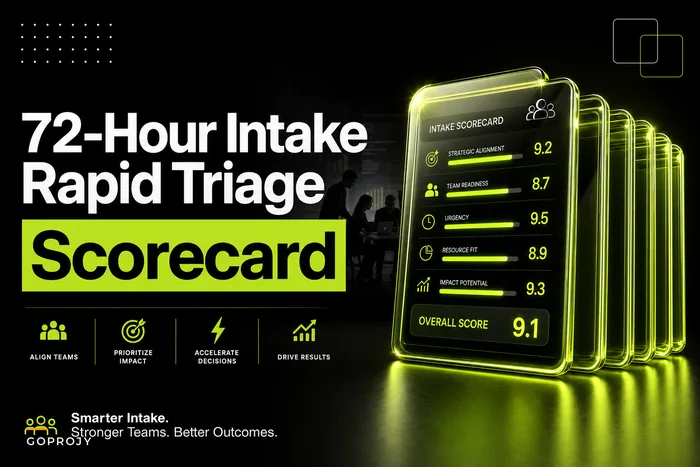
Intake → Assessment Intake produces a scored request with a sponsor, a rough size, and a category (tactical vs strategic). The routing rule sends anything above a size threshold to full assessment; small tactical requests go to a lightweight lane. This is where a fast, disciplined triage matters — the mechanics of scoring and lane-splitting are worth building deliberately, and the approach in 72-hour intake triage is the kind of front door this lifecycle needs.
Assessment → Funding Assessment produces a business case with a cost-to-complete range, a benefits hypothesis, and a risk profile. The evidence package includes the assumptions log and who validated the numbers. Routing sends it to the funding authority matched to its size band.
Funding → Delivery Funding produces an approval with a funded amount, a funding type (CapEx/OpEx), and reallocation triggers. Linking the funding decision to the priority score is what keeps allocation honest as things change — the framework in linking prioritization scores to funding slices is what turns a one-time approval into a living allocation.
Delivery → Close Delivery produces the completed scope plus acceptance evidence. The handoff to close requires the actuals reconciled against the funded amount — this is the first hard reconciliation loop back to finance.
Close → Benefits Close hands the benefits hypothesis to a tracking owner. This is the loop everyone skips, and it's why so many portfolios can't prove they delivered value. Wiring the hypothesis from intake all the way through to finance reconciliation — the way operationalizing benefits realization lays out — is what closes the lifecycle instead of leaving it open-ended.
Each arrow above is a contract with a producer, a consumer, a package, and a deadline. That's the whole game.
Enforceable routing tables
A routing table is where the lifecycle stops being aspirational. It says, in plain terms: this thing, at this size, in this state, goes here, to this role, within this window. If the SLA is breached, it escalates.
Here's a compact example of what a routing table looks like for the front half of the lifecycle:
| Stage transition | Trigger condition | Routes to | SLA to acknowledge | Escalation on breach |
|---|---|---|---|---|
| Intake → Assessment | Score ≥ threshold, est. > $50k | Portfolio analyst | 2 business days | PMO lead |
| Intake → Fast lane | Tactical, est. < $50k | Team backlog owner | 1 business day | Intake manager |
| Assessment → Funding (Tier 1) | Est. $50k–$250k | Portfolio review board | 5 business days | PMO director |
| Assessment → Funding (Tier 2) | Est. > $250k | Steering committee | Next scheduled gate | CFO office |
| Funding → Delivery | Approval recorded | Assigned PM + finance line owner | 3 business days | PMO director |
| Delivery → Close | Acceptance signed, actuals loaded | Finance reconciliation | 5 business days | Finance controller |
The value isn't the specific numbers — yours will differ. The value is that every row has a who, a when, and a what happens if it doesn't move. The most common mistake is building the first three columns and skipping the last two. A routing rule without an SLA and an escalation path is a suggestion, and suggestions don't survive a busy quarter.
Keep the number of tiers small. Portfolios that try to encode eight funding bands and twelve routing exceptions end up with a table nobody can follow.
Keep the number of tiers small. Portfolios that try to encode eight funding bands and twelve routing exceptions end up with a table nobody can follow, so people route by gut and the table becomes decorative. Three tiers covers most real decisions.
Here's a quick visual of how a routing table-driven handoff flows through roles and SLAs.
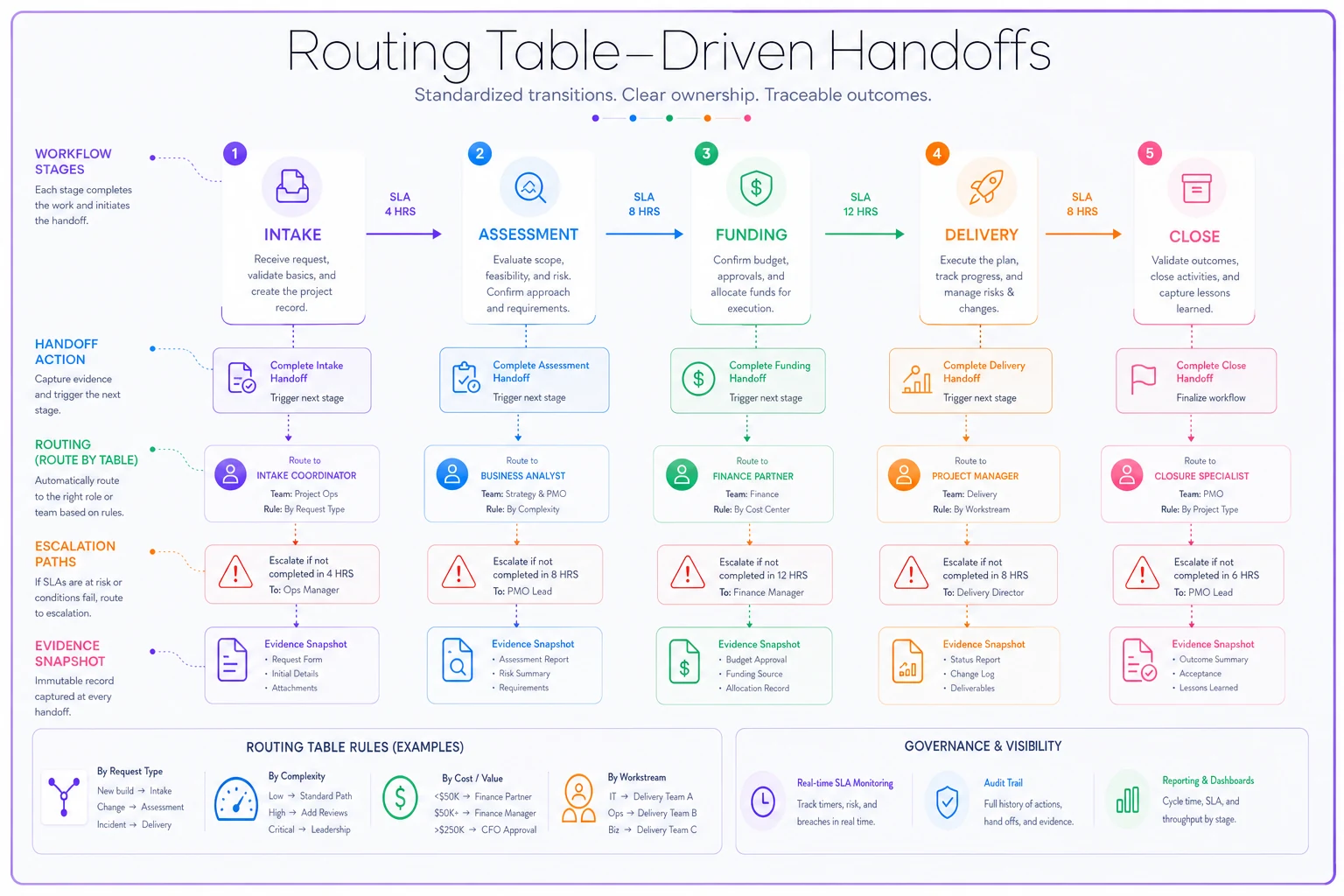
The diagram highlights the automatic routing, SLA timers, and escalation triggers that stop transitions from stalling.
What goes in an evidence package
Evidence is the part everyone underinvests in until an audit forces the issue. Then they overcorrect and turn it into a compliance burden that PMs quietly ignore.
The trick is to define the minimum evidence that proves a stage was legitimately completed, and to capture it as a byproduct of the work rather than a separate documentation exercise. If producing evidence is a second job, it won't get done well.
A funding-gate evidence pack, for a mid-size initiative, realistically contains:
-
The business case version that was actually approved (not the latest draft)
-
The assumptions log with named owners for each key number
-
The decision record
who approved, on what date, the funded amount, and any conditions
-
The risk profile as of approval
-
A link back to the intake score and sponsor
That last point matters more than it looks. The strongest evidence packages are the ones where you can trace a decision all the way back to its source inputs. When audit asks "why was this funded over that?", you want a clean line from decision to assumption to source. Building that lineage deliberately — as covered in tracing decisions back to sources — is what turns evidence from a scramble into a lookup.
Evidence packages assembled after a decision are almost always incomplete, because the context has already evaporated. Evidence captured at the moment of decision is both more accurate and less work. The system should snapshot state when the gate is passed, not ask someone to reconstruct it later.
The reconciliation loops nobody wires up
Two reconciliation loops separate a governed portfolio from a hopeful one, and both are usually missing.
Loop one: funded vs actual. At the Delivery → Close transition, the funded amount has to be reconciled against actual spend. Not "roughly." Line by line. This is where the PMO view and the finance ledger either agree or expose the gap that's been quietly growing all quarter. When these two systems reconcile continuously instead of at period close, the ugly surprises mostly disappear.
Loop two: promised vs realized benefits. At Close → Benefits, the hypothesis from intake becomes a tracked commitment. Most portfolios lose this loop entirely — the project closes, the team disperses, and the benefits case is never checked. Which means nobody ever learns whether the portfolio's prioritization was any good.
A simple process to install these loops:
-
At funding, record the funded amount and the benefits hypothesis in a structured field, not a document body.
-
At delivery milestones, sync actuals from finance on a fixed cadence — weekly or biweekly, not on demand.
-
At close, run the funded-vs-actual reconciliation and flag any variance above a set band.
-
Assign the benefits hypothesis to a named owner with a review date, typically 3–12 months post-close.
-
At the benefits review, compare realized to promised and feed the delta back into how future cases are scored.
Step five is the one that compounds. A portfolio that feeds realized-benefits data back into its scoring gets measurably better at picking work over a couple of years. One that doesn't just keeps guessing with confidence.
A short real scenario
A mid-market services company had grown its portfolio from about 20 to roughly 70 active projects over two years, mostly through acquisition. The PMO was still running on the old model — governance by meeting, evidence by memory. Quarter-close reconciliation between the PMO's numbers and finance's ledger was taking the better part of two weeks every quarter, and the last audit had turned up several funded scope changes with no traceable approval.
They didn't reinvent their lifecycle. They kept the same six stages. What they changed was the connective tissue: they built a routing table with SLAs for each transition, defined a minimum evidence pack per gate, and set up a biweekly actuals sync so funded-vs-actual reconciled continuously instead of at close.
The results weren't dramatic-sounding, but they were real. Quarter-close reconciliation dropped from around two weeks to two or three days, because the numbers had been agreeing all along. The next audit closed with no findings on approval traceability — the evidence was already there because it was captured at each gate. And the PMs, who'd braced for more bureaucracy, ended up spending less time on status reporting because the state was captured automatically as work moved through the routing table.
Nothing about that required a bigger PMO. It required making the transitions enforceable instead of hopeful.
Where tooling actually earns its place
None of this needs a heavy platform to start. A disciplined team can run the first version on a well-structured spreadsheet and a shared drive. But it stops scaling around the same 30–50 project point where the manual model broke in the first place, for the same reason: humans can't reliably enforce SLAs, snapshot evidence at the right moment, and reconcile two ledgers by hand across dozens of projects.
This is where operational software with sensible automation genuinely helps — not as a magic layer, but as the thing that enforces the routing table, snapshots the evidence pack the moment a gate is passed, and runs the actuals sync on schedule without someone remembering to do it. The routing rules you wrote down become rules the system executes. The escalation on SLA breach fires on its own. The reconciliation loop runs on a cadence instead of a heroic quarter-end push.
The point isn't to replace judgment. Funding decisions, prioritization calls, risk trade-offs — those stay human. The tooling handles the mechanical connective tissue that people are bad at maintaining at scale: the routing, the timestamps, the evidence snapshots, the syncs. That's exactly the work that quietly falls apart when a portfolio grows, and exactly the work that's tedious enough that nobody keeps doing it by hand.
For portfolios managing pilots and emerging initiatives, there's an additional dimension worth noting. Moving a pilot into a funded roadmap slot requires its own evidence gate — a structured check that the pilot delivered enough signal to justify full investment. The checklist approach in graduating pilots into funded roadmap slots is a good example of how that gate gets made enforceable rather than discretionary.
When this level of rigor makes sense — and when it doesn't
When it makes sense: You're past the point where one person can hold the portfolio in their head. You have real funding decisions flowing through gates, finance depends on your numbers, and audit is a genuine concern. Roughly 30+ active projects, multiple funding authorities, and a growth trajectory that's going to make coordination harder, not easier.
When it's overkill: A small portfolio of under a dozen projects with a stable team and low audit exposure doesn't need enforceable routing tables. Building this machinery too early creates process for its own sake, and the team will route around it. Start light. Add rigor at the seams that are actually tearing.
Who should NOT do this: If your problem is that stages themselves are undefined — you don't really have a funding gate, or "done" means different things to different teams — fix that first. This lifecycle assumes the stages exist and work. Bolting routing tables and evidence packs onto stages that aren't real just formalizes the confusion. Get the stages honest, then wire them together.
Closing thought
The way most portfolios fail isn't at any single stage. It's in the gaps between stages — the handoffs that stall, the evidence that gets reconstructed after the fact, the finance numbers that drift until quarter-close forces a reckoning. A systems-first lifecycle fixes the gaps, not the boxes.
Treat every stage boundary as a contract: a defined package, a named owner on both sides, an SLA, and a reconciliation check. Enforce those contracts with tooling once you outgrow memory. The lifecycle stops being a diagram you present and starts being a system that actually runs your portfolio — through growth, through audits, and through the quarters when everything's on fire.
Ready to elevate your project delivery?
Join over 2,500 project teams using GoProjy to optimize resources, reduce risks, and drive portfolio success.