

Six months after a steering committee approves a project pivot, an internal auditor asks a simple question: "Show me the KPI numbers this decision was based on, and confirm they hadn't already shifted when the executive signed."
And the PMO can't. There's a meeting minute that says "approved." There's a slide deck somewhere. There's a Slack thread where someone mentioned the forecast. But nobody can reconstruct what the actual numbers were on the day of approval, which assumptions were baked in, or whether the person who signed even saw the version that mattered.
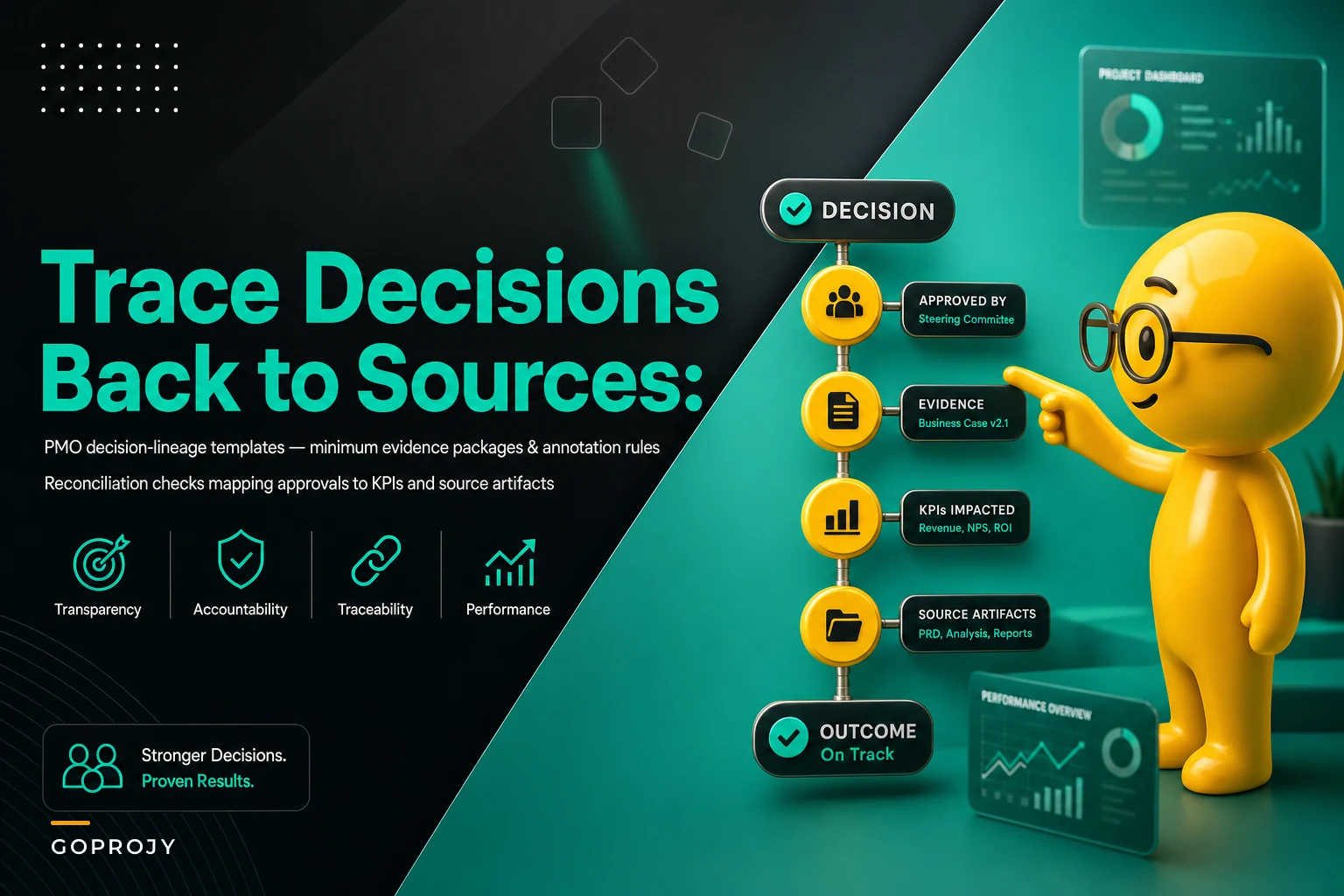
This is the gap that decision evidence lineage in a PMO is supposed to close. Not the decision rights question of who gets to approve — that's a separate problem worth solving with a proper operational governance framework and decision matrices. This is the narrower, uglier problem: after an approval happens, can you trace it back to the exact evidence, assumptions, and source artifacts that justified it — months or years later, under scrutiny?
Most PMOs think they have this covered because they store minutes. They don't. Minutes record that a decision happened, not why it was defensible.
Where the lineage actually breaks
The failure isn't usually one big missing document. It's a chain that snaps in three predictable places.
The KPI drifted and nobody snapshotted it. A funding decision gets approved against a forecast showing cost-to-complete of $2.1M and a benefit case of $4.8M. That forecast lives in a portfolio dashboard that recalculates weekly. Three weeks later the same view shows $2.6M / $4.2M. When someone challenges the decision, there's no frozen record of what the approver actually looked at. The dashboard moved on.
The assumption was verbal. The real reason a scope reduction got approved was an assumption — "vendor confirmed they can deliver the API by Q3." That assumption was said out loud in the room, nodded at, and never written down as a condition of the approval. When the vendor slips, there's no record that the entire decision hinged on a date that turned out to be wrong.
The source artifact is a link that died. The approval referenced "the Q2 capacity analysis (see shared drive)." The file got renamed, moved, or overwritten. Now the decision points to nothing.
Across a lot of PMO setups, these three failures tend to compound. By the time an audit or post-mortem hits, you're not reconstructing a decision — you're doing archaeology.
The minimum evidence package: what "defensible" actually requires
You don't need to attach everything. Over-documenting is its own failure — nobody maintains a lineage system that demands 40 fields per approval. The goal is a minimum evidence package that's small enough to actually get filled in and complete enough to survive a challenge.
Stop losing track of critical projects.
GoProjy helps you monitor, prioritize, and deliver projects on time—seamlessly.
- Unified portfolio visibility
- Real-time resource tracking
- Milestone & risk alerts
No credit card required
Here's the minimum that holds up:
| Element | What it captures | Why it fails without it |
|---|---|---|
| KPI snapshot | Frozen values of the metrics that justified the decision, dated | Dashboards recalculate; you lose the "as-seen" state |
| Assumption log | Explicit conditions the decision depends on, each flagged as verified/unverified | Verbal assumptions vanish; nobody knows what the sign-off was contingent on |
| Source artifact reference | Immutable link or attached version of the underlying analysis | Links rot; files get overwritten |
| Approver + version seen | Who approved and which version of the pack they actually saw | People approve v3 while the "record" points to v5 |
| Decision statement | The specific choice made, in one unambiguous sentence | "Approved" doesn't tell you what was approved |
Pinning the approval to a specific artifact version is what turns "he said / she said" into a closed question.
The one most teams skip is version seen. It sounds pedantic until an executive says "I never saw those numbers" — and they're right, because the deck was updated after they signed. Pinning the approval to a specific artifact version is what turns "he said / she said" into a closed question.
Pinning the approval to a specific artifact version is what turns "he said / she said" into a closed question.
Assumption-annotation rules that don't collapse into noise
The assumption log is where most lineage systems die. Either people write down nothing, or they write down everything ("assuming the sun rises") until the log is useless.
-
Only log assumptions that, if false, would reverse or materially change the decision. If the approval survives the assumption being wrong, it doesn't belong in the lineage.
-
Every logged assumption gets a status
verified,unverified, ordisputed. An unverified assumption attached to an approval is a flag, not a footnote. -
Every assumption gets an owner and a check-by date. "Vendor confirms API by Q3" isn't a note — it's a commitment with a name and a deadline attached.
-
Disputed assumptions must be visible at approval time. If finance thinks the benefit case is optimistic, that dispute travels with the decision, not in a separate email nobody reads.
The pattern worth internalizing: a decision built on three unverified assumptions isn't really a decision, it's a bet. Annotating that honestly at approval time is uncomfortable — which is exactly why it protects you later. When the bet goes wrong, the record shows the risk was named and accepted, not hidden.
A decision-lineage template you can actually maintain
Here's the structure that survives contact with a real PMO — compact enough that a project manager will fill it in without resenting it.
Decision Lineage Record
-
Decision ID + date — unique, sortable, tied to the governance forum
-
Decision statement — one sentence, unambiguous
-
Decision type — funding / scope / schedule / vendor / risk acceptance
-
KPIs referenced — metric name, snapshot value, snapshot date, source dashboard
-
Assumptions — each with status, owner, check-by date
-
Source artifacts — versioned reference for each (analysis, forecast, business case)
-
Approver(s) — name, role, and the artifact version they reviewed
-
Conditions of approval — anything that must hold for the decision to remain valid
-
Reconciliation status — open / reconciled / breached (more on this next)
-
Superseded by — link forward if this decision was later reversed or changed
This diagram shows the workflow for creating and maintaining a decision-lineage record.
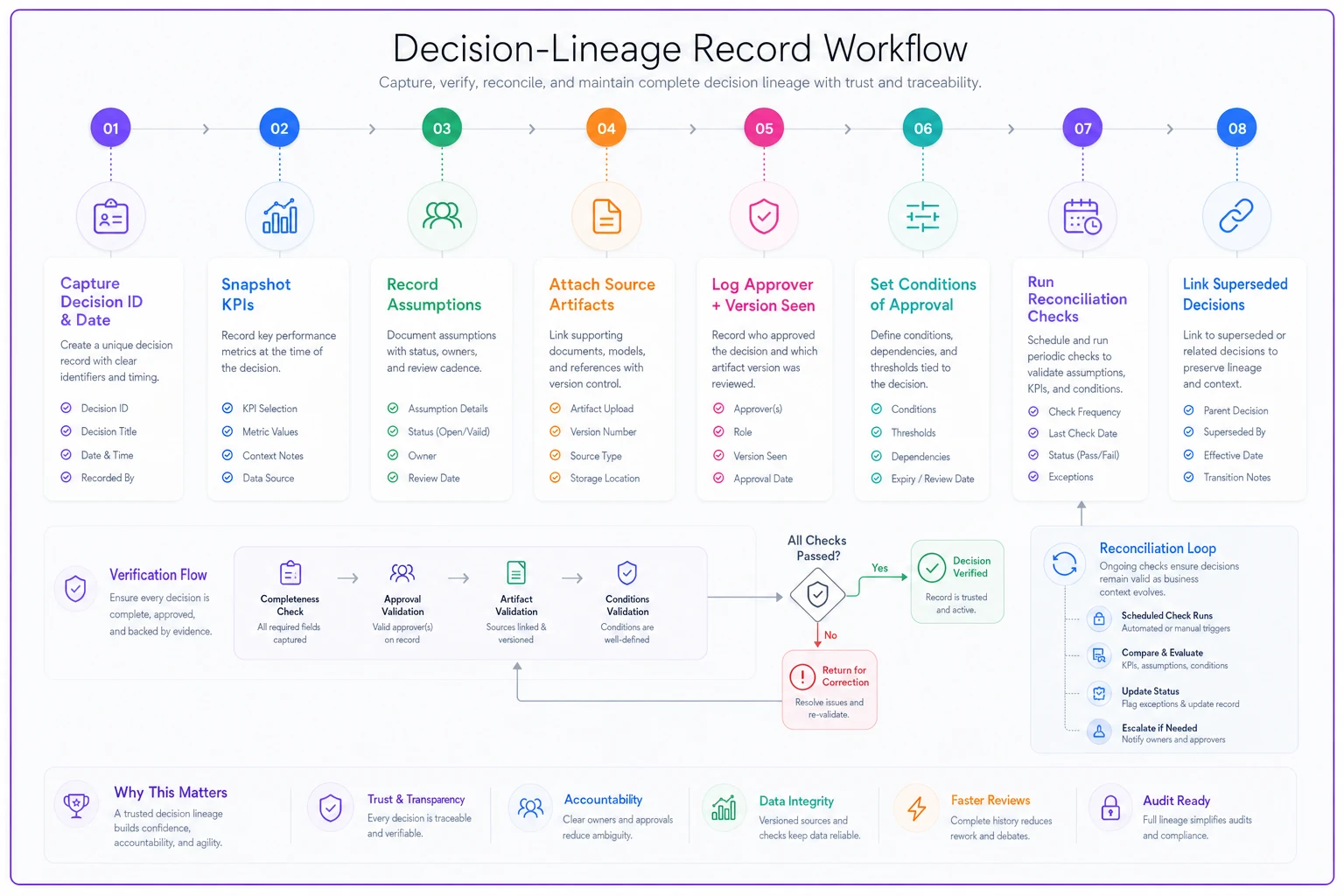
The forward-link in field 10 is underrated. Decisions rarely die cleanly — they get quietly overtaken by later ones. Without a "superseded by" pointer, your lineage shows a decision as still-active when it was replaced two quarters ago, and someone acts on stale authority.
This record doesn't replace your decision-ready portfolio health review — it feeds it. The health review shows the current state; the lineage record explains how the state got approved.
Reconciliation checks: closing the loop between approval and reality
A lineage record that's written once and never revisited is just a nicer filing cabinet. The value comes from reconciliation — periodically mapping approved decisions back against what actually happened.
Three checks matter:
KPI reconciliation. The decision assumed cost-to-complete of $2.1M. What is it now? If actuals have drifted past a set threshold from the snapshot, the decision gets flagged for revisit. This isn't about blame — it's catching decisions that were sound when made but are no longer valid because the ground moved.
Assumption reconciliation. Walk the assumption log. Each unverified assumption past its check-by date is either now verified, or it's a live risk the original approval quietly depended on. A vendor date that never got confirmed and is now two weeks from the deadline is exactly the kind of thing this check surfaces before it becomes a crisis.
Authority reconciliation. Confirm the approver had the standing to approve at that threshold, and that the version they saw matches the record. Auditors love this check because it's binary — either the sign-off maps to a real artifact version or it doesn't.
Run these on a cadence tied to your governance rhythm. Monthly for active high-value decisions, quarterly for the long tail.
A real scenario: the reversed funding call
A mid-sized program office managing around 40 concurrent projects approved a $1.4M reallocation from two paused initiatives into a customer-portal rebuild. The justification: a benefit forecast and a capacity analysis showing the delivery team had slack.
Four months later the portal was over budget and the benefit case had softened. Leadership wanted to understand whether the original decision was flawed or whether execution failed. The PMO had minutes saying "reallocation approved" — and nothing else recoverable. The capacity analysis had been overwritten. The benefit numbers in the current dashboard were different from whatever was presented at the time, and no one could say by how much.
Reconstruction took a project manager the better part of two weeks, pulling old exports and email threads, and it still ended inconclusive. Nobody could prove the decision was reasonable at the time, which meant the whole thing read as negligence even if it wasn't.
After that, they put a lineage record on every decision above a $250k threshold. The next time a reallocation got challenged — around $900k — the answer took under an hour. The snapshot showed the KPIs as-seen, the assumption log showed the capacity slack was flagged unverified and owned by a resource manager, and the reconciliation trail showed exactly when the assumption broke. The decision was still wrong in hindsight, but it was defensibly wrong, and the conversation shifted from "who's at fault" to "what do we correct." That shift is the entire point.
Where tooling actually helps (and where it doesn't)
Most of this can run on a disciplined template and a shared repository. What breaks manual lineage is the boring maintenance: snapshotting KPIs at approval time, freezing artifact versions, chasing assumption check-by dates, running reconciliation without someone dropping the ball.
This is where AI-assisted operational platforms earn their place — not by making decisions, but by removing the manual capture that people skip when they're under pressure. Automation that snapshots the referenced KPI values the moment a decision is logged, flags assumptions whose check-by dates have passed, and surfaces drift between the approved snapshot and current actuals turns lineage from a discipline you hope people maintain into something that maintains itself. The decision still belongs to humans. The record-keeping doesn't have to.
The mistake is buying tooling before you've defined the minimum evidence package. A system that captures everything captures nothing usable. Get the template right first, then automate the parts nobody wants to do by hand.
When this is worth it — and when it isn't
When it makes sense: high-value or irreversible decisions, anything above a funding threshold, vendor commitments, risk acceptances, and any environment where audits, regulators, or post-mortems are a real possibility. If a decision could get challenged 18 months out, it needs lineage.
When it's overkill: routine, low-value, easily-reversed operational calls. Putting a full lineage record on every sprint-level choice will bury your PMO and train everyone to hate the system. Set a threshold and hold it.
Who should not do this: teams that haven't yet sorted out who is allowed to approve what. Lineage records the evidence behind a decision; it can't fix an environment where approval authority is itself ambiguous. Solve decision rights first, then layer lineage on top.
The point isn't paperwork
Decision-evidence lineage in a PMO isn't about generating more artifacts. It's about making sure that when a decision gets questioned — and the important ones always do — you can walk it straight back to the KPIs, assumptions, and source documents that made it reasonable at the time.
Most PMOs discover the gap only when they're standing in front of an auditor or a frustrated executive with nothing but a meeting minute that says "approved." The teams that build a minimum evidence package, annotate assumptions honestly, and reconcile decisions against reality don't just survive those moments — they turn them into short conversations. That's the difference between a decision you can defend and one you can only apologize for.
Decision-evidence lineage in a PMO isn't about generating more artifacts. It's about making sure that when a decision gets questioned — and the important ones always do — you can walk it straight back to the KPIs, assumptions, and source documents that made it reasonable at the time.
Ready to elevate your project delivery?
Join over 2,500 project teams using GoProjy to optimize resources, reduce risks, and drive portfolio success.