


Most PMOs document decision rights in a neat RACI chart, file it away in SharePoint, then wonder why portfolio decisions still get stuck in endless loops. The steering committee debates the same budget reallocation for three meetings. Project managers bypass governance entirely because they can't figure out who approves a scope change under $50k. The portfolio board rubber-stamps everything because nobody's clear on what they're actually supposed to decide versus what they're just being informed about.
The portfolio governance decision rights problem nobody talks about
Here's what breaks: you've got seventeen different decision types across your portfolio. Budget changes, resource swaps, timeline extensions, scope adjustments, priority shifts, vendor switches, risk acceptances. Each one has different thresholds, different approvers, different urgency levels. Your RACI matrix says the portfolio board owns "strategic decisions" but nobody knows if moving resources from Project A to Project B for two weeks counts as strategic or operational.
Project managers sit on critical decisions for weeks because they're not sure if they need portfolio board approval or if their sponsor can sign off. Some escalate everything to be safe. Others make calls themselves and hope nobody notices. The portfolio board gets bombarded with trivial approvals while major decisions slip through because they were framed as "updates."
Why traditional governance frameworks create decision paralysis
Portfolio governance decision rights fail because organizations treat them like org charts instead of operational workflows. You map out the hierarchy, define some thresholds, maybe create approval bands. Senior leadership owns strategy. PMO owns process. Project managers own execution. Clean boxes, clear lines.
Stop losing track of critical projects.
GoProjy helps you monitor, prioritize, and deliver projects on time—seamlessly.
- Unified portfolio visibility
- Real-time resource tracking
- Milestone & risk alerts
No credit card required
Then reality hits. A project needs to pivot its technical approach, which changes the timeline, which impacts three other projects, which affects resource allocation, which has budget implications. Is that a technical decision? Schedule decision? Resource decision? Financial decision? Your neat hierarchy just turned into a tangled web where five different people think they own the call.
The threshold problem makes it worse. You set a $100k limit for project manager approval. But what about cumulative changes? If they approve four $30k changes over two months, did they just bypass governance? What if the change is $99k but fundamentally alters the project's strategic alignment? Thresholds assume decisions exist in isolation when they're actually deeply interconnected.
Traditional frameworks also ignore decision velocity. Some calls need to be made in hours. Others can wait weeks for the monthly portfolio review. But your governance treats everything the same—critical vendor issues sit in the approval queue behind routine budget transfers, time-sensitive resource conflicts wait for the next steering committee while projects bleed productivity.
The documentation problem compounds everything. Your governance charter might clearly state that the portfolio board approves all changes over $250k. But it doesn't specify if that's per project, per quarter, per decision, or cumulative. It doesn't clarify if that includes contingency drawdowns or just new funding requests. It doesn't explain how to handle changes that are technically under threshold but strategically significant.
The decision matrix system that actually works
Stop thinking about portfolio governance decision rights as a hierarchy. Think about them as decision pathways. Every decision type needs its own operational flow with clear triggers, routing logic, and escalation paths.
Start with a decision classification matrix. Not a RACI chart—an actual operational matrix that maps decision types to specific workflows:
| Decision Type | Threshold Triggers | Primary Approver | Escalation Path | Decision Window | Required Artifacts |
|---|---|---|---|---|---|
| Budget Reallocation | <$50k: Single project | Project Sponsor | PMO Director → Portfolio Board | 48 hours | Impact analysis, funding source |
| Budget Reallocation | $50k-250k: Cross-project | PMO Director | Portfolio Board | 5 business days | Business case, risk assessment |
| Budget Reallocation | >$250k: Portfolio impact | Portfolio Board | Executive Committee | Next board meeting | Full financial model |
| Resource Reassignment | <1 week: Same program | Program Manager | PMO Lead | 24 hours | Resource plan, timeline impact |
| Resource Reassignment | 1-4 weeks: Cross-program | PMO Director | Portfolio Board | 3 business days | Capacity analysis, priority trade-offs |
| Schedule Extension | <2 weeks: No dependencies | Project Manager | Project Sponsor | Same day | Dependency check, milestone impact |
| Schedule Extension | 2-8 weeks: Limited dependencies | Project Sponsor | PMO Director | 48 hours | Dependency map, resource implications |
| Schedule Extension | >8 weeks: Portfolio dependencies | PMO Director | Portfolio Board | Next governance cycle | Full replan, portfolio impact |
This matrix becomes your operational playbook. When a project manager needs to extend their timeline by three weeks, they don't wonder who to ask. They check the matrix: limited dependencies means sponsor approval within 48 hours with a dependency map and resource analysis.
The matrix alone isn't enough. You need decision packages that make approval efficient. Create templates for each decision type that pre-populate the required information. A budget reallocation package automatically pulls current burn rate, remaining budget, impact on milestones, and downstream effects. The approver gets everything they need in one view, not scattered across emails and attachments.
Build escalation triggers directly into the workflow. If a sponsor doesn't respond to a resource reassignment request within 24 hours, it automatically escalates to the PMO lead with a note about the delay impact. If the PMO director hasn't approved a budget reallocation within three days, it gets flagged to the portfolio board with urgency markers.
Below is a simple workflow for how a decision type flows from request to approval and escalation.
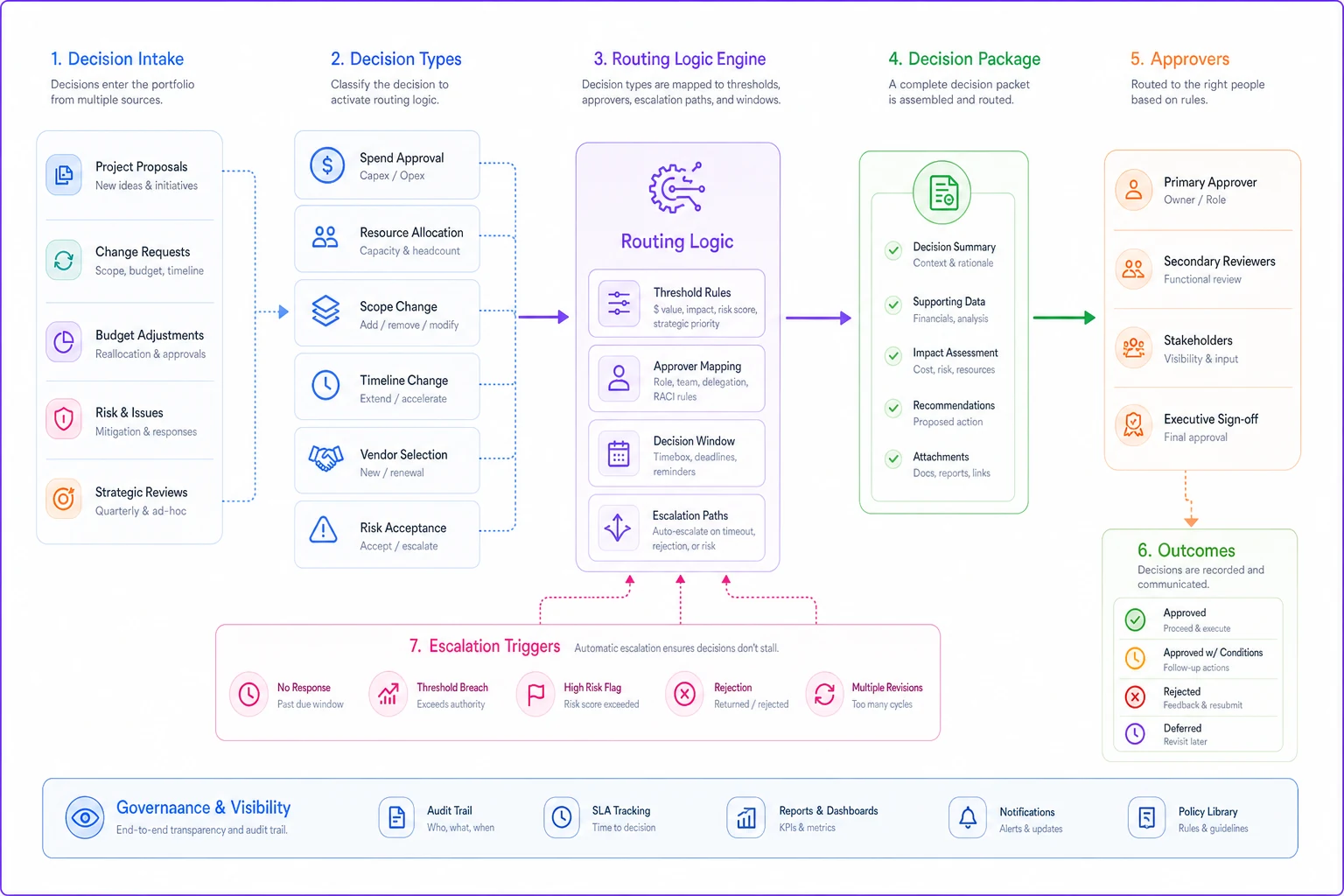
Use this workflow graphic as a template when building your operational matrices.
Meeting cadence designed for decision velocity
Your portfolio governance meetings probably follow a predictable pattern. Monthly portfolio board reviews. Weekly PMO syncs. Quarterly steering committees. Everyone presents status updates. Major decisions get tabled for "offline discussion." Minor decisions eat up 45 minutes of debate.
The problem isn't the meetings. It's that you're trying to make all decisions in the same forum. A critical resource conflict needs resolution in days, not weeks. A strategic pivot requires deep discussion, not a rushed vote squeezed between status updates.
-
Daily Decision Checkpoint (15 minutes) - Virtual standup for urgent approvals - Only decisions that can't wait 24 hours - Pre-read required, no presentation - Yes/no/escalate only outcomes
-
Weekly Operational Review (1 hour) - Routine resource and budget approvals - All materials submitted 48 hours prior - Consent agenda for simple approvals - Deep dive on 2-3 complex decisions max
-
Bi-weekly Portfolio Sync (2 hours) - Cross-project dependencies and conflicts - Resource allocation adjustments - Risk acceptance decisions - Pre-scored decision packages only
-
Monthly Strategic Review (3 hours) - Major scope changes - Portfolio priority shifts - New project approvals - Full business case presentations
Require pre-reads 48 hours before meetings to keep decision velocity high.
This tiered approach matches decision urgency to forum frequency. The operational key: decisions can only enter at the appropriate level. You can't bring a routine resource swap to the monthly strategic review just because that's when everyone's together. You can't delay a critical vendor decision until the bi-weekly sync if it needs daily checkpoint resolution.
Create decision routing rules that enforce this discipline. Any request submitted less than 48 hours before a meeting automatically gets deferred unless it meets emergency criteria. Any decision that could have been handled at a lower-tier meeting gets sent back with a note about the appropriate forum. This forces people to think about decision urgency, not just convenience.
The handoff protocol that prevents decision loops
Watch what happens when a portfolio decision needs multiple approvals. The PMO director approves the resource move. Then it goes to finance for budget validation. Then to the receiving project's sponsor for acceptance. Then back to the PMO for documentation. Each handoff takes a few days. Each person asks new questions. By the time everyone's aligned, the original need has changed.
Decision handoffs need operational protocols, not just approval chains. When multiple stakeholders must weigh in, you need parallel processing, not serial approval.
Structure it like this: identify decision components that can be evaluated independently. Budget impact, resource availability, technical feasibility, schedule implications—these can all be assessed simultaneously. Create a decision package that goes to all reviewers at once with their specific section highlighted. Give them 48 hours to provide input on their component only.
The decision owner (not the requestor) then synthesizes inputs into a recommendation. If finance says the budget works but resources are constrained, the decision owner determines if the trade-off is acceptable. They don't shuttle between stakeholders trying to negotiate. They make a call based on the collective input.
Document handoff expectations explicitly. When the portfolio board approves a major scope change, what exactly are they approving? The strategic direction? The funding? The resource allocation? The timeline? Without that clarity, you get approval in principle followed by death by a thousand tactical objections.
Create decision documentation that travels with the handoff. Not meeting minutes that nobody reads—operational documentation that shows what was decided, what wasn't decided, what assumptions were made, and what conditions apply. When Finance gets a board-approved budget change, they should see not just the approval but the constraints, dependencies, and triggers that govern it.
Ready-to-implement artifacts your PMO needs
Most PMOs have plenty of governance documentation. What they lack are operational artifacts that actually drive decision-making behavior. Here's what you need to build:
The Decision Request Portal Not a form—an actual workflow that routes requests based on type, threshold, and urgency. A project manager submits a schedule extension request. The portal automatically classifies it based on duration and dependency impact, routes it to the appropriate approver with the right template, sets the decision timeline, and triggers escalation if needed.
Pre-Scored Decision Packages Stop making approvers figure out impact and urgency during the meeting. Create scoring rubrics for each decision type. Budget requests get scored on strategic alignment, ROI, risk, and portfolio impact. Resource requests get scored on criticality, alternatives available, and downstream effects. The package arrives with scores already calculated and trade-offs clearly articulated.
The Decision Log That Actually Gets Used Not a spreadsheet of dates and approvals—an operational record that tracks decision velocity, reversal rates, and impact accuracy. How long do budget decisions actually take? How often do approved resource moves get reversed within 30 days? How accurate are impact assessments? This data shapes your governance evolution.
Conditional Approval Frameworks Most decisions aren't binary. Build templates for conditional approvals that specify exactly what triggers apply. "Approved for $200k with monthly checkpoint reviews." "Resources approved contingent on Project B maintaining green status." "Timeline extension approved with automatic reversal if dependencies clear." These frameworks prevent the endless revisiting of decisions.
Common failure patterns in portfolio governance decision rights
Even with solid frameworks, portfolio governance decision rights break in predictable ways.
The shadow governance problem emerges when formal processes take too long. Project managers start making informal deals to swap resources. Sponsors approve changes in side conversations. The real governance happens in hallway discussions while the formal process becomes theater. This happens when your governance doesn't match your operational reality—if it takes two weeks to approve a three-day resource loan, people will bypass the system.
The accountability gap appears when everyone's responsible but nobody's accountable. The portfolio board approves a priority change. The PMO is responsible for implementation. Project managers own execution. But when the change fails to deliver expected results, nobody owns the outcome. Decision rights must include outcome ownership, not just approval authority.
Threshold gaming becomes an art form in poorly designed governance. Project managers get good at structuring changes to fall just below approval thresholds. They'll split a $300k request into three $99k phases. They'll categorize scope changes as "clarifications" to avoid governance. Your thresholds need to include anti-gaming provisions—cumulative limits, category restrictions, pattern detection.
The retroactive approval plague kills governance credibility. Decisions get made in crisis, then brought to governance after implementation for "formal approval." The board becomes a rubber stamp for fait accompli decisions. If this happens regularly, your emergency decision protocols aren't working. You need fast-track paths that maintain governance oversight without slowing critical decisions.
How AI-powered platforms transform portfolio governance operations
The volume of decisions flowing through portfolio governance makes manual tracking genuinely difficult. You're looking at hundreds of micro-decisions weekly, dozens of operational decisions monthly, and several strategic decisions quarterly. Traditional PMO tools track decisions but don't actively manage the decision flow.
AI-powered operational software changes this by automating decision routing and escalation. When a project manager submits a budget change request, the platform automatically classifies it based on amount, impact, and urgency. It routes to the right approver, sets appropriate deadlines, and triggers escalations without manual intervention. The PMO doesn't chase approvals—the system handles the workflow.
Routing is just the start. These platforms can pre-score decision packages using historical data. They analyze similar past decisions, their outcomes, and reversal rates to provide context for current decisions. When the portfolio board sees a resource reallocation request, they also see that similar reallocations have had higher success rates when certain conditions were met—that kind of context is genuinely hard to surface manually.
AI automation also enables dynamic threshold adjustment. Instead of fixed dollar amounts, thresholds can adjust based on portfolio health, project phase, and risk tolerance. A $100k change might need board approval for a struggling project but only sponsor approval for a stable one. The platform applies these nuanced rules consistently without requiring manual oversight every time.
Where it gets genuinely useful is decision pattern detection. AI-powered platforms can identify when similar decisions keep recurring, which usually points to a systemic issue rather than a one-off problem. If project managers request the same type of resource adjustment every month, that's not a decision problem—it's a planning problem. Surfacing those patterns early prevents them from becoming portfolio-wide issues.
These platforms also solve the documentation challenge. Every decision gets captured with full context—not just who approved what, but what data informed the decision, what alternatives were considered, and what conditions apply. That creates an audit trail that actually helps improve future decisions rather than just covering liability.
Building your 90-day implementation roadmap
Don't try to overhaul portfolio governance decision rights all at once. Start with your most painful decision category—usually resource allocation or budget changes. Build the decision matrix for just that category. Test it for 30 days. Refine based on what breaks.
-
Week 1-2
Map your current state.
Document how decisions actually get made today, not how they're supposed to get made. Track a handful of real decisions through your organization. Note where they get stuck, who gets involved, how long each step takes. -
Week 3-4
Design your first decision pathway.
Pick one high-frequency decision type. Create the classification matrix, approval workflow, and escalation triggers. Build the templates and scoring rubrics. Keep it simple—you can add sophistication later. -
Week 5-8
Run a pilot with willing early adopters.
Find a few project managers who are frustrated with current governance. Have them use your new pathway for their decisions. Gather feedback weekly. Document what works and what doesn't. -
Week 9-10
Refine and expand.
Based on pilot feedback, adjust your pathway. Add the next most critical decision type. Start training the broader PMO on the new approach. -
Week 11-12
Institutionalize the process.
Update your governance charter to reflect the new decision rights. Modify meeting agendas to support the new cadence. Build the reporting to track decision velocity and outcomes. -
Month 4-6
Scale across the portfolio.
Add remaining decision types. Integrate with your existing PMO tools. Build in AI-powered automation to handle routing and escalation. Create the feedback loops to continuously improve the process.
The sequencing matters. Organizations that try to deploy a complete governance overhaul in one go almost always end up with the same problem they started with—a framework that looks good on paper and gets ignored in practice.
The difference between governance theater and operational governance
Many organizations run elaborate governance processes that don't actually govern anything. Boards meet monthly to review decisions already made. Committees approve changes already implemented. PMOs document decisions nobody references. That's governance theater—activity without impact.
Operational governance drives real decisions in real-time. When a project hits a critical issue on Tuesday afternoon, the governance framework provides a clear path to resolution by Wednesday morning. When resources need reallocation, approvers have the information they need to decide quickly and confidently.
The difference shows up in portfolio metrics. Organizations with operational governance tend to see faster project delivery, fewer emergency escalations, and better resource utilization. Not because they make better strategic decisions necessarily, but because they make routine decisions faster and more consistently.
It also shows up in behavior. Project managers stop hoarding resources because they know they can get what they need when they need it. Sponsors stop bypassing governance because the formal process actually works. The PMO stops chasing approvals because the system handles the workflow.
Portfolio governance decision rights aren't about control or hierarchy or politics. They're about creating operational clarity so your portfolio can move at the speed your business requires. Build the framework that matches your operational reality, not your organizational chart. Your governance should enable decisions, not just document them—every approval path optimized for speed and clarity, every escalation adding value rather than just seniority, every meeting driving decisions rather than just sharing updates. That's the difference between a RACI matrix gathering dust in SharePoint and an operational governance framework that actually drives portfolio performance.
Ready to elevate your project delivery?
Join over 2,500 project teams using GoProjy to optimize resources, reduce risks, and drive portfolio success.