
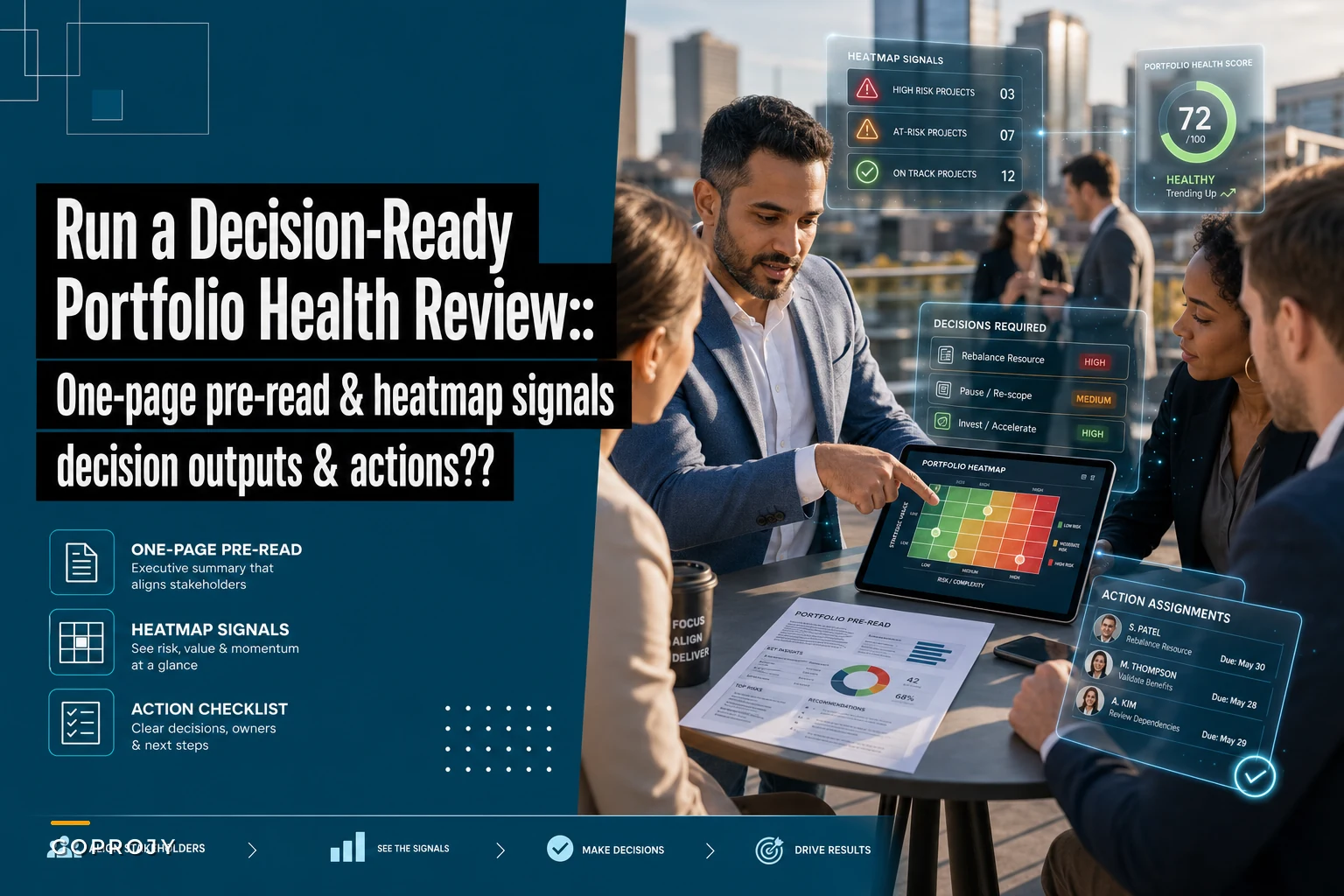

Most portfolio health review meetings turn into three-hour marathons where everyone talks past each other. Project managers defend their RAG statuses. Executives ask for context that should've been in the pre-read. The steering committee debates whether "amber" means "slightly concerning" or "about to explode."
Stop running status theater and start producing decisions your portfolio actually needs
Most portfolio health review meetings turn into three-hour marathons where everyone talks past each other. Project managers defend their RAG statuses. Executives ask for context that should've been in the pre-read. The steering committee debates whether "amber" means "slightly concerning" or "about to explode."
By the time someone actually makes a decision, half the room has mentally checked out.
The problem isn't that people don't care about portfolio health. It's that the meeting structure itself prevents actual decision-making. Without a format that forces clarity upfront, these reviews devolve into status readouts instead of strategic decision points.
Without a format that forces clarity upfront, these reviews devolve into status readouts instead of strategic decision points.
The pre-read problem that derails everything
Portfolio reviews fail before they even start because pre-read materials are either non-existent or useless. PMO teams typically send one of two things: a 47-slide deck that no executive will actually read, or a hastily assembled status dashboard with no context behind it.
Stop losing track of critical projects.
GoProjy helps you monitor, prioritize, and deliver projects on time—seamlessly.
- Unified portfolio visibility
- Real-time resource tracking
- Milestone & risk alerts
No credit card required
Executives show up cold, spend the first 40 minutes asking basic questions ("remind me what Project Falcon does again?"), and the meeting becomes an education session rather than a decision forum.
The fix isn't more documentation—it's better documentation. A single-page pre-read that captures exactly what executives need to make informed decisions. Not project histories. Not methodology explanations. Just the critical facts arranged for rapid comprehension.
The fix isn't more documentation—it's better documentation. A single-page pre-read that captures exactly what executives need to make informed decisions. Not project histories. Not methodology explanations. Just the critical facts arranged for rapid comprehension.
Building the one-page pre-read that executives actually read
The most effective format fits on one page and takes under five minutes to absorb.
Portfolio snapshot header (3 lines max):
-
Total active projects
47
-
Combined budget exposure
$34.2M
-
Critical path dependencies
3 cross-portfolio blocks identified
Decision points required (bulleted, not buried):
-
Kill/continue decision on Project Mercury (burning $180k/month, 4 months behind)
-
Resource reallocation between competing initiatives (Teams A and B both need the same SMEs)
-
Budget release approval for Phase 2 starts (3 projects, $4.7M total)
Material changes since last review:
-
Project Atlas scope expansion (+$2.1M requested)
-
Vendor bankruptcy impacting 4 projects
-
New regulatory deadline accelerating Project Titan
Risk concentration (one sentence each):
-
60% of portfolio completion dependent on a single integration team
-
Q4 budget exhaustion projected if current burn continues
-
Customer commitments at risk if Project Venus slips beyond October
That's it. No explanations of what each project does. No updates on things that are fine. Just the information needed to make the specific decisions on today's agenda.
When you force the pre-read into one page, something interesting happens—people suddenly realize they've been including a lot of information that nobody was actually using to make decisions. The constraint itself is the value.
The heatmap that actually drives discussion
Traditional RAG status reports create more confusion than clarity. One PM's "green" is another's "amber," and nobody agrees what "red" actually means. Should red trigger immediate intervention? Budget reallocation? Project termination?
The heatmap approach that generates real discussion uses signals, not statuses. Instead of asking PMs to self-rate their projects, you measure specific observable indicators and let the data create the heat signature.
| Signal Category | Green Zone | Amber Zone | Red Zone |
|---|---|---|---|
| Budget burn rate | Within 5% of plan | 6-15% variance | >15% variance |
| Schedule adherence | Milestone hit rate >90% | 70-89% hit rate | <70% hit rate |
| Resource stability | <10% turnover/month | 11-25% turnover | >25% turnover |
| Dependency health | All dependencies confirmed | 1-2 dependencies at risk | 3+ or critical path blocked |
| Stakeholder engagement | Weekly check-ins occurring | Biweekly or irregular | No contact >3 weeks |
The power comes from removing subjective interpretation. A project burning through budget 18% faster than planned shows red on financial health—full stop. No debate about whether that's "manageable" or "concerning."
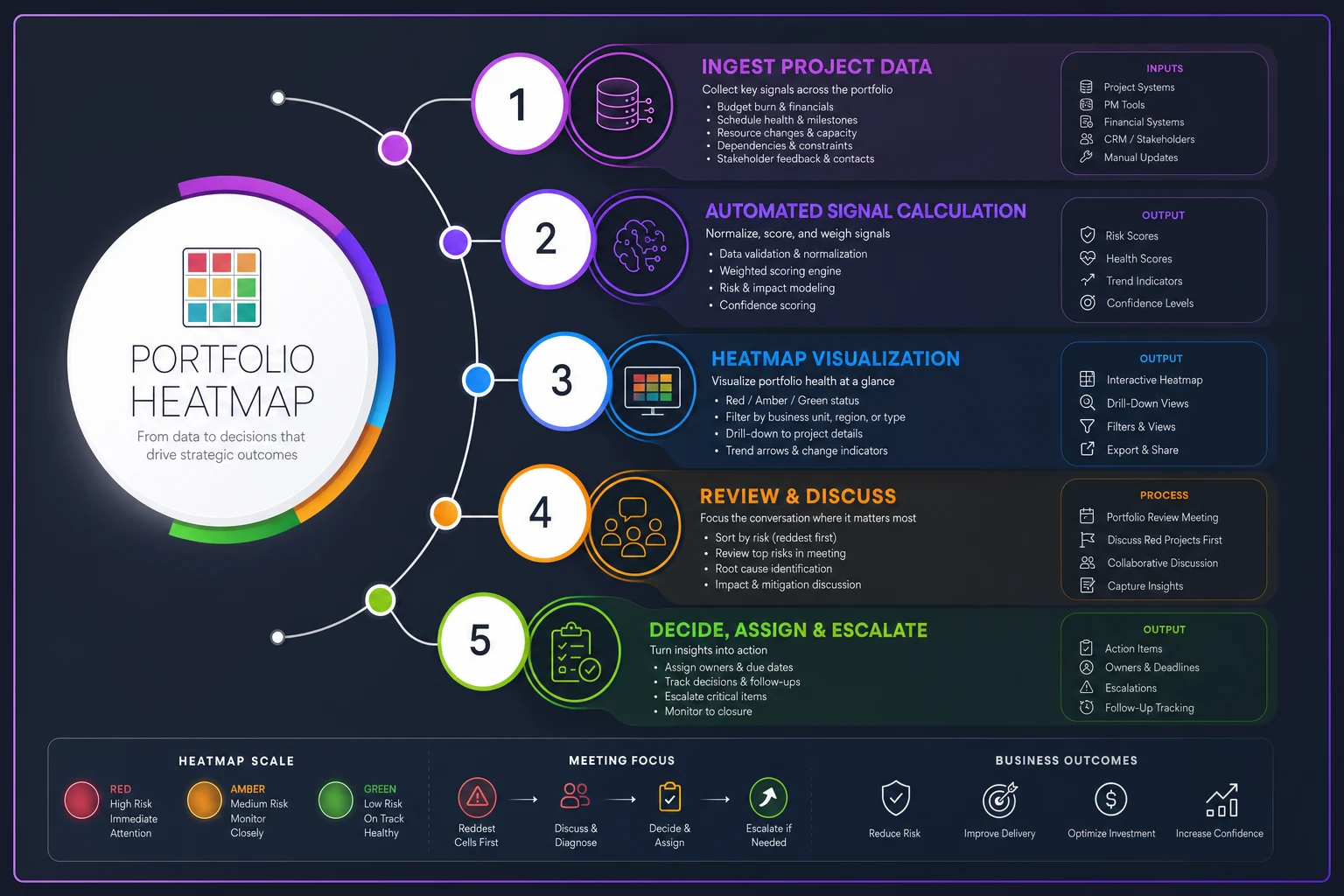
During the review, you project the heatmap and start with the reddest cells. "Project Gamma shows red on resource stability—third PM change in two months. What's the root cause and do we need to intervene?" That's a real conversation. Compare that to "Project Gamma is amber overall"—which tells the room essentially nothing.
Owner assignment that sticks
Here's what typically happens with action items from portfolio reviews: they get captured in meeting minutes, emailed to everyone, and promptly ignored. Three months later, the same issues resurface because nobody actually owned the resolution.
The assignment template that creates real accountability looks different from a typical action log. Instead of listing tasks, you explicitly define decision rights and escalation triggers.
Decision ownership matrix:
Project Mercury termination decision
-
Owner
Sarah Chen (Portfolio Director)
-
Decision deadline
October 15
-
Required inputs
Cost of termination vs. completion analysis (due Oct 10 from Finance)
-
Escalation trigger
If no decision by Oct 15, auto-escalates to CPO
-
Update mechanism
Decision and rationale posted to portfolio channel within 24 hours
Resource reallocation between Team A and Team B
-
Owner
Marcus Williams (Resource Manager)
-
Decision deadline
October 8
-
Constraint
Must maintain Project Venus critical path
-
Fallback
If no internal solution by Oct 8, authorize contractor spend up to $50k
-
Success metric
Both teams confirm adequate coverage by Oct 12
Notice how each assignment includes not just who and when, but also what happens if they don't deliver. The escalation trigger removes the awkwardness of chasing people—the system does it automatically instead of relying on someone's willingness to send an uncomfortable email.
The follow-up cadence that ensures execution
Most PMOs treat portfolio reviews as discrete events. You have your quarterly review, capture some actions, then wait three months to check if anything happened. By then, the decisions are stale and the problems have mutated into something else entirely.
The tracking cadence that actually works operates on a tighter loop:
-
Week 1 post-review All owners confirm they understand their assignment and have what they need. Any blockers surface immediately, not three weeks later when it's too late.
-
Week 2 A quick progress check—not a meeting, just a simple form: "On track / Need help / Blocked." If anyone signals "blocked," the PMO engages immediately to unblock or escalate.
-
Week 4 Interim decisions get made and communicated. Even if the full analysis isn't complete, owners share directional decisions so teams can start adjusting.
-
Week 6 Pre-read assembly for the next review starts based on outcomes from previous decisions. This creates continuity between reviews instead of treating each one as a fresh start.
-
Week 8 Full progress report on all assignments—what got done, what didn't, and why. This feeds directly into the next review's agenda.
The key difference from traditional follow-up: you're not just tracking whether tasks got completed. You're tracking whether decisions got made and whether those decisions achieved their intended outcome. That's a meaningfully different thing to measure.
Common failure patterns to avoid
Even with solid templates and processes, portfolio reviews fail in predictable ways.
The democracy trap: Trying to get consensus on every decision. Portfolio reviews need clear decision rights. If Sarah owns the Project Mercury decision, she makes it. The review provides input, not votes.
The perfection paralysis: Waiting for complete information before committing to anything. Most portfolio decisions need to be made with around 70% confidence. Waiting for 95% usually means the decision makes itself—and badly.
The enthusiasm fade: Starting strong with the new process then gradually sliding back to old habits. The moment you allow "just this once" exceptions, the entire framework unravels. This one kills more PMO improvements than anything else.
The proxy problem: Sending delegates who can't actually make decisions. If the portfolio review needs the CPO there, the CPO needs to be there—not their deputy who has to "check and get back to you."
Technology's role in making this sustainable
Manual portfolio review preparation burns enormous PMO hours. Pulling data from multiple systems, formatting it into readable reports, chasing down updates from project managers—it's a significant recurring cost that most PMOs just absorb without questioning.
This is where building the right data model becomes critical. When portfolio data flows automatically into standardized views, creating that one-page pre-read takes minutes instead of days.
AI-powered operational software can automatically generate heatmap signals by analyzing project data patterns. Instead of PMs subjectively rating their own projects, the system calculates burn rates, tracks milestone achievement, and monitors resource stability continuously. The heatmap essentially builds itself.
For owner assignment and follow-up tracking, automated workflows ensure nothing falls through the cracks. When Sarah gets assigned the Project Mercury decision, she automatically receives the required inputs on schedule. If she hasn't logged a decision by October 14, the system flags it. On October 15, it escalates to the CPO. No manual chasing required.
The most valuable part is connecting decisions to outcomes. When Marcus reallocates resources between teams, the system tracks whether both teams actually confirmed adequate coverage. When the portfolio review decides to kill a project, it monitors whether the shutdown activities actually happened. That closed loop is nearly impossible to maintain manually at any meaningful scale.
When this approach makes sense (and when it doesn't)
This format works best for PMOs managing 20 or more projects with genuine interdependencies. Below that threshold, you probably don't need this much structure—a simpler capacity management approach might be enough.
It's also most valuable when you have real decision authority in the room. If your portfolio review is really just a status update to stakeholders who can't change anything, this framework won't help. You need people who can actually kill projects, reallocate budgets, and reassign resources.
The worst fit is organizations where political considerations override operational realities. If Project Mercury can't be killed because the CEO's golf buddy is the sponsor, no amount of process will fix that. The framework assumes decisions get made based on data and business logic—not relationships.
Making the transition from status theater to actual decisions
You don't need to overhaul everything at once. Start with just the one-page pre-read for your next review. Force yourself to fit everything on a single page. That constraint alone creates more clarity than most teams expect.
Once people experience a review where they're not spending the first hour getting oriented, add the heatmap. Use it alongside your existing RAG statuses at first—present both and see which one drives better discussion.
The owner assignment template usually comes third. People need to see that decisions are actually being made before they'll commit to owning them.
Follow-up tracking is the final piece. By that point, you have real decisions to track and real owners to hold accountable. The tracking starts feeling useful rather than bureaucratic.
Most PMOs see meaningful improvement within two review cycles. The first one feels awkward as people adjust. By the second, executives start expecting the pre-read and project managers start preparing for real decision discussions rather than status defenses.
The ultimate test: your portfolio reviews get shorter while producing more decisions. When you can cover 47 projects in 90 minutes and walk away with clear, owned decisions on every critical issue, the framework is working.
Portfolio reviews don't have to be dreaded marathons of circular discussion. With a focused pre-read, signal-based heatmaps, clear ownership assignments, and systematic follow-up, they become what they were always supposed to be—focused decision forums that actually move your portfolio forward.
The ultimate test: your portfolio reviews get shorter while producing more decisions. When you can cover 47 projects in 90 minutes and walk away with clear, owned decisions on every critical issue, the framework is working.
Portfolio reviews don't have to be dreaded marathons of circular discussion. With a focused pre-read, signal-based heatmaps, clear ownership assignments, and systematic follow-up, they become what they were always supposed to be—focused decision forums that actually move your portfolio forward.
Ready to elevate your project delivery?
Join over 2,500 project teams using GoProjy to optimize resources, reduce risks, and drive portfolio success.