


Every PMO I've worked with starts the same way—they build elaborate scoring models. Projects get evaluated on strategic alignment, ROI potential, risk levels. Spreadsheets multiply. Scores get calculated to three decimal places. Then what happens? The ranked list sits there while funding decisions happen in completely different meetings based on who argues loudest.
The disconnect is painful to watch. You've got project 17 scoring higher than project 8, but project 8 gets funded because "we already started it." Project 23 sits unfunded despite scoring in the top quartile because nobody knows where to pull budget from. The scoring model becomes theater while real allocation decisions happen through backdoor negotiations and emergency escalations.
What's missing isn't better scoring—it's the operational machinery that connects scores to actual funding movements. After building portfolio systems for organizations managing anywhere from 40 to 400+ concurrent projects, the pattern is clear: scoring without allocation rules is just expensive list-making.
Why Traditional Portfolio Scoring Breaks at Scale
The fundamental breakdown usually happens around project 15 or 20. Below that threshold, you can hold the entire portfolio in your head. Senior leadership remembers why each project exists, which stakeholders care, what dependencies lurk beneath. Funding discussions stay manageable because everyone shares context.
Once you cross into 30+ active projects, human memory fails. The portfolio becomes abstract. Nobody can recall if project 47 is the ERP upgrade or the warehouse automation. Scoring models proliferate to create false precision—suddenly you're debating whether customer satisfaction should weight 15% or 18% of the total score.
Meanwhile, the real allocation problems compound. Finance releases quarterly budgets that don't map to project timelines. A high-scoring initiative sits idle for two months waiting for funds while a low-scorer burns through contingency because "we can't stop now." Resource managers protect their budgets regardless of portfolio priorities.
The scoring model produces a number. The number goes into a slide deck. The slide deck gets presented monthly. Nothing actually changes until someone important gets angry enough to override the whole system.
This isn't a scoring problem—it's an allocation mechanics problem. The portfolio prioritization funding allocation framework most organizations need isn't more sophisticated scoring math. It's explicit rules about how scores trigger funding movements.
The Hidden Cost of Allocation Paralysis
Take a typical 80-project portfolio with a $12M quarterly budget. Without clear allocation bands, here's what leaks out:
Stop losing track of critical projects.
GoProjy helps you monitor, prioritize, and deliver projects on time—seamlessly.
- Unified portfolio visibility
- Real-time resource tracking
- Milestone & risk alerts
No credit card required
-
Zombie Projects
Usually 8-12 initiatives scoring below the funding threshold but continuing to consume resources. They're "almost done" or "strategically important" despite scoring poorly. Each burns maybe $30-40k monthly in partial staffing and overhead. That's roughly $400k quarterly in misallocated funds.
-
Opportunity Delays
High-scoring projects wait an average of 6-8 weeks for funding approval after scoring updates. During that lag, market windows close, key resources get reassigned, vendor pricing increases. Figure 15% value erosion on delayed starts—easily $200k per quarter on projects that should have launched already.
-
Reallocation Friction
When priorities shift mid-quarter (and they always do), moving funds between projects takes 3-4 weeks minimum. Legal reviews contracts, finance adjusts budgets, resource managers negotiate transitions. Both old and new priorities operate sub-optimally during those weeks. The switching cost runs around $150k quarterly in lost productivity.
-
Decision Fatigue
Harder to measure but devastating at scale. When every funding move requires custom justification and executive escalation, decision-making slows to a crawl. Leaders spend 30-40% of portfolio reviews relitigating old allocation decisions instead of addressing new challenges.
Stack these up and a typical mid-size portfolio bleeds somewhere between $750k and $1M quarterly through allocation inefficiency alone. That's before counting the morale cost of teams watching their high-scoring projects sit unfunded while pet projects mysteriously find budget.
Building a Funding Band System That Actually Works
The solution isn't complicated—it's just disciplined. Instead of treating scores as suggestions, you create explicit funding bands with clear rules. Here's the framework that's worked across dozens of portfolio implementations:
-
Band A (Top 20% of scores)
Guaranteed full funding within 5 business days of scoring. No additional approval required below $500k. Automatic access to contingency pools. These projects move immediately.
-
Band B (Next 30%)
Funded at 80% of request within 10 business days. Can access additional funds by demonstrating early milestones. Quarterly review for promotion to Band A.
-
Band C (Middle 30%)
Funded at 50% to prove viability. Must hit specific gates to unlock additional tranches. Monthly reallocation review.
-
Band D (Bottom 20%)
No new funding. Existing funds protected for 30 days to enable orderly shutdown or pause. After 30 days, funds automatically reallocate to Band A projects.
Start with conservative band thresholds and run one full quarter before making major adjustments.
The key is the automaticity. Score updates trigger funding changes without meetings, negotiations, or PowerPoint decks. A project drops from Band B to Band C? Funding adjusts automatically next Monday. A Band D project suddenly scores into Band A due to market changes? Funds flow within a week.
One tech company implemented this exact structure across their 120-project portfolio. Allocation decision time dropped from 3 weeks to 3 days. They recovered roughly $2.8M annually in previously trapped funding. More importantly, high-scoring initiatives launched around 40% faster on average.
Reallocation Triggers: The Operational Engine
Static bands solve initial allocation but portfolios are dynamic. Projects slip, markets shift, strategies evolve. Without clear reallocation triggers, you're back to manual intervention and political maneuvering. The framework needs operational rules for moving money between bands.
-
Schedule Triggers
Any project missing two consecutive milestones drops one band automatically. No debate, no exception process. The project manager can appeal after demonstrating recovery, but funds move immediately. This prevents the classic "we're almost back on track" funding trap.
-
Performance Triggers
Projects exceeding KPIs by 25% for two consecutive periods jump one band. This rewards execution and ensures winners get resources to accelerate. One enterprise software company saw their top performers improve velocity by 35% after implementing performance-based band jumps.
-
Market Triggers
External events trigger portfolio-wide reallocation reviews. Customer churn spike? All retention projects jump a band. New competitor enters? Innovation projects get priority. These triggers are pre-defined, not decided in crisis mode.
-
Capacity Triggers
When critical resources hit bottleneck thresholds, lower-band projects using those resources automatically pause. Funds redirect to higher-band projects that can progress without bottlenecked resources.
-
Time Triggers
Projects can't sit in the same band indefinitely. After 90 days in Band C, projects either promote to Band B based on results or drop to Band D. This prevents mediocre initiatives from consuming resources indefinitely.
The triggers need to be operational, not strategic. They fire based on data, not opinion. When a project hits a trigger condition, reallocation happens automatically through the portfolio system. No meetings required.
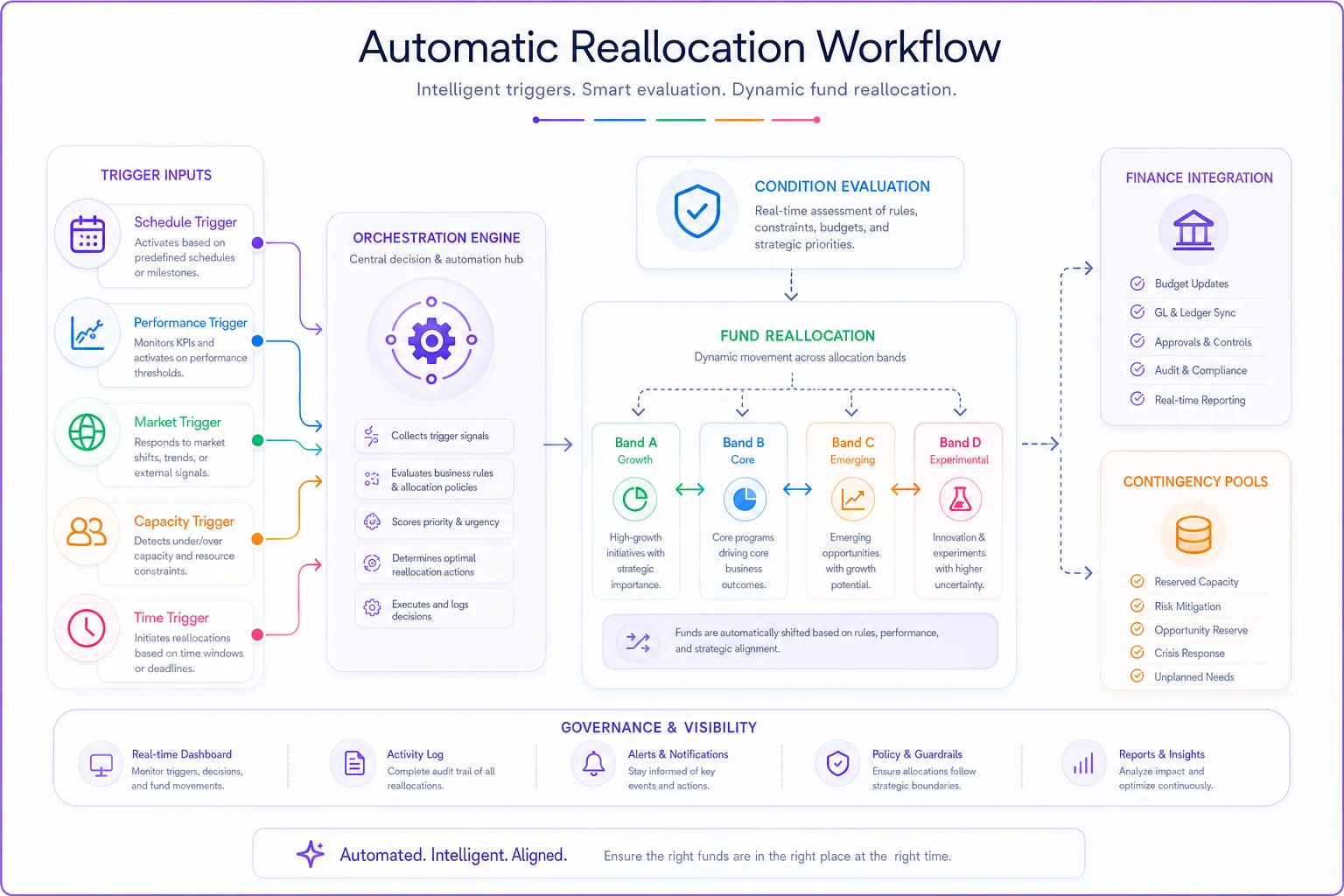
The diagram above illustrates triggers feeding an automated allocation engine that moves funding between bands without manual approvals.
The Finance Integration Challenge
This is where most allocation frameworks fall apart—they ignore how finance actually works. Your portfolio system says move $200k from Project A to Project B. Simple, right? Except Project A's budget sits in three different cost centers, involves committed vendor contracts, and includes prepaid licenses. Project B needs funds in a different fiscal quarter, requires procurement approval, and uses different accounting codes.
The friction is immense. One pharmaceutical company tracked their reallocation attempts—average time from decision to actual fund movement was 23 business days. By then, the portfolio priorities had shifted again.
-
Pooled Contingency Buffers
Instead of moving funds between projects directly, each band maintains a contingency pool. Projects release funds to their band's pool, other projects draw from it. This reduces transaction complexity by around 80%.
-
Quarterly True-Ups
Major reallocations happen at quarter boundaries when finance naturally resets budgets. Mid-quarter movements use contingency pools only. This aligns portfolio allocation with finance rhythms.
-
Commitment Tracking
The system tracks not just allocated budget but committed spend. When a project drops bands, only uncommitted funds move immediately. Committed funds transfer at contract boundaries.
-
Auto-Generated Documentation
Every fund movement generates finance-ready documentation automatically. Transfer memos, budget adjustment forms, approval chains—all created by the system based on the triggering event.
One manufacturing company reduced their fund movement time from 19 days to 4 days after implementing these finance integration patterns. Their CFO became the framework's biggest champion because it eliminated hundreds of ad-hoc budget adjustment requests.
Decision Gates That Prevent Allocation Gaming
The moment you create automatic allocation rules, people start gaming them. Project managers inflate scores before funding reviews. Sponsors hide negative metrics to avoid band drops. Teams sandbag estimates to stay in comfortable funding zones.
-
Graduated Release Gates
Funds release in tranches tied to verified deliverables, not time periods. A Band A project might get 40% upfront, 30% at design approval, 30% at testing complete. Gaming the initial score doesn't help if you can't hit the gates.
-
Cross-Band Dependencies
High-band projects can pull resources from low-band projects, but must deliver defined value back. If Project A (Band A) pulls a developer from Project B (Band C), Project A owes Project B specific deliverables or funds. This creates natural balance.
-
Score Decay Functions
Scores automatically decay over time unless refreshed with new evidence. A project can't ride one good quarter forever. After 60 days, scores drop 10%. After 90 days, another 15%. This forces continuous performance rather than one-time gaming.
-
Outcome Lockbacks
Projects that drop bands after receiving funding owe partial payback to the contingency pool. Not punitive amounts—maybe 20% of unused funds. Just enough to discourage score inflation.
-
Public Score Inputs
All score inputs are visible across the portfolio. If Project X claims 40% ROI improvement, every other project manager sees that claim and the supporting evidence. Peer pressure handles the most egregious gaming without any formal process.
These gates work because they change the incentive structure. Gaming for short-term funding gains leads to long-term resource loss. Teams quickly figure out that honest scoring and consistent execution beats manipulation.
Scale Considerations: From 50 to 500 Projects
The framework scales, but the mechanics change at different portfolio sizes. What works at 50 projects breaks at 200. Here's how to adapt:
| Portfolio Size | Adaptation |
|---|---|
| 50-100 Projects | Quarterly band adjustments work fine. Manual override stays manageable. Finance can handle individual project transfers. Focus on getting the basic band structure operational. |
| 100-200 Projects | Monthly band adjustments become necessary. Override requests overwhelm leadership without automatic triggers. Need dedicated contingency pools per band. Finance integration becomes critical—manual transfers can't keep pace. |
| 200-300 Projects | Weekly micro-adjustments required. Projects need sub-bands (A1, A2, A3) for granular allocation. Contingency pools need autonomous rebalancing rules. Consider regional or divisional band structures. |
| 300+ Projects | Daily allocation adjustments through fully automated systems. Band assignments use ML models rather than static scoring. Multiple parallel allocation frameworks for different project types. Real-time finance integration is mandatory. |
This connects directly to the operating model challenges that emerge as portfolios expand. The allocation framework has to evolve in parallel with broader PMO capabilities.
Real-World Implementation: A 180-Project Case Study
A financial services firm managed roughly 180 concurrent projects across technology, operations, and compliance. Their scoring model was sophisticated—12 weighted criteria, executive validation, quarterly updates. Yet funding allocation remained completely manual, taking an average of 18 days per decision.
-
Weeks 1-2
Mapped existing scores to initial bands. Found 31 projects (about 17%) that were effectively unfunded despite positive scores. Another 19 projects consumed funds despite scoring in the bottom quartile. The misalignment totaled $4.2M quarterly.
-
Weeks 3-4
Built the reallocation triggers. Started simple—schedule slips and performance wins only. Set up contingency pools at 15% per band. Created automated fund movement workflows in their existing PPM tool.
-
Weeks 5-6
Integrated with finance systems. This was the hardest part. Required mapping portfolio bands to GL codes, setting up automated journal entries, creating new approval workflows. Finance pushed back until they saw the reduction in manual adjustments.
First Quarter Results:
-
Allocation decisions dropped from 18 days to 4 days average
-
High-scoring projects launched 35% faster
-
Eliminated $1.3M in quarterly funding to zombie projects
-
Reduced portfolio review meetings by 50%
Unexpected Benefits:
-
Project managers started self-policing scores to avoid gaming penalties
-
Finance reported a 60% reduction in ad-hoc budget requests
-
Resource managers proactively moved people based on band changes
-
Executive confidence in portfolio decisions increased noticeably
The system now runs largely on its own. Monthly reviews focus on strategic changes rather than individual funding decisions. The PMO team spends significantly less time on allocation mechanics and more time on actual project support.
Common Failure Points and How to Avoid Them
Failure Point 1: Over-Complex Scoring Teams create 20+ scoring criteria with complex weighting algorithms. The math becomes a black box nobody trusts. Projects game individual criteria rather than delivering value.
Solution: Start with 5-7 simple criteria. Make scoring transparent and intuitive. Add sophistication after the basic framework proves itself.
Failure Point 2: Weak Trigger Discipline Organizations define triggers but create endless exception processes. "Just this once" becomes standard operating procedure. The automation breaks down and you're back to manual allocation.
Solution: Make triggers irrevocable for the first 90 days. No exceptions. After proving the system works, introduce limited override protocols.
Failure Point 3: Finance Resistance Finance teams see the framework as a threat to budget control. They slow-roll integration, maintain shadow allocation processes, refuse to honor automatic transfers.
Solution: Include finance in design from day one. Give them veto power over trigger thresholds. Show how the framework reduces their manual work. Make them heroes, not victims.
Failure Point 4: Portfolio Scope Creep Organizations try to force every initiative through the framework. Small maintenance projects get scored alongside strategic transformations. The bands become meaningless.
Solution: Define clear portfolio boundaries. Maintenance, support, and sub-$50k projects often need different allocation models. Don't force-fit everything.
Failure Point 5: Leadership Bypass Executives continue making direct funding decisions outside the framework. Teams learn to skip the process and go straight to leadership. The framework becomes optional.
Solution: Make band-based allocation the only path to funding. Even executive-sponsored projects must score and enter bands. Leadership can influence scores but not bypass allocation rules.
The Technology and Automation Layer
The framework can run manually, but technology amplification is what makes it powerful at scale. Modern portfolio platforms with AI automation can shift allocation from a quarterly burden to a continuous optimization process.
-
Score Calculation and Updates
Instead of quarterly manual scoring sessions, AI-powered systems continuously update scores based on project performance data, market indicators, and resource availability. This keeps allocation aligned with current reality rather than last quarter's assumptions.
-
Trigger Monitoring
Automated workflows watch for trigger conditions around the clock. When a project misses its second milestone, the band adjustment happens immediately—not at the next review cycle. This prevents resource waste during the lag between trigger and action.
-
Fund Movement Orchestration
The complexity of moving funds between projects—adjusting budgets, updating forecasts, notifying stakeholders—gets handled automatically. What took finance teams days now happens in hours.
-
Rebalancing Optimization
AI-assisted platforms can simultaneously optimize across multiple constraints—budget limits, resource capacity, strategic alignment, risk tolerance. They surface reallocation opportunities that would get missed in a manual review, often freeing up 10-15% additional capacity.
-
Predictive Adjustments
Machine learning models can identify projects likely to hit triggers before they actually do, enabling proactive reallocation rather than reactive scrambling.
The automation doesn't replace human judgment—it executes human decisions faster and more consistently. Portfolio leaders still set strategy, define bands, approve triggers. But the mechanical work of allocation happens automatically.
One technology company reduced their portfolio administration overhead by 65% after implementing automated allocation workflows. More importantly, they improved project success rates by roughly 20% through faster funding of high-potential initiatives.
Making the Framework Stick
Designing the framework is the easy part. Making it permanent is harder. Organizations revert to old patterns the moment pressure mounts. Here's what makes the difference:
-
Start with a Pilot
Don't flip 200 projects into bands overnight. Choose 20-30 projects in one division. Run the framework for a full quarter. Document everything—wins, failures, adjustments. Use that evidence to expand gradually.
-
Measure Religiously
Track allocation velocity, funding efficiency, project success rates. Compare before and after. When someone questions the framework, show data, not theory.
-
Celebrate Early Wins
When a high-scoring project launches quickly due to Band A funding, make it visible. When zombie projects finally die and free up resources, publicize it. Build momentum through demonstrated value.
-
Adjust Without Abandoning
The framework will need tuning. Band thresholds might be off. Triggers might fire too often or too rarely. Adjust parameters without abandoning the core structure.
-
Build Institutional Memory
Document decisions, capture lessons learned, train new team members. The framework should outlive its creators. This isn't a temporary fix—it's a new operating model.
The framework should outlive its creators. This isn't a temporary fix—it's a new operating model.
The Competitive Advantage of Disciplined Allocation
Organizations that master portfolio prioritization funding allocation gain advantages beyond efficiency. They move faster than competitors, adapt to market changes without chaos, and maintain team morale through transparent resource decisions.
The real power comes from removing friction. When funding flows automatically based on clear rules, teams stop playing politics and start delivering value. When allocation happens in days not weeks, organizations capture opportunities competitors miss. When resources concentrate on genuinely strategic work, the entire portfolio performs better.
This isn't about perfect optimization. It's about creating a system that makes good-enough decisions quickly and consistently. In portfolio management, speed and discipline beat precision. The framework provides both.
Most PMOs will keep treating scoring and funding as separate activities. They'll run elaborate prioritization exercises that produce ranked lists nobody follows. They'll lose months to allocation debates while high-value projects sit idle.
Organizations that connect scores to funding through explicit bands and triggers will pull ahead. They'll move resources fluidly, capture opportunities quickly, and maintain strategic alignment without endless meetings. The framework becomes an operational advantage that compounds over time.
The question isn't whether you need better portfolio prioritization. It's whether you're ready to move beyond scoring theater to actual allocation discipline. The framework exists. The patterns are proven. The only thing left is implementation.
Ready to elevate your project delivery?
Join over 2,500 project teams using GoProjy to optimize resources, reduce risks, and drive portfolio success.