


Most PMO leaders think scaling means hiring more project managers and buying better tools. Then somewhere around 30 concurrent projects, everything starts breaking. Deadlines slip. Resources get double-booked. Steering committees lose visibility. The PMO that ran smoothly with 8 projects becomes a bottleneck at 40.
You're trying to scale tactics when you need to scale an operating model.
This pattern unfolds across tech companies, healthcare systems, financial services firms, and manufacturing operations. The organizations that successfully scale from managing 10 projects to 200+ don't just add headcount and software. They build fundamentally different operating models at each growth stage.
Why Traditional PMO Structures Break at Scale
Most PMOs start simple. You've got maybe 3-5 project managers handling everything directly. Communication happens in hallways. Resource conflicts get resolved in quick Slack messages. The PMO director knows every project intimately.
This works until around 15-20 projects. Then the cracks appear.
Project managers start missing dependencies because they can't track everything manually. Resource managers lose track of who's allocated where. Stakeholders complain about inconsistent reporting formats. The PMO director becomes a bottleneck for every decision.
PMOs try to preserve their original operating model while the underlying complexity grows exponentially. When you go from 5 to 50 projects, you're not just managing 10x more work. You're dealing with potentially 100x more interdependencies, resource conflicts, and communication paths.
A biotech company discovered this the hard way. Their PMO ran flawlessly with 12 R&D projects. By the time they hit 35 projects across multiple therapeutic areas, project managers were spending 60% of their time in status meetings. Critical go/no-go decisions took weeks because the governance structure couldn't handle the volume. They lost two major drug development milestones because the PMO couldn't coordinate fast enough.
The problem isn't volume - it's structural. Traditional PMOs are designed for linear growth, but project complexity grows exponentially.
The Four Maturity Stages Every PMO Passes Through
Clear patterns emerge around natural breaking points and evolution stages.
Stop losing track of critical projects.
GoProjy helps you monitor, prioritize, and deliver projects on time—seamlessly.
- Unified portfolio visibility
- Real-time resource tracking
- Milestone & risk alerts
No credit card required
Stage 1: Direct Control (1-15 projects) Everything runs through individual project managers. There's minimal process documentation because everyone knows what to do. Resource allocation happens informally. The PMO director personally reviews every major deliverable. This stage feels efficient because communication paths are short and decisions happen quickly.
Stage 2: Process Standardization (15-40 projects) The PMO creates standard templates, regular cadences, and formal resource pools. Project managers specialize by type or business unit. Governance committees form for major decisions. Most PMOs get comfortable here and resist further evolution.
Stage 3: Distributed Authority (40-100 projects) Program managers oversee portfolios of related projects. Centers of excellence emerge for specific methodologies or tools. Resource management becomes a dedicated function. Governance happens at multiple levels with clear escalation paths.
Stage 4: Federated Operations (100+ projects) Business units run semi-autonomous PMO functions. The central PMO sets standards and provides shared services. Portfolio management drives strategic alignment. Automated workflows handle routine decisions.
Organizations make the mistake of trying to jump stages or forcing Stage 1 practices into Stage 3 realities. A financial services PMO tried scaling their informal resource allocation model from 20 to 80 projects. Project managers started hoarding resources. Critical projects got starved while low-priority work consumed top talent. It took them 18 months to untangle the mess and implement proper resource management.
The transitions between stages create temporary inefficiency. Accept this instead of fighting it.
Building Role Charters That Actually Scale
Traditional PMO role definitions assume static responsibilities. Effective scaling requires roles that evolve with organizational maturity.
Take the project manager role. In Stage 1, they're generalists handling everything from stakeholder management to budget tracking. By Stage 3, you need distinct tracks:
Delivery PMs focus purely on execution. They manage schedules, track dependencies, and drive completion. They don't handle stakeholder politics or strategic alignment.
Business PMs own stakeholder relationships and benefits realization. They translate between technical teams and business leaders. They ensure projects deliver intended value, not just predetermined outputs.
Technical PMs manage complex technical dependencies and architecture decisions. They coordinate across engineering teams and handle technical risk assessment.
The same evolution happens with other roles. Resource managers start as coordinators matching people to projects. They evolve into capacity planners optimizing utilization across portfolios. Eventually they become talent strategists building long-term capability.
A healthcare system learned this while scaling their EHR implementation program. They initially assigned 12 generalist PMs across all workstreams. After multiple delays, they restructured with specialized roles. Clinical PMs handled provider workflows. Technical PMs managed integrations. Change management PMs focused on adoption. Delivery velocity improved by roughly 40% within two quarters.
Role evolution in practice:
| Role | Stage 1 | Stage 2 | Stage 3 | Stage 4 |
|---|---|---|---|---|
| Project Manager | Owns entire project lifecycle | Follows standard methodology | Specializes by type/domain | Leads integrated delivery teams |
| PMO Director | Personally oversees all projects | Manages PM team and processes | Runs PMO operations and strategy | Drives enterprise portfolio decisions |
| Resource Manager | Informally tracks availability | Maintains resource database | Optimizes cross-project allocation | Plans strategic capacity |
| PMO Analyst | Creates project reports | Standardizes metrics and dashboards | Analyzes portfolio trends | Predicts risks through data models |
Most organizations underestimate how much role clarity matters during scaling. Vague responsibilities create friction when decision speed matters most.
Why Your SOPs Are Probably Working Against You
Most PMOs create standard operating procedures to ensure consistency. But rigid SOPs become straitjackets during scaling. The procedures that work for 10 projects create massive overhead at 50.
Smart PMOs build conditional SOPs with clear triggers for different approaches. A software company structured their project initiation process with three paths:
Lightweight path for projects under $100k and 3 months. Single-page charter. No steering committee. PM has full authority within budget.
Standard path for projects between $100k-$1M or 3-12 months. Full business case. Monthly steering reviews. Formal change control.
Heavyweight path for projects over $1M or 12+ months. Detailed feasibility study. Bi-weekly steering committee. External quality assurance.
The triggers are explicit. No debates about which process to follow. No trying to force a small enhancement through heavyweight governance.
Most organizations fail because they don't adjust the triggers as they scale. The thresholds that made sense with 20 projects create bottlenecks at 80. Suddenly you've got 30 projects in the heavyweight category overwhelming your governance capacity.
Progressive PMOs regularly recalibrate their triggers based on organizational capacity, not just project characteristics. When a retail company expanded from 60 to 150 stores, they adjusted their IT project thresholds. What previously required full governance at $250k moved to $500k. They added intermediate review gates instead of full steering committees. This kept governance effective without creating gridlock.
The key insight: SOPs should be living documents that evolve with organizational capacity.
Tooling Boundaries and the Integration Trap
Every PMO leader wants the perfect integrated tool suite. One platform managing projects, resources, portfolios, and reporting. These monolithic solutions usually create more problems than they solve during scaling.
The issue isn't the tools themselves. It's that different maturity stages need fundamentally different capabilities. Stage 1 needs simple task tracking. Stage 4 needs predictive analytics and scenario planning. No single tool elegantly handles this evolution.
Execution tools handle day-to-day project management. Start with Asana or Monday. Migrate to MS Project or Smartsheet. Eventually move to enterprise platforms like Clarity or Planview.
Resource tools begin as spreadsheets. Evolve to resource management modules. Mature into capacity planning systems integrated with HR platforms.
Portfolio tools emerge at Stage 2 for basic reporting. Expand to strategic alignment and investment optimization. Eventually drive continuous portfolio balancing.
Analytics tools start with Excel dashboards. Progress to Power BI or Tableau. Mature into predictive analytics platforms with ML capabilities.
A manufacturing company tried implementing an enterprise PPM platform while managing just 25 projects. The overhead killed productivity. Project managers spent more time feeding the system than managing work. They reverted to lighter tools, then gradually adopted enterprise capabilities as project volume justified the complexity.
Establish integration points without creating dependencies. Your execution tools should share data with portfolio systems, but project managers shouldn't need portfolio access to update tasks. Resource systems should inform capacity planning without forcing project managers through resource workflows for simple assignments.
Tool evolution should follow organizational readiness, not vendor roadmaps.
Scaling Triggers That Tell You When to Transform
Most PMOs scale reactively. They wait until things break, then scramble to implement new processes. High-growth PMOs identify specific triggers that signal when transformation is needed.
Workload triggers:
-
Project managers consistently manage more than 3-4 concurrent projects
-
PMO director spends over 50% of time on administrative tasks
-
Resource conflicts affect more than 20% of projects
-
Governance meetings exceed 3 hours or happen more than twice weekly
Performance triggers:
-
Schedule variance exceeds 15% across the portfolio
-
More than 30% of projects require baseline changes
-
Benefits realization drops below 70% of business case projections
-
Project manager turnover exceeds 20% annually
Complexity triggers:
-
Average project involves more than 5 departments
-
Over 25% of projects have external dependencies
-
Resource sharing affects more than 40% of team members
-
Portfolio includes more than 3 distinct project types
When triggers hit, the response isn't just adding resources or tools. It's evolving the operating model. A telecom company established clear triggers for their PMO transformation. When average projects per PM exceeded 4, they introduced program management layers. When resource conflicts hit 30% of projects, they implemented dedicated resource management. When governance meetings exceeded 3 hours, they created tiered decision rights.
The most successful PMOs treat these triggers as early warning systems rather than crisis signals.
Where Automation Actually Helps (And Where It Hurts)
The automation conversation in PMOs usually focuses on the wrong things. Everyone wants to automate status reports and dashboards. The real scaling value comes from automating decision flows and routine processes.
High-impact automation opportunities:
Resource assignment workflows. Instead of manually reviewing every resource request, establish rules for automatic assignment. Projects under certain thresholds with available resources get instant approval. Only conflicts escalate to human review.
Risk escalation paths. Define risk thresholds that trigger automatic escalations. When schedule variance exceeds 10% or budget overrun hits 15%, stakeholders get notified without PM intervention.
Health score calculations. Stop manually assessing project status. Aggregate schedule, budget, scope, and quality metrics into automated health scores. PMs focus on fixing problems, not calculating indicators.
Dependency management. Automatically flag when predecessor tasks slip. Notify affected project managers immediately. Escalate critical path impacts without waiting for status meetings.
But automation can hurt when applied carelessly. A consulting firm automated their entire project intake process. Business users submitted requests through a portal. AI assigned priorities. Resources got allocated algorithmically. The result? Complete disconnect between PMO and business needs. Strategic projects got buried under operational requests. The PMO became a black box nobody trusted.
Automate routine decisions and workflows, not strategic judgment. A good rule is the 80/20 split. If 80% of cases follow the same pattern, automate it with escape valves for the 20% exceptions. If each case requires unique consideration, keep human judgment involved.
Modern operational platforms can help by combining structured workflows with flexibility for exceptions. They automate routine approval chains while flagging anomalies for review. They standardize data collection without forcing rigid processes. Choose platforms that enhance human decision-making rather than replacing it.
Real Organization Evolution: From Startup Chaos to Enterprise Excellence
A software company evolved their PMO from startup chaos to enterprise excellence. This isn't a perfect story - they made plenty of mistakes along the way.
Year 1-2: The Wild West (8 projects) Three project managers handled everything. Projects ranged from two-week feature releases to six-month platform rebuilds. No consistent methodology. Resource allocation happened through Slack negotiations. Yet things mostly worked because everyone knew each other and communication was instant.
Year 2-3: The Awakening (25 projects) Growth exposed the cracks. Customer implementations started missing deadlines. Development resources got triple-booked. The VP of Engineering spent entire days in status meetings. They hired a PMO director who implemented basic templates and weekly portfolio reviews. It helped, but felt like applying bandaids to broken bones.
Year 3-4: The Standardization Push (45 projects) New processes everywhere. Detailed project charters. Formal stage gates. Complex resource management spreadsheets. Project managers rebelled against the overhead. Delivery actually slowed down. Two senior PMs quit. The PMO director realized they'd overcorrected.
Year 4-5: The Rebalancing (65 projects) They segmented projects into three categories with different processes. Hired dedicated resource managers. Implemented program management for related initiatives. Created centers of excellence for agile delivery and customer implementations. Things started clicking.
Year 5-7: The Maturation (120+ projects) Business units gained more autonomy while following PMO standards. Automated workflows handled routine approvals. Portfolio management drove quarterly planning. The PMO shifted from execution to enablement. Project success rates improved from around 60% to consistently above 80%.
Key lessons from their journey:
-
Don't implement Stage 4 processes at Stage 2
-
Evolution happens in spurts, not smooth progressions
-
Some complexity is necessary - fight the urge to oversimplify
-
Cultural change takes longer than process change
-
Tools follow process, not the other way around
Their biggest mistake was trying to skip the messy middle stages. You can't jump from informal coordination directly to enterprise excellence.
Building Your PMO Scaling Roadmap
Creating an effective scaling roadmap requires honest assessment of your current state and realistic planning for growth.
Visualize the roadmap with this workflow.
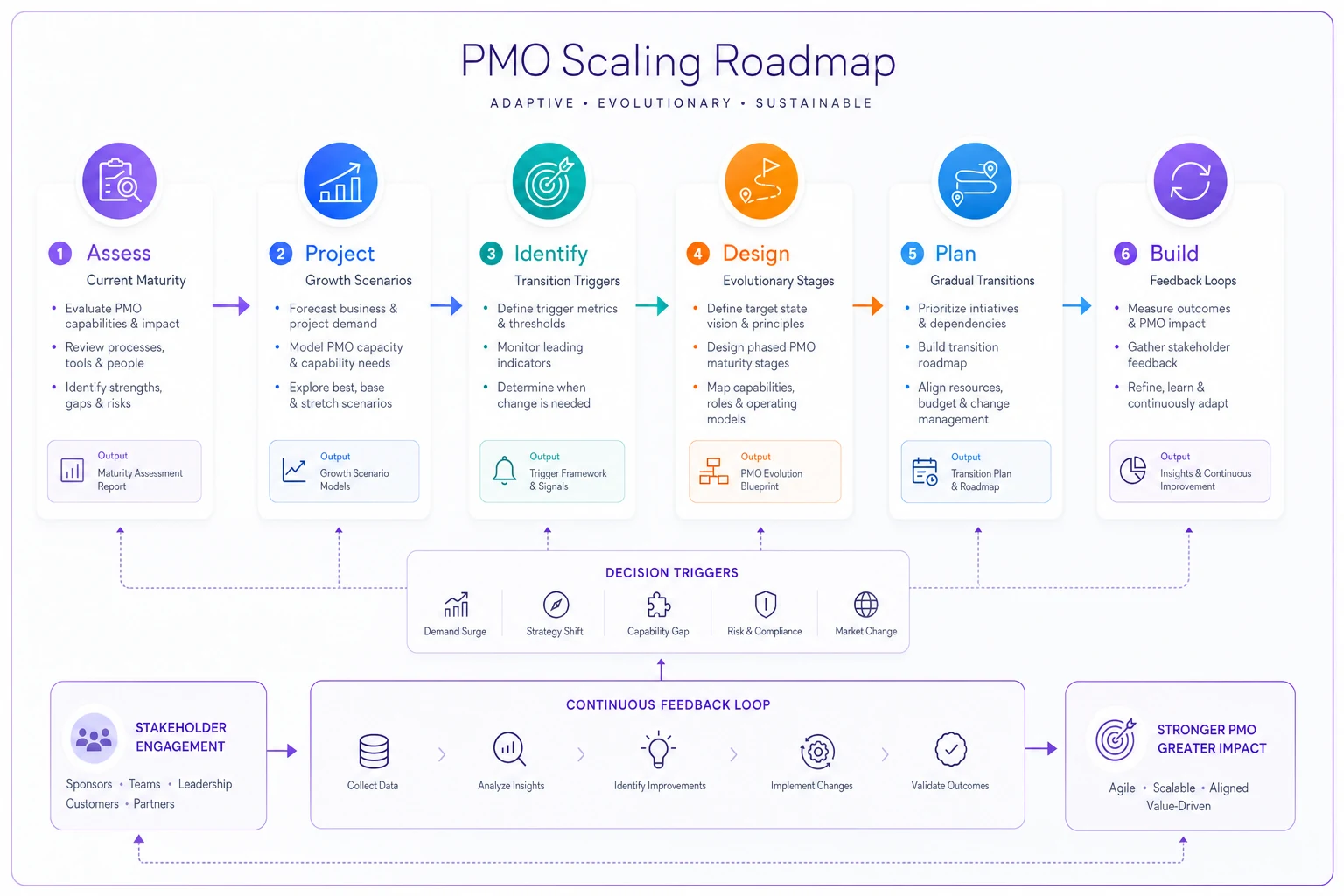
Step 1: Assess current maturity Document your existing project volume, complexity, and pain points. Where do bottlenecks occur? What decisions take too long? Which processes create the most friction?
Step 2: Project growth scenarios Estimate project growth over the next 18-24 months. Consider both volume and complexity. Will you stay in the same industries or expand? Will project size increase? Will you add new delivery methods?
Step 3: Identify transition triggers Define specific metrics that signal when to evolve. Don't use vague criteria like "when things get difficult." Use measurable triggers like "when average PM workload exceeds X projects" or "when resource conflicts affect Y% of portfolio."
Step 4: Design evolutionary stages Map out how roles, processes, and tools evolve at each stage. Be specific. Instead of "implement better resource management," define "transition from PM-owned resources to centralized resource pool with dedicated management."
Step 5: Plan gradual transitions Never transform everything simultaneously. Pick one area - usually the biggest pain point - and evolve it first. Let it stabilize before tackling the next area. A typical sequence might be: resource management → governance structure → project methodology → portfolio processes.
Step 6: Build feedback loops Establish regular reviews of your scaling model. What's working? What's breaking? Are your triggers still appropriate? High-growth PMOs review their model quarterly and adjust based on actual performance.
Most organizations underestimate how much time these transitions take. Budget at least 6-9 months per major evolutionary stage.
Common Scaling Mistakes to Avoid
Certain mistakes appear repeatedly:
Scaling the wrong things first. Organizations often start with tools or methodology when the real problem is governance or resources. Diagnose correctly before prescribing solutions.
Preserving sacred cows. That executive steering committee that worked with 10 projects becomes a bottleneck at 50. Be willing to fundamentally restructure, not just adjust.
Ignoring cultural readiness. Process changes fail when the organization isn't ready. A command-and-control culture won't suddenly embrace distributed decision-making. Evolution requires cultural preparation.
Underestimating change management. PMO transformations affect everyone - project teams, stakeholders, executives. Budget significant time and effort for communication, training, and adoption support.
Creating false precision. Complex processes with 47-step workflows and 15 approval levels don't improve quality. They create overhead. Keep processes as simple as possible for the current maturity stage.
Forcing standardization too early. Some variation is healthy in early stages. Let different teams experiment with approaches. Standardize after you know what works, not before.
The most expensive mistake is rushing transformation. Take time to get each stage stable before moving to the next.
The Platform Advantage in PMO Scaling
Modern operational platforms can significantly accelerate PMO scaling, but only when deployed strategically. Use them to remove friction from growth transitions, not to impose rigid structures.
Effective platforms provide scaffolding for evolution. They start simple for Stage 1 operations - basic project tracking, simple resource views, straightforward reporting. As you scale, they reveal additional capabilities without forcing wholesale process changes.
Resource management might begin as simple availability tracking. As conflicts increase, the platform enables resource pool management. Eventually, it supports capacity planning and skill optimization. The same platform supports all stages
Resource management might begin as simple availability tracking. As conflicts increase, the platform enables resource pool management. Eventually, it supports capacity planning and skill optimization. The same platform supports all stages
Ready to elevate your project delivery?
Join over 2,500 project teams using GoProjy to optimize resources, reduce risks, and drive portfolio success.