


Pilots are dying in no-man's land.
They run for months, collect data nobody reads, then fade out without clear next steps. Meanwhile, executives are still asking "what happened to that blockchain pilot?" while portfolio teams dig through spreadsheets looking for status updates from Q2.
The problem isn't running pilots — it's graduating them. Most PMOs have no real system for moving pilots from experiment to funded initiative. No fixed measurement windows. No success thresholds. No operational machinery to make go/no-go decisions based on actual evidence.
The pilot graveyard pattern
Walk into any enterprise PMO and you'll find pilot zombies. A supply chain optimization pilot that's been "wrapping up" for eight months. An AI customer service experiment that showed promising results but never got budget. A digital transformation proof-of-concept that everyone quietly forgot after the sponsor changed roles.
These pilots consume resources without generating decisions. Team members stay partially allocated. Vendors maintain contracts. Systems run in parallel. But nobody can answer the basic question: should this become a real project or not?
The damage compounds. Teams lose faith in innovation programs when pilots never go anywhere. Vendors get frustrated maintaining proof-of-concept environments with no endpoint in sight. Finance can't reconcile pilot costs against benefits. And the portfolio fills up with half-dead initiatives nobody wants to officially kill.
Why pilots get stuck in limbo
Three core operational reasons.
Stop losing track of critical projects.
GoProjy helps you monitor, prioritize, and deliver projects on time—seamlessly.
- Unified portfolio visibility
- Real-time resource tracking
- Milestone & risk alerts
No credit card required
First, success criteria stay undefined or unmeasurable. The pilot charter mentions "improved efficiency" without specific thresholds. Six months later, the pilot shows 15% improvement in something, but nobody knows if that's good enough to justify full funding. A real pilot-to-roadmap checklist starts with quantifiable success metrics defined before launch — not after.
Second, measurement windows stretch indefinitely. The pilot was supposed to run three months. Edge cases pushed it to four. Technical issues added another month. Now it's month seven with no clear endpoint. Without fixed measurement periods, pilots drift along collecting more data that doesn't actually change the decision.
Third, graduation paths are disconnected from funding cycles. The pilot shows positive results in June, but the next portfolio review isn't until October, and annual budgeting happened in March. By the time funding discussions come around, the team has dispersed, momentum is gone, and stakeholders have moved on.
The measurement window framework
Effective pilot graduation starts with fixed measurement windows tied to decision gates.
Define three phases: baseline collection (typically 2-4 weeks), active measurement (8-12 weeks), and an analysis window (2 weeks). Lock these timeframes in the pilot charter. No extensions without executive approval. This prevents the slow drift that turns three-month pilots into year-long experiments.
During baseline collection, capture current-state metrics without pilot intervention. You need real comparison data, not estimates. One logistics company found their "20-minute process" actually averaged 47 minutes once they measured it properly. Their pilot looked less impressive against the honest baseline — but the decision data was actually useful.
The active measurement phase needs weekly data collection at minimum, not monthly rollups. You're looking for trends, variations, and stability. A pilot showing 30% improvement in week one that drops to 5% by week eight tells you something important. Build data collection into the pilot workflow — don't rely on separate reporting exercises that get skipped when people are busy.
Lock measurement windows in the pilot charter and require executive approval for any extensions to avoid slow drift.
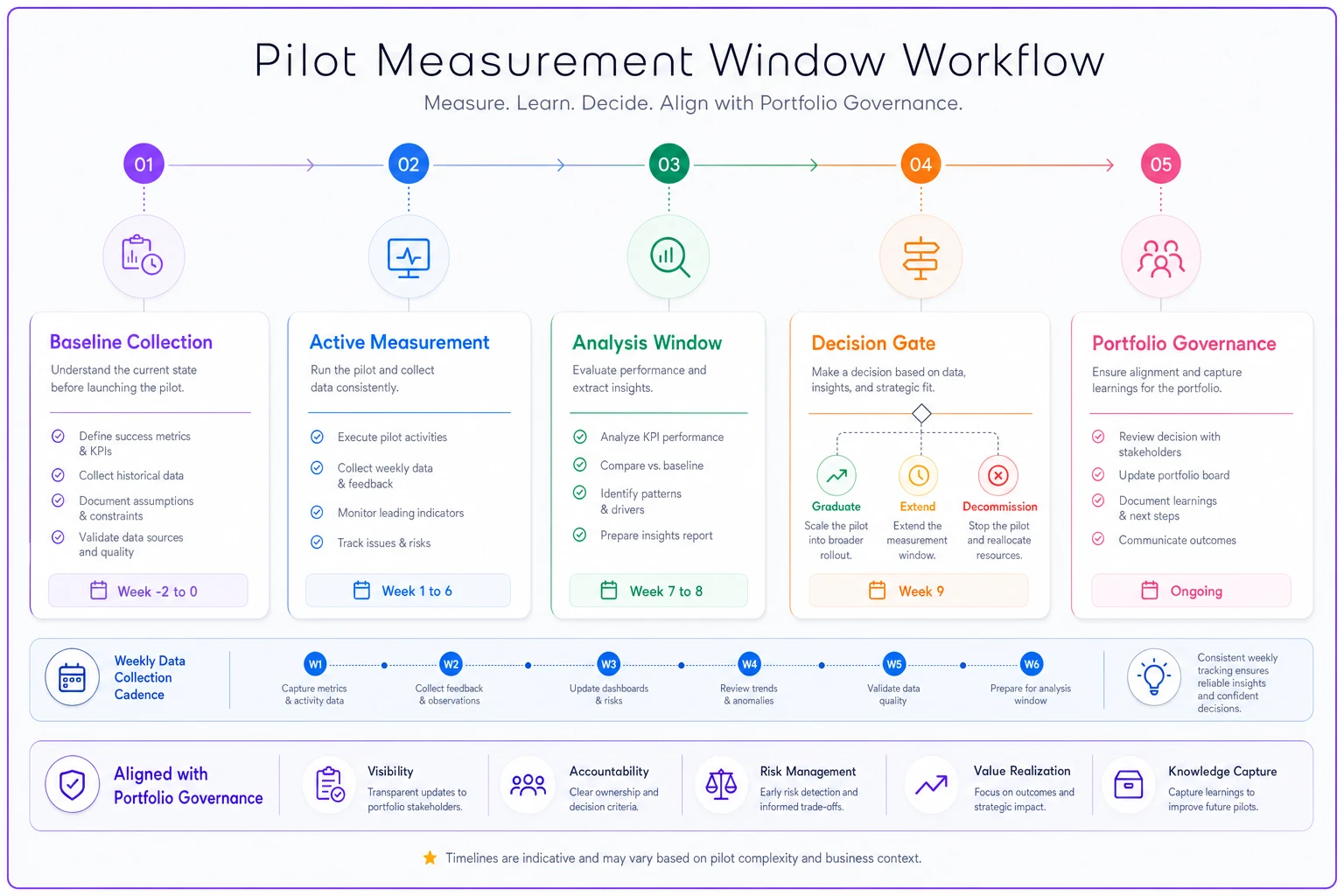
The analysis window forces a decision. No new data collection, no scope adjustments, no "just one more test." Analyze what you have and make the call. This window should align with your portfolio governance calendar, not float independently.
Success thresholds that drive decisions
Generic success criteria kill pilot programs. "Improve efficiency" means nothing. "Reduce costs" could mean anything. You need specific, measurable thresholds tied to business value.
Structure thresholds in three tiers:
Minimum Viable Success: What the pilot must achieve to avoid immediate termination. Usually 10-15% improvement over baseline for efficiency plays, or specific cost reduction targets for optimization initiatives. Below this line, kill the pilot.
Graduation Threshold: What the pilot must hit to qualify for roadmap funding. Typically 25-30% improvement or clear ROI within 12 months. This justifies full implementation costs and change management investment.
Fast-Track Threshold: Exceptional results that trigger accelerated funding and expansion. Usually 50%+ improvement or ROI within 6 months. These bypass normal funding cycles and get executive sponsorship for rapid scaling.
Here's what this looks like in practice. A procurement pilot needs 12% cost reduction to survive, 22% to graduate, 35% for fast-track. The pilot achieves 19% savings. It survives but doesn't graduate immediately. The PMO can either extend for one more measurement window with an adjusted approach, or park it until the next funding cycle with reduced resources.
The funding request template
Most pilot teams write long narratives about their journey. Executives want a one-page decision document with a clear recommendation.
Your template needs five sections:
Evidence Summary (3-4 bullets):
-
Baseline metric
47 minutes average process time
-
Pilot result
28 minutes average (40% reduction)
-
Measurement period
12 weeks, 847 transactions
-
Stability
Consistent weeks 6-12, no degradation
Investment Requirements (table format):
-
Technology costs
$240K one-time, $5K monthly
-
Team resources
2 FTEs for 6 months implementation
-
Change management
$50K training and communication
-
Total Year 1
$380K
Projected Benefits (with confidence levels):
-
Conservative (80% confidence)
$420K annual savings
-
Expected (50% confidence)
$580K annual savings
-
Optimistic (20% confidence)
$750K annual savings
Risk Assessment (top 3 only):
-
Dependency on legacy system upgrade (Q3 scheduled)
-
Requires process change across 4 departments
-
Vendor stability concerns (startup, Series B)
Recommendation (pick one):
-
Graduate with full funding
-
Graduate with conditions
-
Extend pilot with adjustments
-
Decommission and capture learnings
This format forces precision. No storytelling, no buried insights, no ambiguous recommendations. A portfolio governance board can review a dozen of these in an hour and make real decisions.
Decommission rules and learning capture
Not every pilot graduates. Your checklist must include clear termination triggers and a learning capture process — not just graduation criteria.
Define automatic termination triggers before the pilot starts:
-
Missing minimum threshold after the measurement window closes
-
Core assumption proven false (market doesn't exist, technology doesn't scale)
-
Dependency failure (required system sunset, vendor bankruptcy)
-
Resource constraints (key specialist reassigned, budget frozen)
When a pilot hits a termination trigger, execute a structured decommission within two weeks. Document what was learned, archive code and configurations, close vendor contracts, release team members cleanly. Don't let pilots slowly decay — kill them decisively and redeploy resources.
The learning capture can't be a 40-page post-mortem nobody reads. One page:
-
What we tested (2-3 sentences)
-
What we learned (3-4 bullets)
-
What we'd do differently (2-3 bullets)
-
Where learnings apply elsewhere (1-2 bullets)
Store these in a searchable archive. When someone proposes a similar pilot next year, you can pull the summary and say "we tried this in Q2, here's what happened." It prevents repeating failed experiments and helps sharpen future pilot proposals.
Portfolio-level pilot orchestration
Individual pilot governance isn't enough. You need portfolio-level orchestration to manage pilot capacity, funding allocation, and graduation timing.
Most organizations run too many pilots at once. Resources get diluted, teams experience change fatigue, and no single pilot gets the attention it needs to succeed. A reasonable ceiling is 3-5% of portfolio capacity. If you're running 100 projects, you can properly support 3-5 active pilots. That constraint forces prioritization and tends to improve pilot quality noticeably.
Synchronize measurement windows with funding cycles. If your annual budget process runs in October, plan pilot graduations for August. That gives you time to analyze results, prepare funding requests, and get successful pilots onto next year's roadmap. Pilots finishing in December miss the window and lose momentum before the next cycle.
Create a pilot pipeline view showing:
-
Active pilots with measurement window status
-
Queued pilots awaiting capacity
-
Recent graduations and decommissions
-
Success rate trends over time
This helps portfolio governance see the innovation pipeline as a whole rather than a collection of disconnected experiments. Patterns become visible — "procurement pilots consistently graduate but marketing pilots rarely do" — and you can adjust your innovation strategy accordingly.
The graduation decision matrix
The graduation decision isn't binary. You need a matrix that maps pilot evidence to specific actions:
| Evidence Strength | Business Value | Recommended Action | Funding Path |
|---|---|---|---|
| Strong (>30% improvement) | High (>$1M annual) | Graduate immediately | Fast-track funding |
| Strong | Medium ($250K-$1M) | Graduate with conditions | Standard funding cycle |
| Strong | Low (<$250K) | Park for bundling | Combine with related initiatives |
| Moderate (15-30%) | High | Extend pilot, adjust approach | Maintain pilot funding |
| Moderate | Medium | Graduate if resources available | Compete in standard process |
| Moderate | Low | Decommission, capture learnings | No funding |
| Weak (<15%) | Any | Decommission immediately | No funding |
This eliminates subjective debates. The numbers drive the decision. Portfolio governance can process multiple graduation reviews without lengthy discussions about each one.
Worth noting: moderate evidence with high business value triggers extension, not immediate decommission. Some pilots need adjustment to reach their potential. But weak evidence always triggers decommission, regardless of theoretical value. Don't chase bad pilots hoping they'll turn around.
Connecting pilot evidence to [benefits realization tracking](/blog/operationalize-benefits-realization-an-outcome-tracking-system)
Graduated pilots need benefits tracking from day one of full implementation. The pilot provided evidence of potential — actual realization happens during scaled rollout.
Transfer pilot metrics directly into your benefits realization framework. If the pilot showed 28-minute process time, that becomes your implementation baseline. Track whether the full rollout maintains, improves, or degrades from pilot performance. Plenty of initiatives show strong pilot results but struggle at scale due to complexity, resistance, or technical limitations that weren't visible in the controlled environment.
Build a pilot-to-benefits bridge document connecting:
-
Pilot metrics to full implementation KPIs
-
Pilot assumptions to rollout dependencies
-
Pilot resources to scaling requirements
-
Pilot risks to implementation mitigations
This prevents the common situation where a successful pilot stumbles during implementation because critical context was lost in the handoff. The team running full implementation often isn't the team that ran the pilot. Without proper knowledge transfer, they end up solving problems the pilot team already figured out months earlier.
Budget allocation and funding gates
Annual budgeting cycles don't work for pilot graduation. You need dynamic funding mechanisms that can capture pilot success when it actually happens.
Reserve 10-15% of your portfolio budget for pilot graduations — a pool available outside normal budget cycles. When a pilot hits fast-track thresholds, you can fund it without waiting for annual planning. This reserved pool also creates healthy pressure on pilots to perform. There's real money waiting for successful graduations.
Run quarterly funding gates aligned with pilot measurement windows instead of one annual budget cycle. Four smaller allocations maintain momentum and prevent the energy drain of waiting months for budget approval.
Structure funding release in tranches tied to implementation milestones:
-
30% on graduation approval (mobilization)
-
40% on successful limited rollout (validation)
-
30% on full-scale deployment readiness (scaling)
This protects against pilots that performed well in controlled conditions but struggle during implementation. If limited rollout fails to maintain pilot performance levels, you stop funding before committing the full amount.
For your portfolio health reviews, include a pilot graduation section covering:
-
Pilots approaching graduation decisions
-
Recent graduation outcomes and funding allocations
-
Pipeline of queued pilots awaiting capacity
-
Success rate trends and common failure patterns
This keeps pilot graduation visible at the portfolio level rather than buried in innovation team reports where governance rarely looks.
Operational automation for pilot tracking
Manual pilot tracking breaks down fast. Teams forget to submit weekly metrics. Analysts spend hours compiling data from different sources. Decision packages arrive late or incomplete.
AI-powered operational software changes how this works in practice. Instead of chasing teams for updates, the platform automatically pulls metrics from source systems. When pilots approach their measurement window endpoint, it triggers evidence compilation and formats the graduation package. Portfolio managers see real-time pilot status without requesting reports or following up on emails.
The automation extends beyond data collection. When pilots hit termination triggers, the system initiates decommission workflows — scheduling resource release conversations, flagging contract reviews, generating learning capture templates. That's what makes decommissions fast and clean rather than slow and ambiguous.
Over time, AI-assisted platforms can also surface patterns across your pilot portfolio — identifying characteristics of pilots that consistently underperform, flagging optimal measurement window lengths for different pilot types based on historical evidence, and giving early signals on which active pilots are trending toward graduation thresholds. That kind of portfolio-level visibility is genuinely hard to build manually.
The operational impact is straightforward: teams propose better pilots because the evaluation criteria are visible upfront. Executives support the program because they see disciplined graduation processes instead of experiments that quietly disappear. And successful pilots actually become funded initiatives.
Making pilot graduation work
The path from pilot to funded initiative doesn't have to be political or mysterious. With fixed measurement windows, defined success thresholds, and a systematic graduation process, pilots either prove their value or get cleanly decommissioned.
Start with your active pilots. If any of them are running without clear graduation criteria, you're wasting resources and building organizational frustration. Lock in measurement windows — no more open-ended extensions. Build your funding request template and pressure-test it with finance before you actually need it.
Treat pilot graduation as a portfolio management discipline, not an innovation team side project. Integration with funding cycles, resource allocation, and benefits tracking is what determines whether pilots create real value or just generate interesting slide decks.
Organizations that get this right run fewer but better pilots. They make faster graduation decisions. They capture learnings from failures instead of pretending they didn't happen. And they maintain momentum from pilot to implementation without losing it in the gap between proof and production.
The pilot-to-roadmap process should be boring — systematic evaluation against predefined criteria leading to clear decisions. Save the excitement for the ideas being tested, not the process of evaluating them. When pilot graduation becomes operational routine rather than political theater, your portfolio can actually benefit from innovation instead of just talking about it.
Ready to elevate your project delivery?
Join over 2,500 project teams using GoProjy to optimize resources, reduce risks, and drive portfolio success.