
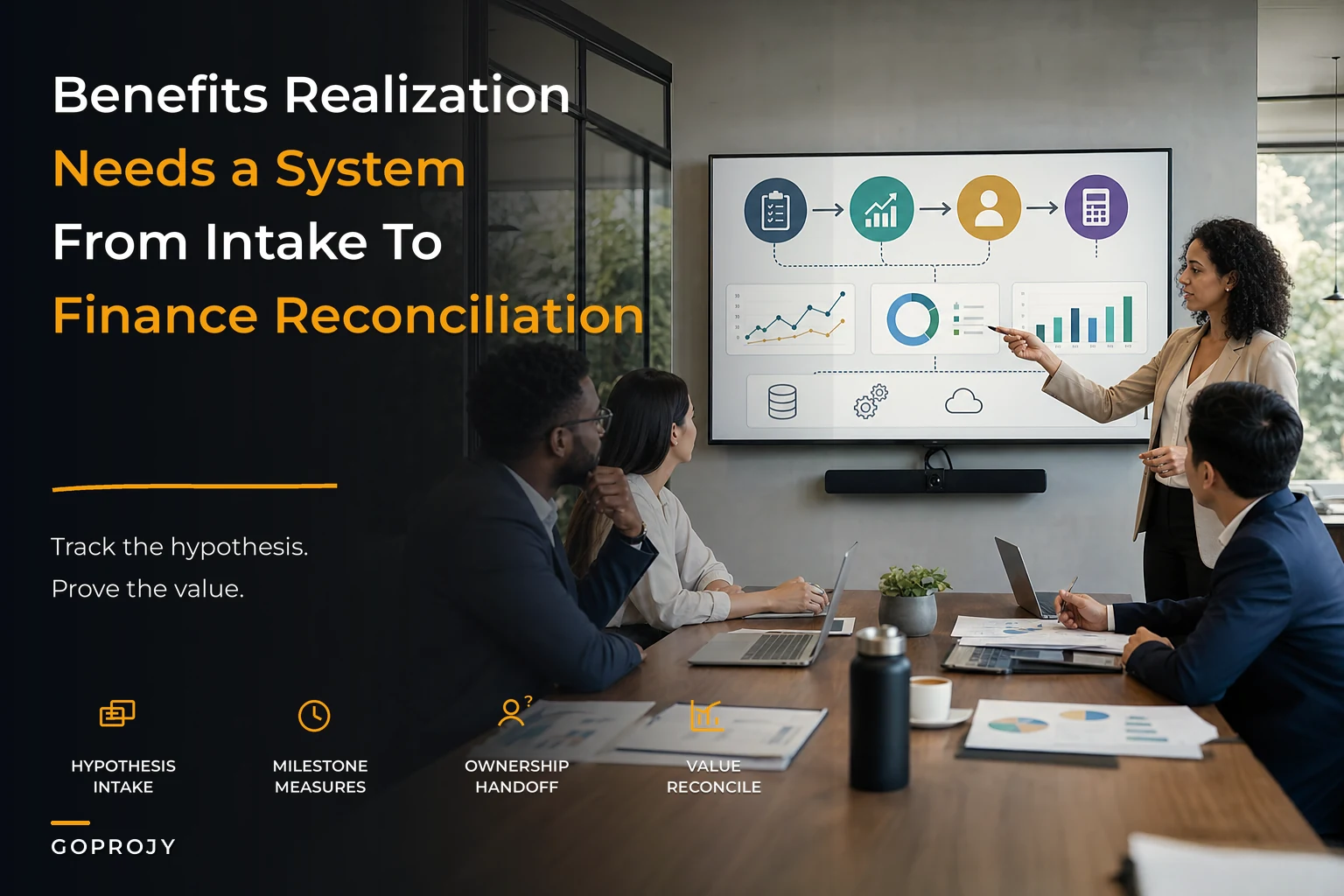

Last month I spent time helping a pharmaceutical PMO untangle their benefits mess. They'd delivered 47 projects over two years, all technically "successful," but couldn't answer a simple question from the CFO: what actual value did we get from our $23M portfolio investment?
The problem wasn't tracking. They had dashboards, green status lights, milestones hit, budgets managed. What they were missing was any real connection between those project metrics and business outcomes. Projects would close, teams would celebrate, and six months later nobody could say whether the promised inventory reduction or cycle time improvement had actually happened.
That disconnect creates a credibility gap that haunts PMOs. You deliver on time and on budget, but executives still treat the PMO like a cost center. The fix isn't more sophisticated project tracking—it's building a system that connects initial hypotheses all the way through to finance-validated outcomes.
The broken lifecycle of benefits tracking
Benefits realization in most PMOs follows a predictable decay pattern. Someone writes optimistic projections in a business case, those numbers get approved, the project runs, and then nothing. Benefits either get forgotten entirely or someone checks a box saying "benefits achieved" without any real validation.
Take a typical ERP implementation promising $2M in working capital improvement. The business case shows detailed calculations about inventory turns and payment terms. Eighteen months later the system is live, the project team has disbanded, and that $2M benefit? Nobody's measuring it. Finance doesn't connect their working capital metrics back to the project. The operational teams who were supposed to change their processes have moved on to other priorities.
The breakdown happens because benefits realization isn't treated as an operational process with clear ownership, measurement points, and reconciliation. It's treated as paperwork—something you do to get funding approval, then quietly forget about.
Even PMOs that try to track benefits usually fail at three points. They accept vague benefit statements that can't be measured. They don't establish baselines before projects start. And they have no mechanism to involve finance in validating claimed benefits against actual results.
A medical device company I worked with ran into this while preparing for an investor presentation. They'd claimed $8M in cumulative benefits from their digital transformation portfolio. When the CFO's team tried to trace those numbers to P&L impact, they could only validate about $1.2M. The rest was either double-counted, attributed to external factors, or theoretical benefits that never translated to financial reality.
Why hypothesis capture at intake changes everything
The most critical moment for benefits realization happens before the project even starts. During intake is when you either set up a measurable framework or doom yourself to vague success claims later.
Stop losing track of critical projects.
GoProjy helps you monitor, prioritize, and deliver projects on time—seamlessly.
- Unified portfolio visibility
- Real-time resource tracking
- Milestone & risk alerts
No credit card required
Most intake processes focus on scope, timeline, and budget. Benefits get a text field where someone writes "reduce costs" or "improve efficiency." Those aren't hypotheses—they're wishes. A real hypothesis has specific mechanisms, measurable outcomes, and testable assumptions.
Vague benefit statement: "Implement automated scheduling to improve resource utilization"
Testable hypothesis: "By implementing automated scheduling that considers skill matrices and availability in real-time, we'll reduce scheduler effort from 12 hours to 3 hours weekly and increase billable utilization from 72% to 78% within 6 months of go-live, assuming 85% user adoption and no major client contract changes"
The second version gives you everything needed for actual tracking. You know what to measure, when to measure it, and what assumptions could invalidate the benefit.
Building this discipline into intake requires three things:
-
Baseline metric and current performance
-
Target metric and expected performance
-
Measurement method and data source
-
Time frame for realization
-
Critical assumptions and dependencies
-
Business owner accountable for realization
Validation checkpoint before approval: Before any project gets approved, someone from finance or operations needs to confirm the hypothesis is measurable and that baseline data actually exists. Too many projects claim benefits against metrics nobody's currently tracking.
Capture baseline snapshots during intake to avoid costly retroactive data collection later.
Assumption tracking registry: Every hypothesis rests on assumptions—market conditions, adoption rates, process compliance. These need documentation and monitoring. When assumptions break, you should know immediately that benefits are at risk, not discover it months later.
Linking measures to milestones (not just project close)
Benefits don't suddenly appear when a project closes. They emerge gradually as capabilities roll out, processes change, and adoption builds. Yet most PMOs only check benefits at two points: initial business case and some vague post-implementation review that may or may not actually happen.
Connecting measurement points to specific milestones throughout the project—and beyond it—creates early warning signals when benefits aren't materializing and gives you data for course correction while you can still do something about it.
A consumer goods company restructured their benefits tracking around what they called "value gates"—specific milestones where partial benefits should be visible:
| Milestone | Expected Benefit Indicator | Measurement Method | Escalation if Not Met |
|---|---|---|---|
| Pilot complete | 15% reduction in processing time for pilot group | Time study comparison | Adjust rollout approach |
| 25% rollout | Extrapolated savings of $200K annually | Financial analysis of pilot regions | Pause expansion, investigate |
| 50% rollout | $500K run-rate savings visible | Month-over-month variance analysis | Executive review of assumptions |
| Full deployment | $1.2M annualized savings | Quarterly financial reconciliation | Benefits recovery plan required |
| 6 months post | $600K realized savings in P&L | Finance validation against baseline | Project retrospective and lessons learned |
This approach surfaces problems while you can still fix them. When the 25% rollout showed only $80K in extrapolated savings instead of $200K, they discovered that regions weren't following the new process consistently. They paused expansion, reinforced change management, and got back on track.
The key is treating these measurement points as operational requirements, not optional check-ins. Build them into your portfolio KPI framework from the start. Every project with claimed benefits needs defined measurement milestones in the project charter. Missing a benefits checkpoint should trigger the same escalation as missing a delivery milestone.
Defining acceptance criteria for closure (beyond "system went live")
Most projects close when technical deliverables are complete. System went live? Check. Training delivered? Check. Documentation done? Check. Project closed, team celebrates, everyone moves on. Then six months later someone asks about the benefits and gets blank stares.
Real closure acceptance should include benefits-realization criteria. Not full benefits—those can take months or years to fully materialize—but clear evidence that the foundation is in place and early indicators are moving in the right direction.
Capability confirmation:
-
Required functionality is not just deployed but being used
-
Adoption metrics meet minimum thresholds
-
Process changes are demonstrably in place
-
Support structures are operational
Early indicator validation:
-
Leading indicators show positive movement
-
No major assumption violations have occurred
-
Benefit owners confirm the path to realization is clear
-
Baseline measurements have been re-validated
Handover completeness:
-
Benefit owners formally accept accountability
-
Measurement responsibilities are documented
-
Reporting mechanisms are tested and working
-
Escalation paths for benefit shortfalls are defined
One manufacturing company created a "Benefits Readiness Review" required before any project could close. The review included the benefit owner, a finance representative, and operational leaders who would sustain the changes. Projects couldn't close without sign-off from all three that benefits were achievable based on current evidence.
This occasionally delayed project closure by a few weeks while teams addressed adoption issues or measurement gaps. But it prevented the much costlier problem of phantom benefits that never materialized.
The finance reconciliation reality check
This is where most benefits realization frameworks completely fall apart: connecting claimed benefits to actual financial results. The PMO reports millions in benefits delivered, finance looks at the P&L and sees no improvement, and credibility evaporates.
The disconnect happens because PMO and finance speak different languages. PMO tracks project-level benefits—"we reduced processing time by 30%." Finance tracks financial outcomes—"operating expenses increased 2% year-over-year." Without a reconciliation mechanism, these two realities never connect.
A technology company discovered this gap when their board questioned why $15M in "realized benefits" from their transformation program hadn't improved EBITDA. The investigation turned up several problems:
-
Multiple projects claimed the same benefit (three different projects claimed credit for reducing customer churn)
-
Timing mismatches (benefits claimed in Q2 didn't hit P&L until Q4)
-
Gross vs. net confusion (claimed $2M savings but spent $1.5M to achieve it)
-
External factors (market growth would have improved revenue regardless)
Building finance reconciliation into benefits realization requires three things:
Benefit coding structure: Every claimed benefit needs a financial code that traces to specific P&L or balance sheet accounts. "Reduce inventory" maps to working capital. "Improve productivity" maps to specific labor cost centers. This seems obvious but rarely happens.
Periodic reconciliation cycles: Quarterly or semi-annually, finance and PMO jointly review claimed benefits against financial actuals. This isn't about perfect one-to-one matching—lots of factors affect financial results. It's about identifying major disconnects and understanding why they occurred.
Variance analysis protocol:
-
Did the operational improvement actually occur?
-
Did the improvement translate to financial impact?
-
Were there offsetting factors that negated the benefit?
-
Was the timing different than expected?
-
Was the benefit real but non-financial?
This isn't about perfect one-to-one matching—lots of factors affect financial results. It's about identifying major disconnects and understanding why they occurred.
Building measurement discipline without measurement theater
The danger in building comprehensive benefits tracking is creating measurement theater—lots of tracking and reporting that doesn't actually drive value realization. I've seen PMOs build elaborate benefits dashboards that nobody looks at, require detailed reports that don't change behavior, and run reviews that become pure compliance exercises.
The difference between measurement discipline and measurement theater is operational integration. Measurement discipline means benefits tracking drives real decisions and actions. Measurement theater means it runs in parallel and doesn't affect how work actually gets done.
A pharmaceutical company learned this after spending six months building a benefits realization platform that tracked every claimed benefit across their 200+ project portfolio. Impressive dashboards, detailed reports, automated calculations. One problem: project teams treated it as extra paperwork. They'd update benefits tracking after making all their real decisions based on other factors.
The fix wasn't abandoning measurement—it was integrating it into existing rhythms:
Portfolio reviews: Benefits realization becomes a standing agenda item alongside schedule and budget. Projects with benefits at risk get the same scrutiny as projects with schedule delays. This connects to broader portfolio health reviews where benefits are part of overall portfolio performance.
Resource allocation: Projects struggling with benefits realization can request resources for adoption support, change management, or process reinforcement—not just technical delivery.
Performance management: Benefit owners have realization metrics in their performance goals. Not just project managers—the business leaders who are supposed to sustain and realize the benefits.
Funding decisions: Historical benefits realization performance affects future funding. Teams that consistently overstate benefits face higher scrutiny. Teams that reliably deliver get faster approval.
The timeline problem nobody talks about
Most benefits take longer to realize than anyone admits during planning. A project promises $2M in annual savings starting month one after go-live. Reality: month one shows increased costs from parallel running, months two through six show gradual improvement, and maybe by month twelve you're approaching target run-rate.
This mismatch creates constant tension. Executives expect immediate results based on business case promises. Project teams know benefits take time but don't want to sound like they're making excuses. Finance books provisions for benefits that haven't materialized.
-
Technology implementations
20% of benefits in first 6 months, 60% in months 7-12, remaining 20% in year two
-
Process improvements
40% in first 3 months, 80% by month 6, 100% by month 9
-
Organizational changes
Near zero for first 6 months, rapid acceleration months 7-12, full benefits by month 18
They built these patterns into their benefits forecasting. That did two things. It set realistic expectations with executives about when financial impact would appear. And it helped identify when projects were genuinely underperforming versus just following normal realization curves.
The timeline problem gets worse with interdependent benefits. Project A enables Project B which enables Project C's benefits. If Project A delays two months, Project C's benefits might shift by six. Without understanding these dependencies, portfolio-level benefits forecasting is basically fiction.
The ownership handoff that determines success
The moment a project closes and responsibility for benefits transfers from the project team to operational owners—that's when most benefits realization fails. The project team disbands, the consultants leave, and suddenly a business unit director who was peripherally involved now owns delivering $3M in benefits they don't fully understand.
Successful benefits realization requires treating this handoff as carefully as any critical operational transition. It's not just a signature on a closure document—it's a capability transfer that needs planning, validation, and real support.
A medical device manufacturer restructured their entire handoff process after realizing that over 60% of promised benefits never materialized post-project. Their new approach treats benefits handoff like a production line transfer:
Pre-handoff preparation (starting at 75% project complete):
-
Benefit owner shadows project team on measurement and reporting
-
Documentation of all processes, calculations, and assumptions
-
Trial runs of benefits measurement with owner involvement
-
Identification of sustaining resources and budgets needed
Handoff validation (at project closure):
-
Benefit owner demonstrates understanding of measurement methodology
-
Finance confirms owner has access to required data and systems
-
Operational plan for sustaining changes is reviewed and resourced
-
Early warning indicators and escalation triggers are defined
Post-handoff support (first 90 days):
-
Weekly check-ins between former project lead and benefit owner
-
Monthly benefits review with PMO and finance participation
-
Rapid response available for adoption issues
-
Adjustment authority for targets based on learned realities
This might seem like overkill for smaller benefits. But the discipline compounds—ten projects each delivering 80% of promised benefits is a lot better than ten projects with completely unknown outcomes.
When benefits tracking actually kills value
PMOs don't like admitting this, but sometimes the cost of measuring and tracking benefits exceeds the benefits themselves. A government agency I saw spent around $200K annually on benefits tracking administration for a portfolio delivering maybe $500K in questionable benefits. The tracking had become a value-destroying activity.
Smart benefits realization matches measurement intensity to materiality. Not every project needs the same level of rigor. A $50K process improvement doesn't need monthly finance reconciliation. A $5M transformation program does.
One approach that works: tiered tracking based on claimed benefit size and strategic importance:
-
Tier 1 (>$1M or strategic)
Full lifecycle tracking with finance reconciliation, monthly measurement, dedicated benefit owner, executive visibility
-
Tier 2 ($250K-$1M)
Quarterly measurement, simplified reporting, delegation to operational metrics, annual finance validation
-
Tier 3 (<$250K)
Self-reported by benefit owner, spot-check validation, aggregate portfolio reporting only
-
Tier 4 (Enabler/compliance)
No benefits tracking, value assumed through project completion
This tiering keeps measurement overhead from overwhelming smaller initiatives while ensuring material benefits get proper scrutiny. It also helps focus executive attention on what actually matters.
The AI automation opportunity in benefits lifecycle management
Tracking benefits across dozens or hundreds of projects creates natural breakpoints where manual processes fall apart. Someone forgets to update a measurement. Data lives in different systems. Finance reconciliation requires manual spreadsheet gymnastics. These friction points accumulate until benefits tracking becomes too painful to sustain.
AI-powered operational platforms can automate much of this friction away. Instead of manually collecting measurements from multiple sources, automation can pull data from financial systems, operational databases, and project tools—flagging variances, surfacing assumption violations, and identifying when benefits aren't moving as expected.
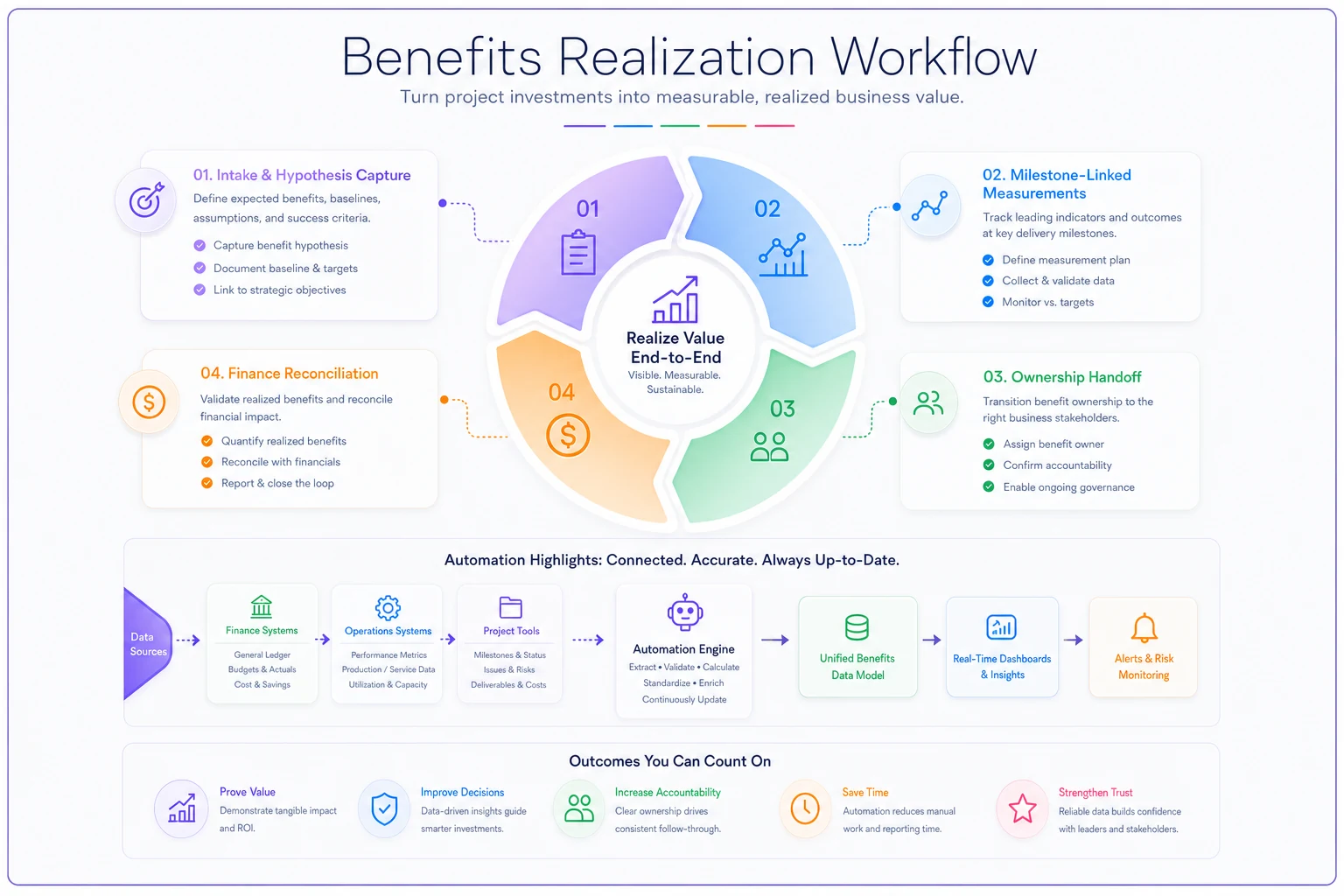
The opportunity extends beyond data collection. These platforms can identify patterns across your portfolio: which types of projects consistently overstate benefits, which assumptions commonly break, which benefit owners reliably deliver value. That kind of insight helps you adjust estimation approaches and support structures before problems emerge, not after.
The reconciliation challenge with finance is another area where AI-assisted platforms add real value. Mapping project benefits to financial outcomes, adjusting for timing differences and external factors, running variance analysis—all of that can be largely automated, freeing your team to focus on investigation and decisions rather than chasing data and updating spreadsheets.
The key is that this kind of automation doesn't replace the human judgment needed for benefits realization. It eliminates the mechanical work that makes benefits tracking unsustainable in the first place.
Moving from theory to operational reality
Building an end-to-end benefits realization system sounds compelling. Making it work requires gradual implementation and adjustment based on what you actually learn. Start with your next major project—implement the full lifecycle from hypothesis capture through finance reconciliation. Learn what works, what breaks, what takes more effort than it's worth.
Most PMOs try to implement benefits tracking all at once across the entire portfolio. That almost always fails. Too much change, too many stakeholders, too much complexity. Build the capability incrementally:
Phase 1: Hypothesis discipline. Start requiring testable hypotheses for new project approvals. Don't worry about perfect tracking yet—just get comfortable defining measurable benefits upfront.
Phase 2: Milestone measurement. Pick your five highest-value projects and implement milestone-based benefits measurement. Learn what types of measures work and what frequency makes sense.
Phase 3: Finance partnership. Bring finance into quarterly reviews for those five projects. Work through reconciliation challenges on a small scale before expanding.
Phase 4: Ownership transfer. Formalize the handoff process for projects closing in the next quarter. Test what support benefit owners actually need versus what you assume they need.
Phase 5: Portfolio expansion. Gradually extend the full lifecycle to more projects, using tiering to manage complexity.
Companies that successfully implement benefits realization tracking share a few traits. Executive sponsorship that treats benefits realization as seriously as on-time delivery. Investment in the operational infrastructure—tools, processes, people—needed to sustain measurement over time. And a willingness to accept that benefits realization is messy and imperfect, but still worth doing systematically.
Your PMO's credibility ultimately depends not on how many projects you deliver, but on how much value those projects create. Building a systematic approach to benefits realization—from initial hypothesis through finance reconciliation—is what shifts the PMO from a delivery function to a value creation function.
The question isn't whether you need it. It's whether you build it before or after the next time an executive challenges what your portfolio is actually worth.
Ready to elevate your project delivery?
Join over 2,500 project teams using GoProjy to optimize resources, reduce risks, and drive portfolio success.