


Most PMOs don't have a prioritization problem. They have a decision-economics problem. The scores are fine. The heatmaps are colorful. The steering committee nods. And then three months later half the funded work is behind, the two projects everyone quietly knew were shaky are still consuming capacity, and nobody can point to the exact moment the portfolio should have rebalanced but didn't.
That gap — between "we have priorities" and "we make disciplined, economically-grounded decisions when reality changes" — is what this framework is about. Not another scoring rubric. A way to write down what your portfolio is actually trying to maximize, what constraints it can't violate, and what specifically triggers a reallocation before the damage compounds.
A portfolio optimization framework for a PMO isn't a spreadsheet. It's a set of pre-agreed contracts about how money and capacity move when conditions shift. Without those contracts, every rebalance becomes a political negotiation — and political negotiations are slow, expensive, and biased toward whoever presents best.
Your portfolio has an objective function whether you've written it down or not
Every portfolio is implicitly optimizing for something. The problem is that when it's implicit, different stakeholders optimize for different things at the same time. Finance wants capitalizable spend and predictable burn. The CPO wants strategic coverage. Delivery leads want to keep their teams busy. Nobody is optimizing for the portfolio.
An objective function forces the argument into the open. It's a weighted statement of what "good" means, expressed clearly enough that you can actually compare two allocation choices. A workable one for a mid-sized portfolio might look like:
Maximize: (0.45 × expected strategic value) + (0.25 × risk-adjusted benefit realization) + (0.20 × option value / learning) − (0.10 × capacity strain penalty)
It doesn't need to be mathematically pure. It needs to be stable — agreed once, referenced every time someone proposes moving money. The weight on "capacity strain penalty" is the one most PMOs forget, and it's also the one that saves you. Without it, the math will happily recommend funding six high-value projects that all need the same four specialists.
One pattern worth noting: the moment you write down weights, people start arguing about the weights instead of the individual projects. That's actually a feature. Arguing about weights is a governance conversation you have once a quarter. Arguing about individual projects is a fight you have every week.
Constraints are where portfolios actually break
Value scoring gets all the attention. Constraints get ignored until they blow up mid-quarter. But portfolios fail on constraints far more often than they fail on picking the wrong high-value work.
Stop losing track of critical projects.
GoProjy helps you monitor, prioritize, and deliver projects on time—seamlessly.
- Unified portfolio visibility
- Real-time resource tracking
- Milestone & risk alerts
No credit card required
Three constraint families matter, and they interact in ways that consistently catch people off guard:
Capacity constraints. Not FTE headcount — bindable capacity in skills that are actually scarce. A portfolio can be 80% funded and still be 130% committed against two senior data engineers. The headline capacity number lies constantly.
Budget constraints. Both the ceiling and the shape. A portfolio with a $12M annual budget but a hard rule that no more than 40% can be OpEx in any given quarter has a very different feasible set than one with a flat ceiling. Shape constraints are the ones that quietly kill otherwise-good rebalances.
Risk constraints. Concentration limits. You might cap "no more than 30% of budget in projects with a single-vendor dependency," or "no more than two red-risk initiatives running in the same value stream simultaneously." Without these, risk aggregates silently until one vendor problem takes down a quarter of your delivery.
The modeling discipline that separates working frameworks from decorative ones: write constraints as hard vs. soft, and price the soft ones. A hard constraint can't be violated — the optimizer removes any option that breaks it. A soft constraint can be violated, but at a cost you've defined in advance. When you attach a price to bending a soft constraint, the "should we push it?" conversation becomes arithmetic instead of ego.
| Constraint | Type | Violation cost / rule |
|---|---|---|
| Annual budget ceiling | Hard | Cannot exceed. Full stop. |
| Scarce-skill capacity (senior eng) | Hard | Committed hours ≤ available hours per sprint |
| OpEx share per quarter | Soft | Each 1% over target = 3-point objective penalty |
| Contingency buffer (15%) | Soft | Dipping below charges against next-quarter flexibility |
| Single-vendor concentration | Hard | ≤ 30% of active budget |
| Concurrent red-risk per stream | Soft | 3rd concurrent red = mandatory exec review |
Most teams miss this: constraints don't just limit choices, they reveal which projects are secretly expensive. A modestly-scored initiative that eats 60% of your scarcest skill and bends three soft constraints is far more costly than its score suggests. Pure value scoring hides that. Constraint modeling surfaces it.
Rebalancing triggers: the part everyone skips
Static allocation is the default failure mode. You fund the portfolio in Q1, then don't touch it — not because it's still optimal, but because reopening the allocation feels like admitting the first one was wrong. So drift accumulates. Projects that should have been paused six weeks ago keep drawing capacity because there was no trigger forcing the conversation.
The fix is defining triggers in advance — objective conditions that automatically put a reallocation decision on the table. Not automatic reallocation. Automatic review. The trigger doesn't decide; it forces a decision to happen instead of drifting.
-
Benefit erosion projected benefit drops more than 25% below its funding-case assumption
-
Cost-to-complete blowout ETC rises more than 20% against baseline for two consecutive reporting periods
-
Capacity breach any scarce skill exceeds 100% committed for three straight sprints
-
Strategic drift an OKR the portfolio was funding gets deprioritized or retired
-
Concentration breach any hard risk constraint crosses threshold
-
Schedule signal a critical-path milestone slips past its tolerance band twice
The tolerance band matters as much as the trigger itself. If it fires on every 2% wobble, you'll drown in false alarms and start ignoring them — which is worse than having no triggers at all. In practice, a well-calibrated set of triggers fires roughly 2–4 times a quarter across a 30-project portfolio. More than that and your thresholds are too tight; fewer and they're too loose.
This connects directly to reallocation logic once a trigger fires. If you want the mechanics of moving funding between priority tiers cleanly, the approach in linking prioritization scores to funding slices with reallocation triggers pairs naturally with the trigger definitions here — triggers decide when, that framework helps decide how much moves where.
A worked numeric example
Abstract frameworks convince nobody. Here's a small portfolio to make it concrete.
Say you've got a $6M quarterly budget, 4 senior integration engineers (your binding constraint at roughly 640 productive hours/quarter), and five candidate allocations competing for funding. Each has a strategic value score, an expected benefit, a scarce-skill draw, and a risk flag.
| Project | Value score | Expected benefit | Sr-eng hours | Cost | Risk |
|---|---|---|---|---|---|
| A – Billing modernization | 82 | $2.1M | 240 | $1.8M | Amber |
| B – Data platform | 91 | $3.4M | 320 | $2.2M | Amber |
| C – Partner API | 74 | $1.2M | 180 | $0.9M | Green |
| D – Compliance rework | 68 | (mandatory) | 120 | $1.1M | Green |
| E – Analytics refresh | 79 | $1.6M | 260 | $1.3M | Red |
Naive scoring says fund by value: B, A, E, C, D. But total senior-eng draw for that set is 1,120 hours against 640 available. Infeasible. The capacity constraint just eliminated your "obvious" answer.
Now run it through the objective and constraints. Compliance (D) is a hard regulatory requirement — it gets funded regardless, consuming 120 hours and $1.1M. That leaves 520 hours and $4.9M.
Fund B (highest value, 320 hrs, $2.2M): remaining 200 hrs, $2.7M. Next by value is A at 240 hours — infeasible, only 200 left. Skip to C (180 hrs, $0.9M): remaining 20 hrs, $1.8M budget. E is red-risk and needs 260 hours — both the capacity constraint and a soft risk constraint push against it.
Final feasible set: D + B + C, using 620 of 640 hours and $4.2M of $6M. Budget is underspent, but capacity is nearly maxed — which correctly tells you the real constraint was never money. It was the four engineers. That's the most useful output of running this model: it names your actual binding constraint, which is almost never the one leadership assumes.
Project A, high-value but crowded out, becomes the natural rebalance candidate the moment a trigger frees up senior-eng capacity mid-quarter.
A simple simulation recipe you can run in a spreadsheet
You don't need optimization software to get most of the value here. A rough Monte Carlo in a spreadsheet exposes fragility that point estimates hide.
-
For each project, replace single benefit/cost/effort numbers with a three-point range (low, likely, high).
-
Run roughly 1,000 iterations, drawing a random value from each range per iteration (triangular distribution is fine).
-
In each iteration, apply your hard constraints and record which projects make the feasible funded set.
-
Count how often each project gets funded across all iterations — that's its funding robustness.
-
Flag anything that funds in fewer than about 60% of runs as fragile — its inclusion depends on optimistic assumptions.
What this reveals is useful and slightly uncomfortable: projects that look "clearly funded" on the base case sometimes only survive 55% of scenarios once you account for uncertainty. Those are the ones that quietly blow up your quarter.
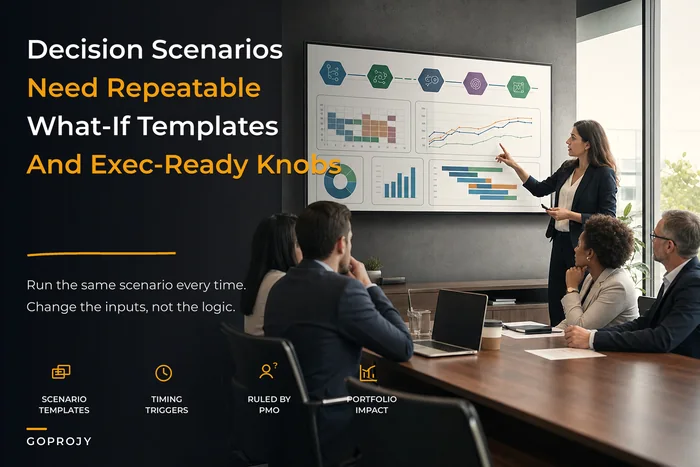
Building these ranges into repeatable scenario templates is the muscle described in decision-ready what-if roadmap scenarios for constrained portfolios, and the simulation output feeds those exec conversations directly.
Executive commitment contracts: making decisions stick
The failure that undoes everything above: you run a clean model, present a clean recommendation, get a nod in the room — and then two weeks later a VP quietly lobbies to keep their pet project alive, and the allocation you agreed to quietly unravels. The math was never the problem. The commitment was.
An executive commitment contract is a short, signed artifact that turns a decision into an obligation. Not legal — governance. It states, for each funded initiative:
-
What we're funding and for how much
-
What outcome we expect and by when (the funding case, restated)
-
What the tolerance bands are before this gets reopened
-
What we agree to do if a trigger fires (pause, descope, reallocate, escalate)
-
Who owns the decision if the trigger fires, and by when they must decide
The power is in the last two lines. You're getting executives to pre-agree, while calm and rational, what happens when things go sideways — before anyone is emotionally attached to a struggling project. When the trigger fires later, you're not asking permission. You're executing a contract they already signed. That shift — from re-litigating to executing — is worth more than any scoring improvement.
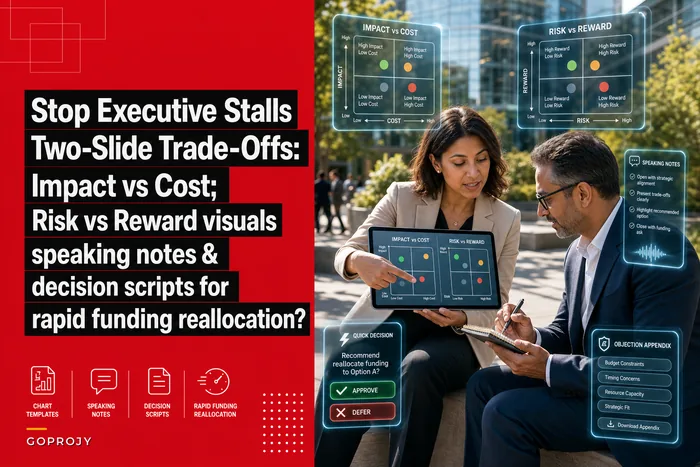
For the actual conversation mechanics of getting fast reallocation decisions in the room, the trade-off visuals and decision scripts in stopping executive stalls with two-slide trade-off visuals pair well with commitment contracts — the visuals get the yes, the contract makes the yes durable.
A rebalance playbook for when a trigger fires
When a trigger fires, you don't want improvisation. You want a runbook that produces a decision within a fixed window. A workable one:
-
Trigger logged — automated or manual, with the specific threshold breached and the supporting data (within 48 hours of detection).
-
Impact framing — PMO analyst produces a one-page delta
what changes in the objective function, which constraints tighten, which projects become candidates to pause or fund.
-
Options generated — always at least three
hold, partial reallocation, full reallocation. Each with objective-function impact and constraint check.
-
Decision owner reviews — per the commitment contract, the named owner decides within the contracted window (often 5 business days).
-
Execute and re-baseline — move funding and capacity, update commitment contracts for affected projects, log the decision with its rationale.
-
Close the loop — check at the next review whether the rebalance produced the expected effect. If it didn't, that's a signal your model's assumptions need tuning.
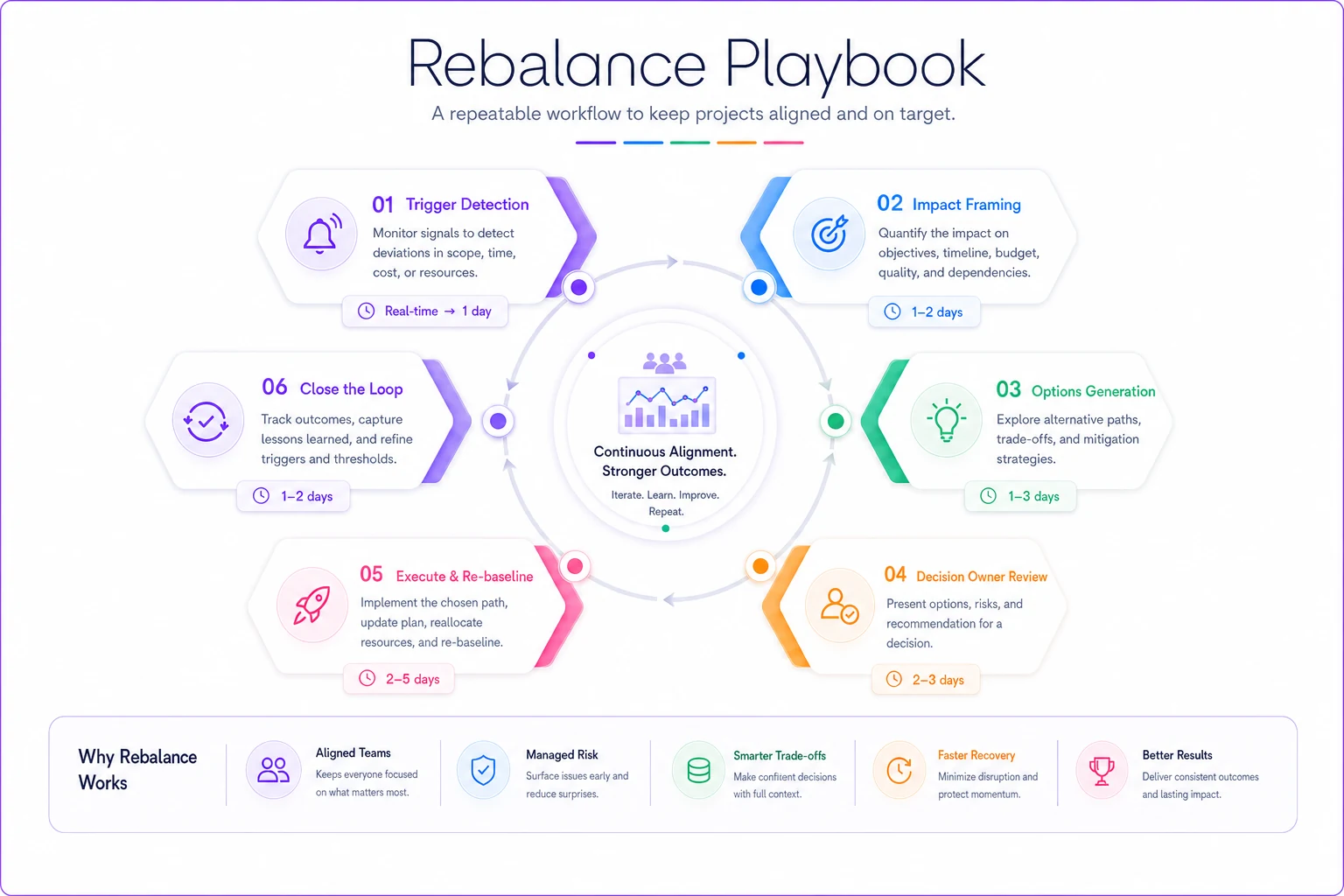
Step 6 is the one everyone drops. It's also how the framework gets smarter over time. A rebalance that consistently fails to produce the predicted benefit is telling you your objective weights or benefit estimates are miscalibrated — and that's actually valuable information if you bother to capture it.
A short real scenario
A PMO running about 28 concurrent initiatives on roughly a $20M annual portfolio kept hitting the same wall: every quarter, delivery slipped, and every quarter the "why" was fuzzy. They had scoring. They had a steering committee. What they didn't have was constraint modeling or triggers.
The first time they mapped scarce-skill capacity against commitments, they found they were running at roughly 140% committed against their cloud-security specialists — a group of three people the portfolio had implicitly bet a third of its work on. No one had modeled it because the top-line capacity number looked fine.
They introduced hard capacity constraints, soft-priced contingency rules, and six rebalancing triggers with tolerance bands. Over the next two quarters, "surprise" reforecasts dropped noticeably — from a near-monthly scramble to two planned rebalances that both hit their contracted decision windows. Nothing about the projects changed. What changed was that constraint breaches surfaced before they became slippage, and reallocations happened on a contract instead of a debate. The portfolio didn't get bigger. It got harder to fool.
When this framework makes sense — and when it doesn't
When it's worth it: You're running enough concurrent work (roughly 15+ initiatives) that constraint interactions aren't obvious, you share scarce specialists across projects, and reallocation currently happens through negotiation rather than rule. If your quarters keep ending in surprise reforecasts, this is your fix.
When it's overkill: A portfolio of five clearly-separated projects with dedicated teams and no shared constraints doesn't need objective functions and Monte Carlo simulations. You'd be adding governance weight to solve a problem you don't have.
Who should hold off: If your basic portfolio data is unreliable — benefit estimates are fiction, capacity data is stale, cost-to-complete is guessed — don't build optimization on top of it. The model will produce confident, precise, wrong answers. Fix the data foundation first, then layer this on.
Where tooling actually helps
None of this requires software to start. A disciplined PMO can run the objective function, constraints, and triggers in spreadsheets for a couple of quarters. That's often the right way to learn what your real weights and thresholds should be before committing to anything heavier.
Where operational software earns its place is when trigger-monitoring becomes too much to do by hand. Checking capacity commitments against thresholds across 30 projects every sprint, watching cost-to-complete trends against tolerance bands, flagging concentration breaches — that's exactly the kind of continuous, low-glamour monitoring that gets dropped when the PMO is busy. AI-assisted operational platforms are genuinely useful here: they watch thresholds continuously, surface the specific breach with supporting data the moment tolerance is crossed, and hand the PMO a pre-framed rebalance decision instead of a raw alert. The judgment stays human. The tireless watching doesn't have to be.
Start with spreadsheet discipline before automating triggers.
A framework that depends on someone remembering to check twelve triggers every sprint will quietly decay. Whatever removes that fragility — spreadsheet discipline early, automation later — is what keeps it alive past the first busy quarter.
Bringing it together
A portfolio optimization framework for a PMO isn't scoring dressed up in math. It's four connected commitments: a written objective function so everyone optimizes the same thing, honest constraint modeling so your real binding limits surface, triggers with tolerance bands so drift can't hide, and commitment contracts so decisions survive contact with politics.
Each piece is modest on its own. Together they change what a portfolio is — from a list of projects competing for attention into a system that reallocates deliberately when reality shifts. The teams that get this right don't make dramatically better initial bets. They just stop letting bad situations run three months past the point anyone should have acted. Over a year, that's usually the difference between a portfolio that delivers what it promised and one that spends the whole year explaining why it didn't.
Each piece is modest on its own. Together they change what a portfolio is — from a list of projects competing for attention into a system that reallocates deliberately when reality shifts. The teams that get this right don't make dramatically better initial bets. They just stop letting bad situations run three months past the point anyone should have acted. Over a year, that's usually the difference between a portfolio that delivers what it promised and one that spends the whole year explaining why it didn't.
Ready to elevate your project delivery?
Join over 2,500 project teams using GoProjy to optimize resources, reduce risks, and drive portfolio success.