

Portfolio managers burn through weeks building custom scenario models for every quarterly planning cycle, only to watch executives ask for "just one more variation" during review sessions. Meanwhile, the actual roadmap sits frozen while teams wait for decisions that should take hours, not weeks.
Most PMOs treat roadmap scenario planning portfolio work like a one-off exercise. They spin up complex models in Excel, run a few variations, present to leadership, then start from scratch next quarter. The scenarios themselves become artifacts instead of living tools that drive actual decisions.
The real problem with roadmap scenario planning isn't complexity—it's repeatability
What makes this worse is how disconnected these scenarios feel from operational reality. Finance wants cost impacts. Engineering needs resource allocation views. Product wants feature timelines. Executives want simple visuals showing trade-offs. Everyone gets a different PowerPoint deck that goes stale the moment someone adjusts a priority or shifts a resource.
Organizations that actually make scenario planning work have figured out something different. They've built repeatable systems with adjustable parameters that connect directly to their portfolio data. When leadership asks "what if we cut budget by 20%" or "what if we accelerate this initiative," they can generate decision-ready outputs in hours, not weeks.
Why traditional scenario planning breaks down under real portfolio constraints
Resource constraints kill most scenario planning before it starts. You model a perfect world where every project gets the people it needs, then reality hits. Your lead architect supports three critical projects. Your data team is already stretched across five initiatives. The scenario that looked great on paper becomes impossible to execute because you can't clone your specialists.
Stop losing track of critical projects.
GoProjy helps you monitor, prioritize, and deliver projects on time—seamlessly.
- Unified portfolio visibility
- Real-time resource tracking
- Milestone & risk alerts
No credit card required
Budget constraints add another layer. Projects rarely fail cleanly—they bleed resources while delivering partial value. A scenario might show cutting Project A to fund Project B, but Project A is 70% complete with sunk costs and committed vendor contracts. The simple "cut or keep" decision becomes a complex unwinding exercise that your scenario model never captured.
Timeline dependencies make everything worse. Moving one project affects three others. Delaying an infrastructure upgrade pushes out four dependent initiatives. Accelerating a platform migration means pausing customer features. These cascading impacts rarely show up in traditional scenario models until someone actually tries to execute the plan.
And the political constraints are what really break things. Every scenario has winners and losers. The sales organization won't accept delays to their CRM upgrade. Engineering refuses to compromise on technical debt reduction. Marketing has already promised features to customers. Your technically optimal scenario becomes politically impossible.
Organizations that run effective scenario planning have learned to model these constraints explicitly. They don't just adjust timelines and budgets—they model resource conflicts, dependency chains, and even political feasibility scores. The scenarios that survive this analysis actually have a chance of working in the real world.
Building adjustable scenario 'knobs' that executives can actually understand
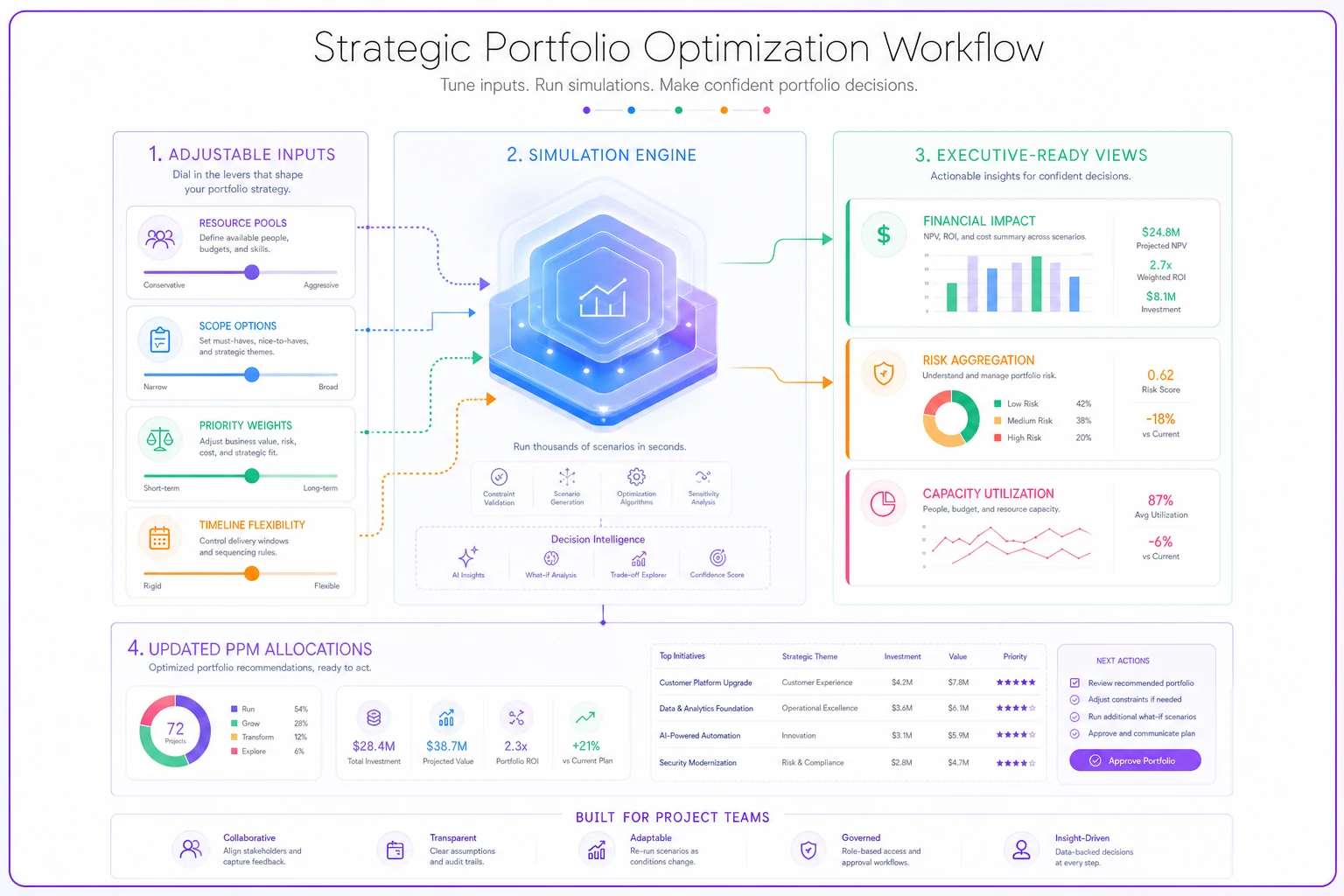
The best roadmap scenario planning portfolio systems work like mixing boards, not spreadsheets. You have clear knobs to adjust—resource levels, project scope, timeline flexibility, priority weights—and the system shows you what changes across the entire portfolio.
Start with resource allocation knobs. Instead of modeling individual people, create resource pools with capacity ranges. "Data engineering: 3-5 FTEs" becomes an adjustable parameter. Executives can see what happens when you dial data engineering up to 5 (three projects accelerate) or down to 3 (two projects slip, one gets descoped). The knob makes the trade-off visible and immediate.
Scope knobs let you model different project sizes without rebuilding entire plans. Each initiative gets minimum viable, standard, and enhanced scope options with different resource needs and timelines. An executive can dial back three projects from enhanced to standard scope and immediately see how that frees up resources for a critical new initiative.
Priority weight knobs change how the system allocates scarce resources. Strategic alignment might be weighted at 40%, revenue impact at 30%, risk reduction at 30%. Adjusting these weights reshuffles the entire portfolio prioritization. Executives can see exactly which projects move up or down based on what they value most.
Timeline flexibility knobs show the real cost of acceleration or delay. Some projects can slip three months with minimal impact. Others create cascading delays if they move even two weeks. Building these constraints into adjustable parameters lets executives understand what "just pushing that out a quarter" actually costs.
When these knobs work together, things get interesting. Reducing scope on two projects frees up resources to accelerate a third. Adjusting priority weights changes which projects get those freed resources. Extending timelines on flexible projects creates capacity for critical fixed-date initiatives. The entire portfolio becomes a system you can tune, not a static plan you have to rebuild from scratch.
Here's a quick workflow sketch showing how knobs feed into portfolio reprioritization and execution readiness.
Below is a quick reference for how each knob type maps to its primary impact and the trade-off it surfaces:
| Knob Type | What You Adjust | Trade-off Made Visible |
|---|---|---|
| Resource allocation | FTE ranges per pool | Capacity vs. delivery speed |
| Scope | Min viable / standard / enhanced | Output quality vs. resource demand |
| Priority weights | Strategic, revenue, risk weighting | Which initiatives win scarce resources |
| Timeline flexibility | Slip tolerance per project | Schedule risk vs. cascade cost |
When these knobs are implemented as adjustable parameters connected to portfolio data, executives can make fast, informed trade-off decisions without rebuilding plans from scratch.
Creating simulation outputs that connect to executive decision-making
Executives don't want to see Gantt charts and resource histograms. They want to understand trade-offs, risks, and outcomes. The simulation outputs that actually drive decisions translate portfolio complexity into business impact.
Financial impact views show more than just project costs. They model cash flow timing, expected returns, and investment efficiency. When you adjust scenario knobs, executives see how those changes affect quarterly cash position, annual ROI, and payback periods. A delay might save $2M this quarter but cost $8M in delayed revenue next year—that trade-off needs to be crystal clear.
Risk aggregation views reveal hidden dangers in scenarios. Five projects might individually have acceptable risk, but together they create a concentration problem. All depend on the same vendor. Three require the same scarce skill set. Two have regulatory deadlines in the same month. Simulation outputs need to surface these aggregate risks before they become crises.
Capacity utilization views show whether a scenario is actually executable. Not just "do we have enough people" but "can these specific people handle this workload." If your scenario requires your top architects to support four simultaneous projects while also doing production support, the simulation needs to flag that as unsustainable.
Strategic alignment scoring connects scenarios to business objectives. Each scenario gets scored against OKRs, strategic themes, and business priorities. Executives can see that Scenario A delivers 80% of the digital transformation objective but only 40% of customer experience goals, while Scenario B balances both at 65%. The trade-offs become explicit and measurable.
The most effective simulation outputs include confidence ranges, not just point estimates. A scenario might show $10M in benefits, but with a confidence range of $7M–$12M. This uncertainty modeling helps executives understand which scenarios are solid bets versus speculative gambles. Without it, every scenario looks equally credible on paper, which means none of them actually are.
Release triggers that tie scenarios to real adoption signals
Scenarios mean nothing if they sit on a shelf. The organizations that make scenario planning work build explicit triggers that activate different scenarios based on real-world signals. These triggers transform scenarios from plans into operational playbooks.
-
Level 1 — Minor adjustments Shift resources between projects or adjust timelines by a few weeks. These fire automatically based on metrics thresholds and require no committee approval.
-
Level 2 — Broader scenario activation Scope reductions across multiple projects or portfolio-wide priority reordering. Requires sign-off from the portfolio lead but uses pre-approved parameters.
-
Level 3 — Fundamental restructuring Canceling initiatives, pursuing completely different strategies, or major funding reallocation. Requires executive decision but scenarios pre-built so the analysis is already done.
Pre-negotiate trigger thresholds with finance and portfolio leads so activations can proceed without delay.
Market triggers connect scenarios to external changes. If customer acquisition costs rise above a set threshold, trigger the efficiency scenario that cuts growth projects and doubles down on retention. If a competitor launches a specific feature, trigger the acceleration scenario for your competing initiative. These triggers need specific thresholds, not vague conditions.
Performance triggers link scenarios to portfolio metrics. If overall portfolio schedule performance drops below 70% for two consecutive months, trigger the scope reduction scenario. If resource utilization exceeds 90% for critical skills, trigger the timeline extension scenario.
Financial triggers respond to budget reality. If Q1 revenue misses by 10%, automatically trigger the cost reduction scenario. If funding arrives from a canceled project, trigger the acceleration scenario for the next priority initiative. These triggers should be pre-negotiated with finance, not require fresh approval each time.
Dependency triggers handle cascade effects. If the platform migration slips by a month, automatically trigger timeline adjustments for dependent projects. If a key vendor misses a milestone, trigger the contingency scenario that brings work in-house. These triggers prevent small delays from becoming portfolio disasters.
The key is making triggers automatic rather than requiring a committee to convene every time a metric crosses a line. Pre-negotiated thresholds mean the decision is already made in principle—execution just needs a signal.
Connecting scenario outputs to portfolio governance and funding decisions
Scenario planning without funding authority is just expensive fiction. The organizations that make this work connect scenario outputs directly to portfolio governance and funding decisions. When executives pick a scenario, the money and authority follow automatically.
Pre-approved funding ranges accelerate decision-making. Each scenario comes with a budget envelope—Scenario A needs $8-10M, Scenario B needs $12-15M. Finance pre-approves these ranges during planning, so executing a scenario doesn't require another funding cycle. This might sound unrealistic, but several large enterprises now operate this way for their innovation portfolios.
Governance gates adapt to chosen scenarios. The aggressive timeline scenario might skip certain approval gates but require weekly executive reviews. The risk-mitigation scenario might add quality gates but extend timeline buffers. The governance model flexes with the scenario instead of forcing every project through the same process regardless of context.
Resource commitment models vary by scenario too. The innovation scenario might use dedicated teams with no shared resources. The efficiency scenario might maximize resource sharing across projects. The chosen scenario determines not just who works on what, but how they're organized and managed.
What really makes this work is connecting scenarios to existing portfolio tools. The scenario choice automatically updates project charters, resource assignments, and budget allocations in your PPM system. Teams see their updated roadmaps immediately. Finance sees revised forecasts. Nobody has to manually cascade decisions through multiple systems.
The operational reality of maintaining living scenarios
Building scenarios is the easy part. Keeping them alive and relevant as your portfolio evolves—that's where most organizations fall apart. Static scenarios become useless within weeks as projects shift, resources change, and priorities evolve.
Living scenarios need continuous calibration against actual performance. If your optimistic scenario assumed 85% resource efficiency but you're achieving 70%, every scenario needs recalibration. If project delivery is consistently running 20% longer than estimated, your timeline assumptions need updating. This isn't admitting failure—it's ensuring scenarios reflect operational reality.
Some organizations run monthly scenario refresh cycles. They don't rebuild from scratch but adjust parameters based on the last month's actuals. Resource capacity gets updated based on real availability. Cost estimates get refined based on actual spend. Timeline buffers get adjusted based on measured performance. Each refresh makes the scenarios more accurate.
The challenge is preventing scenario proliferation. Every executive wants their own variation modeled. Every risk needs a contingency scenario. Before long, you're maintaining 20 scenarios that nobody can keep straight. The best practice is limiting active scenarios to 3-5 with clear differentiation. Additional variations become parameter adjustments, not entirely new scenarios.
What makes scenarios truly "living" is their connection to portfolio health metrics. When portfolio velocity drops, scenarios automatically adjust timelines. When resource utilization spikes, scenarios factor in increased risk. The scenarios evolve based on actual portfolio performance, not manual updates.
Why spreadsheet-based scenario planning hits a wall
Excel starts as every PMO's scenario planning tool. It's flexible, everyone knows it, and you can model anything. Then you hit around 20 projects with resource constraints and dependencies, and the spreadsheet becomes a nightmare that only one person understands.
The first crack appears when you need to model resource allocation across time. Sarah can work on Project A in Q1, then shift to Project B in Q2, but she also provides 20% ongoing support to Project C. In Excel, this becomes a three-dimensional modeling problem that breaks every time someone adjusts a timeline. One project shifts by two weeks and you spend hours manually updating resource allocations.
Dependencies make it worse. Project A depends on Project B's Phase 2, which depends on Project C's infrastructure work. Change one timeline and you're hunting through dozens of sheets updating dates and checking for conflicts. Miss one dependency and your entire scenario falls apart during execution.
The real killer is when executives want to compare scenarios side-by-side. You've built three scenarios across multiple worksheets. Now someone wants to see resource utilization across all three. Or compare financial impacts. Or understand which projects appear in which scenarios. You end up building complex summary sheets that break whenever you update the underlying data.
Version control becomes impossible. You have "Scenario Planning v2.3 FINAL FINAL (exec review).xlsx" and nobody knows if it includes the latest resource updates. Someone makes a local change for a specific analysis and suddenly you have five versions floating around with different assumptions. The scenarios stop being trusted because nobody knows which version is correct.
The organizations that scale roadmap scenario planning portfolio work move beyond spreadsheets to purpose-built systems. These platforms maintain relationships between projects, resources, and dependencies automatically. When you adjust a parameter, impacts cascade properly through the entire portfolio. When you compare scenarios, you're comparing identical data structures with different parameters—not hoping someone updated all the right cells.
[Portfolio size check] | < 15 projects → Excel may still work | 15–25 projects with shared resources → Excel starts breaking | > 25 projects OR heavy dependency chains | → Move to purpose-built scenario planning platform | Add distributed teams or monthly trigger logic | → AI-assisted portfolio simulation recommended
Moving from static scenarios to dynamic portfolio simulation
The next evolution in scenario planning is continuous simulation. Instead of building discrete scenarios, you model your portfolio as a system with variable inputs and let simulation show you the range of possible outcomes.
Monte Carlo simulation for portfolios isn't new, but most organizations implement it wrong. They randomize task durations and costs, then act surprised when the simulation shows huge variance. Real portfolio simulation models the factors that actually drive uncertainty: resource availability, dependency delays, scope creep patterns, and external risks.
One tech company replaced their quarterly scenario planning with continuous simulation. They model each project with probability distributions for key parameters—duration has a 70% chance of hitting estimate, 20% chance of a 20% overrun, 10% chance of a 40% overrun. Resources have availability distributions based on historical data. The simulation runs thousands of iterations showing the range of portfolio outcomes.
What makes this valuable is identifying non-obvious risks. The simulation might reveal that seemingly independent projects actually create resource conflicts 30% of the time. Or that a particular sequence of delays cascades through the portfolio in ways nobody anticipated. These insights don't come from manually building three scenarios—they emerge from modeling the portfolio as a complex system.
The challenge with simulation is making outputs actionable for executives. Showing probability distributions and confidence intervals makes eyes glaze over. The organizations that make this work translate simulation outputs into simple decision frameworks: "We have 80% confidence of delivering Option A by Q3, but only 50% confidence for Option B."
AI-powered operational platforms are starting to make this kind of dynamic simulation accessible to smaller organizations. Instead of needing specialized simulation software and statistical expertise, these platforms can model portfolio dynamics automatically based on historical patterns. They identify which parameters matter most, where uncertainty creates real risk, and which scenarios have the highest probability of success.
The hidden cost of scenario planning without execution tracking
Most organizations plan scenarios beautifully, pick one, then never check if reality matches the model. Six months later, they wonder why nothing delivered as expected. The gap between scenario and execution becomes a costly surprise.
Scenario variance tracking should start immediately after selection. If your scenario assumed 4 developers starting in January but you only hired 3 by February, that variance needs immediate visibility. If project costs are running 15% above scenario estimates, you need to know in month one, not month six.
The organizations that close this gap build explicit scenario scorecards. Each key assumption becomes a tracked metric. Resource levels, cost run rates, timeline adherence, scope stability—everything that went into the scenario model gets measured against reality. When variances exceed thresholds, triggers activate to either correct course or switch scenarios.
One financial services firm discovered their scenarios consistently underestimated coordination overhead. Every scenario assumed 80% productive time for shared resources, but reality was closer to 65% after accounting for meetings, context switching, and coordination work. They now build this overhead explicitly into scenarios and track it monthly. That one adjustment made their estimates dramatically more reliable.
Without execution tracking, scenario planning becomes an expensive theoretical exercise. Teams learn nothing about which assumptions hold and which consistently fail. The next round of scenarios makes the same mistakes. Portfolio bottlenecks that could have been predicted keep appearing as surprises.
Making scenario planning work with distributed teams and varied time zones
Global portfolios add complexity that most scenario planning approaches ignore. Your scenario might look perfect on paper, then fall apart because it requires real-time collaboration between teams 12 hours apart. The Sydney team can't wait for New York's approval. The London architects can't support San Francisco's late-night deployments.
Time zone constraints need explicit modeling in scenarios. Some work can happen asynchronously—documentation, development, testing. Other work requires synchronous collaboration—architectural decisions, issue resolution, stakeholder reviews. If your scenario requires heavy synchronous work across time zones, you need to model the productivity hit and coordination overhead.
One software company learned this the hard way. Their scenario assumed they could accelerate development by distributing work across three time zones. In theory, this provided 24-hour coverage. In practice, it created 3-hour daily windows for synchronous communication and tripled coordination overhead. Projects took longer, not shorter.
The organizations that make distributed scenarios work build explicit handoff protocols into their models. Team A completes work by their EOD, documented and ready for Team B to pick up. Team B has clear escalation paths for questions that can't wait 12 hours. The scenario includes buffer time for coordination and handoff overhead.
Cultural differences affect scenario execution in ways models rarely capture. Some teams over-commit to avoid disappointing leadership. Others pad estimates assuming they'll get cut. Some cultures escalate issues immediately while others try to solve everything internally first. If your scenario doesn't account for these differences, your timeline estimates become fiction.
Building scenarios that survive leadership transitions
The average executive tenure in tech is under 3 years. Your carefully crafted scenarios, approved by current leadership, might become irrelevant when new leadership arrives with different priorities. The organizations that maintain scenario planning momentum build scenarios that can survive leadership changes.
Strategy-agnostic scenarios focus on operational excellence regardless of strategic direction. The "efficiency scenario" improves delivery performance whether you're focused on growth or profitability. The "quality scenario" reduces technical debt and improves reliability under any strategy. These scenarios remain valuable even when strategic priorities shift.
Modular scenarios let new leadership remix rather than rebuild. Instead of monolithic scenarios tied to specific strategies, you build component parts that can be recombined. The "customer experience modules" can be added to any base scenario. The "technical modernization modules" can be dialed up or down. New leadership can adjust emphasis without starting from scratch.
Documentation becomes critical for scenario continuity. Not just what each scenario contains, but why specific trade-offs were made. What constraints were considered. What options were rejected and why. When new leadership asks "why aren't we doing X," you can show it was considered and explain the reasoning.
One enterprise learned to build "transition scenarios" explicitly. These scenarios assume 6-month periods of strategic uncertainty during leadership changes. They emphasize work that delivers value under any strategy—infrastructure improvements, technical debt reduction, process optimization. These scenarios keep the portfolio moving even when strategic direction is unclear.
The expertise gradient: when scenario planning makes sense vs. when it's overkill
Not every portfolio needs sophisticated scenario planning. A 5-project portfolio with dedicated resources and clear priorities wastes time building elaborate scenarios. A 50-project portfolio with shared resources and competing stakeholders needs scenario planning to survive.
The complexity threshold usually hits around 15-20 initiatives with shared resources. Below this, you can hold the entire portfolio in your head and adjust intuitively. Above this, the interactions become too complex for mental models. You need systematic scenario planning to understand ripple effects and trade-offs.
Resource scarcity accelerates the need for scenarios. When every project has dedicated resources, planning is straightforward. When five projects compete for the same three architects, you need scenarios to model different allocation strategies. The scarcer the critical resources, the more valuable scenario planning becomes.
Stakeholder conflict is another trigger. If everyone agrees on priorities, you don't need elaborate scenarios to build consensus. When sales, engineering, and operations have fundamentally different priorities, scenarios become the language for negotiating trade-offs. Each group can see what they gain and lose under different scenarios.
Some organizations use scenario planning as a crutch to avoid hard decisions. They model a dozen scenarios hoping the "right" answer becomes obvious. It never does. Scenario planning should illuminate trade-offs, not eliminate them. If you're maintaining more than 5 active scenarios, you're probably avoiding decisions rather than enabling them.
The organizations that excel at roadmap scenario planning portfolio work treat scenarios as operational tools, not planning artifacts. They build repeatable systems with clear parameters, understandable outputs, and explicit triggers. When conditions change, they don't scramble to rebuild plans—they activate pre-built scenarios designed for those conditions.
This shift from reactive to proactive planning requires real investment in systems and processes. You need tools that can model complex resource interactions and dependencies. You need governance processes that can adapt to different scenarios. You need teams trained to execute different operational models based on which scenario gets activated.
The payoff is real though. Instead of six-week planning cycles that produce outdated plans, you have living scenarios that adapt to reality. Instead of surprise portfolio crashes when constraints hit, you have pre-planned responses ready to activate. Instead of endless executive debates about hypothetical trade-offs, you have data-driven scenarios showing real impacts.
The most successful organizations are now coupling scenario planning with AI-assisted portfolio management platforms. These systems continuously monitor portfolio performance, automatically flag when reality diverges from scenarios, and suggest parameter adjustments based on observed patterns. The scenario planning that used to require weeks of expert analysis becomes an ongoing operational capability rather than a quarterly fire drill.
The roadmap scenario planning portfolio approaches that actually work share common patterns: they model realistic constraints, not ideal worlds. They create adjustable parameters, not fixed plans. They generate executive-ready outputs, not technical details. They include execution triggers, not just planning documents. And they evolve based on operational reality, not theoretical models.
For PMOs drowning in planning cycles and fire-fighting, this shift to systematic scenario planning might seem like adding complexity. It's actually the opposite—it's replacing chaotic reactive planning with structured proactive management. The complexity already exists in your portfolio. Scenario planning just makes it visible and manageable.
Ready to elevate your project delivery?
Join over 2,500 project teams using GoProjy to optimize resources, reduce risks, and drive portfolio success.