

Your product team just went radio silent on a critical API delivery. Marketing's campaign launches tomorrow. Infrastructure needs that API to provision customer environments. Three project managers are texting you. Steering committee meets in 90 minutes.
This plays out constantly across portfolios. Not because people don't care, but because most PMOs have no real operational framework for when dependencies break. What they have are vague escalation policies that say "notify stakeholders" without specifying who gets called, when, or what they're actually authorized to decide.
The difference between organizations that contain dependency failures and those that let them cascade usually comes down to one thing: explicit decision ladders with clear trigger points and ownership that's been agreed on before anything breaks.
Why dependency failures cascade into portfolio disasters
Dependency failures rarely start as emergencies. They start as small delays—a team misses a handoff by two days, an approval stalls, a vendor slips a week. The real damage happens in the gap between detection and containment.
Most PMOs treat dependency management as a tracking exercise. You map dependencies during planning (ideally with a solid system for cross-project dependency mapping), update them weekly, flag risks in status reports. But when a dependency actually breaks, the response usually looks like this:
-
PM discovers the issue through a casual Slack message
-
Spends a few hours figuring out the blast radius
-
Escalates to their manager with incomplete information
-
Manager schedules a meeting for tomorrow
-
Meeting surfaces more unknowns, spawns a follow-up
-
Meanwhile, three downstream projects keep burning resources on work that's about to get thrown away
By the time anyone's clear on who should be making decisions, you've already lost your containment window.
The 4-hour decision window framework
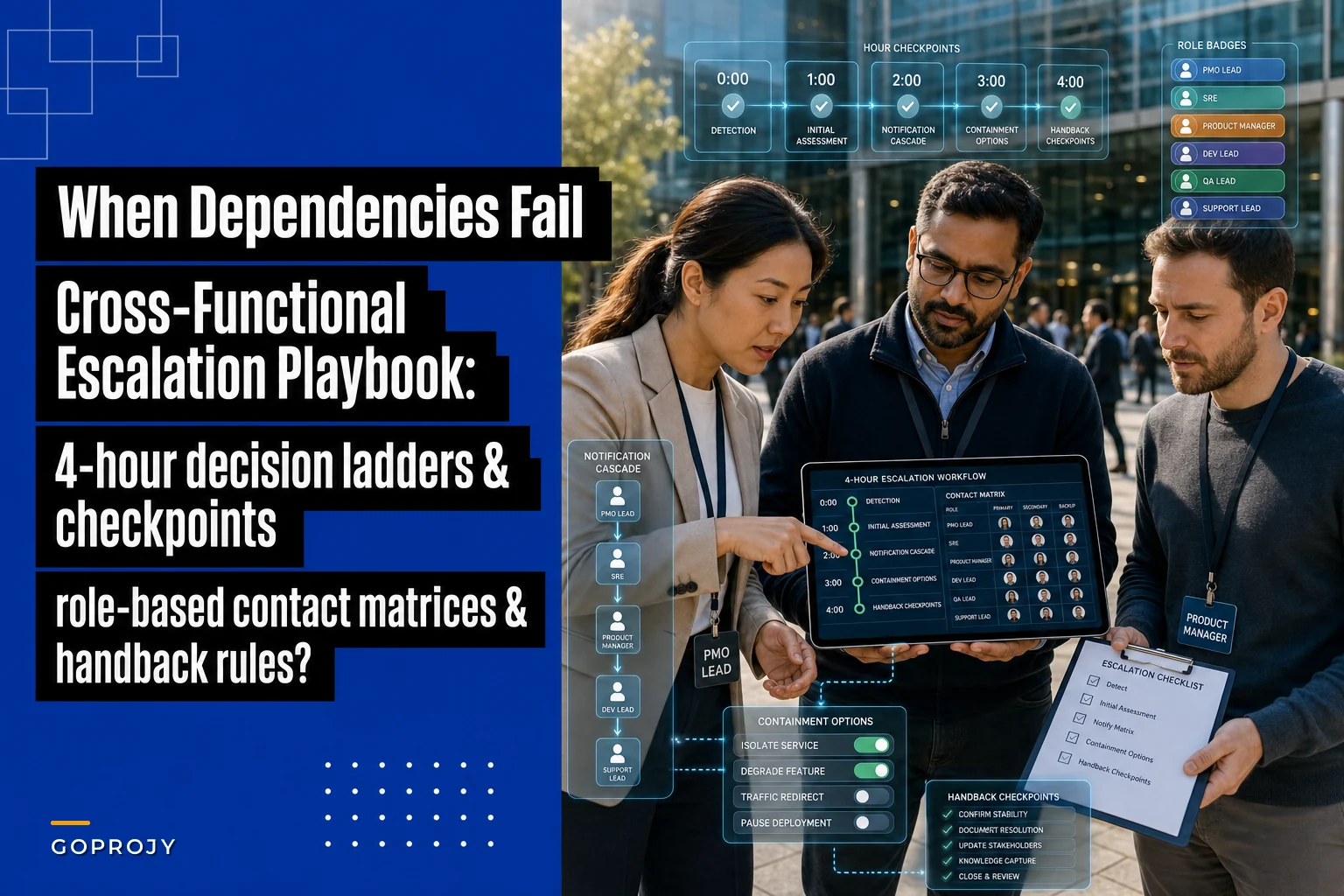
The most effective dependency escalation playbooks center on a simple idea: every confirmed dependency failure triggers a 4-hour decision window with pre-defined checkpoints and escalation paths.
Stop losing track of critical projects.
GoProjy helps you monitor, prioritize, and deliver projects on time—seamlessly.
- Unified portfolio visibility
- Real-time resource tracking
- Milestone & risk alerts
No credit card required
Here's how it works in practice:
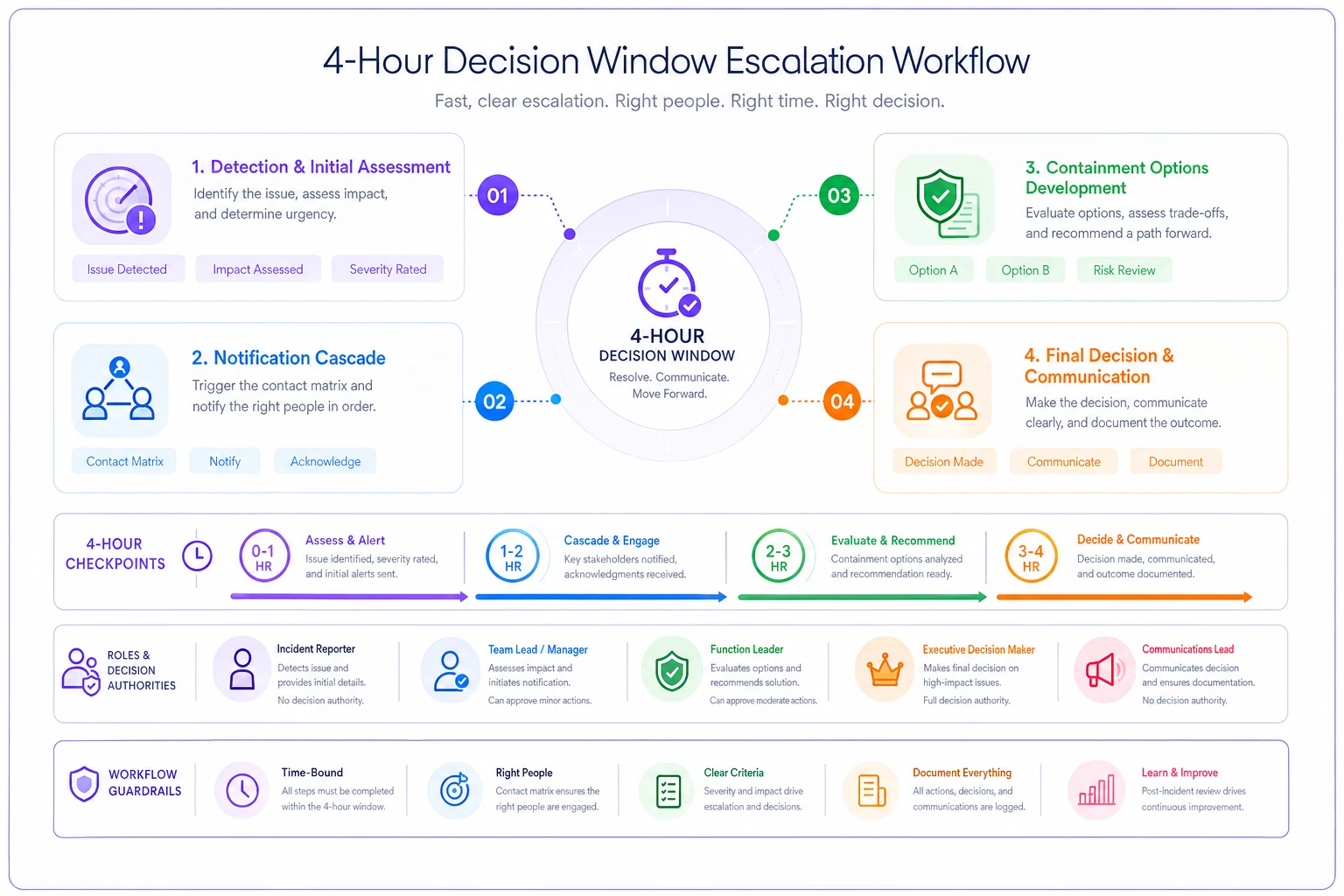
Hour 0–1: Detection and Initial Assessment Once a failure is confirmed—not suspected, confirmed—the owning PM has one hour to complete a rapid impact triage. Not a full analysis. Just enough to answer which projects are immediately blocked, which milestones shift if this isn't resolved within 24 hours, estimated daily burn rate of blocked resources, and what workarounds exist with their rough cost.
Hour 1–2: Notification Cascade Based on the assessment, notifications go out to a pre-defined contact matrix. Not a generic stakeholder list—specific people matched to specific failure types:
| Failure Type | Primary Contact | Secondary Contact | Decision Authority |
|---|---|---|---|
| Vendor delivery slip | Procurement lead | Project sponsor | PMO Director for delays >5 days |
| Technical dependency | Tech lead + Architecture | Product owner | CTO for architecture changes |
| Resource availability | Resource manager | Department head | Portfolio steering for reallocation |
| Compliance/Legal | Compliance officer | Legal counsel | COO for regulatory impacts |
Hour 2–3: Containment Options Development While notifications go out, the project team develops three containment options: continue and absorb the delay with a cost estimate, implement a workaround with a risk assessment, or pause dependent work with defined restart criteria.
Hour 3–4: Decision and Communication The decision authority picks an option. It gets documented—not in a 10-page report, but in a decision log capturing the option selected, rationale, resource reallocation instructions, handback criteria, and a follow-up review date.
Building your dependency escalation playbook PMO standard
Most dependency failures fall into predictable categories. Instead of treating each one as a unique crisis, build pattern-based response templates.
Technical Dependency Failures
These typically involve API deliveries, data migrations, infrastructure provisioning, or integration points.
Trigger Criteria:
-
Delivery misses committed date
-
Technical specification changes after sign-off
-
Performance requirements not met in testing
Role-Based Response Matrix:
-
Technical lead
Owns workaround assessment within 2 hours
-
Enterprise architect
Evaluates alternative technical paths within 4 hours
-
Product owner
Decides on feature scope adjustments if needed
-
PMO lead
Coordinates resource reallocation across affected projects
Sample Containment Decision Tree:
-
Can we use a mock/stub service temporarily? → If yes, implement within 24 hours
-
Can we defer integration to next sprint? → If yes, resequence the backlog
-
Is there an alternative technical approach? → If yes, assess impact within 4 hours
-
Must we delay the milestone? → Calculate minimum viable delay and cascade impacts
Vendor/Third-Party Failures
External dependencies need different escalation paths because you have less direct control over resolution.
Trigger Criteria:
-
Vendor misses contractual delivery date
-
Quality issues require rework
-
Vendor goes unresponsive for 48+ hours
Escalation Ladder:
-
Hour 1
PM contacts vendor account manager
-
Hour 2
Procurement engages vendor relationship manager
-
Hour 4
Legal reviews contract penalties and exit clauses
-
Hour 8
Executive sponsor contacts vendor executive
-
Hour 24
Initiate contingency vendor engagement
Handback Criteria: Define exactly what resolution looks like before you need it—revised delivery date with a daily checkpoint schedule, penalty credits applied, alternative vendor engaged with a transition plan, or internal team formally taking over delivery.
Resource Availability Failures
When key resources drop off unexpectedly—illness, resignation, sudden reallocation—the response has to balance immediate coverage with longer-term capacity impact.
Immediate Response (0–4 hours):
-
Identify critical tasks for the next 48 hours
-
Find temporary coverage from the same skill pool
-
Document knowledge transfer requirements
-
Adjust sprint commitments accordingly
Extended Response (4–24 hours):
-
Evaluate project timeline impact
-
Consider contractor augmentation
-
Reassign work across the team where possible
-
Update portfolio capacity model
Most dependency failures fall into predictable categories. Instead of treating each one as a unique crisis, build pattern-based response templates.
Operationalizing the playbook
Templates alone don't make a dependency escalation playbook usable. It needs to be integrated into how the PMO actually operates week to week.
Weekly Dependency Reviews Every Monday, a 30-minute dependency review covers dependencies with delivery in the next 10 days, anything flagged yellow in the past week, contact matrix updates based on team changes, and playbook activation stats from the previous week. Thirty minutes, same time every week. If it keeps getting skipped, it won't work when you actually need it.
Quarterly Playbook Calibration Every quarter, go back through your escalation patterns. Which triggers fired most often? What was average containment time? Which decisions got reversed or escalated beyond initial authority? What new failure patterns showed up? That data is how you refine triggers, tighten time windows, and keep contact matrices current.
Decision Documentation Standards Every escalation needs documentation, but keep it short. A standard format works better than freeform notes:
``
Dependency: [Project A] Data migration to [Project B] CRM
Failure Type: Technical specification mismatch
Detection Time: Tuesday 14:30
Decision Time: Tuesday 17:45
Decision: Implement temporary data transformation layer
Estimated Impact: 3-day delay, $12K additional development
Handback Criteria: Production data validation complete
Review Date: Thursday 09:00
``
Here's a quick visual you can use to explain the escalation flow to stakeholders.
Keep the weekly dependency review to 30 minutes at the same time to ensure it doesn't get deprioritized.
Over time, this becomes a searchable history of decisions that helps you spot patterns and cut response times.
Common pitfalls in dependency escalation
Over-escalating minor delays. Not every missed handoff needs the full escalation ladder. Set materiality thresholds—delays under 2 days or cost impacts under $5K might only trigger monitoring, not formal escalation.
Under-defining decision rights. "Notify stakeholders" isn't actionable. Your playbook needs to answer specific questions: Can a PM approve a $10K workaround? Can a technical lead change integration approaches without sponsor sign-off? Who can reallocate resources across projects?
Ignoring cumulative impacts. A two-day delay looks minor for one project. Multiply it across five downstream projects and it's not minor anymore. Assessment templates need to capture cascade effects, not just direct impact.
Waiting for perfect information. The 4-hour window forces decisions with roughly 80% of the information you'd want. Waiting for complete analysis usually costs more than making a reasonable call quickly and adjusting as things develop.
Real scenario: Multi-vendor integration program
A financial services PMO managing a 14-project modernization program found out their payment gateway vendor would miss their API delivery by three weeks. The dependency touched four projects with a combined monthly burn rate around $340K.
Hour 1: PM completed impact assessment showing roughly $250K monthly impact after accounting for work that could continue in parallel.
Hour 2: Escalation triggered to vendor management and technical architecture based on the contact matrix.
Hour 3: Team developed three options—wait for the vendor at a 3-week delay and $250K cost, build a temporary mock service for around $40K with some testing limitations, or engage a backup vendor for a $180K change order with a 2-week implementation window.
Hour 4: Portfolio steering chose the mock service option with specific handback criteria for production cutover.
The mock service went live in four days. When the vendor delivered three weeks later, the transition took two days instead of grinding four projects to a halt. What could have been a $750K impact ended up costing around $40K. The playbook made the difference.
Building automation into your escalation workflows
Dependency escalation playbooks that rely entirely on manual tracking and notification are fragile. When people are already stretched thin during an active failure, things slip through. AI-powered operational software can handle milestone monitoring, trigger notifications, and track decisions automatically—which removes a lot of the coordination overhead at exactly the wrong moment.
The useful automation points are dependency milestone monitoring with automatic flag generation, role-based notification routing based on failure type, decision documentation with timestamp tracking, impact calculation using resource allocation data, and handback criteria monitoring with automatic status updates.
When connected to your portfolio health review system, these workflows help ensure failures get contained before they ripple across the portfolio—without requiring someone to manually chase down status at every step.
Moving from reactive to proactive dependency management
Once you have an operational escalation playbook running, patterns start to surface on their own. Which vendors consistently miss deliveries? Which technical dependencies always run late? Which teams struggle with handoffs?
Use that to adjust future planning. If a vendor averages a 10-day slip, build it into the schedule. If two teams consistently need rework on integration handoffs, add a validation checkpoint between them.
Each playbook activation tells you something about your portfolio's vulnerability points. Over time, you'll use it less—not because dependencies stop failing, but because you've built better buffers and alternative paths based on what you've learned. PMOs that contain dependency failures aren't running perfect projects. They just have a response system that kicks in quickly, gets decisions to the right people fast, and forces containment choices before impacts multiply.
Each playbook activation tells you something about your portfolio's vulnerability points. Over time, you'll use it less—not because dependencies stop failing, but because you've built better buffers and alternative paths based on what you've learned. PMOs that contain dependency failures aren't running perfect projects. They just have a response system that kicks in quickly, gets decisions to the right people fast, and forces containment choices before impacts multiply.
Ready to elevate your project delivery?
Join over 2,500 project teams using GoProjy to optimize resources, reduce risks, and drive portfolio success.