


Three months into a digital transformation program, and suddenly everything needs the same database migration completed first. Marketing's CRM upgrade, finance's ERP modernization, and operations' inventory system overhaul—all grinding to a halt because nobody mapped out that they all touch the same customer master data. The PMO director stares at a Gantt chart that looked perfect six weeks ago, watching milestone after milestone slide right.
This isn't a planning failure. It's how dependencies hide until they collide.
The hidden geometry of project dependencies
Most organizations track dependencies the way they track risks—in a spreadsheet somewhere, reviewed occasionally, updated when something breaks. But cross-project dependency mapping requires something fundamentally different than risk registers or issue logs.
Dependencies have directionality, criticality, and timing windows that shift as projects evolve. When you're running fifteen projects simultaneously, each with forty to sixty deliverables, you're managing somewhere between 200 and 400 potential collision points. Traditional project management treats these as bilateral relationships—Project A needs something from Project B. But dependencies form networks with cascading effects that simple bilateral thinking can't capture.
A procurement system upgrade delays because legal needs to finalize vendor contract templates. Legal delays because compliance is restructuring approval workflows. Compliance delays because IT is still implementing the authentication system they need. IT delays because the procurement upgrade hasn't delivered the vendor onboarding module yet. Circular dependencies emerge that nobody saw coming because everyone was looking at their own project plan.
Tracking these dependencies isn't the hard part. Understanding their behavior patterns—and building systems that surface collisions before they happen—that's where most programs fall apart.
Taxonomy matters more than you think
Without a consistent language for dependencies, every project manager describes the same relationship differently. One calls it a "data dependency," another labels it "system integration," a third marks it as "technical prerequisite." When you try to aggregate these across a portfolio, you can't see patterns because the noise drowns out the signal.
Stop losing track of critical projects.
GoProjy helps you monitor, prioritize, and deliver projects on time—seamlessly.
- Unified portfolio visibility
- Real-time resource tracking
- Milestone & risk alerts
No credit card required
A working taxonomy needs three layers:
Dependency type classification:
-
Technical dependencies (system, data, infrastructure)
-
Resource dependencies (people, equipment, facilities)
-
Deliverable dependencies (documents, approvals, outputs)
-
External dependencies (vendors, regulations, customers)
Dependency strength indicators:
-
Hard dependency
Cannot proceed without completion
-
Soft dependency
Can proceed with workarounds but suboptimal
-
Preferential dependency
Better to wait but not required
Dependency timing characteristics:
-
Point dependency
Needed at a specific milestone
-
Continuous dependency
Ongoing requirement throughout a phase
-
Recurring dependency
Needed at multiple points
This feels academic until you realize it drives everything downstream. Hard technical dependencies get different treatment than soft resource dependencies. Point dependencies can be scheduled around; continuous ones need sustained coordination.
| Taxonomy items |
|---|
| Technical dependencies (system, data, infrastructure) |
| Resource dependencies (people, equipment, facilities) |
| Deliverable dependencies (documents, approvals, outputs) |
| External dependencies (vendors, regulations, customers) |
| Hard dependency: Cannot proceed without completion |
| Soft dependency: Can proceed with workarounds but suboptimal |
| Preferential dependency: Better to wait but not required |
| Point dependency: Needed at a specific milestone |
| Continuous dependency: Ongoing requirement throughout a phase |
| Recurring dependency: Needed at multiple points |
One manufacturing company found that roughly 60% of what their teams called "critical dependencies" were actually preferential once they applied a real classification system. Project managers had been marking everything critical because the taxonomy didn't give them better options. Once they had proper classification, they sequenced projects more aggressively and cut overall program duration by about four months.
Visual patterns reveal collision zones
Dependency matrices and network diagrams usually look impressive and communicate nothing. The visualization that actually works combines timeline views with dependency flows, showing where collision zones emerge over time.
Picture a horizontal timeline with projects as swim lanes. Dependencies flow between lanes as curved lines—color-coded by type, thickness-weighted by criticality. Add a vertical line representing "today" moving through time. As that line approaches points where multiple dependencies converge, collision zones become visible weeks before they hit.
The real insight comes from overlaying resource allocation beneath the dependency flows. Suddenly you see that three critical dependencies all need the same technical architect during the same two-week window. Or that four projects expect CFO sign-off during quarterly close.
Pattern recognition happens almost automatically once you visualize dependencies this way. Clusters of lines converging on the same point. Parallel paths that suddenly merge. Circular flows with deadlock potential. These patterns repeat across portfolios, and once you learn to spot them, intervention stops being reactive.
Sequencing rules that actually scale
Most organizations sequence projects based on business priority and assume dependencies will work themselves out. This holds up to around eight concurrent projects. After that, collision frequency exceeds coordination capacity.
Effective sequencing requires a different frame:
First, identify the critical path through your entire portfolio—not individual projects. Which sequence of deliverables across all projects minimizes total duration? This often means starting lower-priority projects earlier because they produce dependencies that higher-priority initiatives need.
Second, implement phase-gating that respects dependency windows. Instead of arbitrary quarterly gates, align phase transitions with dependency completion clusters. If seven dependencies resolve in week 23, that's your natural gate point—not the end of Q2.
Third, build in dependency buffer zones. When multiple projects depend on the same deliverable, add a two-week buffer after planned completion before dependent projects can treat it as ready. This prevents cascade failures when the source project slips by even a few days.
Add a two-week buffer after planned completion before dependent projects can treat it as ready.
A software company running twelve parallel product initiatives reduced collision events by around 75% after implementing these rules. Their lowest-priority project turned out to need an early start because it produced foundation components everything else depended on. Starting it first actually accelerated overall delivery.
The discovery-to-enforcement workflow
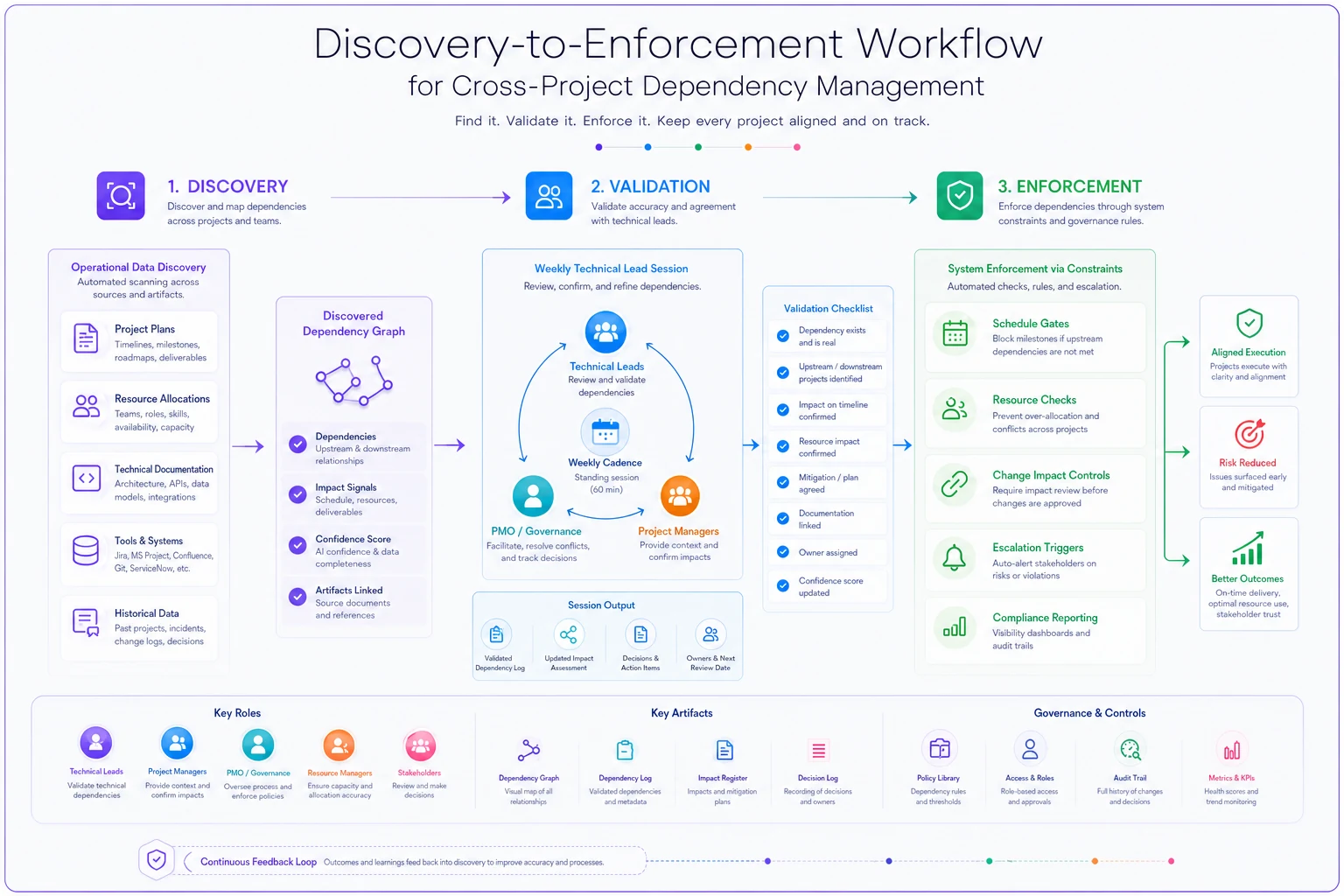
Dependency management breaks down when it relies on project managers to self-report. They're too buried in their own work to keep dependency status constantly updated. You need a workflow that discovers dependencies through operational data, validates through structured review, then enforces through system constraints.
Below is a workflow diagram of the discovery-to-enforcement process.
Discovery phase:
Mine project artifacts for dependency indicators. When project plans reference other projects, when resource allocations overlap, when technical documents mention shared systems—these signal potential dependencies. AI-powered operational software can scan project documentation, meeting notes, and technical specs to surface these patterns continuously, rather than waiting for someone to manually spot them during a quarterly review.
Weekly dependency discovery sessions bring together technical leads—not project managers, but the people actually doing the work—for rapid validation. Show them the discovered dependencies and let them confirm, deny, or clarify. These sessions run about thirty minutes and can prevent thousands of hours of downstream delay.
Validation phase:
-
Both parties agree on the dependency?
-
Timing windows aligned?
-
Deliverable specifications clear?
-
Fallback plan identified?
-
Escalation path defined?
Dependencies that fail validation get flagged for resolution before they can impact schedules. This catches misunderstandings early—Project A thinks they need the final API; Project B thinks they're providing draft specifications.
Enforcement phase:
Validated dependencies become system constraints. Project schedules can't move dependency-linked milestones without triggering review. Resource assignments check dependency windows before allowing allocation. Status reports automatically flag when source projects slip and threaten dependent initiatives.
Enforcement needs real consequences. One organization implemented a simple rule: any project manager who moves a milestone that others depend on must personally notify all affected parties within 24 hours and document mitigation plans within 48 hours. Dependency-driven delays dropped 40% in the first quarter.
Building the operational foundation
The components individually seem straightforward—taxonomy, visualization, sequencing rules, discovery workflow. Making them work together is where it gets harder.
Start with a dependency register that serves as the single source of truth. Not another spreadsheet—a proper database with validation rules, audit trails, and API access. Every dependency gets a unique identifier, standard classification, and an owner.
Build intake processes that capture dependencies at project initiation. Templates that force dependency thinking. Checklists that won't let projects move forward without dependency documentation. Make compliance easier than skipping it.
Create feedback loops that improve the system over time. When collisions happen despite the process, run a root cause analysis. Was it a classification error? A discovery gap? An enforcement failure? Each collision teaches the system something.
Track both leading and lagging indicators:
-
Dependencies discovered per project (leading)
-
Validation completion rate (leading)
-
Collision events per quarter (lagging)
-
Schedule impact from dependencies (lagging)
Track both leading and lagging indicators:
When automation amplifies human judgment
AI-powered operational software changes cross-project dependency mapping from a manual coordination problem into something systematic. The point isn't to replace human judgment—it's to give humans better information faster.
Pattern recognition surfaces dependencies that manual review misses. Natural language processing pulls dependency signals from unstructured documents. Predictive models flag collision probability based on historical patterns. None of this makes decisions; it surfaces information so people can act.
The highest-value automation is in discovery. Scanning through thousands of project documents, meeting transcripts, and technical specs to find dependency indicators would take weeks manually. Automated workflows can do this continuously, flagging potential dependencies as they emerge rather than waiting for a periodic review cycle that's already too late.
Workflow automation also keeps the system running consistently without requiring constant attention. Validation reminders, escalation triggers, and status updates happen on dependency timelines automatically. Project managers spend their time on resolution, not on chasing status.
The integration layer connects dependency management with other portfolio systems—resource platforms check dependency windows before allowing assignments, financial systems link budget releases to dependency completion, risk registers update automatically when dependencies threaten critical paths.
Beyond collision avoidance
The immediate win is fewer milestone collisions. The longer-term value is more interesting.
Organizations with mature dependency mapping make different decisions. They sequence projects based on dependency efficiency rather than just business priority. They identify which capabilities become portfolio bottlenecks and invest in removing them. They spot architectural problems—when every project depends on the same legacy system—and prioritize technical debt accordingly.
Portfolio planning gets more realistic. Instead of optimistic Gantt charts that assume perfect parallel execution, plans reflect actual dependency constraints. This leads to better resource allocation, more accurate budgeting, and stakeholders who actually trust what they're being told.
The cultural shift might matter most. Teams stop thinking in project silos and start seeing the portfolio as a system. They surface dependencies early rather than discovering them mid-execution. They design projects to reduce dependency complexity instead of assuming coordination will sort it out later.
Making it stick
Implementation fails when organizations try to deploy the full system at once. Start with a single program—enough projects to matter, not so many that the complexity overwhelms the new process.
Build the taxonomy first and test it on historical projects. Can you classify past dependencies consistently? Do the categories reveal patterns you hadn't noticed before? Refine until it feels natural.
Add visualization next. Even basic timeline views with dependency flows will surface collision zones you're not currently seeing. Don't worry about real-time updates or system integration yet—weekly manual updates are enough to prove value.
Layer in the discovery workflow once people trust what the visualization shows. Start manual, add validation checkpoints, then implement basic enforcement. Each layer builds on the previous one. Too many organizations buy dependency management tools before they understand their own dependency patterns, then end up bending their process to fit the tool's constraints.
The path forward
Cross-project dependency mapping isn't just about avoiding collisions—it's about understanding how your portfolio actually works versus how you think it works. Every organization has shadow dependencies nobody tracks, circular relationships nobody sees, and collision zones nobody anticipates until they're already in one.
Building a repeatable system requires consistent taxonomy, clear visualization, smart sequencing, and systematic discovery. But more than anything, it requires treating dependencies as first-class portfolio elements rather than things someone will figure out during execution.
The organizations getting this right don't have fewer dependencies. They have better visibility and earlier warning. They see collisions coming weeks or months in advance. They sequence based on dependency logic rather than political priority. They prevent the cascade failures that derail entire portfolios.
Start small, build systematically, and measure what matters. The foundation you build now is what separates portfolios that actually deliver from ones that just have good-looking Gantt charts.
Ready to elevate your project delivery?
Join over 2,500 project teams using GoProjy to optimize resources, reduce risks, and drive portfolio success.