


Vendor governance frameworks sound great on paper. Then reality hits. Your critical path vendor misses their third milestone, your internal team has been sitting idle for two weeks, and the contract language gives you zero leverage beyond strongly worded emails. Meanwhile, finance still releases payments because procurement signed off on vague deliverable definitions that basically say "vendor will do stuff."
This pattern destroys project margins — not because teams don't understand vendor management, but because they build governance structures that look comprehensive without actually creating operational leverage. The spreadsheets are color-coded, the RACI charts are detailed, but when push comes to shove, there's no mechanism to actually change vendor behavior.
Why traditional vendor SLAs fail at the milestone level
Most PMOs inherit procurement contracts written by legal teams who've never run a project. These contracts focus on liability protection and indemnification clauses while completely missing operational reality. The SLA language covers uptime percentages and response times — metrics that matter for ongoing services but are useless for project-based vendor work.
The real breakdown happens at milestone intersections. Your vendor delivers "something" that technically meets the contract description but requires three rounds of rework before your team can actually use it. Or they deliver on time but with undisclosed dependencies, forcing you to scramble for additional resources. The contract says they delivered. Your project schedule says otherwise.
Traditional procurement treats vendor relationships like purchase orders — define the thing, agree on price, wait for delivery. But complex project work doesn't operate that way. Every milestone creates new information that changes downstream requirements. Every integration reveals technical debt nobody anticipated. Every acceptance test uncovers gaps between what was specified and what's actually needed.
The compounding problem is coordination overhead. When vendors operate in their own timeline bubble, disconnected from your internal dependencies, every delay triggers a cascade of replanning. Your technical architect scheduled for integration work gets pulled onto something else. The testing environment reserved for next week gets reallocated. Business stakeholders who cleared their calendars for UAT sessions lose availability.
Building milestone-linked governance that actually works
Effective vendor governance starts with understanding that milestones aren't just delivery dates — they're coordination points that affect your entire portfolio capacity model. Each milestone represents a handoff between vendor work and internal work, and those handoffs need explicit governance structures.
Stop losing track of critical projects.
GoProjy helps you monitor, prioritize, and deliver projects on time—seamlessly.
- Unified portfolio visibility
- Real-time resource tracking
- Milestone & risk alerts
No credit card required
The procurement framework needs three interconnected components: milestone definitions with measurable acceptance criteria, payment structures tied to acceptance (not just delivery), and escalation pathways that trigger before problems become critical.
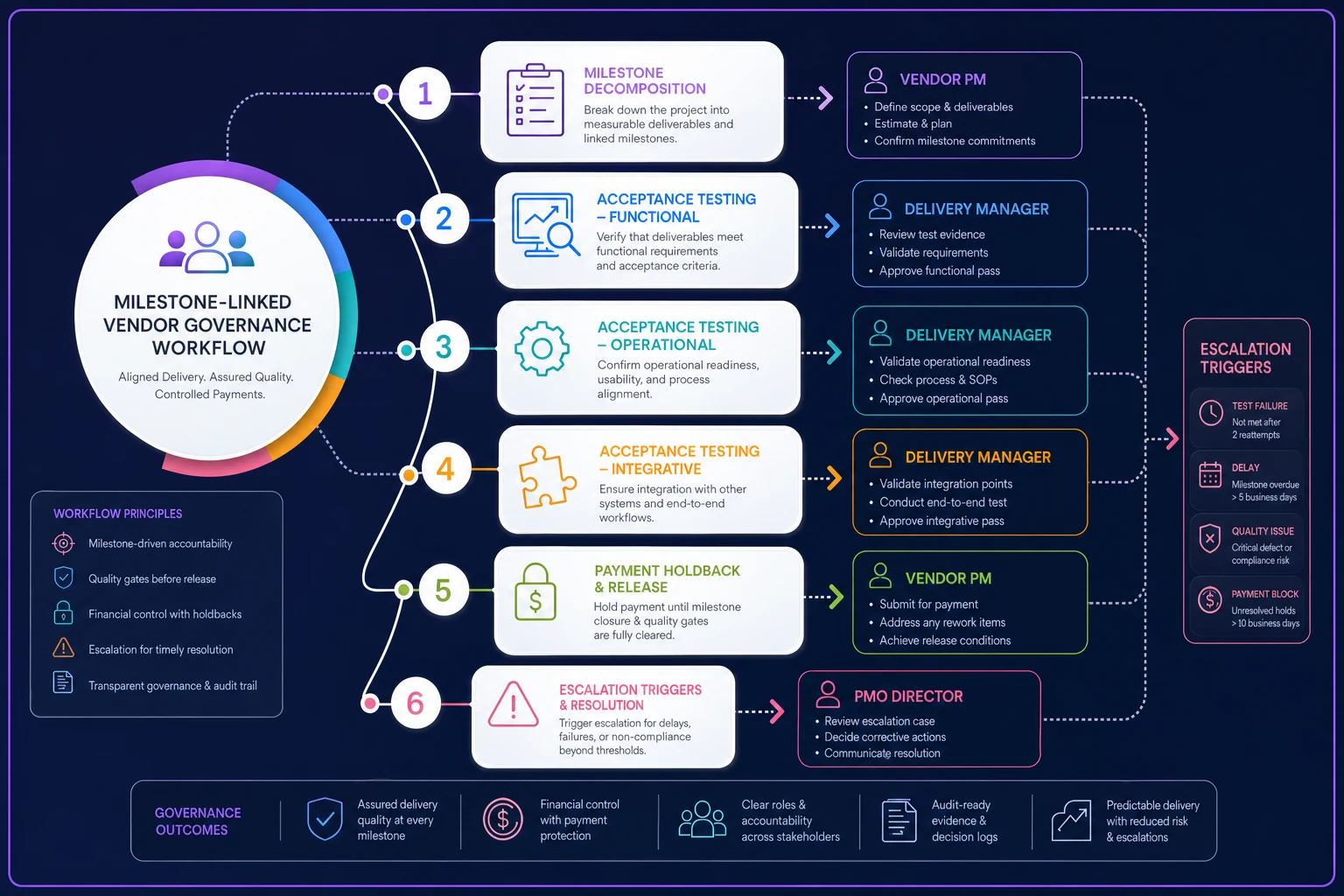
Start with milestone decomposition. Instead of "Phase 1 Complete," define specific deliverables with testable outcomes. For a system integration vendor, this might mean: "Authentication module passes all 47 test cases, API documentation reviewed and approved by technical team, performance benchmarks met under production-equivalent load." Each component gets its own acceptance test, documented before work begins.
Payment structures need teeth. Traditional models pay on delivery or monthly retainers regardless of acceptance. Better models hold back 20-30% of each milestone payment until acceptance criteria pass. The most effective structures use graduated penalties — 5% penalty if acceptance is delayed by vendor issues, 10% if it requires rework, 15% if it blocks dependent work streams.
But penalties alone don't fix delays. You need positive incentives too. Early delivery bonuses — when they don't compromise quality — can shift vendor prioritization. One PMO offered 3% bonuses for milestones completed a week early with zero defects. Suddenly their perpetually late vendor started hitting dates.
The acceptance test framework most PMOs miss
Acceptance testing sounds straightforward until you're arguing with a vendor about whether their delivery meets requirements. The problem usually isn't bad faith — it's ambiguous success criteria defined at contract signing when nobody fully understood the work.
Build acceptance tests in three layers: functional (does it work?), operational (can we use it?), and integrative (does it work with everything else?). Most contracts stop at functional, which is why vendors deliver technically correct but operationally useless outputs.
Document ownership and evidence required for each test layer up front to avoid "waiting for feedback" delays.
Functional tests are table stakes — the thing needs to work as specified. But operational tests determine whether your team can actually use what's delivered. Can your analysts understand the data model? Can operations maintain the system? Does the documentation match your standards? These aren't nice-to-haves; they're prerequisites for the vendor's work to create any value.
Integration tests catch the expensive surprises. The vendor's module works perfectly in isolation but crashes your reporting system. Their API follows standards but doesn't handle your specific edge cases. Their data format is correct but requires transformation steps that add 20 hours of work per month.
Document these test layers in a responsibility matrix. Vendor runs functional tests and provides evidence. Internal technical team validates operational tests within 48 hours of delivery. Integration tests run in staging with both parties present. Clear ownership prevents the endless "waiting for feedback" delays that kill project momentum.
Payment and penalty mechanisms that change behavior
Money talks, but most procurement contracts whisper. Standard payment terms (Net 30 after invoice) give vendors zero urgency. Milestone-based payments help, but without granular mechanisms, you're still playing catch-up after problems occur.
| Component | Details |
|---|---|
| Base milestone payments (70% of total): | Released on delivery, not acceptance. This keeps vendor cash flow healthy while maintaining leverage. |
| Acceptance payments (20% of total): | Released only after all acceptance criteria pass. No partial credit, no "we'll fix it in the next phase" promises. |
| Performance adjustments (±10% of total): | Penalties for delays or rework, bonuses for early or excellent delivery. Calculated based on objective metrics. |
| Holdback pool (10% retained until project end): | Released only if overall project objectives are met. This prevents vendors from front-loading easy work and abandoning difficult integration tasks. |
Document the calculation methodology in detail. "Delay" means acceptance criteria not met within 5 business days of milestone date. "Rework" means acceptance tests failed and required vendor correction. "Integration issues" means the vendor deliverable caused documented problems with existing systems. Remove interpretation room.
Some PMOs worry these structures will scare away vendors or increase bid prices. In practice, good vendors appreciate clear expectations and bad vendors self-select out. The slight premium you might pay upfront is nothing compared to the cost of delayed projects and wasted internal resources.
Escalation ladders that prevent surprise disasters
By the time vendor issues reach executive attention, it's usually too late. The project is months behind, the budget is blown, and switching vendors would delay things even further. Effective escalation ladders catch problems while they're still solvable.
Structure escalations around objective triggers, not subjective judgment calls. First-level triggers are operational: missed check-in, incomplete status report, failed test case. These go to vendor PM and internal PM jointly, requiring response within 24 hours.
Second-level triggers indicate pattern problems: two missed check-ins, acceptance criteria failed twice, dependency not communicated that's affecting other work streams. These escalate to vendor delivery manager and internal program manager, requiring a remediation plan within 48 hours.
Third-level triggers suggest systematic failure: milestone missed by more than 5 days, multiple acceptance test failures, or impact on critical path. These go to vendor account executive and PMO director, triggering contract review and potential penalty enforcement.
The key is making escalation automatic based on data. When a project manager has to decide whether to escalate, they'll usually wait too long, hoping things improve. When the system escalates based on missed checkpoints, problems surface faster.
Create an escalation contact matrix with names, roles, phone numbers, and response SLAs for each level. Update it quarterly — nothing worse than escalating to someone who left the vendor company six months ago. Include timezone and working hours for global vendors. Document who can make which decisions: payment holds, scope changes, resource additions, contract modifications.
Role clarity in vendor governance operations
Vendor governance fails when everyone assumes someone else is handling it. The project manager thinks procurement owns the contract. Procurement thinks legal owns enforcement. Legal thinks the PMO owns operational management. The vendor does whatever they want while internal teams point fingers.
-
Vendor Relationship Owner Usually from procurement or PMO, owns the commercial relationship, contract modifications, and escalation management. Not involved in daily delivery but steps in when structural issues arise.
-
Delivery Accountability Lead From the project team, responsible for milestone acceptance, test coordination, and daily vendor management. Can't modify contracts but can trigger escalations and payment holds.
-
Technical Validation Lead From IT or the technical team, owns acceptance testing, integration validation, and technical requirement interpretation. Has veto power over milestone acceptance but can't direct vendor work.
-
Financial Controller From finance or PMO, manages payment processing, penalty calculations, and budget impact assessment. Executes payment decisions but doesn't make them unilaterally.
-
Business Outcome Owner From the business unit, validates that vendor deliverables actually solve business problems. Doesn't manage vendor relationships but has final say on acceptance from a business value perspective.
Each role needs documented decision rights and boundaries. The Delivery Lead can hold payments but can't waive penalties. The Relationship Owner can modify payment terms but can't accept deliverables. The Technical Lead can reject deliverables but can't change requirements. Clear boundaries prevent both gaps and overlaps.
Example contract language that creates real leverage
Theoretical frameworks mean nothing without contractual teeth. Here's language that actually works — adapt for your legal context:
For milestone definition: "Milestone X is considered complete only when: (a) all deliverables listed in Appendix B are provided, (b) deliverables pass acceptance criteria defined in Appendix C, (c) integration tests defined in Appendix D complete successfully, and (d) Client provides written acceptance within 5 business days of successful testing."
For payment terms: "Vendor payment for Milestone X consists of: Base Payment (70% of milestone value) invoiceable upon deliverable submission; Acceptance Payment (20%) invoiceable only after written acceptance; Performance Payment (10%) subject to adjustment based on Schedule A metrics. Payment delay does not constitute acceptance."
For acceptance testing: "Client will complete acceptance testing within 5 business days of deliverable receipt. Testing consists of: functional validation against requirements, operational validation against use cases, integration validation against system dependencies. Vendor must remedy failed tests within 3 business days or face penalties per Schedule B."
For penalties: "Milestone delays attributable to Vendor will result in: 5% penalty for 1-5 days delay, 10% penalty for 6-10 days delay, 15% penalty for 11+ days delay. Additionally, Client may withhold all Performance Payments until delayed milestone achieves acceptance. Penalties are deducted from next invoice, not requiring separate payment."
For escalation: "Issues are escalated per Appendix E contact matrix when: Level 1 (missed checkpoint or single test failure), Level 2 (pattern of issues or multiple failures), Level 3 (milestone delay exceeding 5 days or critical path impact). Vendor must respond within SLAs defined in Appendix E or face additional penalties."
Avoid vague language that lawyers love but operators can't use. "Reasonable efforts" means nothing. "Best practices" is undefinable. "Timely manner" is a lawsuit waiting to happen. Every requirement needs objective measurement criteria.
Integration with broader PMO operations
Vendor governance can't exist in isolation from your other PMO processes. Vendor delays affect resource allocation, milestone slippage impacts portfolio sequencing, and acceptance failures can trigger replanning across multiple projects. The governance framework needs to feed into your broader operational systems.
Connect vendor milestones to your resource capacity planning. When a vendor delay pushes out integration work, your architects need to know immediately so they can be reallocated. When acceptance testing fails, your test team needs schedule adjustments. Build these connections into escalation triggers — vendor delays automatically flag resource conflicts in your capacity model.
Link vendor performance metrics to portfolio reporting. Executive dashboards showing green project status while vendor deliverables fail acceptance creates dangerous blind spots. Include vendor health indicators in your portfolio reviews: acceptance pass rates, average delay days, penalty enforcement frequency. These leading indicators predict future project issues before they hit critical path.
Vendor-related risks need specific attention in your risk register. Generic "vendor delay" risks are useless. Specific risks like "Payment processor integration vendor has failed 2 of last 3 acceptance tests" drive action. Track vendor performance patterns across projects — a vendor who consistently delivers late on one project will likely do the same on others.
The coordination overhead of vendor management often exceeds what people expect. Every status meeting, every escalation call, every rework cycle burns internal resources. Track this overhead as part of total vendor cost. Some organizations discover they're spending close to 40% of the vendor contract value on internal coordination alone. That kind of visibility changes how future contracts get structured.
The operational reality after implementation
Building this framework is just the start. The real challenge is operationalizing it when your organization has muscle memory for loose vendor management. Start with new contracts — it's easier to establish expectations fresh than modify existing relationships. Pick a critical vendor with an upcoming renewal and pilot the full framework. Use what you learn to refine things before broader rollout.
Training matters more than documentation. Your project managers need to understand how to run acceptance tests, not just that they exist. Your procurement team needs to know why specific language matters, not just copy templates. Run scenario workshops where teams practice escalation triggers and penalty calculations before they're dealing with a real vendor dispute.
The first few penalty enforcements will test organizational resolve. Vendors will push back, claim unfairness, threaten relationship damage. This is where executive alignment matters. If leadership caves at the first vendor complaint, the whole framework collapses. Document everything, follow the process, and let the contract language do its job.
You'll also discover gaps in your own organization. That acceptance test that seemed clear reveals internal disagreement about requirements. The escalation that should trigger automatically gets stuck because nobody updated the contact matrix. The penalty calculation that looked simple requires three meetings to interpret. Treat these as process improvements, not failures.
Vendor governance as competitive advantage
Strong vendor governance isn't about being tough on vendors — it's about creating clarity that helps everyone succeed. Good vendors appreciate clear expectations and objective success criteria. They can price appropriately, resource effectively, and deliver confidently when they know exactly what's required.
This framework might seem elaborate compared to traditional procurement approaches. But consider the alternative: projects derailed by vendor delays, resources wasted on rework, teams demoralized by preventable failures. A few hours investing in proper milestone definition and acceptance criteria saves weeks of project delays and coordination overhead.
This also isn't a one-time implementation. Vendor patterns evolve, project complexity increases, and new failure modes emerge. The PMOs that handle vendor governance well treat it as a continuous improvement discipline — tracking metrics, identifying patterns, and refining based on operational reality rather than theoretical best practices.
The goal isn't perfect vendor performance. That's unrealistic. The goal is predictable vendor performance with clear remediation paths when things go wrong. When vendor delays become visible, measurable, and manageable, they stop being project killers and become normal operational variance you can actually plan around.
That's the real competitive advantage — not hoping vendors deliver, but actively managing delivery through systematic controls that make the outcome far less dependent on luck.
Ready to elevate your project delivery?
Join over 2,500 project teams using GoProjy to optimize resources, reduce risks, and drive portfolio success.