


Post-MVP is where the real chaos starts. You've shipped, you've got some traction, maybe 50–100 paying customers, and suddenly everyone has opinions about what to build next. Sales wants that enterprise feature yesterday. Support is drowning in quality-of-life requests. Your biggest customer is threatening to churn without some integration. And you're burning through runway while needing to show growth to investors in three months.
The standard advice is to use a prioritization framework — RICE scores, value vs. effort matrices, whatever. But these frameworks fall apart when you're trying to map actual dollars to actual work slots with a team of five people who all wear multiple hats.
After MVP ships, prioritization gets expensive fast
Post-MVP is where the real chaos starts. You've shipped, you've got some traction, maybe 50–100 paying customers, and suddenly everyone has opinions about what to build next. Sales wants that enterprise feature yesterday. Support is drowning in quality-of-life requests. Your biggest customer is threatening to churn without some integration. And you're burning through runway while needing to show growth to investors in three months.
The standard advice is to use a prioritization framework — RICE scores, value vs. effort matrices, whatever. But these frameworks fall apart when you're trying to map actual dollars to actual work slots with a team of five people who all wear multiple hats.
Small teams need something different. Not another scoring system, but a way to connect priority scores to funding tranches, work slots to acceptance criteria, and strategic initiatives to concrete budget allocations. This matters most when you're operating with limited runway and every sprint has real consequences.
Why traditional prioritization breaks at the post-MVP stage
Traditional portfolio management assumes dedicated resources, clear ownership, and predictable capacity. Post-MVP teams have none of that. Your backend engineer also handles DevOps. Your PM doubles as customer success. Your designer codes the frontend when things get tight.
Stop losing track of critical projects.
GoProjy helps you monitor, prioritize, and deliver projects on time—seamlessly.
- Unified portfolio visibility
- Real-time resource tracking
- Milestone & risk alerts
No credit card required
Traditional frameworks also assume you can evaluate initiatives in isolation. Post-MVP, everything is connected. That authentication improvement touches the API refactor which blocks the enterprise features which enables the pricing change which funds the next quarter of development.
The funding piece gets even messier. You're not working with annual budgets. You're working with whatever's left after payroll, trying to stretch runway while showing enough progress to raise the next round or hit profitability. Every feature decision is also a financial decision.
The post-MVP teams that survive this phase tend to share one thing: a systematic way to connect limited funding to specific work slots, with clear gates that determine what gets built and what gets killed. They don't just prioritize — they slot work into funded buckets with explicit acceptance criteria.
Building a cost-impact-strategic weight matrix that actually works
The matrix needs three core dimensions that map to post-MVP reality.
Cost isn't just developer hours. It's opportunity cost, operational overhead, and ongoing maintenance burden. A two-week feature that requires monthly manual data exports costs more than a three-week feature that runs itself.
Impact has to be measurable within the timeframe that actually matters. If you have six months of runway, a feature that pays off in month seven is worthless. Impact should map to customer retention changes, support ticket reduction, sales cycle acceleration, or direct revenue increase within your planning horizon.
Strategic weight captures the stuff that doesn't show up in immediate metrics but determines whether you have a business in 12 months. Platform stability, technical debt, market positioning, competitive differentiation.
| Initiative | Dev Weeks | True Cost | 3-Month Impact | Strategic Weight | Composite Score |
|---|---|---|---|---|---|
| SSO Implementation | 3 weeks | $18k + ongoing auth complexity | 2 enterprise deals ($8k MRR) | Opens enterprise segment | 8.2 |
| Onboarding Automation | 2 weeks | $12k + 1 week QA | Reduce churn 15% (~$3k MRR saved) | Improves activation metrics | 7.1 |
| API Rate Limiting | 1 week | $6k | Prevent 2 outages/month | Platform stability | 6.8 |
| Mobile App MVP | 8 weeks | $48k + App Store overhead | Unknown, customers asking | Market expectation | 4.2 |
| Custom Reporting | 4 weeks | $24k + ongoing support burden | Keep largest customer ($5k MRR) | Sets bad precedent | 5.9 |
The composite score formula should weight based on your situation. If you're raising in 3 months, strategic weight goes up. If you're bootstrapping to profitability, immediate impact dominates. The point is making those weights explicit rather than leaving them floating in leadership's heads.
Mapping initiatives to funding slots with concrete constraints
This is the part most frameworks skip entirely: actually slotting work into fundable chunks that match your reality.
Post-MVP teams typically operate with three funding constraints:
-
Runway preservation
Can't commit more than X% of remaining runway to any single initiative
-
Resource capacity
Can't parallelize work that requires the same person
-
Operational overhead
Can't take on work that meaningfully increases burn rate
These constraints create natural funding slots. With 4 months of runway at $50k/month burn, you might have:
-
Critical slot
Up to 15% of remaining runway (~$30k) for must-have work
-
Growth slot
Up to 10% of runway (~$20k) for revenue-driving features
-
Foundation slot
Up to 5% of runway (~$10k) for platform and tech debt work
-
Experimental slot
Up to 3% of runway (~$6k) for quick bets
Work gets slotted based on both score and fit. That SSO implementation might score highest, but if it ties up your only backend engineer for 3 weeks, you need to make sure nothing else critical breaks during that window.
create an image depicting the workflow of evaluating initiatives, mapping them to funding slots, checking resource conflicts, and executing weekly gate reviews for a small post-MVP product team
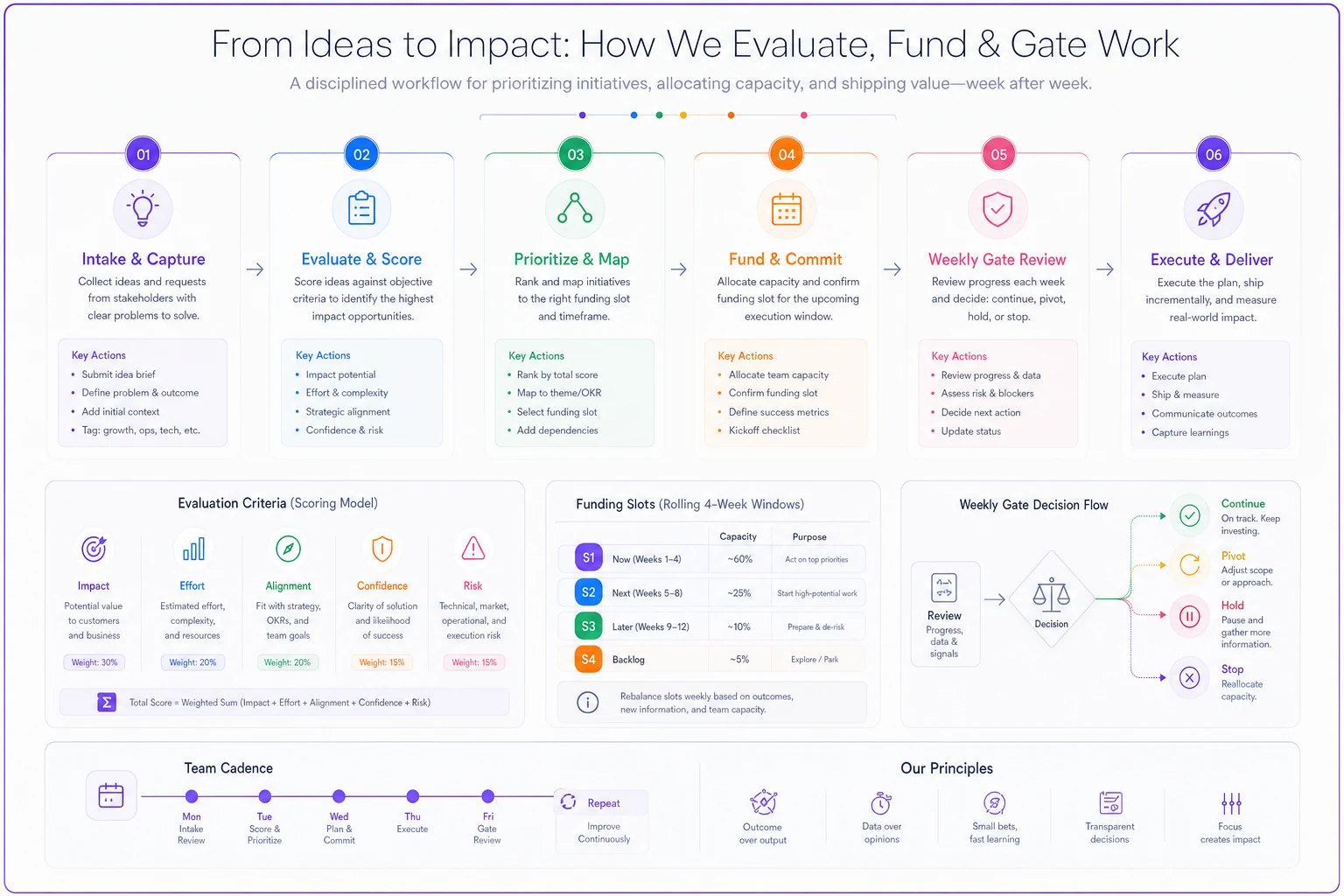
This visual shows how scoring, slotting, and gates interact so teams can make quick, money-aware decisions.
Creating acceptance gates that prevent scope creep
Every slotted initiative needs hard gates that determine whether it continues, pivots, or dies. Post-MVP teams can't afford to let projects drift.
Week 1 Gate (Feasibility)
-
Technical approach validated
-
No blocking dependencies discovered
-
Cost estimate still valid (+/- 20%)
-
Continue or kill decision
Mid-point Gate (Progress)
-
Core functionality demonstrable
-
On track for timeline
-
No scope expansion beyond 10%
-
Continue, descope, or extend decision
Pre-launch Gate (Value)
-
Acceptance criteria met
-
Customer validation completed
-
Operational handoff ready
-
Launch or iterate decision
The gates need teeth. One rule that works well: if an initiative fails a gate, its remaining budget immediately moves to the next item in queue. No negotiations, no "just one more sprint." It forces realistic planning and honest mid-project assessment.
Real examples of slotting decisions from actual post-MVP teams
Example 1: B2B Analytics Platform (6-person team, 5 months runway)
Three competing priorities: multi-tenant architecture ($25k, 4 weeks), CSV export feature ($8k, 1 week), and performance optimization ($15k, 2.5 weeks).
Traditional scoring said do multi-tenant first. But their funding slots revealed a real problem — multi-tenant would consume 50% of technical capacity for a full month, blocking everything else. Instead, they slotted:
-
CSV export into Critical slot (kept an enterprise customer)
-
Performance optimization into Foundation slot (cut AWS costs by roughly $2k/month)
-
Multi-tenant into next quarter's Growth slot (after closing Series A)
They extended runway by around 2 months through cost savings and retained revenue, then closed funding with better metrics than they'd have had following the initial scoring.
Example 2: Developer Tools Startup (4-person team, 3 months runway)
Classic post-MVP dilemma: build for enterprise or double down on self-serve growth.
The slotting exercise surfaced something important — they couldn't actually do enterprise properly with their current team. The real cost wasn't just development. It was sales cycles, security audits, and support overhead they simply didn't have capacity for. So they slotted:
-
Self-serve onboarding improvements
Growth slot ($15k)
-
Documentation overhaul
Foundation slot ($5k)
-
Community features
Experimental slot ($4k)
Staying disciplined kept them focused on sustainable growth rather than chasing enterprise deals they couldn't support.
When to adjust slots and reallocate funding
Slots aren't static. They should shift based on three triggers.
Runway changes: If you close a big customer or lose one, recalculate slot sizes immediately. A 20% runway increase might open up a new experimental slot or expand the growth slot.
Velocity changes: If you're consistently delivering under budget, you can expand slots. If you're consistently over, shrink them. Track this monthly, not quarterly.
Strategic shifts: Market feedback, competitive moves, or investor input might require wholesale reallocation. Make these shifts explicit through a portfolio health review rather than letting them happen organically and quietly.
Document what triggered the change, what moved between slots, and what the new acceptance criteria are. The common failure mode here is constantly shifting priorities in ways that demoralize the team without anyone actually naming the shift.
Building your own small team roadmap slotting template
Start here and adapt as needed:
-
Define your slots — Calculate total available funding (runway × acceptable burn %), divide into 3–5 slots based on strategic priorities, assign hard dollar limits to each slot
-
Score your backlog — List everything people are asking for, score on cost, impact, and strategic weight, be honest about real costs including maintenance burden
-
Slot the work — Start with highest scores, check for resource conflicts, verify totals don't exceed slot limits, document what didn't make the cut and why
-
Set gates — Define 2–3 gates per initiative, make gates objective and measurable, specify what happens when a gate fails
-
Track and adjust — Weekly gate reviews, monthly slot reallocation check, quarterly strategy alignment
This connects to broader portfolio allocation frameworks but stays simple enough that a small team can actually run it without a dedicated ops person.
Common pitfalls in post-MVP prioritization
The everything-is-critical trap: Post-MVP, everything feels urgent. Customers threatening to leave, investors asking questions, team morale tied to shipping wins. The slotting framework forces you to acknowledge that critical doesn't mean unlimited. Even critical work has to fit in the critical slot budget.
The big bet fallacy: Small teams often convince themselves they need one killer feature to change everything, then funnel all resources into it. Post-MVP success usually comes from a lot of small improvements compounding. Slots make it harder to go all-in on a single initiative.
Acceptance criteria inflation: Teams start with clear gates then gradually make them fuzzier to avoid killing projects. "Core functionality demonstrable" becomes "design mostly finalized." Write specific, measurable criteria upfront and don't renegotiate them mid-project.
The sunk cost spiral: Two weeks spent doesn't mean you should spend two more. That's exactly what gates are for. If something fails mid-point, those two weeks are gone — but you save the next two.
Making acceptance gates work in practice
Gates fail when they become bureaucratic box-checking rather than real decision points. For small teams, they need to be lightweight but firm.
-
Reviews under 30 minutes
-
One person makes the call (usually founder or CTO)
-
Decision documented in a single sentence
-
Immediate move to next priority if something fails
A passing gate looks like: "SSO implementation week 1 gate: Technical approach validated with Auth0, no blockers, estimate holds. Continue."
A failing gate looks like: "SSO implementation week 1 gate: Azure AD complexity doubles the timeline. Killed. CSV export moves from queue to active."
No extended discussions. No committee. No "let's revisit next week."
Connecting slots to sustainable growth
The ultimate goal isn't just surviving post-MVP — it's getting to sustainable growth. The slotting framework helps by building in regular reality checks.
Every month, ask whether you're shipping work that measurably improves your numbers, whether burn rate is declining relative to growth, and whether you're building platform capabilities or just features.
The slotting data gives you concrete answers. If your Growth slot keeps delivering less than projected, you might need to shift toward Foundation work that enables better growth later. If Experimental slots keep working, maybe expand that allocation.
Teams that run this consistently tend to extend runway significantly — not through one brilliant decision, but through dozens of small, well-slotted decisions that compound over months.
The operational reality of small team prioritization
Post-MVP prioritization isn't about finding the perfect scoring formula. It's about connecting the money you have to the work that needs doing in a way that everyone understands and accepts.
The cost-impact-strategic weight matrix gives you a systematic way to evaluate options. Funding slots create realistic constraints that prevent overcommitment. Acceptance gates keep you from throwing good money after bad. Together, they form a small team roadmap slotting template that actually holds up when things get messy.
Most importantly, this approach takes post-MVP reality seriously: limited resources, real urgency, and decisions that need to happen in minutes not days. It fits in a spreadsheet, updates weekly, and doesn't require a dedicated product operations hire.
The teams that make it through this phase aren't necessarily the ones with the best product or the most funding. They're the ones who got systematic about allocating limited resources to work that matters, killing work that doesn't, and maintaining velocity even when everything feels urgent. That's what the slotting template actually does — not perfect progress, but steady, fundable progress that gets you to the next stage.
The cost-impact-strategic weight matrix gives you a systematic way to evaluate options. Funding slots create realistic constraints that prevent overcommitment. Acceptance gates keep you from throwing good money after bad. Together, they form a small team roadmap slotting template that actually holds up when things get messy.
Most importantly, this approach takes post-MVP reality seriously: limited resources, real urgency, and decisions that need to happen in minutes not days. It fits in a spreadsheet, updates weekly, and doesn't require a dedicated product operations hire.
Ready to elevate your project delivery?
Join over 2,500 project teams using GoProjy to optimize resources, reduce risks, and drive portfolio success.