



Most PMO rollouts don't fail because the framework was wrong. They fail because six months later, only three project managers are logging risks in the shared register, half the portfolio still runs on someone's personal spreadsheet, and the steering committee is reading status decks assembled the night before by copy-pasting from Slack.
Adoption is the quiet killer. You can have a beautiful governance model, well-designed gates, a clean KPI schema — and none of it matters if people route around it. And the thing nobody wants to admit is that adoption isn't really a training problem or a comms problem. It's a sequencing problem. You're asking people to change how they work, and change that lands all at once, everywhere, tends to bounce off.
This is a PMO adoption playbook built around time-boxed rollout sprints — pilot, embed, scale — with the messy operational parts spelled out: who actually owns what, who quietly influences whether it sticks, what you measure, and how you keep it alive after the launch buzz fades.
Why big-bang rollouts collapse under their own weight
The default instinct when you've spent months designing a new PMO operating model is to launch it broadly. Kickoff email, mandatory training session, new templates dropped into everyone's drive, a go-live date. It feels efficient. It's the opposite.
When you push a new process to 40 project managers simultaneously, you generate 40 slightly different interpretations, 40 sets of edge cases you didn't anticipate, and a support load nobody staffed for. The PMO lead becomes a full-time help desk for two weeks, the early confusion gets read as "this new system is broken," and momentum dies before anyone forms a habit.
There's also a coordination trap. A new adoption effort touches intake, reporting, resourcing, and finance handoffs all at once. Each of those has its own stakeholders and its own downstream dependencies. Roll everything out together and you can't tell which part is failing — the intake form nobody fills in, or the reporting cadence nobody follows, or the resource view finance doesn't trust. You've bundled five experiments into one and lost the ability to learn from any of them.
Time-boxed sprints solve this by shrinking the blast radius. You prove the thing works with a small group, fix what breaks while it's still cheap to fix, then expand deliberately. The point isn't speed for its own sake — each sprint gives you a clean signal about what's working before you spend political capital scaling it.
If you're building or reshaping the broader model this adoption effort sits inside, it's worth reading what high-growth PMOs get right about operating-model design alongside this — adoption is where a good operating model either takes root or quietly dies.
The three sprint phases, and what "done" means for each
The rollout runs in three phases. Each is time-boxed, each has an exit condition, and you do not advance until the exit condition is met. That last part matters more than the phases themselves. Teams love the pilot → embed → scale language and then ignore the gates, which turns the whole thing back into a big-bang rollout wearing a costume.
Stop losing track of critical projects.
GoProjy helps you monitor, prioritize, and deliver projects on time—seamlessly.
- Unified portfolio visibility
- Real-time resource tracking
- Milestone & risk alerts
No credit card required
| Phase | Duration | Scope | Exit condition |
|---|---|---|---|
| Pilot | 2–3 weeks | 1 team, 3–5 projects | Core workflow used unassisted; blocking issues logged and triaged |
| Embed | 4–6 weeks | 1 department / 8–12 projects | Adoption KPIs hit target for two consecutive weeks; reinforcement routine running |
| Scale | 6–10 weeks, staggered | Full portfolio, wave by wave | Each wave reaches embed-level adoption before the next wave starts |
Pilot is where you find out if the design survives contact with real work. Pick a friendly-but-honest team — not your biggest fans, and not your loudest skeptics. You want people who'll use it seriously and tell you what's annoying. The goal isn't perfect adoption; it's a clean list of what breaks and a workflow someone can run without you sitting next to them.
Embed is the hardest phase and the one people rush. This is where a single group moves from "using it because we're the pilot" to "this is just how we work now." If it doesn't become habitual here, scaling it just spreads a fragile process across more people. The exit condition is deliberately strict — two consecutive weeks of hitting adoption targets — because one good week is often just novelty.
Scale is staggered on purpose. You roll out in waves, and each wave has to reach embed-level adoption before the next one opens. This feels slow. It's actually the fastest reliable path, because a stalled wave doesn't contaminate the ones behind it, and each successful wave produces internal proof and internal champions for the next.
RACI is table stakes. The influence map is where adoption actually lives.
Everyone builds a RACI for a rollout. Responsible, Accountable, Consulted, Informed — clean, official, useful for settling arguments about who signs off. But a RACI describes the org chart's version of reality, and adoption doesn't happen on the org chart.
In practice, the person who determines whether a new process sticks is often not the accountable manager. It's the senior PM everyone quietly copies. It's the resource coordinator who's been doing status the old way for six years and whose opinion carries more weight than any memo. When those people shrug, adoption dies no matter what the RACI says.
So you build two maps.
The RACI covers the formal machinery: who owns the rollout, who approves changes to the process, who gets consulted on gate definitions, who needs to be kept informed. Standard stuff, and you do need it.
The influence map is separate and more honest. It answers: for each team, who actually shapes behavior? You're looking for:
-
The informal standard-setters — people others imitate without being told to
-
The blockers — people with enough credibility that their skepticism spreads
-
The connectors — people who talk across teams and carry sentiment between them
-
The quiet supporters — people who'll champion it if asked but won't volunteer
The biggest adoption risk is usually a respected blocker who was never consulted during design. They find out about the change the same way everyone else does, feel steamrolled, and — often without even meaning to — become the source of "this is a waste of time." You prevent this by mapping influence before the pilot and pulling key influencers into the design conversation early. Consulted status on the RACI and a real seat at the table aren't the same thing, and influencers can smell the difference.
A quick visual to show the workflow:
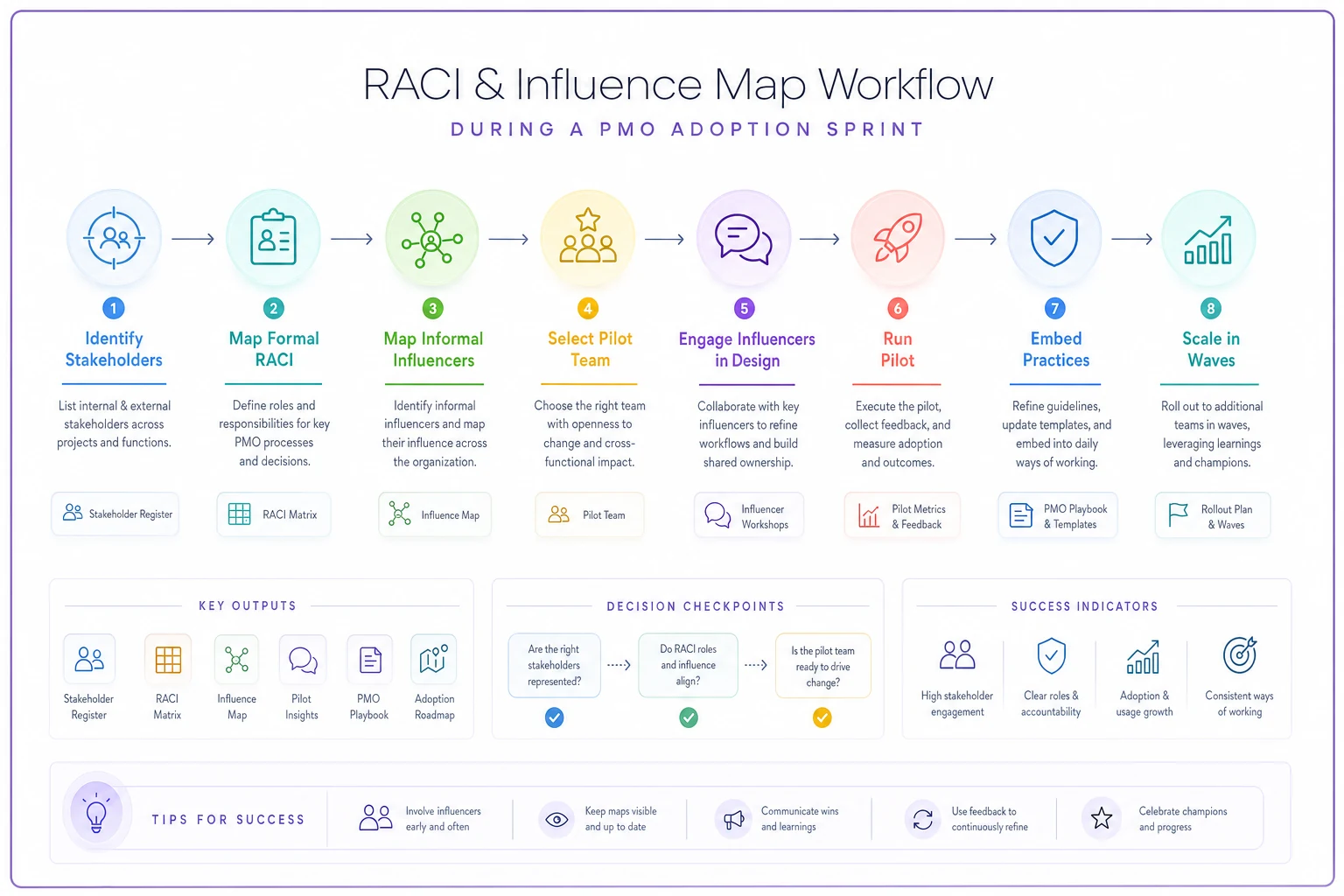
Use this to keep conversations concrete — point to a step when someone asks why an influencer was engaged or when a pilot issue needs escalation.
Adoption KPIs that mean something (and the vanity ones to skip)
You can't manage adoption on vibes, but most adoption metrics are noise. "Number of logins" tells you people opened the tool, not that they did anything useful. "Training completion rate" tells you they clicked through slides. Neither predicts whether the process survives.
-
Workflow completion rate — percentage of active projects where the core workflow (say, weekly status + risk update) was completed on time, without a chase. Chasing is the tell. If your PMO team is manually reminding people, adoption isn't real yet.
-
Unassisted usage — percentage of process actions completed without support tickets or someone asking "how do I…". This should climb across the pilot and plateau high by end of embed.
-
Data freshness — how old the portfolio data is at the moment a decision gets made. If the steering committee is looking at status that's five days stale, the process isn't feeding decisions, which means it'll get abandoned.
-
Rework rate — how often submitted data has to be corrected or reformatted. High rework signals the templates or definitions are confusing, and confusion is where adoption leaks.
-
Voluntary reference — how often people cite the PMO data in their own conversations without being prompted. Soft, but it's the strongest signal that the process has moved from imposed to owned.
Set targets per phase, not one global number. Pilot might aim for 70% workflow completion; embed's exit condition might be 90% for two straight weeks. And watch the trend more than the absolute value — a metric climbing week over week during embed is healthier than a flat high number that turns out to be three keen people carrying everyone else.
One trap: don't measure so much that measurement itself becomes a burden. If tracking adoption requires the PMO team to spend hours assembling reports, you've recreated the very manual overhead you were trying to eliminate. Pull the signals from where the work already happens.
Micro-training beats the two-hour workshop every time
The mandatory training session is one of the most reliably wasted hours in a rollout. People sit through a walkthrough of a system they haven't used yet, on work that isn't theirs, retain almost nothing, and go back to their actual jobs where the new process feels foreign the first time they hit it for real.
-
The 10-minute task drill. One workflow, one live example from the person's own project, done together, then they do the next one solo while you watch. No slides. This single change usually cuts support questions more than any documentation effort.
-
The 5-minute reinforcement clip. Short screen recordings of "how to do X" that live where the work happens, so people self-serve instead of interrupting a teammate. Keep each one to a single task.
-
The peer walk-through. During embed, have a pilot-phase PM run the drill for a new team member. Peers teaching peers builds the "this is just how we work" norm far faster than PMO staff doing it.
-
The office-hours slot. A recurring 30-minute drop-in during embed for the sticky questions. Attendance dropping over time is a good sign — it means the questions are running out.
Run the 10-minute task drill during an existing team meeting so it attaches to real work and attendance stays high.
The underlying principle: training should attach to real work, in small doses, spaced over time. Teams that front-load all their training see a spike of confidence followed by a crash when the details are forgotten. Teams that space small doses across the embed phase build slower but keep it.
Reinforcement: the part everyone skips, and why it kills rollouts
The launch is the easy part. The failure almost always happens four to eight weeks later, when the novelty is gone, the PMO lead has moved on to the next initiative, and there's no active pressure keeping the new behavior in place. People drift back to the old way one exception at a time, and by the time anyone notices, the drift is the norm again.
Reinforcement routines are what hold the line. Lightweight, boring, and absolutely essential:
-
A weekly adoption check during embed and early scale — a five-minute look at the KPIs, flagging any team sliding backward before it becomes a pattern.
-
Visible use by leadership. If the steering committee runs its portfolio review off the new data — and openly refuses to accept the old-format side decks — adoption becomes non-negotiable in a way no memo achieves. If leaders still accept the old artifacts, everyone learns the new process is optional.
-
A "first exception" response. The first time someone submits status the old way after go-live, how you respond sets the norm. Quietly redo it their way and you've signaled the process is optional. Walk them through the new way instead and you've reinforced it.
-
Retiring the old rails. Adoption doesn't finish until the old spreadsheet is genuinely gone. As long as the parallel path exists, a chunk of people will use it. Decommissioning the old way is the real end of the rollout — and it should have a date, not a hope.
That last point connects to a broader discipline. The same rigor you'd apply when graduating pilots into funded roadmap slots with clear thresholds and decommission rules applies here: a rollout without a decommission plan for the old process isn't finished, it's just running two systems at once.
A real scenario: mid-size PMO, 30-odd projects
A software services firm with a PMO running around 30 concurrent projects had tried to roll out a standardized status-and-risk process twice. Both times it launched broadly, worked for about a month, then decayed. By the third month, status reporting was back to ad-hoc emails and the portfolio review deck was manually assembled from scratch every fortnight — roughly a day and a half of someone's week, every review cycle.
The third attempt used sprints. Pilot ran with one delivery team, four projects, two weeks. That surfaced two real problems the earlier rollouts had never caught: the risk template asked for fields nobody had data for, and the weekly cadence clashed with an existing client-reporting deadline. Both got fixed cheaply because only four projects were affected.
Embed ran across one department, about ten projects, over five weeks, with 10-minute task drills instead of a workshop and a weekly adoption check. Workflow completion sat around 60% in week one, climbed to the high 80s by week four, and held there — the two-week-stable exit condition was met in weeks four and five.
Scale went out in three waves over roughly two months, each wave gated on the previous one reaching embed-level adoption. One wave stalled — a team with a respected skeptic who'd been missed on the influence map — and because it was isolated, they paused that wave, pulled the skeptic into a redesign conversation, and restarted without contaminating the others.
The outcome wasn't dramatic in a headline sense, but it was durable. Portfolio review prep dropped from that day-and-a-half of manual assembly to something closer to an hour, because the data was current and consistent. And critically, six months later it was still running — the first time a rollout there had survived past the novelty window.
When the sprint approach is worth it — and when it isn't
This isn't the right approach for everything.
It makes sense when you're changing behavior across many people, when past rollouts have decayed, when the process touches multiple teams with different workflows, or when you can't afford a support spike from a big-bang launch.
It's overkill when the change is small and affects a handful of people who already trust the PMO — sometimes a change really is simple enough to just announce and support directly. Wrapping a trivial change in three formal sprint phases wastes everyone's time and makes the PMO look bureaucratic.
Who should be careful with it: teams under intense executive pressure to "roll it out now." Sprints look slower on a timeline even though they're more reliable, and if leadership doesn't understand why you're being deliberate, they'll read the pilot as foot-dragging. Get the phased plan endorsed up front, with the exit conditions visible, so the pacing is a feature and not something you have to defend later.
Where the tooling quietly helps
None of this requires software — plenty of PMOs run sprint-based adoption on spreadsheets and discipline. But two things get painful by hand at scale, and this is where a workflow platform earns its place.
The first is measuring adoption without creating manual overhead. If your KPIs — workflow completion, data freshness, rework — have to be assembled by hand every week, tracking adoption becomes its own full-time chore, and you end up abandoning the measurement that keeps the rollout honest. A platform that captures process actions as they happen can surface those signals automatically, so the weekly adoption check is a glance, not a project.
The second is the drift problem. Reinforcement lives or dies on catching backsliding early, and manual monitoring across many teams simply won't happen consistently. AI-assisted operational platforms are genuinely useful here — flagging when a team's completion rate starts sliding, or when data is going stale, before it becomes the new normal. That's the difference between fixing drift in week five and discovering in month three that everyone quietly reverted. The tooling isn't the strategy; it's what makes the reinforcement routine survivable when you're running it across dozens of projects.
The takeaway
Adoption fails in predictable ways: too much at once, no honest map of who really drives behavior, metrics that measure activity instead of use, training that lands before it's relevant, and no reinforcement once the launch glow fades. Time-boxed sprints attack all five by shrinking the change into provable chunks, gating each one on real evidence, and building the habit-forming and drift-catching machinery into the rollout itself rather than hoping it happens organically.
The framework you designed was never the risky part. Getting people to actually use it — deliberately, in waves, with the influencers on your side and the old rails decommissioned — is the work. Do that well once, and the next rollout is easier, because you've built something rarer than a good process: a PMO people trust enough to adopt.
The framework you designed was never the risky part. Getting people to actually use it — deliberately, in waves, with the influencers on your side and the old rails decommissioned — is the work. Do that well once, and the next rollout is easier, because you've built something rarer than a good process: a PMO people trust enough to adopt.
Ready to elevate your project delivery?
Join over 2,500 project teams using GoProjy to optimize resources, reduce risks, and drive portfolio success.