


Most PMOs are decent at steady-state governance. The quarterly gate, the monthly review, the annual planning cycle — those run fine because there's time to prepare. What breaks is the unplanned pivot: a major client pulls a contract, a regulatory change kills a product line, a key vendor collapses, or leadership decides Thursday afternoon that Q3 priorities are now different.
In that moment, the question isn't "what's our prioritization framework." It's "how fast can we move money and people without creating three months of cleanup." And that's where a lot of PMOs fall apart — not because they lack a scoring model, but because they've never rehearsed the speed at which the scoring, the decisions, and the communications all have to happen together.
This is a playbook for that. Not a philosophy of reallocation — a timed sequence with decision gates, who-does-what, comms templates, and reallocation rules you can run in 72 hours or stretch across 30 days depending on how big the shock is.
Why pivots go sideways (and it's rarely the math)
The scoring part is usually the least of the problem. If you already link prioritization to funding, you have most of the inputs. The failures come from timing mismatches and ambiguity:
-
The re-score happens, but the money doesn't actually move because finance needs approvals nobody scheduled.
-
Teams get reallocated in a meeting, but their old project leads never got told, so people are double-booked for two weeks.
-
Executives approve "the pivot" verbally, but nobody wrote down the specific stop/continue/scale decisions, so different VPs remember different versions.
-
Comms go out in the wrong order — the team that got defunded hears about it from a calendar invite instead of their manager.
What you see across a lot of portfolio reshuffles is that the delay is almost never in deciding. It's in the gap between the decision and the thing being real. People act like the decision is the pivot. It isn't. The reallocation is the pivot, and that has a dozen moving parts.
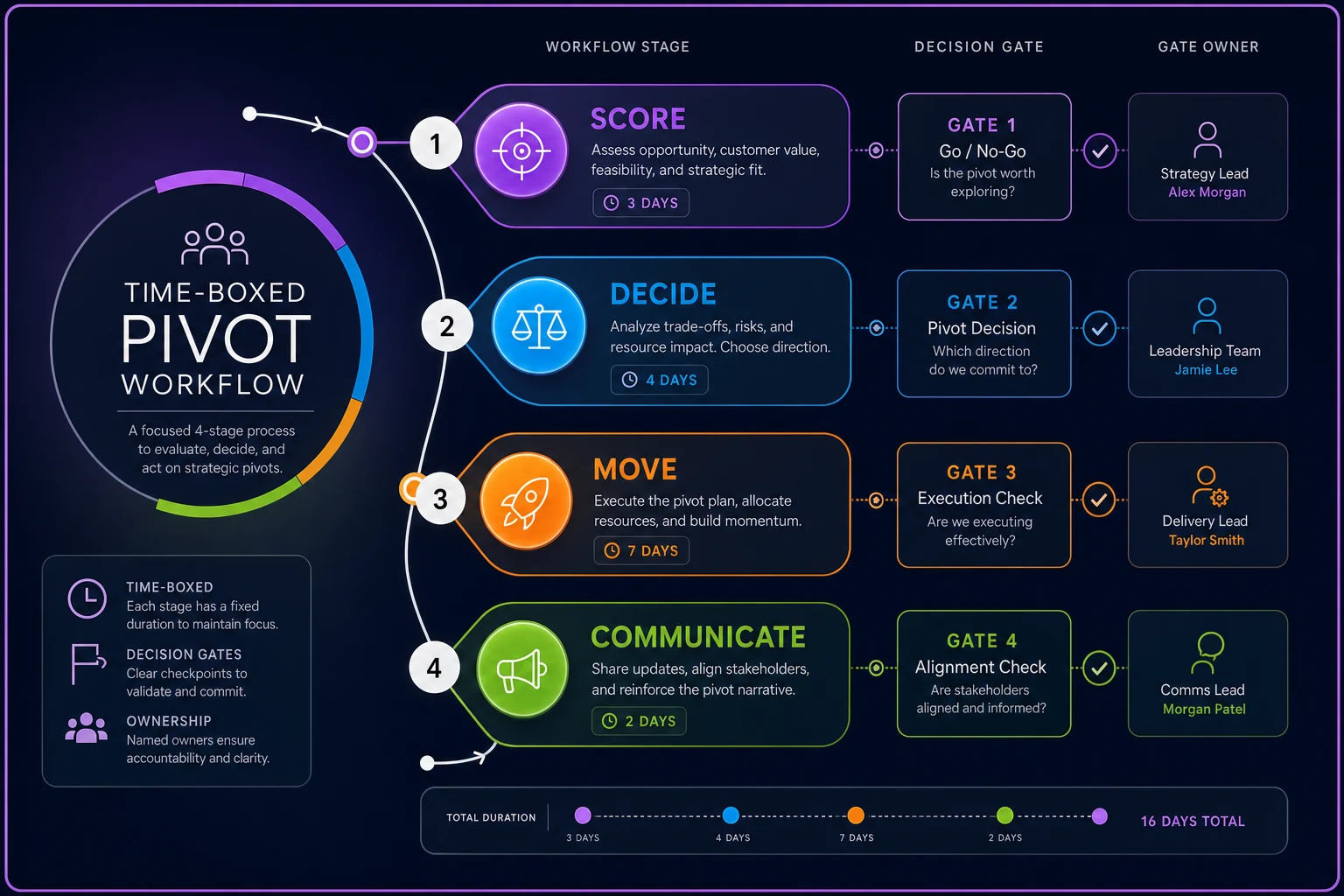
A time-boxed flow fixes this by forcing every piece — score, decide, move, communicate — onto the same clock, with named owners and hard gates.
The three speeds of a pivot
Not every disruption deserves a 72-hour sprint, and not every one can wait 30 days. Pick the speed based on how reversible the damage is if you do nothing.
Stop losing track of critical projects.
GoProjy helps you monitor, prioritize, and deliver projects on time—seamlessly.
- Unified portfolio visibility
- Real-time resource tracking
- Milestone & risk alerts
No credit card required
| Speed | Trigger example | Scope of change | Who signs off | Risk tolerance |
|---|---|---|---|---|
| 72-hour | Contract cancellation, vendor failure, funding pulled mid-quarter | 1–5 projects, immediate stop/hold | Portfolio lead + CFO delegate | Accept some rough edges; fix later |
| 7–10 day | Strategic reprioritization, new executive mandate | 10–20 projects, re-score a segment | Steering group | Moderate; validate before committing people |
| 30-day | Market shift, annual direction change, M&A integration | Full or large-segment re-score | Full governance + exec sponsor | Low; proper analysis expected |
The mistake people make is running everything at 30-day pace out of caution, which means a 72-hour emergency gets a committee and three weeks of analysis while the actual bleeding continues. Or the opposite — ramming a full-portfolio strategic shift through in 72 hours and spending the next quarter unwinding bad calls.
Match the clock to the irreversibility. If waiting a week costs you nothing recoverable, don't run the fire drill.
The 72-hour playbook
This is the hardest one to get right because there's no slack. Every hour has to count. Here's the sequence.
Hours 0–6: Freeze and frame
Before anything, stop the bleeding. Issue a spend-and-commitment hold on the affected projects only — no new POs, no new hires, no new contractor starts. This is not a full change freeze; it's a narrow pause so you don't reallocate money that's still quietly leaking out. Then write the frame in one page: what triggered this, what's in scope, what's explicitly out of scope, and which of the three speeds you're running. The out-of-scope line matters more than people think. Without it, a vendor-failure pivot mysteriously grows into "while we're at it, let's reconsider the whole roadmap."
Decision gate 1: Portfolio lead confirms scope and speed. If they can't, escalate immediately — don't start the clock on an undefined pivot.
Keep a single shared tracker that shows funded status, banding, and re-entry notes so everyone sees the current state.
Hours 6–24: Rapid re-score
You're not building a new model. You're running your existing scoring on a narrow set of candidates — the projects that could absorb freed-up resources, plus the ones being questioned. Use whatever your standard inputs are, but cut the data-gathering to what you can get in a few hours. A rapid re-score is deliberately coarse. Three bands, not thirty decimal places:
-
Protect — keep funded and staffed, no change
-
Reallocate-from — pause or stop; resources become available
-
Reallocate-to — absorb freed capacity, accelerate
If you've already built the link between scores and funding slices in your portfolio allocation framework, this step is mostly mechanical. You're applying the rules you already agreed to under calm conditions — which is exactly why you built them then instead of now.
Decision gate 2: Scores reviewed and banded. Anything that can't be banded with available data goes to a "needs-24h" list and does not block the rest.
Hours 24–48: Reallocation rules and the move
Now the part everyone skips planning for. Banding a project "reallocate-from" means specific people, dollars, and contracts have to actually move. Run these rules in order:
-
People first, money second. Confirm which named individuals are freed and when they're genuinely available — not "in theory next week" but actually unblocked. Check for handover obligations on the project being paused.
-
Honor in-flight commitments. A paused project may have signed vendor work that can't stop cleanly. Flag these; they come off the "available" pile.
-
Match freed capacity to reallocate-to projects by skill, not headcount. Three freed backend engineers don't help a project that needs a data scientist.
-
Set a re-entry note for every paused project. One paragraph
where it stopped, what it would take to restart, decay date after which restarting costs more than beginning fresh.
Decision gate 3: CFO delegate approves the money movement; resource owners confirm the people movement. Both, in writing, same document.
Hours 48–72: Comms, in the right order
Comms are where good pivots still blow up. The content isn't hard — the sequencing is. People should hear news in order of how much it affects them, from their own manager, before it shows up anywhere public.
-
Directly affected individuals (defunded teams), from their line manager
-
Reallocate-to teams receiving new people/scope
-
Adjacent stakeholders and dependency partners
-
Broader portfolio / all-hands note
-
External parties (clients, vendors) per contract
Here's a comms template for the hardest one — telling a team their project is paused:
> To: [Project team] > From: [Line manager — not PMO] > Subject: Change to [Project] — what it means for you > > As of [date], we're pausing [Project] due to [one-line reason]. This is a portfolio decision, not a reflection of your work. > Here's what happens next: [person] moves to [new project] starting [date]. [Person] finishes handover on [item] by [date]. > The project is paused, not cancelled — restart conditions are documented and owned by [name]. > I'll meet each of you individually this week. Questions before then, come straight to me.
The line that matters most: "paused, not cancelled" (when true) and "come straight to me." People fill silence with worst-case stories. Give them a channel.
The 30-day playbook
Same bones, more rigor, more validation. The extra time buys you three things the 72-hour version can't afford:
Week 1 — Full re-score with proper inputs. Instead of coarse bands, run your complete scoring across the affected segment. Pull real cost-to-complete, dependency impact, and benefits data. This is also where you check your assumptions against finance rather than estimating.
Week 2 — Scenario modeling. Build two or three reallocation options, not one. "Aggressive" (move everything now), "staged" (move in two waves), "minimal" (protect more, pivot less). Each gets a rough cost, a people-disruption score, and a recovery timeline.
Week 3 — Decide and sequence. Steering group picks a scenario. Then you build the actual move sequence — which projects pause which week, which teams transition in what order, so you don't create a two-week period where half the portfolio is mid-handover at once.
Week 4 — Execute and stabilize. Run the comms sequence over days, not hours. Set up a lightweight check-in at day 7 and day 21 post-move to catch the things that always go wrong: double-booked people, orphaned vendor contracts, paused projects that someone keeps quietly working on.
The operating-model foundations that make this smooth — clear decision rights, resource ownership, reallocation triggers — are the same ones that high-growth PMOs build deliberately rather than improvising under pressure. A 30-day pivot is really just those foundations running at speed.
A worked example
A mid-sized software org — around 18 active projects in the portfolio — lost a large enterprise customer who represented a meaningful chunk of a product line's roadmap justification. Three projects were built largely around that customer's requirements.
-
Day 1 Froze new spend on the three affected projects. Scoped the pivot to just those three plus four candidate projects that had been under-resourced.
-
Day 2 Rapid re-score banded two of the three as "reallocate-from" (the third had other paying customers and was protected). Freed up roughly 11 people, mostly engineers and two QA.
-
Day 3 Matched eight of those eleven to two under-resourced projects that genuinely needed the skills. The other three had handover obligations that tied them up for about two weeks. Comms went out manager-first, then wider.
What they got right: the "paused not cancelled" framing held, because they documented real restart conditions. One of the paused projects actually did restart four months later when a different customer picked up similar requirements, and the re-entry note saved them weeks.
What they got wrong the first time — and fixed in the next pivot — was underestimating the in-flight vendor commitments. Two contractor agreements on the paused projects couldn't stop cleanly and cost about three weeks of spend they'd already mentally reallocated. Now "honor in-flight commitments" is step two in their rules, not an afterthought.
The whole move, including the vendor cleanup, settled inside about three weeks. A year earlier, the same org had taken most of a quarter to react to a similar shock, mostly because nobody had agreed in advance who could approve moving money and people fast.
When a fast pivot is a bad idea
Speed is a tool, not a virtue.
Don't run the 72-hour playbook when:
-
The trigger is ambiguous. If you're not sure the contract is actually lost or the mandate is actually final, you'll reallocate, then reverse, then look chaotic. Wait for confirmation.
-
The projects being paused have irreversible stop costs. Some work, once halted, can't resume — regulatory submissions mid-cycle, time-sensitive integrations. Pausing these isn't a pause, it's a cancellation in disguise. Price it honestly.
-
Your scoring inputs are stale. A rapid re-score on bad data is worse than slow deliberation. If your last decent cost-to-complete numbers are three months old, the 72-hour band assignments will be fiction.
-
People are already at breaking point. Reallocation that moves exhausted specialists into yet another high-pressure project doesn't buy capacity, it buys attrition.
Reallocation that moves exhausted specialists into yet another high-pressure project doesn't buy capacity, it buys attrition.
Who should NOT run this unchanged
If your PMO doesn't yet have agreed decision rights and pre-approved authority for emergency money movement, don't try to invent them during the pivot. The 72-hour clock assumes the CFO delegate exists and can say yes. If getting a reallocation approved normally takes a week of signatures, your real first project is building that authority — calmly, now — not improvising it mid-crisis.
Likewise, very small portfolios (a handful of projects, one shared team) usually don't need formal bands and gates. A conversation and a shared doc will do. The machinery here earns its keep once you're juggling enough projects that people genuinely lose track of who's committed to what.
Keeping the whole thing on one clock
The reason these playbooks work is that score, decide, move, and communicate all run against the same timeline with named owners at each gate — instead of drifting into separate workstreams that finish weeks apart. When portfolio data, resource assignments, and funding status live in one place, running a rapid re-score and seeing freed capacity in real time is the difference between a 72-hour pivot and a three-week scramble. Platforms that centralize that view — with the scoring, the resource picture, and the reallocation rules connected — make the mechanical parts fast enough that your time goes to the judgment calls, which is where it should go.
But the tooling is secondary. What actually separates PMOs that pivot cleanly from the ones that flail is that they rehearsed the sequence before they needed it. They decided in advance who can move money in 24 hours, what the bands mean, and in what order comms go out. The pivot itself is just running a plan — not inventing one under pressure.
Here's a simple visual of the core workflow.
Write the three playbooks now, while nothing's on fire. Name the owners. Agree the authority. Then the next time Thursday afternoon rearranges your quarter, you're executing a known sequence instead of hoping everyone remembers the same version of a hallway decision.
Write the three playbooks now, while nothing's on fire. Name the owners. Agree the authority. Then the next time Thursday afternoon rearranges your quarter, you're executing a known sequence instead of hoping everyone remembers the same version of a hallway decision.
Ready to elevate your project delivery?
Join over 2,500 project teams using GoProjy to optimize resources, reduce risks, and drive portfolio success.