
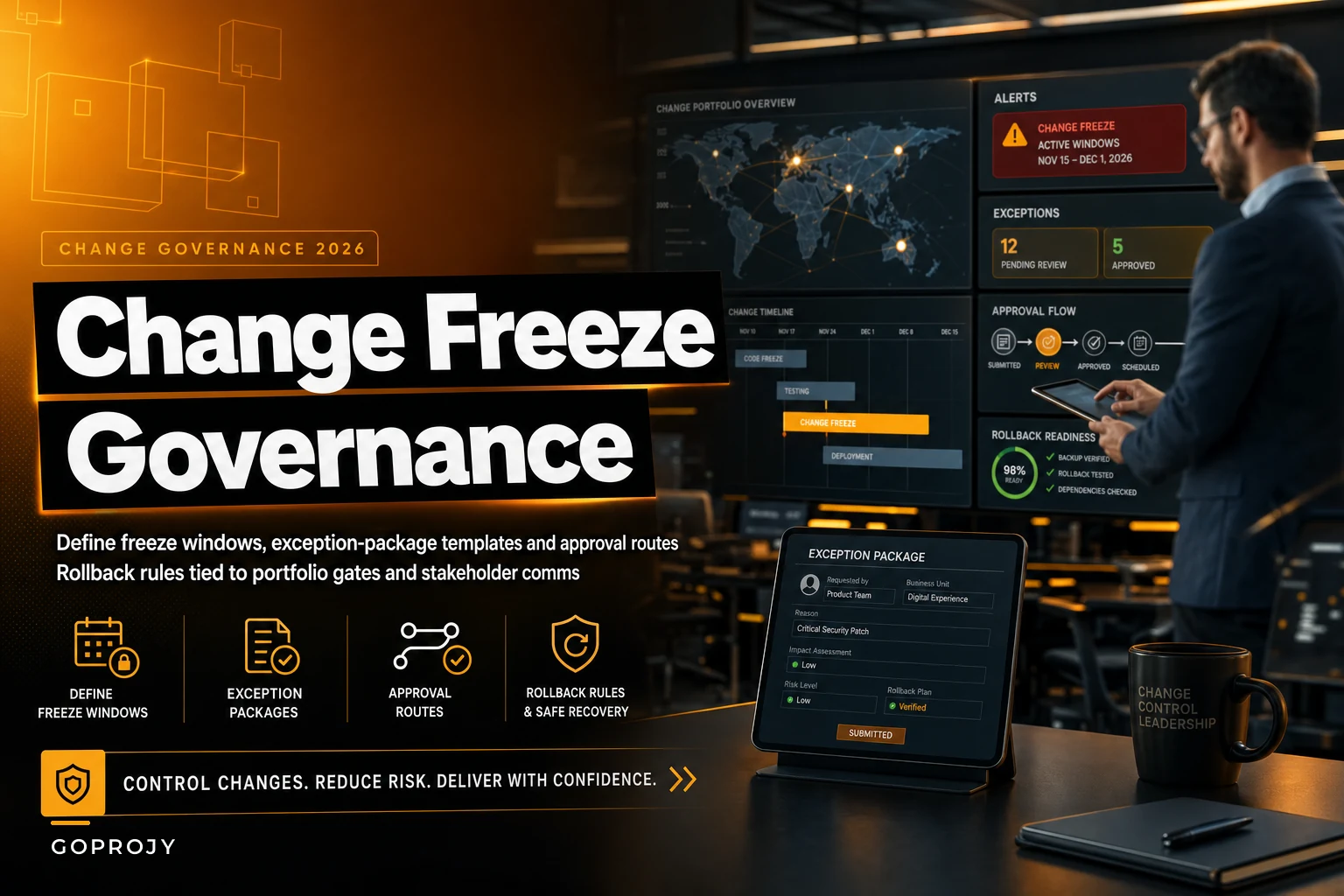

Most freeze windows fail in one of two directions. Either they're so airtight that a genuine security patch sits blocked for eleven days while a director hunts for someone with override authority, or they're so porous that "just this one exception" gets granted forty times and the freeze becomes something nobody takes seriously. Both outcomes trace back to the same problem: the freeze policy defined what was frozen but never built the machinery for the exceptions that were always going to happen.
This post is about that machinery. Not the concept of a change freeze — you already know what that is — but the specific, unglamorous, load-bearing parts: how the exception package is structured, who approves what within which time window, how rollback gets pre-agreed before anyone deploys, and how all of it connects to your portfolio gates so a freeze in one project doesn't quietly break the sequencing of three others.
The moment a freeze actually breaks
Freeze windows don't collapse on day one. They collapse around day three, when the first "reasonable" exception shows up.
Here's the pattern. A retailer's PMO calls a hard freeze from November 8 through peak trading. Everyone nods. Then on November 11 the payments team flags that a card processor is deprecating an API endpoint on the 15th — if they don't push a small config change, checkout starts failing. Clearly that has to go through. So it does.
The problem isn't that exception. The problem is that nobody wrote down how it was evaluated, so the next four requests all point at it. "You let payments through." Now the freeze coordinator is negotiating each new request from scratch, under time pressure, with no consistent bar. By day six the freeze has become a queue of special cases, each argued on escalation volume and seniority rather than actual risk.
What we've seen repeatedly is that the strength of a freeze has almost nothing to do with how firmly it's announced. It has everything to do with whether there's a repeatable, low-friction path for legitimate exceptions. When that path exists, people use it. When it doesn't, every request becomes a political event.
Why freezes and portfolio gates have to be the same conversation
A change freeze that only lives at the delivery level is half a policy. The part people consistently miss is that a freeze changes the state of work relative to your gates.
Stop losing track of critical projects.
GoProjy helps you monitor, prioritize, and deliver projects on time—seamlessly.
- Unified portfolio visibility
- Real-time resource tracking
- Milestone & risk alerts
No credit card required
-
Work that was supposed to hit a gate this week can't deploy, so the gate criteria can't be met, so the gate slips.
-
A dependent project waiting on that deployment now has a downstream slip it didn't cause and can't control.
-
Capacity reserved for the frozen window sits idle or gets quietly reassigned.
If your gate governance and your freeze policy are managed by different people using different documents, these effects don't get reconciled until something breaks. It's the same problem that shows up when decision rights get treated as a checklist rather than an operational framework — the authority exists on paper but the mechanism for using it in a live situation is missing.
The fix is treating a freeze as a gate condition, not a separate memo. When a freeze is active, affected gates move to a "hold — freeze active" state, and the projects behind them get an explicit note that their gate date is suspended, not failed. That one distinction — suspended, not failed — saves an enormous amount of blame-shifting later.
The exception package: what it needs before anyone reads it
The highest-leverage artifact in the whole system is a standardized exception-request package. Not a free-text email. A template with mandatory fields, because the fields are the risk assessment.
A workable exception package has these sections:
| Field | Why it's mandatory | What a weak answer looks like |
|---|---|---|
| Change summary (1–2 lines) | Forces clarity; approvers read dozens of these | "Various fixes" |
| Business impact if NOT approved | This is the real justification | "It would be nice to have" |
| Deadline / drop-dead date | Distinguishes "urgent" from "convenient" | "ASAP" |
| Blast radius (systems, users, projects touched) | Determines approval route | Left blank |
| Rollback plan + rollback time | The gate for approval, see below | "We'll roll back if needed" |
| Validation / smoke test after deploy | How you'll know it worked | "Team will monitor" |
| Dependent projects affected | Ties it back to portfolio gates | Not considered |
The rule worth pushing hardest: no rollback plan, no approval. Not "rollback should be documented soon." No rollback plan means the request is incomplete and doesn't enter the queue. This single rule eliminates somewhere around 30–40% of casual exception requests outright, because people asking for convenience-driven changes rarely want to write out rollback steps, and people with genuinely urgent needs almost always already have them.
There's a quiet insight buried here: the quality of the exception package correlates almost perfectly with whether the change should be granted. Vague packages describe changes that could have waited. Precise packages describe changes that couldn't.
This diagram shows the exception-request workflow and how mandatory fields feed the routing and rollback checks.
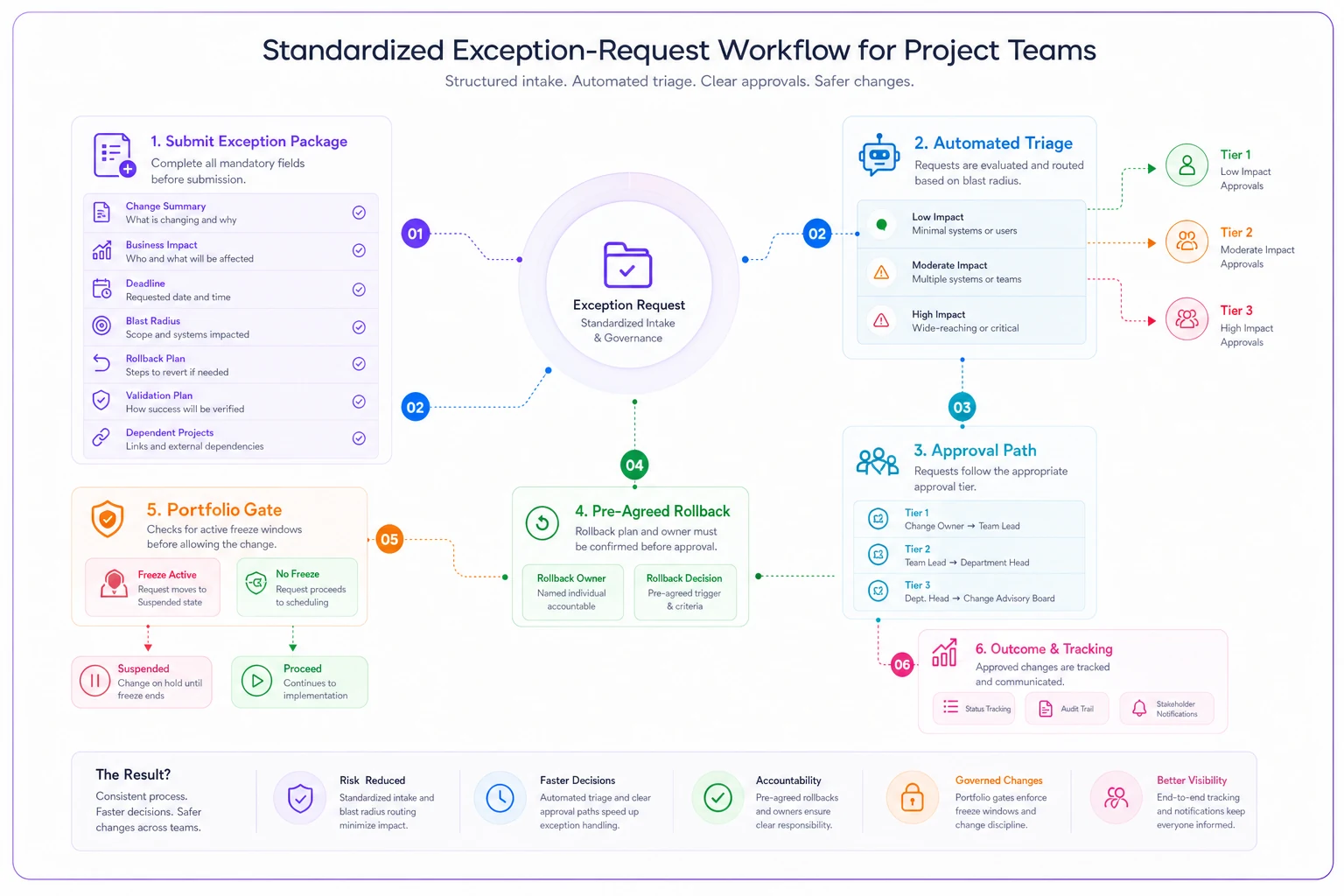
Use a standardized package and an automatic routing workflow and you'll remove most of the guesswork that turns one exception into forty.
Approval routes: match the route to blast radius, not the requester's seniority
The most common mistake in freeze governance is routing every exception to the same senior approver "to be safe." That person becomes the bottleneck, exceptions pile up, and the freeze coordinator starts pre-approving things informally just to keep work moving — which defeats the point entirely.
-
Tier 1 — contained change, single system, reversible in minutes. Approved by the freeze coordinator alone, logged, no meeting. Example: a config toggle on an internal reporting tool with no external users.
-
Tier 2 — multiple systems or external-facing, reversible in under an hour. Requires freeze coordinator plus the affected system owner. Short async approval, decision within four hours during business hours.
-
Tier 3 — customer-impacting, touches money/data/compliance, or rollback exceeds an hour. Requires the change-advisory group or a named executive sponsor, decision within a defined SLA, and a mandatory rollback rehearsal note.
The point of tiers is that most exceptions are Tier 1 or 2 and should never reach an executive. Reserving senior attention for the genuinely dangerous 10% is what keeps the whole system fast enough that people trust it.
The seniority of the requester should not shorten the route.
Worth stating plainly: the seniority of the requester should not shorten the route. A VP asking for a Tier 3 change still goes through the Tier 3 process. The moment "who's asking" changes the path, the policy is effectively dead.
Rollback rules: decided before deploy, not during the incident
Rollback is where freeze policies quietly lie to themselves. Everyone agrees it's important. Almost nobody defines the trigger in advance, so when something goes wrong at 9pm, the team is still debating whether it's bad enough to roll back while the situation is actively getting worse.
-
The rollback trigger. A specific, observable condition. "Error rate on checkout exceeds 2% for five minutes" — not "if things look bad."
-
The rollback owner. One named person with authority to pull the trigger without convening anyone. This is the whole game. A rollback decision that requires a meeting is a rollback that happens too late.
-
The rollback window. How long the change stays "on probation" before it's considered stable. Often somewhere in the 24–72 hour range during a freeze.
A pattern worth internalizing: the changes that cause the worst freeze-window incidents are almost never the ones flagged as risky. They're the "tiny, obviously safe" ones that got a rollback plan of "revert the commit" and then turned out to have a data-migration side effect that a revert couldn't undo. That's why the rollback section asks for rollback time, not just "yes we can roll back." A change that takes six hours to unwind is not reversible in any way that matters during peak trading.
A short real scenario
A mid-sized logistics software company — around 90 people, roughly a dozen active projects — ran freezes purely by email announcement. During their last two peak periods, they averaged somewhere around 25–30 exception requests per freeze, and the freeze coordinator spent most of each freeze arbitrating them by hand. Two of those exceptions caused customer-facing incidents, one of which took most of a day to recover because nobody had thought through the rollback path.
They didn't buy anything new. They restructured the process. They introduced a standard exception package with the mandatory rollback field, split approvals into the three tiers above, and — the part that mattered most — made active freezes visibly change the state of affected portfolio gates so downstream teams could see their dates were suspended rather than blown.
Next freeze, exception requests dropped to roughly a dozen, because the "no rollback plan, no approval" rule filtered out the convenience requests before they reached the coordinator. The PMO lead spent maybe an hour a day on freeze administration instead of most of the day. The two Tier-1 changes that did go through were reversible in minutes. No incidents. The improvement wasn't dramatic in a slide-deck sense — it just stopped being chaotic.
Stakeholder communication: the part that determines whether people respect the freeze
A freeze that people don't understand is a freeze people route around. The communication piece isn't optional; it's structural.
Three messages need to go out, to different audiences:
-
Before the freeze the window, what's frozen, what counts as an exception, and the link to the exception package. If people can't find the legitimate path in under a minute, they'll invent their own.
-
During the freeze a running, visible log of approved exceptions and their tier. Visibility does two things — it stops duplicate requests, and it removes the "you let them through" argument because the reasoning is on record.
-
After the freeze which gates were suspended, which are now released, and a short note on any exception that triggered a rollback. This feeds directly into your next portfolio health review, where the pattern of exceptions often reveals which projects have unrealistic release timing baked into their plans.
That last point is underrated. The exception log from a freeze is one of the clearest signals you'll get about which teams are chronically trying to ship at the wrong moment. If the same project files three "urgent" exceptions every freeze, that's not bad luck — that's a planning problem you can fix upstream.
When a hard freeze actually makes sense — and when it doesn't
A full freeze is a blunt instrument. It's the right tool when the cost of a bad deploy is genuinely catastrophic and the window is short: peak retail trading, a regulated reporting cutoff, a high-stakes launch. In those cases the asymmetry justifies the friction.
It's the wrong tool when the freeze is really just anxiety about a fragile release process. Freezing everything for three weeks because deploys are scary doesn't fix the fragility — it batches up all the risk into a giant thaw where twenty held-back changes ship in the same 48 hours. That thaw is often more dangerous than whatever the freeze was supposed to protect against.
Who should not run a hard freeze: teams whose real problem is a lack of confidence in their own rollback capability. If you can't reliably reverse a change, the answer is to fix rollback, not to stop deploying. A freeze built on top of shaky rollback just delays the incident and makes it larger.
Bringing it together
The freeze announcement is the easy part. Anyone can send the "we're frozen" email. What decides whether it actually works is the exception package that forces a real risk assessment, the tiered routes that keep fast changes fast and dangerous ones properly scrutinised, the rollback rules agreed in writing before anyone touches production, and the tie-in to your gates so a freeze suspends dates instead of silently breaking them.
Get those four pieces right and a freeze stops being a period of negotiation and damage control.
Get those four pieces right and a freeze stops being a period of negotiation and damage control. It becomes what it was always supposed to be — a controlled window where the only changes getting through are the ones that genuinely can't wait, each one carrying its own escape hatch.
Ready to elevate your project delivery?
Join over 2,500 project teams using GoProjy to optimize resources, reduce risks, and drive portfolio success.