



Most SOW disputes don't blow up at signature. They blow up at month four, when a vendor says "we delivered" and your PMO says "not what we asked for," and neither side has anything concrete to point to except a 40-page document nobody read carefully. By then the money's half spent, the sponsor's annoyed, and someone in procurement is quietly forwarding email threads to legal.
The root problem isn't bad vendors or lazy PMs. It's that most SOWs describe intentions instead of artifacts. They say things like "deliver a fully functional integration" without ever defining what "functional" produces, who inspects it, and what evidence proves it happened. An intention can be argued forever. An artifact either exists or it doesn't.
This is a playbook for building SOWs the other way around — starting from the concrete things that must exist at each portfolio gate, tying acceptance to a reusable library of tests, capturing evidence snapshots as work happens, and making the procurement-to-PMO handoff clean enough that audits stop being fire drills. If you run a portfolio and you're tired of relitigating scope, this is the system worth stealing.
Why intention-based SOWs quietly rot at portfolio scale
One project can survive a vague SOW. A skilled PM absorbs the ambiguity, negotiates in the hallway, and keeps things moving on relationships and goodwill. That works right up until you have thirty vendors across fifteen projects and four PMs who've never met each other's suppliers.
At that scale, the informal glue disappears. Nobody remembers what "done" meant on a project that kicked off eight months ago. The PM who negotiated the handshake understanding left the company. The vendor swapped account managers twice. And now finance is asking why a milestone was paid when the deliverable "clearly isn't finished," and the only record is a Slack thread and a PDF that says "comprehensive documentation" without ever defining comprehensive.
What we've seen across a lot of portfolios is that dispute volume doesn't grow linearly with vendor count — it grows with the variance in how each SOW was written. Ten SOWs written ten different ways create ten different audit trails, ten different acceptance conventions, and ten different ways for a milestone to be "sort of done." The PMO ends up spending its best people mediating instead of steering.
There's a related failure that's easy to miss: when SOWs are inconsistent, your portfolio gates become theater. A stage-gate review is only as good as the evidence flowing into it. If Project A defines acceptance rigorously and Project B defines it as "sponsor is happy," you can't compare them, can't roll them up, and can't trust the green status on either. The gate approves things it never actually verified.
The artifact-first flip
An artifact-first SOW starts with a simple, almost annoying question for every deliverable: what physical thing exists when this is done, and how would a stranger verify it?
Stop losing track of critical projects.
GoProjy helps you monitor, prioritize, and deliver projects on time—seamlessly.
- Unified portfolio visibility
- Real-time resource tracking
- Milestone & risk alerts
No credit card required
Not "improved onboarding flow." Instead: a deployed onboarding flow in staging, a test report showing the 12 defined user paths pass, a signed-off UX review document, and a runbook for support. Four artifacts. Each one either exists or it doesn't. There's nothing to argue about.
This flip changes the whole conversation with vendors. Instead of negotiating feelings ("it feels incomplete"), you're checking a list of things that either got produced or didn't. It also changes internal dynamics — your sponsor can't move the goalposts at acceptance because the goalposts were written as artifacts before work started.
A useful discipline: every artifact should have an owner, a format, a location, and an inspector. Owner is who produces it. Format is what it actually is (a signed PDF, a Git tag, a Confluence page, a passing test suite). Location is where it lives permanently. Inspector is who confirms it meets the bar. Miss any of the four and the artifact quietly turns back into an intention.
A quick contrast makes it obvious why this matters:
| Deliverable phrasing | What it produces | Disputable? |
|---|---|---|
| "Deliver production-ready API" | Nothing specific | Endlessly |
| "API deployed to prod, OpenAPI spec published, load test report showing p95 < 400ms at 500 rps, security scan with zero criticals" | Four concrete artifacts | Barely |
| "Provide training" | A meeting, maybe | Yes |
| "3 recorded sessions, a slide deck in the shared drive, and a completion roster with ≥80% attendance" | Recordings, deck, roster | No |
The right column takes more effort to write. It saves ten times that effort at acceptance.
Building a milestone acceptance library
Writing artifact-level acceptance criteria from scratch for every SOW is exhausting, and exhausted people cut corners. The fix is a reusable acceptance test library — a curated set of standardized acceptance patterns your PMs pull from instead of reinventing.
Think of it as a catalog. Each entry describes a common deliverable type and its default acceptance package: the artifacts required, the tests that must pass, the evidence to capture, and the inspector role. When a PM scopes a data migration, they grab the "data migration" acceptance entry. When someone scopes a vendor integration, they grab that one. The SOW gets assembled from proven components instead of prose.
-
Software deliverables — deployment evidence, test coverage thresholds, defect counts by severity, rollback proof
-
Documentation deliverables — completeness checklist, review sign-off, storage location, version tag
-
Data deliverables — reconciliation report, record counts source vs target, quality rule pass rates
-
Process/operational deliverables — runbook existence, dry-run completion, support handoff acknowledgment
-
Training/enablement deliverables — materials, delivery evidence, competency check results
The insight most teams miss: the library isn't just efficiency, it's comparability. When every data migration across the portfolio uses the same acceptance pattern, your gates can actually roll up. A sponsor reviewing five projects sees five acceptance packages built the same way, and green means the same thing everywhere. This is the quiet foundation under any systems-first operational portfolio lifecycle with evidence and SLAs — standardized acceptance is what makes portfolio-level evidence trustworthy.
One mistake to avoid: don't let the library ossify. Every acceptance entry should have an owner who updates it when a new failure mode shows up. If a vendor once slipped a migration through with silent data truncation, the migration entry should grow a truncation check the next day. The library gets smarter every time something goes wrong.
Tying acceptance to portfolio gates
A lot of PMOs leave real value on the table here. They build decent acceptance criteria at the project level but never connect them to the portfolio gates that control funding and progression. So a project passes its internal acceptance, but the gate review has no structured way to consume that evidence. The gate ends up rubber-stamping status colors again.
The fix is to make gate progression contingent on acceptance artifacts, not narrative status. A project shouldn't advance past a gate because the PM says it's on track. It advances because the acceptance packages for that phase's deliverables exist, are inspected, and are stored. The gate becomes a verification checkpoint, not an opinion poll.
In practice this means mapping each portfolio gate to the specific acceptance packages expected at that point. Concept gate might require a signed problem statement and a validated cost estimate artifact. Build gate might require deployment evidence and passing test reports for the committed scope. Close gate might require operational handoff runbooks and benefit-baseline documents.
A simple workflow that holds up well at scale:
-
Scope stage — PM assembles the SOW from acceptance library entries, mapping each deliverable to the gate where its evidence is due.
-
Execution — vendor and team produce artifacts; evidence snapshots get captured as milestones close, not reconstructed later.
-
Milestone acceptance — the named inspector verifies each artifact against its library criteria and signs off or rejects with specifics.
-
Gate assembly — accepted artifacts for the phase auto-compile into a gate evidence pack.
-
Gate decision — the review board approves progression based on the evidence pack, or holds with a documented gap list.
-
Payment release — vendor payment triggers off accepted milestones, keeping money and proof in lockstep.
This diagram illustrates the gate workflow and how artifacts, inspectors, and evidence snapshots interact.
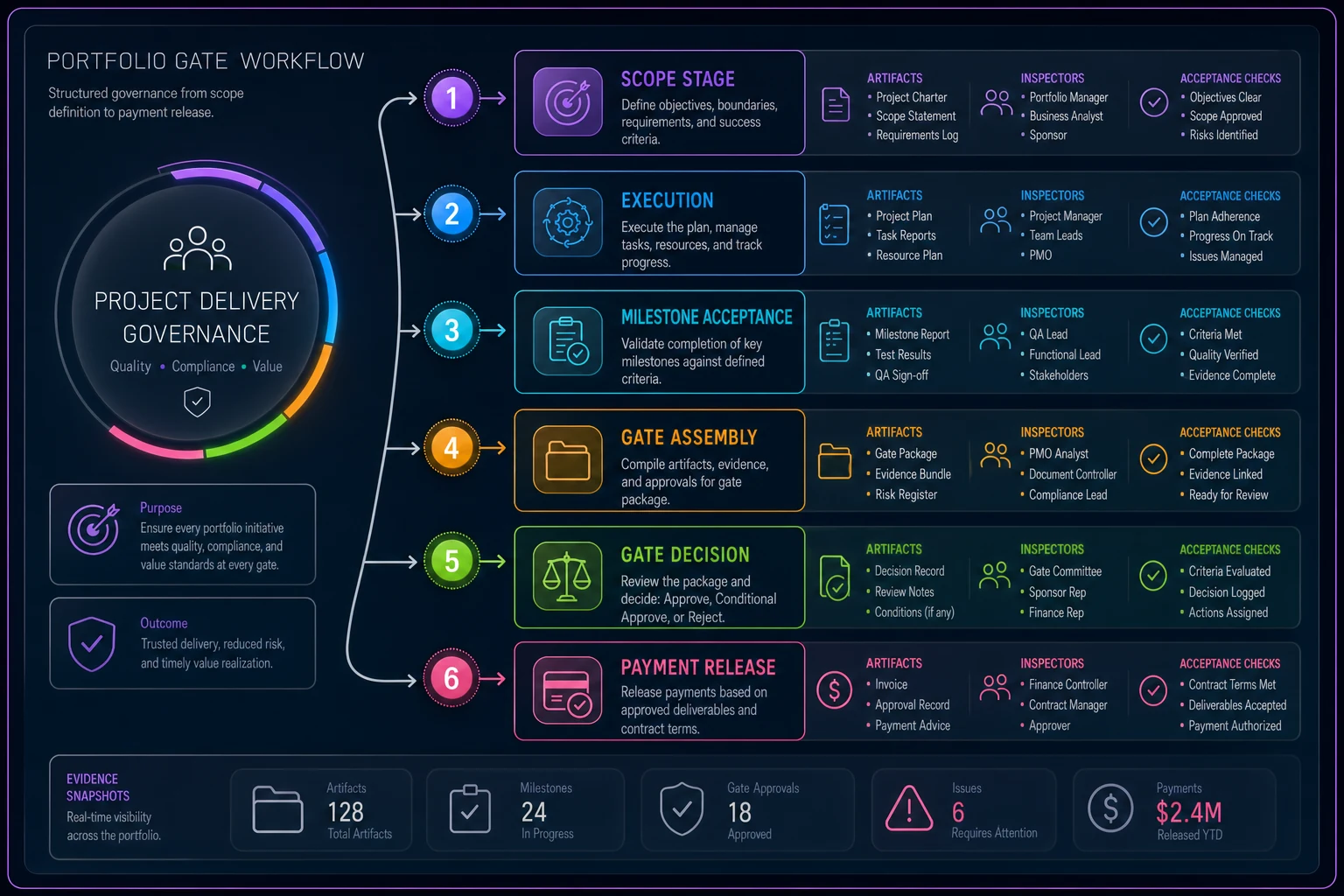
That last step matters more than it looks. Linking payment to accepted artifacts rather than elapsed time is one of the strongest anti-dispute mechanisms there is — the topic gets deeper treatment in this piece on milestone-linked governance, acceptance tests and payment knobs for procurement, and it pairs directly with the artifact-first approach here. Artifacts define what, payment knobs define what happens when what doesn't show up.
Evidence snapshots: capture in the moment, not in the postmortem
The single biggest source of audit friction isn't missing evidence — it's evidence that existed once and can't be reproduced. A test passed in March, but the environment changed, the report wasn't saved, and now nobody can prove the deliverable ever met the bar. So the audit turns into archaeology.
An evidence snapshot is a point-in-time capture of the proof that a deliverable met its acceptance criteria, stored immutably with a timestamp and a reference to the criteria it satisfied. The report itself, the who, the when, and the against-what. Captured at the moment of acceptance, never reconstructed.
The discipline here is capturing evidence at the moment of acceptance, not weeks later when someone asks. A typical failure pattern: a PM accepts a milestone verbally, moves on, and the evidence — a test log, a screenshot, a sign-off email — scatters across tools and inboxes. Six months later during an internal audit, half of it is gone. Reconstructing it costs days and still looks weak because it was assembled after the fact.
-
Timestamped and immutable — you can't quietly backfill or edit them
-
Linked to specific acceptance criteria — the snapshot references exactly what it proves
-
Self-contained — a reviewer shouldn't need to chase five systems to understand it
-
Attributed — who produced it, who inspected it, who accepted it
When evidence snapshots are routine, audits stop being events and become lookups. An auditor asks "prove milestone 3 was accepted correctly" and you hand them the snapshot in thirty seconds. That's the difference between a PMO that dreads audit season and one that barely notices it.
The procurement→PMO handoff (where most trails go cold)
There's a specific moment where audit trails break, and it's the handoff between procurement and the PMO. Procurement negotiates the contract, defines the commercial terms, and signs the SOW. Then it gets thrown over the wall to a PM who wasn't in any of those conversations and now has to deliver against terms they didn't write.
What breaks: the acceptance criteria in the contract don't match how the PM actually tracks work. The payment schedule assumes milestones the PM never planned. The vendor thinks "done" means one thing (per their sales conversation), procurement documented another, and the PM enforces a third. Three interpretations, zero shared record.
A clean handoff needs a structured transfer, not an email with a PDF attached. At minimum:
-
The SOW's acceptance packages, mapped to the PM's milestone plan — so what's contractually due lines up with what's actually tracked
-
The payment schedule tied to specific accepted artifacts — no "net 30 from invoice" divorced from delivery
-
The named inspectors for each deliverable — decided before work starts, not scrambled at acceptance
-
The evidence storage location and format expectations — agreed up front so nobody's reformatting logs at audit time
-
The escalation path when acceptance fails — who decides, in what window, before it festers
Procurement and the PMO optimize for different things. Procurement optimizes for commercial protection and clean terms. The PMO optimizes for delivery and coordination. Neither is wrong, but if the handoff doesn't reconcile them into one artifact-based record, you get a contract that reads great and delivers terribly.
Teams that do this well treat the handoff as a scheduled working session with a checklist, not a file transfer. Twenty minutes of reconciliation up front saves months of "well, the contract says X but we planned Y."
A real scenario: mid-size infrastructure program
A regional financial services firm ran a portfolio of roughly 18 concurrent projects, heavy on external vendors — data center migration work, a handful of integration builds, and compliance tooling. They had a recurring, expensive problem: vendor invoices arrived, got paid on the commercial schedule, and then deliverables turned out to be incomplete. Disputing those took an estimated 15–20 hours a month of senior PM time, and two disputes the previous year had escalated far enough to involve legal.
The bigger cost was less visible. Their internal audit function flagged that acceptance evidence was inconsistent across projects — some milestones had solid documentation, others had nothing but an approved invoice. That inconsistency was creating audit findings and forcing the PMO to do reconstruction work every audit cycle.
They rebuilt their approach around artifact-first SOWs. Started with a small acceptance library — about eight deliverable archetypes covering most of their vendor work. Each new SOW got assembled from those entries, with acceptance packages mapped to their existing stage gates. Payment milestones were rewritten to trigger off accepted artifacts. And they instituted a short procurement-to-PMO handoff session on every new contract.
The results showed up over the following two quarters rather than overnight. Dispute-related PM time dropped to a few hours a month — mostly because there was nothing left to argue about. Audit cycles produced far fewer findings on acceptance evidence, because the snapshots existed by default. And vendor behavior shifted in a way nobody quite expected: when the SOW spelled out exact artifacts, vendors stopped over-promising in sales conversations and started scoping more realistically, because vague promises couldn't survive contact with the acceptance list.
The firm's own summary was blunt — they weren't managing vendors better, they'd just made it impossible to be vague.
When this is worth it — and when it's overkill
Artifact-first SOWs with full acceptance libraries and evidence snapshots are a real investment. It's worth being honest about where the effort pays off and where it's just bureaucracy.
When it clearly makes sense:
-
You run multiple concurrent vendor engagements and disputes are recurring
-
You're in a regulated or audit-heavy environment where evidence gaps create real risk
-
Payment is tied to milestones and you've been burned by paying for incomplete work
-
Your portfolio gates need to roll up comparable evidence across many projects
-
Vendor and PM interpretations of "done" routinely diverge
When it's overkill:
-
A single small project with a trusted long-term vendor and a tight feedback loop
-
Highly exploratory or R&D work where the deliverable genuinely can't be defined up front — forcing artifacts here creates false precision and kills flexibility
-
Very short engagements where the setup cost exceeds the dispute risk
One thing worth flagging: teams sometimes confuse artifact-first with waterfall. This isn't about locking scope forever. It's about making each committed increment verifiable. Agile teams handle this fine — the artifacts just attach to sprints and releases instead of a single big-bang delivery. The mistake is treating the acceptance library as a compliance box rather than a living tool, at which point it becomes exactly the paperwork everyone resents.
Making it stick
The failure mode for all of this isn't design — it's decay. Teams build a solid acceptance library, use it well for a quarter, and then drift back to copy-pasting last project's SOW because it's faster under deadline pressure.
Assign a clear owner to the acceptance library so it stays current and make artifact-first scoping the default template.
Keeping it alive comes down to a few unglamorous habits. Assign a clear owner to the acceptance library so it stays current. Make artifact-first scoping the default template, not an optional add-on, so the easy path is also the right path. Review disputes and audit findings quarterly and feed every lesson back into the library entries. And measure the thing that actually matters — not how many SOWs you wrote, but how many milestones got accepted without argument and how many audits closed without findings.
SOW quality, acceptance rigor, gate integrity, and audit readiness aren't four separate problems. They're one system with four visible surfaces. Fix the SOW at the artifact level and the acceptance flows cleaner, the gates verify real evidence, and audits become lookups instead of investigations. Leave the SOW vague and all four surfaces crack in ways that show up months apart, so nobody connects them back to the root.
The PMOs that stop drowning in disputes aren't the ones with the toughest contracts or the strictest vendors. They're the ones who decided, early, that "done" would mean something specific enough that a stranger could verify it — and then built the boring, repeatable machinery to make that true across every project in the portfolio.
Ready to elevate your project delivery?
Join over 2,500 project teams using GoProjy to optimize resources, reduce risks, and drive portfolio success.