



Most portfolios don't fail during the disruption. They fail in the 48 hours after it, when nobody can agree on what "stabilized" even means and three project managers are quietly making conflicting calls because the official response hasn't landed yet.
That gap — between "something broke" and "we have a coordinated response" — is where portfolio damage compounds. A single vendor outage becomes six slipped milestones. A funding freeze becomes a staffing panic. The original shock is rarely the expensive part. The scramble is.
What separates PMOs that recover cleanly from the ones that limp along for a quarter isn't better crisis instincts. It's that they stopped improvising. They built a portfolio continuity playbook where the first moves are already decided, the funding triggers are already agreed, and everyone knows which artifacts tell the truth when the status reports go stale.
This is about the system that holds a disrupted portfolio together — not the heroics of one program manager who happened to be awake at 2am.
Why disruption spreads faster than most PMOs expect
A disruption hits one project, and the portfolio-level response lags by a day or two because leadership is still "gathering information." During that lag, individual PMs make locally rational decisions that are globally terrible.
A typical example: a payments integration vendor goes down. The PM on that project immediately pulls two engineers off a neighboring project to build a workaround. Reasonable, in isolation. Except those two engineers were on the critical path of a release three weeks out, and now that project slips, which triggers a dependency failure on a fourth project that was waiting on the release. One outage, four projects affected, none of it coordinated.
This is what people underestimate about portfolios: disruptions don't stay contained to where they start. Shared capacity, shared vendors, and shared funding pools are exactly the channels that transmit shock across projects. The tighter your resourcing, the faster it spreads.
The standard response — "let's get everyone on a call" — actively makes things worse in the first day. Twelve people talking, no decision owner, a lot of status theater. The information exists. The decision structure doesn't.
The real problem isn't visibility. Most PMOs can see the fire. The problem is nobody pre-decided who gets to pull the alarm, who decides what gets sacrificed, and how long you wait before escalating funding. Those decisions get invented live, under stress, badly.
The scenario-first approach: decide the response before you need it
Stop writing generic continuity plans. Start writing scenario-first runbooks. A generic plan says "assess impact and escalate appropriately." A scenario-first runbook says: vendor X goes dark → here's the triage owner, here's the surge rule, here's the funding trigger, here's who gets told at hour 4 and hour 24.
Stop losing track of critical projects.
GoProjy helps you monitor, prioritize, and deliver projects on time—seamlessly.
- Unified portfolio visibility
- Real-time resource tracking
- Milestone & risk alerts
No credit card required
You don't need fifty scenarios. Four or five cover the vast majority of what actually disrupts a portfolio:
-
A critical vendor or platform outage
-
A sudden capacity loss (key specialists pulled, a team reorg, mass departure)
-
A funding shock (budget freeze, reprioritization from above, rate changes)
-
A compliance or security event that forces a freeze
-
An external shock with a hard deadline (regulatory, contractual, seasonal)
For each one, you build the same skeleton: a triage window, surge rules, funding triggers, a comms ladder, and the portfolio artifacts that stay authoritative while everything else is in flux. When the real thing hits, you're not designing the response — you're executing it and adapting at the edges.
Teams that do this well treat the runbook like a flight checklist. Nobody expects it to cover every variable. It exists so the first ten moves are automatic and the humans can spend their judgment on the parts that are genuinely novel.
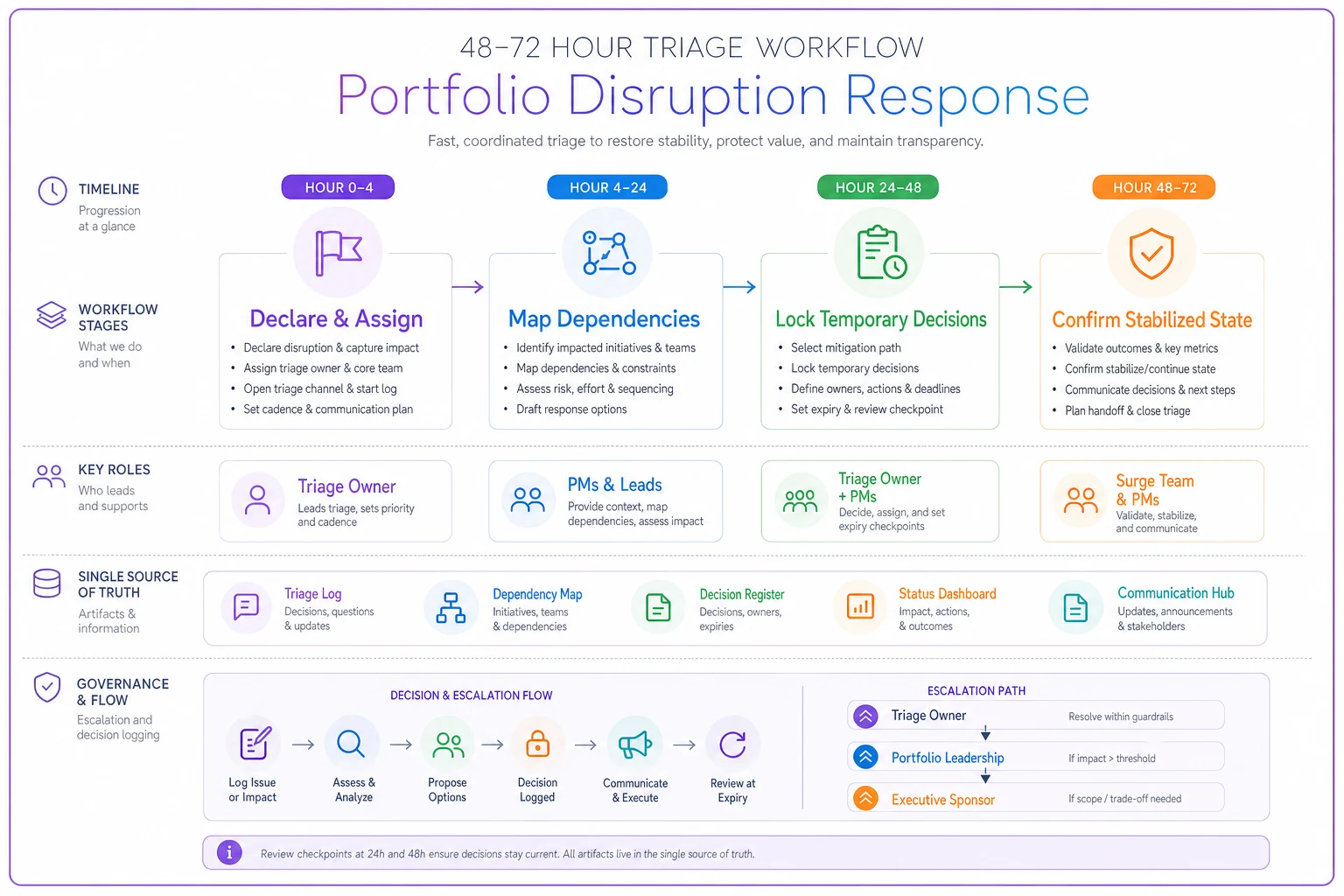
The 48–72 hour triage window
The first window has one job: stop the bleeding and establish a single source of truth. Not fix everything. Not rebaseline. Just stabilize and get everyone operating off the same picture.
A workable structure for that window:
-
Hour 0–4
Declare and assign.
Someone with authority formally declares the disruption active and names a triage owner for the portfolio — one person, not a committee. This sounds trivial. It's the single most skipped step, and its absence is why the first day turns into chaos. The declaration also defines scope: which projects are in the blast radius, which are explicitly not. -
Hour 4–24
Map the real dependency spread.
Figure out which projects are directly hit and which are hit through shared resources or dependencies. This is where a worked cross-functional escalation playbook with clear decision ladders earns its keep — you want pre-defined contact matrices and decision windows, not a frantic search for who owns what. -
Hour 24–48
Lock temporary decisions.
Decide what's frozen, what continues, and what gets temporary resourcing. Every one of these is marked temporary with an expiry. The failure mode here is "emergency" decisions quietly becoming permanent because nobody scheduled a review. -
Hour 48–72
Confirm the stabilized state.
Document the as-is: what's running degraded, what's paused, what the surge staffing looks like, and what the known unknowns are. This becomes the input to the 30-day rebaseline.
The discipline that makes this work: every triage decision gets logged with an owner and an expiry timestamp. Not in someone's head. Not in a Slack thread. In one place that survives the week. When you hit the rebaseline, you'll need to reverse a lot of these temporary calls, and if you can't find them, they ossify into permanent damage.
Here's a quick workflow visualization.
When you hit the rebaseline, you'll need to reverse a lot of these temporary calls, and if you can't find them, they ossify into permanent damage.
Surge staffing rules that don't cannibalize the portfolio
The engineers-pulled-from-the-critical-path problem is almost always a rules problem, not a people problem. People reallocate capacity under pressure because there's no agreed policy telling them what's off-limits.
The runbook needs pre-agreed surge staffing rules:
| Surge rule | What it prevents | Typical trigger |
|---|---|---|
| Protected critical paths | Pulling people off the one thing that can't slip | Any reallocation that touches a flagged critical-path task requires triage-owner sign-off |
| Surge capacity tiers | Ad-hoc poaching from random teams | Draw surge staff from a pre-designated reserve pool first, then tier-2 projects, never tier-1 |
| Time-boxed assignments | Temporary pulls becoming permanent | Every surge assignment has a hard end date, max 10 working days before review |
| Substitution over addition | Burning out specialists | Where possible, backfill the pulled person's old work rather than stacking both loads on them |
The pre-designated reserve pool is the part most PMOs don't have, and it's the part that saves you. If you've already identified which capacity is "breakable" in an emergency — the lower-priority work you can genuinely pause — surge staffing becomes a lookup instead of a negotiation. You're not deciding whose project to hurt in the middle of a crisis. You decided that calmly, months ago, when you could think clearly.
Treat your reserve pool like insurance — update it after each disruption so it reflects real pausable work, not assumptions.
One pattern worth flagging: surge staffing works for days, not weeks. If you're still running on surge capacity at day 20, that's not a staffing situation anymore — it's a baseline that hasn't been acknowledged. Prolonged surge is a signal to rebaseline, not a sustainable state.
Contingency funding triggers: pre-agreed, not pre-begged
Nothing slows a disruption response like having to go ask for money mid-crisis. By the time the funding request works its way through approval, the cheap window to act has closed.
The move is to pre-authorize contingency release against defined triggers, so money becomes available the moment conditions are met rather than after a scramble. This connects directly to how you structure reserves in the first place — if you've already built tiered contingency bands with clear release triggers, your continuity runbook just references those triggers instead of inventing a new approval path under pressure.
A clean structure ties funding tiers to the triage window:
-
Tier 1 (immediate, pre-authorized) A small band the triage owner can release without additional sign-off, for the first 72 hours. Emergency vendor swaps, short-term contractor cover, overtime. Capped and time-boxed.
-
Tier 2 (fast-track, 24-hour approval) A larger band that needs a single named approver, not a committee. Used for sustained surge staffing or a confirmed vendor replacement.
-
Tier 3 (rebaseline funding) Only unlocks during the 30-day rebaseline, when you actually know the shape of the damage. Trying to authorize this in the first week is guessing.
The reconciliation discipline matters as much as the release. Every tier-1 dollar needs to be logged against the disruption and reconciled during rebaseline, or your contingency reserves quietly drain across a few incidents and you discover you're exposed right before the next one.
Comms and escalation ladders that cut the noise
During disruption, communication fails in two opposite directions at once: executives get flooded with updates they can't act on, and the people who actually need to coordinate can't find each other. Both are symptoms of not having a ladder.
A comms ladder defines who gets told what, when, and in what format at each stage:
-
Response team real-time channel, raw and unpolished, updated as things change
-
Portfolio leadership structured updates at fixed checkpoints (hour 4, hour 24, hour 72), decision-focused — what's decided, what needs a decision, what's blocked
-
Executives and sponsors a tight brief at declared milestones only, framed around impact and the decisions being made on their behalf, not technical detail
-
Affected but non-involved teams a simple "here's what's happening, here's what we need from you, here's what you can ignore"
The escalation ladder sits alongside this: a pre-defined sequence of who gets pulled in as severity rises, with time thresholds. If a decision isn't made within the triage owner's authority inside a set window, it automatically escalates to the next level. No waiting for someone to decide to escalate — the clock decides.
Worth internalizing: in a disruption, silence reads as either "it's fine" or "it's catastrophic," and people assume whichever is worse for them. A disciplined comms cadence, even when the news is bad, prevents the rumor-driven panic that doubles your actual problem.
Mapped portfolio artifacts: what tells the truth when status goes stale
Your normal status reports become unreliable almost immediately during a disruption. They're built on a weekly cadence and assumptions that no longer hold. By day two, the dashboard says green on a project that's actually frozen.
The runbook needs to specify which artifacts remain authoritative during disruption and who maintains them. Usually a thin, high-frequency set:
-
A live triage decision log (every temporary call, owner, expiry)
-
A current blast-radius map (what's affected, directly and through dependencies)
-
A surge staffing ledger (who's deployed where, until when)
-
A contingency drawdown record (what's been released against which trigger)
-
A rebaseline tracker (opened at day 3, closed at day 30)
The mistake is trying to keep the normal reporting machinery running during a crisis. It's too slow and measuring the wrong things. You deliberately switch to a lean set of continuity artifacts and tell everyone: these are the source of truth right now, the normal dashboards are frozen until rebaseline.
Where a central system actually helps
This is the one place where tooling genuinely changes outcomes rather than just adding overhead. Keeping triage logs, surge assignments, contingency drawdowns, and dependency maps coherent across a dozen projects is hard enough on a calm day. During disruption, when things change hourly, scattered spreadsheets fall apart fast.
A portfolio platform that already holds your dependency maps, capacity data, and contingency bands lets the continuity artifacts live in one connected place — so when you mark a project frozen, the downstream dependency impacts surface automatically instead of being discovered three days later. The value isn't automation for its own sake; it's that the blast radius becomes visible fast enough to act on. That's the difference between containing a disruption and chasing it.
The 30-day rebaseline: turning the temporary into the real
Triage stabilizes. The rebaseline is where you rebuild a portfolio you can actually run against.
The purpose of the 30-day window is to systematically reverse every temporary decision — or formally make it permanent. This is the step most PMOs skip, and it's why disrupted portfolios never fully recover. They stay in emergency mode indefinitely because nobody did the work of converting the stabilized mess back into a real plan.
A workable rebaseline sequence:
-
Pull the triage decision log and sort every temporary call into: reverse it, keep it, or replace it with a proper decision.
-
Reset surge staffing. Everyone on surge either goes back or gets formally reassigned with the capacity impact acknowledged in the plan.
-
Reconcile contingency drawdown. Close out tier-1 and tier-2 spending, assess whether tier-3 rebaseline funding is actually needed, and top reserves back up.
-
Rebuild the affected baselines. New dates, new dependencies, new resourcing — grounded in the stabilized reality, not the pre-disruption fantasy.
-
Run a short continuity retro. What in the runbook worked, what was missing, which scenario you should add. The best runbooks get written after the first few disruptions, not before.
The honest signal of a good rebaseline: the portfolio looks worse on paper than it did before the disruption, because you've finally stopped pretending the slipped dates aren't real. That's not failure. That's the first accurate plan you've had in a month.
A real scenario: a mid-market PMO after a core vendor collapse
A software services firm running around 18 concurrent projects had a core infrastructure vendor announce an abrupt service wind-down with roughly six weeks' notice. Four projects depended on that vendor directly; another three depended on them through shared platform work.
Before they had a runbook, individual PMs started grabbing engineers and renegotiating timelines independently. Within a week, the "one vendor problem" had touched nine of the eighteen projects, and leadership genuinely couldn't say which commitments were still real. Contingency was being spent with no central record. Two senior engineers were quietly doing the work of three.
After rebuilding around a scenario-first runbook, the same class of event played out very differently the next time a platform dependency failed. A triage owner was named inside the first few hours. Surge staff came from a pre-designated reserve instead of the critical path. Tier-1 contingency released against a defined trigger without a funding meeting. The blast radius was mapped and communicated by hour 24, and the rebaseline closed inside the month with reconciled reserves.
The headline numbers weren't dramatic — recovery time dropped from most of a quarter to a few weeks, and contingency overspend fell somewhere in the 30–40% range because decisions were bounded and logged. But the real win was quieter: leadership trusted the plan again, because the artifacts actually matched reality.
When this level of structure makes sense — and when it doesn't
When it's worth building: If you're running more than a handful of interdependent projects that share capacity, vendors, or funding pools, you need this. The more shared your resources, the faster disruption propagates. Portfolios past roughly 10–15 concurrent projects essentially can't improvise their way through a real disruption without lasting damage.
When it's overkill: A small portfolio of independent projects with dedicated teams and loose timelines doesn't need a five-scenario runbook. If a disruption to one project genuinely can't touch the others, a lightweight "name an owner, log decisions, review in a week" approach is enough. Building heavy continuity machinery in that context is process for its own sake.
Who should be careful: PMOs that confuse documentation with readiness. A beautiful runbook nobody has ever run is only marginally better than no runbook. The value comes from rehearsing it — even a tabletop walkthrough once a quarter — so the triage owner, the surge rules, and the escalation ladder are muscle memory, not a document someone has to find and read while the portfolio is on fire.
Pulling it together
A disrupted portfolio doesn't need heroes. It needs a system where the first 72 hours are pre-decided, surge staffing has rules instead of instincts, contingency money releases against triggers instead of begging, and a thin set of artifacts stays honest while the normal dashboards go stale.
Then it needs the discipline to actually rebaseline — to convert the emergency mess back into a plan you can run against.
The PMOs that recover cleanly aren't the ones with the best crisis reflexes. They're the ones who did the boring work ahead of time: naming owners, agreeing triggers, mapping dependencies, and designating the capacity they're willing to sacrifice before they're forced to choose. Build that once, rehearse it occasionally, and the next disruption becomes a bad week instead of a lost quarter.
Ready to elevate your project delivery?
Join over 2,500 project teams using GoProjy to optimize resources, reduce risks, and drive portfolio success.

