


Contingency budgets are weird. Every project needs them, finance hates releasing them, and most PMOs treat them like emergency funds that only get touched when something catches fire. Meanwhile, projects run thin on resources while millions sit locked away "just in case."
A $50M portfolio holding back 15-20% in contingency means somewhere between $7.5M and $10M sitting dormant. Projects hit predictable speed bumps—vendor delays, scope creep, resource conflicts—but can't access funds without three approval meetings and a sign-off chain that takes longer than the problem itself. So project managers either work around the shortage and cause delays, or they blow past deadlines waiting for approvals.
The real problem isn't that contingency exists. It's that most organizations treat all of it the same way—one giant pool with one set of rules, regardless of whether you need $5,000 for overtime or $500,000 for a major scope change.
Why traditional contingency management creates operational gridlock
PMOs typically structure contingency one of two ways, and both create problems.
The first approach locks everything behind executive approval. Need $15,000 to expedite vendor deliveries? Same process as requesting $150,000 for a scope expansion. Projects grind to a halt waiting for CFO signatures on routine adjustments. One telecommunications PMO had projects sitting idle for 8-12 days on average waiting for contingency approvals—even for amounts under $25,000.
The second approach gives project managers discretionary pools but with vague guidelines. "Use your judgment" sounds flexible until audit season, when finance starts questioning every contingency draw. PMs become gun-shy about using reserves even when it makes operational sense. They'd rather eat small overruns than deal with reconciliation headaches later.
Both approaches share the same fundamental flaw: they don't distinguish between different types of contingency needs. A vendor missing a delivery date requires different handling than discovering asbestos during construction. Yet most contingency systems treat them identically.
Finance sees this differently, of course. They're protecting shareholder value, maintaining forecast accuracy, ensuring proper controls. From their perspective, every contingency release represents potential profit erosion. Without clear frameworks, they default to maximum control.
This tension creates a vicious cycle. Finance tightens controls, projects suffer delays, PMs pad budgets to avoid the approval nightmare, finance sees the padding and tightens further. Everyone loses.
Building a tiered contingency system that actually works
After watching dozens of PMOs struggle with this, the pattern became clear: you need different rules for different situations. Not every contingency draw needs board-level approval, but some definitely should.
Stop losing track of critical projects.
GoProjy helps you monitor, prioritize, and deliver projects on time—seamlessly.
- Unified portfolio visibility
- Real-time resource tracking
- Milestone & risk alerts
No credit card required
Tier 1: Operational Contingency (Up to 2% of project budget or $50K) These are predictable friction points—vendor delays, minor scope clarifications, resource conflicts. The stuff that happens on every project but you can't pinpoint exactly when or how much.
-
Vendor delivery delays (up to 10 days coverage)
-
Resource overtime for critical path activities
-
Minor scope clarifications under change control threshold
-
Quality issues requiring rework (first occurrence only)
Project managers can draw from this tier immediately when triggers hit. No approval meetings, no waiting. They document the trigger, pull the funds, keep moving.
Tier 2: Tactical Contingency (2-5% of budget or $50K-$250K) This covers known risks that didn't quite make it into the baseline—regulatory changes, technology compatibility issues, moderate scope adjustments.
-
Standing weekly approval slot
-
Pre-populated decision templates
-
48-hour SLA for response
-
Automatic escalation if no response
The key here is standardized documentation. Same format every time. Decision-makers know exactly where to look for impact analysis, alternatives considered, and downstream effects.
Tier 3: Strategic Contingency (Above 5% or $250K) Major pivots, significant scope changes, force majeure events. These need proper governance because they often signal deeper issues—market shifts, strategy changes, or fundamental project viability questions.
Full approval process applies here, but with one crucial difference: because Tiers 1 and 2 handle routine stuff, executives only see genuinely strategic decisions. No more board meetings to approve overtime.
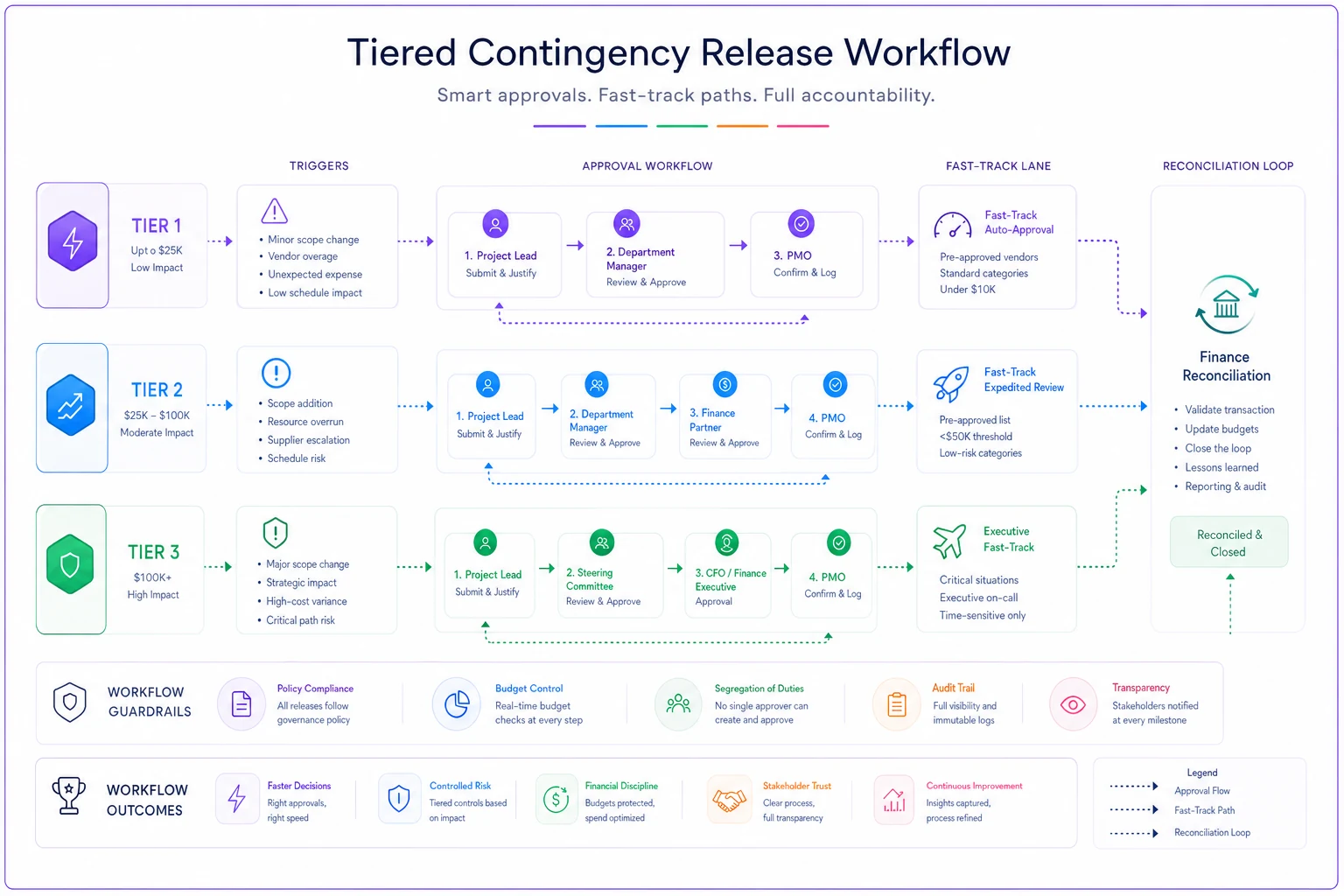
This flow shows how triggers move from immediate release to escalated reviews and then into reconciliation so roles and timing are clear.
Pre-approved use cases eliminate ambiguity
The magic happens when you define specific use cases for each tier. Not vague categories—actual scenarios with clear boundaries.
Take vendor delays. Instead of "vendor-related issues" as a trigger, specify:
Tier 1 Release Authorized When:
-
Vendor misses contractual delivery date
-
Delay impacts critical path
-
Expedited delivery available at premium
-
Premium cost under $X per day of schedule recovery
-
Maximum draw
lesser of 15 days coverage or tier limit
Now the PM knows exactly when they can act independently. Finance knows exactly what they've pre-approved. Audit has clear criteria to evaluate.
Construction projects have different triggers than software implementations. Manufacturing rollouts differ from marketing campaigns. Build your use-case library based on your actual portfolio, not generic templates.
Here's what a software implementation might include:
| Trigger Type | Tier 1 (Immediate) | Tier 2 (48hr) | Tier 3 (Full) |
|---|---|---|---|
| Integration Issues | First 40 hours troubleshooting | External consultant up to 2 weeks | Architecture redesign |
| Data Migration | <1% records need manual cleanup | 1-5% need cleanup | >5% or structural issues |
| Training Gaps | Additional sessions, same scope | Expanded scope, same audience | New audience or delivery model |
| Testing Delays | Overtime for existing team | Augmented team up to 30 days | Revised testing approach |
The specificity eliminates gray areas. When integration issues surface, everyone knows the first 40 hours of troubleshooting comes from Tier 1, no questions asked.
Release triggers that protect both speed and control
Smart triggers balance operational flexibility with financial control. They need enough detail to prevent abuse but not so much that they paralyze decision-making.
1. Activation Criteria What specific, measurable condition must exist? Not "project is behind schedule" but "critical path activities delayed by X days with no float remaining."
2. Validation Requirements What evidence proves the trigger condition exists? For vendor delays: delivery confirmation emails, updated shipping notices, or signed change orders from vendors.
3. Use Restrictions What can't this contingency cover? Vendor delay contingency might exclude delays caused by the project team's late orders or specification changes, for example.
4. Escalation Thresholds When does this trigger move up a tier? A third vendor delay might automatically require Tier 2 review, even if the amount stays within Tier 1 limits.
Some PMOs create 50-page trigger documents that nobody reads. Keep it simple. One page per trigger type, clear examples, accessible to everyone. Update quarterly based on actual usage patterns.
Reconciliation that satisfies audit without crushing productivity
Finance and audit need to verify contingency use without creating administrative nightmares. The solution is automated capture with periodic review—not constant oversight.
For Tier 1 draws, require documentation within 48 hours but review monthly:
-
Screenshot of triggered condition
-
Amount drawn and specific use
-
Impact on project metrics (schedule, scope, quality)
-
Link to project management system records
Build contingency capture into your project management tool so logging takes seconds, not hours.
Build this into your standard project tools. When a PM logs overtime due to vendor delays, the system automatically creates a contingency record. They add three lines of context, attach the vendor notice, done. Two minutes, not two hours.
Monthly reconciliation follows a standard pattern:
-
System generates list of all Tier 1 draws
-
Finance samples 10-20% for detailed review
-
Patterns get flagged (same project drawing repeatedly)
-
Quarterly trend analysis identifies systemic issues
For Tier 2 and 3, maintain full documentation from day one. Because these happen less frequently and with proper approval, the audit trail builds itself through the approval process.
The real key is variance analysis. If contingency use exceeds plans by 20%, trigger a portfolio review—but not project by project. Look for patterns. Are all construction projects hitting the same issue? That's a planning problem, not a contingency problem.
Making approval levels work at portfolio scale
Approval hierarchies usually become bottlenecks because they're designed for control, not flow. Fix this by creating standing approval mechanisms that run continuously, not ad-hoc.
Weekly Tier 2 Review Cycles Every Tuesday, 2-4pm: standing contingency review session. Requests submitted by Monday noon get answered by Wednesday morning. No exceptions, no delays.
Standardize the packet:
-
One-page summary per request
-
Standard financial impact template
-
Risk assessment if denied
-
PM recommendation with alternatives
Decision makers commit to attending or delegating with full authority. No "pending Bob's return from vacation" delays.
Monthly Tier 3 Planning Sessions Strategic contingency needs deeper discussion, but schedule it proactively. First Thursday of each month, review all Tier 3 potentials—not just active requests but emerging risks that might trigger next month.
This forward-looking approach lets executives prepare for big decisions rather than getting ambushed. They can ask questions, request analysis, and align stakeholders before the critical moment hits.
Delegation Matrices That Actually Work Most delegation matrices fail because they're too rigid or too vague. Build yours around project characteristics, not just dollar amounts:
-
Projects under 6 months
PM approves Tier 1, Portfolio Manager approves Tier 2
-
Strategic initiatives
All tiers require portfolio manager minimum
-
Compliance projects
Legal signs off on any scope-related contingency
-
Multi-region projects
Regional heads approve their portions independently
Update these quarterly based on actual patterns. If every construction project needs Tier 2 approval for weather delays in winter, adjust the matrix for seasonal patterns.
Pattern recognition turns contingency data into planning intelligence
Most PMOs treat contingency draws as one-off events. But patterns in contingency use reveal systematic planning and capacity issues that better organizations fix proactively.
Track contingency draws by category, project type, and timing. When 70% of software projects tap contingency for integration issues in months 3-4, that's not bad luck—it's bad planning. Build it into the baseline for future projects.
A medical device company discovered that every single product launch needed contingency for regulatory documentation in the final quarter. They were planning based on best-case regulatory timelines, then scrambling when reality hit. Once they built realistic regulatory timelines into baselines, contingency draws dropped around 40%.
Look for correlation patterns too:
-
Do certain PMs consistently trigger contingency?
-
Do specific vendors drive more contingency use?
-
Are certain project phases predictably under-resourced?
One pattern that shows up regularly: projects approved in Q4 use significantly more contingency than those approved in Q2. Year-end pressure leads to aggressive estimates and rushed planning. Companies push projects through to hit annual targets, then pay for it with contingency draws all next year.
The operational reality of making this work
Setting up tiered contingency sounds clean on paper. Reality gets messy fast.
The first two months will be rough. Project managers used to hoarding will overdraw Tier 1, thinking it's free money. Finance will panic watching Tier 1 burns spike. Don't overreact. Set weekly check-ins, adjust triggers based on actual use, but give it 90 days before making major changes.
You'll discover gaps in your triggers immediately. That weird vendor situation that doesn't fit any category. The scope change that's somehow both minor and critical. Document these, add them to monthly reviews, update triggers quarterly. The framework grows through use, not planning.
Politics matter more than process here. If the CFO doesn't trust the PMO, no framework fixes that. Start with a pilot—pick 3-5 projects with strong PMs and reasonable risk profiles. Prove the model works, then expand. Success sells better than PowerPoints.
Training can't be generic either. Run scenarios specific to your projects. Take last year's biggest contingency draws and walk through how they'd work under the new system. People learn through examples, not rules.
Watch for gaming behaviors. PMs splitting single issues into multiple Tier 1 draws. Finance creating "informal requirements" that defeat the tiering. Address these directly—gaming the system usually means the system needs adjustment, not punishment.
Technology enablement without over-engineering
The temptation is to build elaborate workflow systems with dozens of approval steps and automated everything. This usually fails. Start simple, add complexity only where friction persists.
Your existing project management platform probably handles 80% of what you need. Add custom fields for:
-
Contingency tier
-
Trigger type
-
Approval status
-
Draw amount
-
Impact metrics
Create simple forms that push data to a central dashboard. Finance sees aggregate draws by tier, project, and trigger. PMs see their remaining contingency by tier. Portfolio managers spot patterns and trends.
Automated alerts matter more than automated approvals:
-
Alert when project draws 50% of any tier
-
Flag when multiple projects hit the same trigger
-
Notify of approaching tier thresholds
-
Highlight unusual patterns
This is where AI-powered operational software starts to show real value. Instead of manually tracking patterns across dozens of projects, modern platforms can flag anomalies automatically. When three projects suddenly start drawing integration contingency, the system alerts portfolio leadership to investigate systemic issues.
Keep the human decision element intact, though. Automated recommendation, human approval. The system suggests this looks like a Tier 1 trigger based on past patterns, but the PM confirms and documents the specific context.
Quarterly calibration keeps the system responsive
Static contingency rules become outdated fast. Markets shift, projects evolve, organizations learn. Build calibration into your operating rhythm.
Every quarter, analyze:
-
Usage rates by tier and trigger
-
Approval cycle times
-
Override patterns
-
Unused contingency
If Tier 1 runs dry on most projects while Tier 3 goes untouched, your bounds need adjustment. If certain triggers never activate, remove them. If new patterns emerge, add triggers.
Pay attention to seasonal patterns. Construction contingency spikes in winter. Software projects hit integration issues during holiday code freezes. Marketing campaigns need flexibility during peak seasons. Adjust tier limits and triggers accordingly.
Get feedback from all stakeholders:
-
PMs
What triggers are missing? What approval delays hurt most?
-
Finance
Which controls feel inadequate? Where do you need more visibility?
-
Executives
Are you seeing the right decisions at the right level?
-
Audit
Any compliance gaps or documentation issues?
One manufacturing PMO discovered their Tier 2 approval cycle averaged 6 days despite the 48-hour SLA—decision makers were traveling constantly. They shifted to rolling approvals with clear delegation chains and cut actual cycle time to 36 hours.
The compound effect of structured contingency management
When tiered contingency works well, the benefits cascade through the entire portfolio.
Projects move faster because PMs aren't paralyzed by approval fears. They know exactly what they can handle independently and what needs escalation. A semiconductor company cut project delays by roughly 22% just by eliminating contingency-approval bottlenecks.
Finance gets better forecasting because contingency draws become more predictable. Instead of random massive draws, they see steady Tier 1 usage with occasional Tier 2 bumps. Variance analysis actually means something when you can separate operational noise from strategic shifts.
Executives focus on real decisions, not administrative approvals. When the board only sees Tier 3 requests, those discussions become strategic conversations about market conditions and project viability—not rubber-stamping routine overages.
The portfolio view improves too. Patterns in contingency use reveal systemic issues you can actually fix. Maybe all your enterprise software projects need more integration budget. Maybe your construction estimates consistently miss weather impacts. These insights drive better future planning.
Most importantly, trust increases across the organization. PMs trust they can access funds when needed. Finance trusts the controls prevent abuse. Executives trust they'll know about major issues before they explode. That trust reduces the friction that typically plagues portfolio operations.
Moving from reactive to strategic contingency operations
The best PMOs eventually flip contingency from insurance to intelligence. They stop seeing it as emergency funds and start treating it as operational data that drives portfolio strategy.
When you know exactly which triggers activate most often, you can address root causes. If vendor delays constantly trigger contingency, maybe you need different vendors or different contract terms. If scope clarifications always emerge in phase 2, maybe your requirements process needs work.
This intelligence feeds back into project approval too. New projects get evaluated not just on their business case but on their contingency profile. A project with unclear requirements might need 25% contingency while a well-defined infrastructure upgrade needs only 10%.
Resource allocation improves as well. If certain skill gaps consistently drive contingency use—emergency contractors, consultants, overtime—that's a signal to hire or train. One financial services PMO discovered they spent around $2M annually on contingency-funded Excel consultants. They hired two full-time analysts and cut contingency draws by $1.5M.
The contingency framework becomes a living system that learns and adapts. Each project contributes data, patterns emerge, processes adjust, and future projects benefit. It's not just about managing today's contingency—it's about needing less of it tomorrow.
This kind of systematic improvement requires discipline most organizations struggle to maintain. Tracking every draw, analyzing patterns quarterly, updating triggers regularly—it's detailed work that's easy to skip when projects get hectic. But the organizations that stick with it consistently outperform those that treat contingency as a static slush fund.
The path from reactive to strategic contingency management isn't complicated, but it requires commitment to the framework even when individual situations tempt you to make exceptions. Every override, every special case, every "just this once" erodes the system's effectiveness.
Start with the basics: three tiers, clear triggers, simple documentation. Let the system prove itself on routine decisions before tackling edge cases. Build confidence through consistent execution, then gradually expand sophistication as your organization's capability grows.
Start with the basics: three tiers, clear triggers, simple documentation. Let the system prove itself on routine decisions before tackling edge cases. Build confidence through consistent execution, then gradually expand sophistication as your organization's capability grows.
Ready to elevate your project delivery?
Join over 2,500 project teams using GoProjy to optimize resources, reduce risks, and drive portfolio success.