

Most PMOs don't have a data problem. They have an ownership problem that looks like a data problem.
Ask around and you'll hear the usual complaints — the numbers don't match, the dashboard is three weeks stale, finance disagrees with delivery, and every steering committee opens with 20 minutes of arguing about whose spreadsheet is right. But underneath all of that, the actual failure is almost always the same: nobody owns the data as a product. It gets assembled, reactively, by whoever happens to be free when the deck is due.
That's the gap this blueprint is meant to close. Not another tool recommendation, not another canonical model diagram — those matter, but they're downstream. This is about the operating model: who owns what, in what order you build things, how you contract for quality between teams, and how you tie every dollar of analytics investment to something a CFO would actually sign off on.
Why analytics keeps breaking even after the "platform" goes in
There's a pattern worth naming early. A PMO buys or builds a reporting platform, connects a few systems, ships some dashboards — and within about two quarters, trust erodes anyway. People go back to their own spreadsheets. The platform becomes the thing you check after you've already decided.
Why does this keep happening?
Because the platform was treated as a project, not a product. A project ends. Someone builds the connectors, hands over a dashboard, and moves on. But portfolio data changes constantly — new project codes, a reorg, a vendor swap, a finance system upgrade. Without a standing owner, entropy wins. The connector that pulled actuals silently breaks. The status field someone renamed stops mapping. Nobody notices until a number looks wrong in front of an executive.
The second reason is subtler. Most PMOs conflate reporting with data reliability. They spend heavily on the visualization layer — the pretty part — and almost nothing on the contracts and stewardship underneath. It's like polishing the dashboard of a car with no oil in the engine. Getting the plumbing right matters more than the charts; we've written separately about the portfolio data integration patterns that make KPIs reliable, and that plumbing is the foundation everything here sits on.
The operating model is what keeps that foundation from rotting.
The roles nobody assigns (and then wonders why data rots)
If you take one thing from this article, make it this: data reliability is a role, not a task. Until someone's charter explicitly says "you own this," it belongs to no one.
Stop losing track of critical projects.
GoProjy helps you monitor, prioritize, and deliver projects on time—seamlessly.
- Unified portfolio visibility
- Real-time resource tracking
- Milestone & risk alerts
No credit card required
Two roles do most of the heavy lifting in a PMO analytics operating model. They're borrowed from data-product thinking, but they translate cleanly to portfolio work.
The Data Product Owner (DPO)
This is the person accountable for a domain of portfolio data — say, "project financials" or "resource capacity" or "delivery status" — as a product with users, a roadmap, and quality standards.
They don't build the pipelines themselves. They decide what "good" looks like, prioritize what gets integrated next, and make the call when two source systems disagree. Crucially, they own the definitions. When someone asks "what counts as an active project?" the DPO has the answer, it's written down, and it's enforced.
In smaller PMOs this is often a portfolio analyst wearing the hat part-time — and that's fine, as long as it's on their charter and protected in their week. The failure mode is leaving it implicit.
The Data Steward
Where the DPO sets direction, the steward keeps the day-to-day clean. They monitor quality, chase down the project manager who hasn't updated actuals in three weeks, validate that new project codes follow the naming convention, and flag when a connector's row counts drop off a cliff.
The steward is closer to the source systems and the people entering data. In practice this role lives best inside the PMO itself, not in central IT — because a lot of stewardship is really chasing humans, and that requires relationships and standing, not just system access.
One mistake worth avoiding: combining both roles into one overloaded person and then wondering why neither gets done well. Strategy work — definitions, roadmap — gets crowded out by firefighting every single time. The urgent eats the important.
A compact role charter template
-
Owns which data domain(s) and which KPIs depend on them
-
Decides what this role can decide alone vs. must escalate
-
Standards the definitions and quality thresholds they enforce
-
Cadence what they review weekly, monthly, quarterly
-
Interfaces who they hand off to (finance, IT, delivery leads)
-
Not responsible for the explicit list of things people will try to dump on them
That last line does more work than the rest combined. Write down what the role is not responsible for, or it will absorb everything and accomplish nothing.
Sequencing the roadmap: quick wins before the platform, always
The instinct in a lot of PMOs is to design the perfect target-state architecture and build toward it for eighteen months. By the time it lands, the sponsors have changed, priorities have shifted, and the thing solves last year's problem.
A better approach runs the other way: prove value fast on the messiest, most-argued-about numbers first, then invest in the platform once you've earned the credibility and learned where the real pain actually is.
| Band | Timeframe | Goal | Typical work | Investment posture |
|---|---|---|---|---|
| Quick wins | 0–3 months | Stop the arguments on 1–2 high-visibility KPIs | Manual-but-governed data pulls, agreed definitions, one clean dashboard | Low — mostly people time |
| Consolidation | 3–9 months | Automate the pulls, add data contracts, expand coverage | Connectors for the top 3–4 sources, steward monitoring, QA checks | Medium |
| Platform | 9–18 months | Scale to the full portfolio, self-service, historical trends | Canonical model, sync SLAs, governed self-service reporting | Higher — tooling + staffing |
The reason quick wins matter isn't just morale. They teach you the roadmap. When you manually reconcile project financials for a quarter, you learn exactly which fields are unreliable, which PMs never update on time, and where two systems define "committed spend" differently. That knowledge is what makes the platform build actually correct instead of theoretically correct.
A quick-win scenario that plays out pretty often: a PMO with around 40 active projects can't get a trustworthy "portfolio spend to date" number because three departments track it three ways. Instead of a six-month integration project, the DPO agrees on a single definition, the steward pulls and reconciles it manually every two weeks, and within a month the steering committee stops arguing about the figure. The automation comes later, once the definition is stable.
Prove value fast on the messiest, most-argued-about numbers first.
Here's a simple illustration of the typical sequencing workflow from quick wins to consolidation to platform.
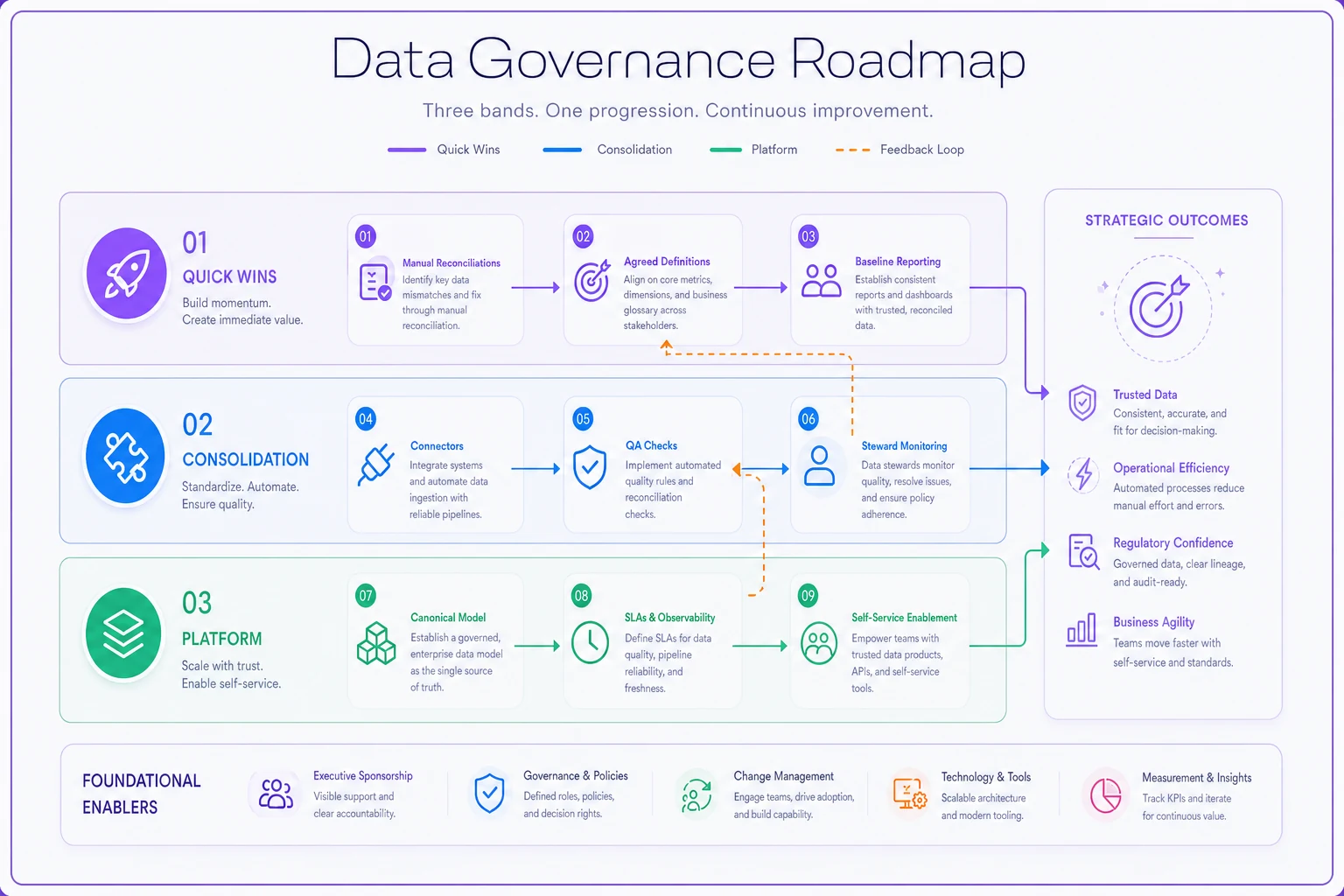
The visual emphasizes proving value early, capturing learnings, and using those lessons to design a scalable platform rather than building to an unvalidated target state.
Data contracts and QA: the part everyone skips
A data contract is just an agreement between a source system (or the team that owns it) and the PMO about what data will be delivered, in what shape, at what quality, and how often. It sounds bureaucratic. It's actually the single thing that separates a reporting layer people trust from one they quietly route around.
Without contracts, every schema change upstream becomes a silent break downstream. Someone in finance renames a cost category, and your portfolio roll-up is wrong for three weeks before anyone catches it — usually in a meeting, in the worst possible way.
A workable contract for a PMO doesn't need to be a 40-page document. It needs to specify:
-
Fields and types — what columns you're relying on and their format
-
Freshness — how often it updates and the maximum acceptable staleness
-
Completeness — what "fully populated" means (e.g., every active project must have an owner and a current forecast)
-
Change notice — how much warning you get before the source changes structure
-
Owner — a named human on the source side, not a team alias
The QA layer sits on top of these contracts as automated checks: row counts within expected ranges, no null values in required fields, totals that reconcile to a control figure, freshness timestamps within SLA. When a check fails, the steward gets flagged before the number reaches a dashboard.
This is where the connection to your KPI layer becomes concrete. The whole point of contracts and QA is that the numbers arriving at the top are decision-grade — which is the same principle behind turning status noise into decision-ready insights. Contracts are how you stop noise at the source instead of cleaning it up at the end.
A simple QA process to run every reporting cycle
-
Freshness check — confirm every source updated within its SLA window; flag anything stale.
-
Completeness check — validate required fields are populated for all active projects.
-
Reconciliation check — tie a key total (e.g., portfolio committed spend) back to a trusted control number from finance.
-
Variance check — flag any KPI that moved more than an expected threshold since last cycle for human review.
-
Sign-off — steward marks the dataset "clean," or logs the exception and who's fixing it.
Run this before anyone builds the deck, not after someone questions a number in the meeting.
Build vs. buy: a decision matrix that ties to actual constraints
At some point you'll face the build-vs-buy question for the platform layer, and it's easy to answer it emotionally — engineers want to build, procurement wants to buy, everyone has a preference dressed up as analysis.
Ground it instead. The real drivers are how standard your needs are, how much integration complexity you're carrying, and whether you have people to maintain what you build.
| Factor | Lean toward BUY | Lean toward BUILD |
|---|---|---|
| Requirements | Standard PMO KPIs, common tools | Highly bespoke definitions/logic |
| Integration complexity | Few, well-supported source systems | Many legacy or custom sources |
| In-house capability | No standing data engineering | Real, retained engineering capacity |
| Timeline | Need value in 1–2 quarters | Can invest over 12+ months |
| Change frequency | Requirements fairly stable | Constant change you must control |
| Total cost view | Predictable subscription preferred | Willing to own long-term maintenance |
The trap almost nobody sees coming: teams evaluate build-vs-buy on the build cost and forget the maintain cost. Building a custom integration layer isn't a one-time spend — it's a standing commitment to keep it alive as every connected system evolves. A PMO with no retained engineers who builds custom pipelines is signing up for a slow-motion outage the day that one contractor rolls off.
A pragmatic middle path most healthy PMOs land on: buy the platform and reporting layer, own the definitions and contracts. Let a vendor handle the plumbing and self-service, while your DPO and steward own the thing no vendor can own for you — what the numbers mean in your portfolio. This is also where AI-assisted operational platforms can quietly earn their keep: automated QA checks, anomaly flags on data that suddenly looks off, reconciliation that would otherwise eat a steward's whole week. Not automation for its own sake — just freeing up scarce people from chasing broken pulls so they can do the judgment work that actually matters.
Staffing and investment: what to fund, and when
The staffing question tends to get answered backwards — PMOs fund tools first and people last, then can't figure out why the expensive platform underdelivers.
The order that actually works:
-
Fund the DPO role first (even part-time). No platform pays off without someone owning definitions and direction.
-
Fund stewardship next. A tool with no steward degrades into an untrusted tool within a couple of quarters.
-
Fund automation/tooling third, sized to the reliability the first two roles have already proven you can maintain.
Tie every increment to ROI in language finance recognizes. The value of PMO analytics isn't "better dashboards" — it's decisions made faster and mistakes avoided.
Analytics investment ROI table
| Investment | Cost posture | ROI mechanism | How to evidence it |
|---|---|---|---|
| DPO (part-time) | Low | Fewer disputed numbers, faster steering decisions | Time-in-meeting spent reconciling drops |
| Steward | Low–medium | Fewer bad decisions from stale/wrong data | Count of caught data errors per cycle |
| Automated pulls | Medium | Analyst hours reclaimed, faster cycle | Hours saved per reporting cycle |
| Full platform | Higher | Portfolio-wide visibility, earlier risk detection | Slippage/overspend caught earlier |
A mid-size PMO — call it around 60 projects — had two analysts spending close to a full week each, every month, manually assembling and reconciling the portfolio report. That's roughly 8–10 person-days a cycle just to produce numbers people still argued about. After assigning a part-time DPO to lock definitions, standing up a steward for weekly checks, and automating the three worst data pulls, the assembly work dropped to something like a day and a half — and the steering committee stopped relitigating the figures. The analyst time didn't vanish; it moved to actual analysis. Nobody put a heroic dollar figure on it, but reclaiming roughly a week of skilled analyst time a month, plus fewer decisions made on bad data, paid for the modest investment several times over.
When this blueprint is overkill (and when it's overdue)
Not every PMO needs the full apparatus, and pretending otherwise is how you build governance nobody follows.
When the lighter version is enough:
-
You're running fewer than ~15–20 projects and one person can genuinely hold the numbers in their head
-
Your source systems are few and stable
-
Decisions aren't being delayed or reversed because of data disputes
In that case, do the roles-and-definitions part and skip the platform entirely. Contracts and a shared definition of your key KPIs will get you 80% of the value.
When it's overdue:
-
Steering meetings routinely open with arguments about whose number is right
-
People maintain private spreadsheets because they don't trust the official report
-
A source-system change has burned you at least once
-
You're scaling past the point where any one person can track it all
Who should not rush into a platform build: any PMO without a named data owner and steward already in place. Buying tooling before assigning ownership is the most common — and most expensive — sequencing mistake there is. The tool doesn't create the discipline. The roles do; the tool just scales what the roles already enforce.
Pulling it together
The reason PMO analytics so often disappoints isn't the technology. It's that data reliability gets treated as an output — something the dashboard produces — instead of an operating capability that people own, contract for, and maintain on a cadence.
Get the sequence right and the whole thing gets easier. Assign the owner and steward before you buy anything. Prove value on your most-argued-about numbers with manual-but-governed pulls. Write the contracts that stop upstream changes from silently breaking you. Then, and only then, invest in the platform — sized to the reliability you've already demonstrated you can hold. Tie each step to a ROI story finance actually believes, which is almost always about faster decisions and avoided mistakes rather than prettier charts.
Do that, and the portfolio numbers stop being a thing to argue about at the start of every meeting. They become the thing you decide with.
The reason PMO analytics so often disappoints isn't the technology. It's that data reliability gets treated as an output — something the dashboard produces — instead of an operating capability that people own, contract for, and maintain on a cadence.
Do that, and the portfolio numbers stop being a thing to argue about at the start of every meeting. They become the thing you decide with.
Ready to elevate your project delivery?
Join over 2,500 project teams using GoProjy to optimize resources, reduce risks, and drive portfolio success.