

Running hybrid delivery governance means getting caught between two forces that genuinely don't want to coexist. Portfolio leadership needs governance gates to manage risk and funding decisions across dozens of initiatives. Agile teams need autonomy to iterate, pivot, and deliver without constant approvals grinding things to a halt.
When portfolio governance collides with team autonomy, everyone loses momentum
The collision usually shows up around month three or four. Teams start missing gate reviews because they're mid-sprint. Portfolio committees hold up funding while waiting for documentation that doesn't map to Agile artifacts. Product owners spend more time building governance decks than actually working with their teams. That friction compounds until either governance falls apart or teams quietly drop Agile practices just to clear the next stage gate.
Both sides have a legitimate point. Portfolio governance genuinely needs visibility and decision checkpoints to manage risk across a multi-million dollar portfolio. Agile teams genuinely need room to respond to feedback without sitting in approval queues. The problem isn't either model — it's forcing them to coexist without any intentional adaptation.
The cadence mismatch that breaks everything
The core conflict is incompatible rhythms. Traditional stage-gate governance runs on milestone-based timelines — requirements done, design approved, build complete, testing finished. Gates might be months apart, tied to project phases. Agile teams operate on fixed cadences — two-week sprints, quarterly planning increments, continuous delivery.
Stop losing track of critical projects.
GoProjy helps you monitor, prioritize, and deliver projects on time—seamlessly.
- Unified portfolio visibility
- Real-time resource tracking
- Milestone & risk alerts
No credit card required
Overlay those two patterns and the misalignment gets obvious fast. A team running two-week sprints crosses six iteration boundaries between quarterly governance gates. Governance still wants comprehensive documentation at phase completions that have nothing to do with iterative delivery. Teams either fake the documentation to clear the gate or pause their cadence to produce materials nobody seriously reads.
The documentation problem makes everything worse. Stage gates want detailed requirements specs, design documents, and test plans. Agile teams produce user stories, sprint reviews, and working software. Neither side speaks the other's language, so PMO leads end up translating between frameworks — overhead that adds zero delivery value.
Resource allocation breaks down entirely under this dual system. Portfolio governance funds based on gate approvals: pass design review, get development money. But Agile teams need consistent funding across their roadmap, not stop-start approvals tied to phase gates. Finance gets confused about which model applies. Teams start hoarding resources between gates because they can't predict when the next approval is coming.
Why traditional fixes fail at portfolio scale
The usual first attempt involves creating "Agile-friendly" governance gates. PMOs reduce documentation requirements, accept sprint demos instead of formal presentations, and try to schedule gates around PI planning events. This holds together for maybe three to five teams. Once you hit 15–20 teams across different product lines, simplified gates still create bottlenecks.
Scheduling alone becomes a mess. Twenty teams on different sprint cadences means someone is always mid-sprint during governance reviews. Force alignment to a common cadence and you've destroyed team autonomy. Let teams pick their own review slots and portfolio governance loses any coherent decision rhythm.
Another common approach exempts Agile teams from certain gates entirely. Small enhancements skip design review. Internal tools bypass architecture approval. This creates a two-tier system where some initiatives get scrutinized and others run free. Risk accumulates in the exempt bucket until something fails badly enough that governance overcorrects and starts controlling everything again.
The hybrid model — Agile practices inside waterfall gates — creates the worst of both worlds. Teams can't truly iterate because they're locked to gate commitments. They can't use Agile's feedback loops because pivoting would require re-approval. You end up with mini-waterfalls inside sprint boundaries, which is the exact opposite of what you were trying to build.
Some PMOs run parallel tracks — traditional gates for waterfall, Agile governance for iterative teams. This fragments portfolio visibility. Leadership can't compare initiatives across tracks. Resource allocation gets painful when specialists move between both models. The PMO team burns out maintaining two complete governance frameworks.
Building cadence contracts that respect both needs
The shift that actually works is treating governance integration as a coordination problem rather than a control problem. Cadence contracts create clear agreements between portfolio governance and Agile teams about what information flows when — without forcing either side to abandon how they work.
A cadence contract maps synchronization points where team cadences naturally meet portfolio needs. Instead of arbitrary gates, you identify moments when teams already produce artifacts governance cares about. Sprint reviews become lightweight decision points. PI planning incorporates portfolio prioritization. Retrospectives feed risk registers.
Here's what a basic cadence contract includes:
Information flows:
-
What metrics teams automatically share (velocity, burn-up, escaped defects)
-
Which artifacts get published to portfolio tools (roadmaps, dependency maps, risk logs)
-
How status translates between frameworks (story points to percentage complete)
-
When exceptions trigger escalation (blocked dependencies, resource conflicts, scope creep)
Decision boundaries:
-
What teams can decide autonomously (technical choices, story prioritization within epics)
-
What requires portfolio input (major pivots, resource reallocation, scope changes over 20%)
-
How fast portfolio decisions happen (24-hour emergency, 1-week standard, quarterly strategic)
-
Who makes tie-breaking calls (product owner, portfolio manager, steering committee)
Resource commitments:
-
How long funding stays committed (full PI, annual allocation, rolling quarters)
-
When teams can request additional resources (monthly review, exception process)
-
How shared specialists get allocated (percentage model, sprint rotation, project blocks)
-
What happens to unused capacity (return to pool, carry forward, team discretion)
Start cadence contracts small—focus on five to seven decision types and iterate based on real issues.
The contract explicitly states that teams keep their chosen cadence as long as they meet information flow requirements. Portfolio governance gets the visibility it needs without dictating how teams organize their work. Both sides know what to expect and when.
Gate-lite flows that maintain control without blocking delivery
Traditional gates create binary pass/fail moments that stop work until approval comes through. Gate-lite flows replace those hard stops with continuous assessment happening alongside delivery. Teams keep building while governance evaluates risk and makes funding decisions.
The shift starts with redefining what gates actually control. Instead of approving phases, gate-lite flows approve resource commitments. A team doesn't need permission to start design — they need funding to bring in designers. They don't need approval to begin testing — they need access to test environments and QA capacity.
Gate-lite reviews run on a rolling basis aligned with team cadences. Every sprint review includes a lightweight governance check:
-
Are we still solving the right problem? (strategic alignment)
-
Is the solution approach still holding up? (technical feasibility)
-
Are resources being used effectively? (delivery efficiency)
-
What risks are starting to surface? (risk management)
These aren't formal presentations to committees. They're structured conversations between product owners and portfolio managers using existing team artifacts. The sprint demo shows working software. The burnup chart shows progress. The dependency board surfaces integration risks.
Major gates still exist — they're just positioned differently. Instead of phase gates, you have decision gates tied to resource commitments:
-
Inception gate Validates problem worth solving, approves discovery funding
-
Commitment gate Confirms solution approach, releases delivery funding
-
Scale gate Verifies initial success, approves expansion resources
-
Harvest gate Assesses outcomes, decides on sustained funding
Between these major gates, teams operate autonomously within their cadence contracts. They can pivot and adjust as long as they stay within defined decision boundaries. If they need to break those boundaries, they trigger an exception review rather than waiting for the next scheduled gate.
Decision contracts that define escalation without constant approval
The slowest part of hybrid governance usually isn't the gates themselves — it's the ambiguity about who decides what. Teams wait for approvals they don't actually need. Portfolio committees review decisions they shouldn't be touching. Everyone burns time in the confusion.
Decision contracts cut through this by explicitly mapping decision rights across different scenarios. Unlike traditional RACI matrices focused on roles, decision contracts focus on decision types and trigger conditions.
A functioning decision contract covers:
Technical decisions stay fully with teams unless they:
-
Impact other teams' architectures
-
Require new technology purchases over $25k
-
Create new security or compliance risks
-
Change fundamental platform choices
Scope decisions follow a threshold model:
-
Under 10% variance
Team decides
-
10–25% variance
Product owner approves
-
25–50% variance
Portfolio manager approves
-
Over 50% variance
Steering committee reviews
Resource decisions depend on type:
-
Team members
Product owner controls
-
Shared specialists
Resource manager coordinates
-
External vendors
Procurement approves based on thresholds
-
New hires
Portfolio approval required
Timeline decisions trigger different responses:
-
Slip under 2 weeks
Team adjusts internally
-
Slip 2–4 weeks
Portfolio notification required
-
Slip 4–8 weeks
Replanning session triggered
-
Slip over 8 weeks
Full gate review required
The contract also defines escalation speed. Emergency decisions get a 4-hour response window. Standard decisions get 48 hours. Strategic decisions wait for the next portfolio review cycle. This keeps everything from becoming urgent while making sure real emergencies get handled immediately.
What makes decision contracts actually stick is that they're bi-directional. Teams commit to raising decisions that exceed their authority. Portfolio governance commits to responding within defined timeframes. Both sides can audit compliance — accountability without micromanagement.
Synchronization points that don't force artificial alignment
Managing touchpoints between Agile cadences and portfolio rhythms is genuinely one of the harder parts of running hybrid delivery governance. Force too much synchronization and you kill team autonomy. Allow complete independence and you lose portfolio coherence.
Effective synchronization happens at natural intersection points rather than manufactured ones. These are moments when teams already pause to plan, review, or adjust. You're not adding ceremonies — you're leveraging existing ones for portfolio needs.
The diagram below shows the synchronization flow between team cadences and portfolio governance.
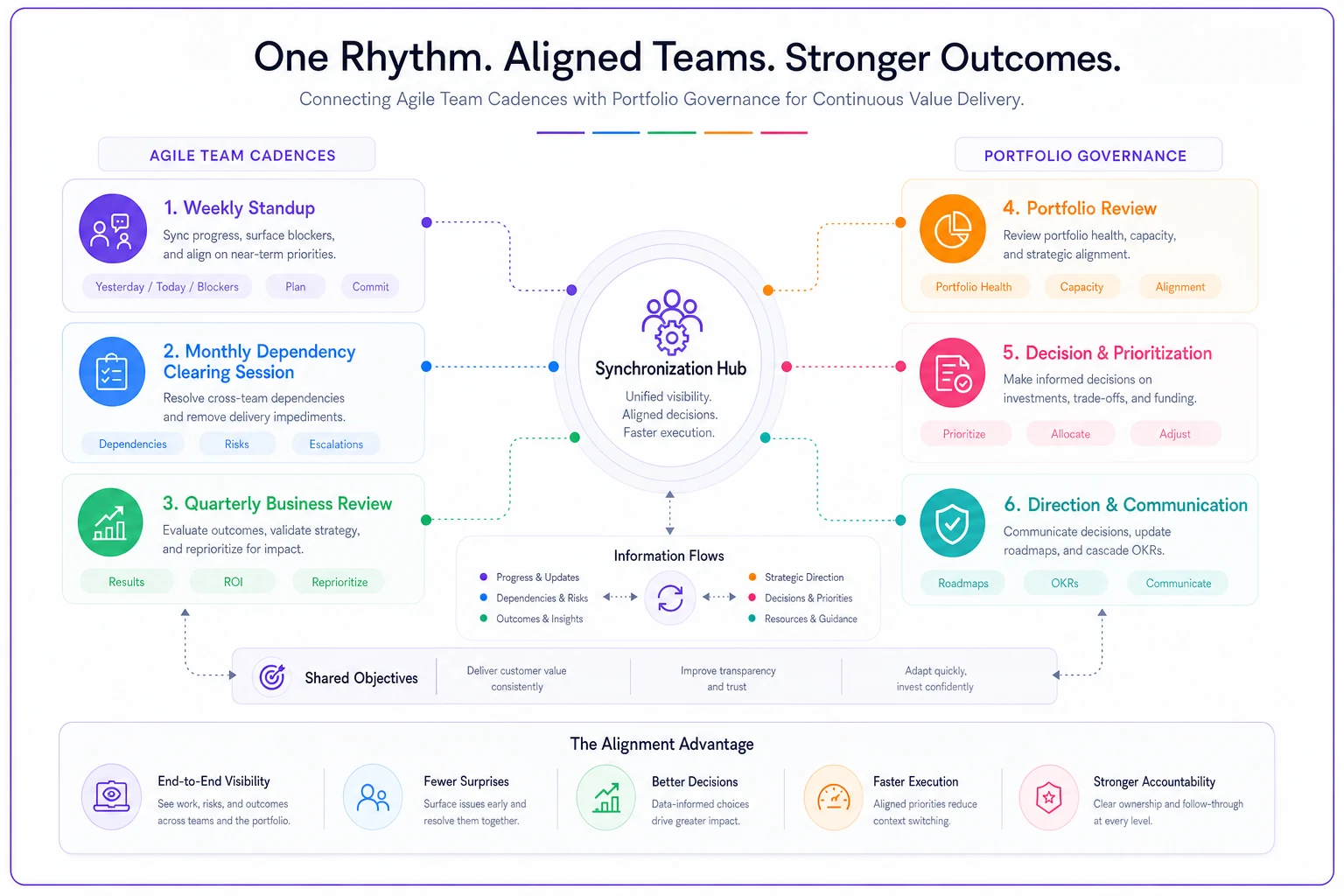
Quarterly business reviews become portfolio synchronization points. Every team is somewhere in their cadence during the quarter, but they all generate quarterly metrics: velocity trends, delivery predictability, outcome measurements. These roll up into portfolio views without forcing sprint alignment.
During quarterly syncs, teams share:
-
Completed features and measured outcomes
-
Updated roadmaps for the next quarter
-
Resource needs and constraint impacts
-
Risk updates and mitigation plans
Portfolio governance provides:
-
Strategic priority adjustments
-
Resource reallocation decisions
-
Funding confirmations for next quarter
-
Cross-team dependency resolutions
Monthly dependency clearing sessions handle integration points between teams. Rather than trying to align all cadences, you create a monthly forum where dependency conflicts get resolved. Teams send representatives with authority to adjust sprint plans. The session produces binding commitments about integration timelines and handoff points.
Weekly portfolio standup gives sponsors and stakeholders continuous visibility without disrupting team flow. One representative from each major initiative gives a two-minute update: status, key accomplishments, upcoming decisions needed. Thirty minutes replaces a dozen status meetings.
Synchronization doesn't require simultaneous action. Teams can operate on different cadences as long as information flows at regular touchpoints.
Measuring governance effectiveness without drowning in metrics
Traditional governance metrics track compliance — gates passed, documents delivered, approvals obtained. None of that tells you whether governance actually helps delivery. Hybrid delivery governance needs different measures that balance autonomy with control.
| Metric Category | What to Measure | Why It Matters |
|---|---|---|
| Flow efficiency | Decision speed, governance overhead, blocker resolution, rework from gates | Shows whether governance enables or impedes delivery |
| Autonomy indicators | Decisions within boundaries, pivot frequency, escalation rate, gate pass rate | Reveals whether decision contracts are well-calibrated |
| Value delivery | Feature throughput, outcome achievement, resource utilization, time to value | Connects governance overhead to actual business results |
| Portfolio coordination | Dependency delays, resource conflicts, integration defects, portfolio predictability | Measures coordination friction across teams |
Start with flow efficiency. If decision speed holds under SLA targets and governance overhead stays below 10% of team capacity, the framework is working. If blockers drag on for weeks or gates consistently trigger rework, something needs adjustment.
High autonomy with low escalation suggests decision contracts are well-calibrated. Frequent pivots with high pass rates indicate teams are effectively self-managing. These aren't guarantees — they're signals worth paying attention to.
Effective governance should reduce coordination friction over time. If these metrics improve as teams adopt cadence contracts and gate-lite flows, the framework is creating real value. If they don't move, the framework needs to be reworked, not just better enforced.
A real scenario: 24 teams, 3 frameworks, 1 portfolio
A financial services company running a $47 million annual portfolio hit the wall with hybrid governance. They had 24 teams across three divisions — 12 fully Agile, 8 using waterfall for regulatory work, 4 trying to blend both. The PMO was spending roughly 60% of their time just translating between frameworks and chasing status.
Every quarterly portfolio review turned into a three-week scramble. Agile teams paused sprints to produce gate documentation. Waterfall teams fudged milestone dates to align with review windows. The hybrid teams couldn't explain their status in either framework's language. Portfolio decisions got delayed because information arrived in incompatible formats.
-
They rolled out cadence contracts starting with the 12 Agile teams.
-
Each team mapped their information flows, decision boundaries, and resource commitments.
-
Teams committed to sharing velocity metrics weekly, updating roadmaps monthly, and participating in quarterly planning.
-
Portfolio governance committed to 48-hour decision SLAs and quarterly funding locks.
-
The gate-lite flows replaced their 7-stage phase gate process with 4 decision gates tied to funding releases.
Teams could move through technical phases at their own pace as long as they stayed within approved investment levels. Only major pivots or resource requests triggered formal reviews.
Six months in, governance overhead dropped from roughly 60% to around 20% of PMO capacity. Teams spent significantly less time preparing governance materials. Decisions that used to take two to three weeks were resolving in two to three days for standard requests. Feature delivery increased by roughly 30% as teams stopped waiting on approvals.
The improvement came from eliminating translation and waiting time, not from abandoning governance. Portfolio oversight and funding control stayed in place — they just got there through lightweight synchronization instead of heavy-handed phase gates. Building on the operating model principles we've explored before, this company created a governance rhythm that supported rather than suppressed delivery velocity.
Common implementation failures and how to avoid them
The most common failure happens when PMOs implement cadence contracts without genuine executive support. Teams agree to contracts, then portfolio leaders override them the first time something goes sideways. Once teams see contracts don't actually protect their autonomy, they stop trusting the framework entirely — and governance friction comes back worse than before.
Get explicit executive commitment to honor contracts except in genuine emergencies. Define what constitutes an emergency (significant revenue impact, regulatory violation, security breach). Everything else goes through contracted decision processes. When executives want to override, make the cost visible — breaking contracts erodes trust and reduces future velocity.
Another failure mode is building overly complex contracts that try to cover every possible scenario. A 47-page contract with hundreds of decision types and a dozen synchronization points becomes impossible to follow in practice. Teams spend more time interpreting contracts than shipping.
Keep them simple and iterative. Start with five to seven key decision types, three or four synchronization points, and basic information flows. Add complexity only when actual problems demand it. A simple contract teams actually follow is worth far more than a comprehensive one everyone ignores.
Some PMOs implement gate-lite flows but keep the old gate mentality running underneath. Reviews stay "lightweight" on paper but still demand 50-slide decks and committee sign-off. Gates get called "rolling" but still block funding until documentation is complete. The form changes; the friction doesn't.
The partial implementation trap catches a lot of organizations. Cadence contracts for some teams, not others. Gate-lite flows for enhancements, full gates for new initiatives. This creates governance tiers that confuse everyone. Similar to building consistent decision rights across your portfolio, hybrid governance needs uniform application to actually function.
Making hybrid governance sustainable with the right operational platform
The manual coordination required to run cadence contracts and gate-lite flows can quietly overwhelm a PMO team. Tracking different team cadences, managing rolling gate reviews, monitoring decision SLAs, and synchronizing information flows across 20-plus teams is a real operational burden. Most PMOs try to manage it through spreadsheets and weekly meetings until the complexity becomes unworkable.
AI-powered operational software changes this considerably. Instead of PMO analysts manually collecting status from each team's tools, the platform automatically pulls metrics from Jira, Azure DevOps, or wherever teams track their work. It translates between frameworks — story points become percentage complete, sprint reviews feed gate assessments, velocity trends inform resource decisions — without anyone having to do that translation manually.
The real value shows up in automated synchronization and exception handling. The platform monitors team cadences and flags when synchronization points are approaching. It tracks decision SLAs and escalates when responses go overdue. It identifies when teams are approaching decision boundaries and triggers the appropriate reviews. The PMO shifts from chasing information to managing actual exceptions.
These platforms also solve the documentation translation problem that plagues hybrid governance. AI-assisted tools can generate gate-appropriate summaries from Agile artifacts — pulling sprint demos, velocity charts, and backlog priorities into portfolio-level views. They maintain audit trails that satisfy governance requirements without forcing teams to build redundant documentation. That eliminates the hours teams waste on governance theater while still giving portfolio leaders the visibility they need.
When a sprint review surfaces a dependency risk, the platform notifies affected teams and schedules a resolution discussion. When multiple teams request the same specialist resource, it triggers portfolio prioritization rather than leaving teams to sort it out informally. When gate reviews flag issues, follow-up items land directly in team backlogs rather than getting buried in an email thread.
Moving forward with confidence
Hybrid delivery governance doesn't have to be a constant friction point between portfolio control and team autonomy. Cadence contracts, gate-lite flows, and decision contracts give both sides the structure to operate effectively without fighting over every decision. That's the actual shift worth making — treating governance as something that enables coordination rather than enforces compliance.
Start small. Pick two or three Agile teams and pilot cadence contracts for one quarter. Define simple information flows and decision boundaries. Run gate-lite reviews alongside existing gates to build confidence before switching fully. Measure the impact on both governance effectiveness and delivery velocity before expanding.
Focus on reducing friction rather than adding control. Every governance touchpoint should either provide something useful to teams or protect against a real portfolio risk. If a gate or review doesn't meet either criteria, cut it. The goal is minimum viable governance — enough oversight to manage risk without getting in the way of delivery.
Hybrid governance is itself iterative. First contracts won't be perfect. Gate-lite flows will need adjustment. Decision boundaries will need calibration. Build in quarterly retrospectives to refine the framework based on what actually happens. What works for your portfolio won't look exactly like what works elsewhere.
The organizations that get this right treat hybrid governance as an operational capability worth investing in — not a compliance framework to impose. They measure success by delivery outcomes, not governance adherence. Respecting team autonomy while maintaining portfolio oversight isn't a compromise. It's just how you actually deliver at scale.
Hybrid delivery governance doesn't have to be a constant friction point between portfolio control and team autonomy. Cadence contracts, gate-lite flows, and decision contracts give both sides the structure to operate effectively without fighting over every decision.
Ready to elevate your project delivery?
Join over 2,500 project teams using GoProjy to optimize resources, reduce risks, and drive portfolio success.