


There's a specific kind of silence that happens in steering committee meetings. You've spent two days pulling clean data, your dashboards are green-amber-red, the burn charts are accurate, and then you present. The room nods. Someone says "great, thanks for the update." And nothing gets decided.
That silence is expensive. Not because the metrics were wrong, but because nobody built the bridge between the number and the choice the number was supposed to force. A schedule variance of -14% is not a decision. "Do we reallocate two engineers from Project Delta by Friday, or accept a six-week slip on the compliance deadline?" — that's a decision. The gap between those two sentences is where most PMOs lose their influence.
An executive narrative system for a PMO is the machinery that closes that gap consistently, meeting after meeting, so metrics reliably produce commitments instead of head-nods. It's not storytelling in the fluffy sense. It's a set of connected components — metric-to-message mapping, decision-ready bundles, objection playbooks, follow-up commitments, and post-decision tracking — that turn raw portfolio signals into things executives can actually act on in the room.
This isn't about better slides. Plenty of PMOs have gorgeous slides and zero decision throughput. It's about treating the path from data to decision as an operational workflow with its own failure points, handoffs, and quality gates — the same way you'd treat intake or capacity planning.
The real problem: your data pipeline ends where the decision pipeline should start
Most PMOs invest heavily in the front half of the chain. Data contracts, canonical models, sync SLAs, reliable KPIs — all of that gets attention because it's tangible and you can measure whether it's working. But the back half, where a metric becomes a message and a message becomes a decision, is usually improvised. Every PM writes their own status narrative, invents their own framing, and shows up with a different sense of what "decision-ready" even means.
What shows up across a lot of portfolio reviews is that the failure isn't analytical. The metric exists. The insight exists. The person presenting it just hasn't packaged it in a form that maps cleanly to a choice an executive is authorized and motivated to make.
-
Metrics get presented without a "so what." A variance number sits on a slide with no attached recommendation, so the executive has to do the interpretive work in real time — and busy executives don't.
-
The ask is vague. "We need more support on Delta" instead of "We need a decision to either fund one contractor for eight weeks or descope module 3."
-
Objections aren't anticipated. The moment someone says "can't the team just work harder?" the whole narrative collapses because there's no prepared response.
-
No one closes the loop. A decision gets made verbally and then evaporates because nobody wrote down who committed to what by when.
Individually these look like presentation quirks. Together they're a systemic leak. And at scale, that leak compounds.
What breaks when you scale from a dozen projects to a hundred
At small portfolio sizes, the narrative gap is survivable because relationships carry it. The PMO lead knows the CFO, the CFO trusts the PMO lead, and a lot of decisions happen in hallways and Slack threads that never needed a formal narrative at all.
Stop losing track of critical projects.
GoProjy helps you monitor, prioritize, and deliver projects on time—seamlessly.
- Unified portfolio visibility
- Real-time resource tracking
- Milestone & risk alerts
No credit card required
That model shatters somewhere between 40 and 80 active projects. When you have twelve projects, one person can hold the full context in their head. They know why Project Delta matters more than Project Echo this quarter, they know the CFO cares about the compliance date, and they can improvise the right framing on the spot. When you have a hundred projects across six portfolios and four PMs feeding into the same executive committee, that improvisation stops working. Now you have four different narrative styles, four different definitions of "urgent," and executives who can't tell whether an amber status from PM A means the same thing as an amber status from PM B.
The symptom leadership notices is decision latency. Choices that used to take a day now take three weeks and two follow-up meetings. The root cause is almost always that every metric arrives wrapped in a different, ad-hoc narrative, so executives spend their limited attention re-deriving context instead of deciding.
One pattern that shows up often: a mid-size infrastructure program office grows from roughly 15 to around 90 projects over two years. Their data gets better the whole time — they invest in reporting tooling and clean up their KPIs. But their decision cycle time gets worse, drifting from same-week decisions to a rolling backlog of around 11 unresolved escalations at any given point. The metrics were fine. The narrative layer just never scaled with the portfolio.
The five components of a working narrative system
Think of this as a small assembly line. Each stage takes an input and produces a standardized output that the next stage can consume. The whole point is that any PM in your org can run it and produce a consistent, decision-ready result — not just your most charismatic program lead.
1. Metric-to-message mapping
This is the translation layer, and it's the piece most PMOs skip entirely. For every metric that can appear in an executive review, you predefine what message it produces when it crosses a threshold.
| Metric signal | Threshold | Standard message | Implied decision |
|---|---|---|---|
| Schedule performance (Tier-1) | < 0.90 for 2 periods | "In-plan recovery no longer feasible" | Rescope, refund, or accept slip |
| Contingency drawdown | > 60% before 50% complete | "Buffer exhausting faster than progress" | Release Tier-2 reserve or freeze scope |
| Specialist utilization | > 95% sustained 3 weeks | "Bottleneck risk, throughput will drop" | Reprioritize queue or add capacity |
| Benefit forecast | -20% vs intake hypothesis | "Business case eroding" | Continue, pivot, or decommission |
| Dependency slippage | Upstream slip > 10 days | "Downstream projects will cascade" | Resequence or protect critical path |
The table isn't the deliverable. The shared logic is. When every PM maps the same metric to the same message, executives stop having to recalibrate for each presenter — and that alone recovers a meaningful amount of decision speed.
2. Decision-ready bundles
A decision-ready bundle is the package you hand an executive so they can decide in the room without asking for more information. It has a fixed shape:
-
The situation in one sentence (from the metric-to-message map).
-
The decision required, stated as a choice between concrete options — not "help us," but "Option A vs Option B vs Option C."
-
The trade-offs for each option in the terms the executive cares about (cost, date, risk, benefit).
-
The recommendation, with the reasoning compressed to two or three lines.
-
The deadline for the decision and what happens if it's missed.
The mistake most people make is loading the bundle with evidence and burying the choice. Executives don't need to see your work; they need the decision surfaced and the supporting evidence available if they push back. The bundle leads with the choice. The evidence sits behind it, one layer down, ready if an objection comes.
Lead with the choice and keep the supporting evidence one click or slide away so executives can probe without derailing the decision.
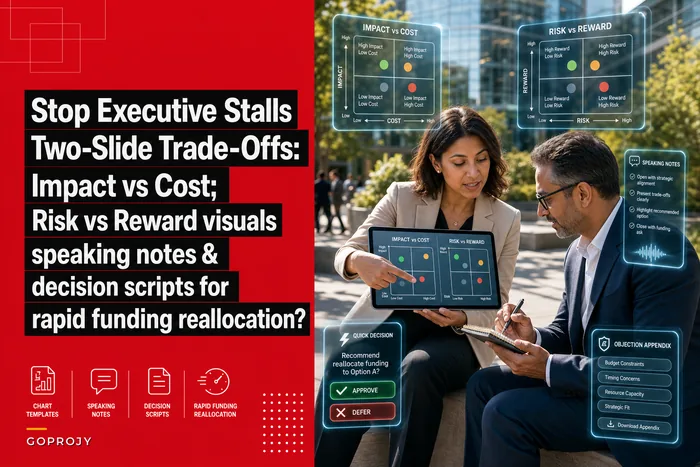
If you want a concrete pattern for compressing a trade-off into something executives can decide against quickly, the approach in the two-slide trade-off and decision-script method pairs directly with this — the bundle is the content, that format is the container.
3. Objection playbooks
This is the component that separates PMOs that get decisions from PMOs that get "let's take that offline." Every recurring decision type attracts the same handful of objections. You already know what they are because you've heard them repeatedly.
-
"Can't the team just absorb it?"
-
"Why didn't we see this sooner?"
-
"Is this really a Tier-1 problem or are we overreacting?"
-
"What if we wait one more cycle?"
An objection playbook prepares a factual, non-defensive response to each one before the meeting. Not a scripted comeback — a prepared piece of evidence. When someone says "can't the team just work harder," the answer isn't a shrug, it's "current sustained utilization is already at 96%, and the last time we pushed past that on Project Echo we lost two people to attrition within the quarter. Here's what that cost us."
Objections are predictable, so treat them as part of the deliverable, not as interruptions. A PM who's rehearsed the top three objections for their decision looks composed and trustworthy. A PM who gets caught flat-footed looks like they haven't thought it through — and the decision gets deferred regardless of how good the underlying data was.
4. Follow-up commitments
The moment a decision is made verbally, it starts decaying. If nobody captures it in a standard form before people leave the room, you'll be re-litigating it in three weeks.
A follow-up commitment is a single structured record captured live: what was decided, who owns the action, what the deadline is, what condition triggers a revisit, and what the decision assumed to be true. That last field matters more than people realize — decisions get made on assumptions, and when the assumption breaks, you need to know which decisions to reopen.
The discipline is capturing the commitment before the meeting ends, out loud, and confirming it: "So we've agreed to fund one contractor for eight weeks, owned by the Delta PM, revisited at the next gate if utilization doesn't drop below 90%. Everyone aligned?" That verbal confirmation, written down in real time, is worth more than any amount of post-meeting minutes.
5. Post-decision tracking
Most PMOs stop at the decision. The mature ones track whether the decision worked. Did funding that contractor actually recover the schedule? Did releasing the contingency reserve fix the buffer problem or just delay it?
Post-decision tracking closes the learning loop. Over a year, it tells you which decision types your organization handles well and which ones consistently miss. Maybe your resourcing decisions land well but your descope decisions almost always underdeliver on the promised benefit. You can only see that pattern if you're tracking outcomes against decisions, not just tracking project status.
This is also what builds PMO credibility over time. When you can walk into a review and say "the last four times we made this call, three worked and here's what we changed about the fourth," executives start deciding faster because they trust your track record.
The workflow, end to end
Here's how the pieces move together in a normal review cycle — where it stops being five separate ideas and becomes one system.
-
Metrics land in your reporting layer through your normal data pipeline. Nothing new here.
-
The metric-to-message map fires. Any metric crossing a defined threshold automatically generates its standard message and flags that a decision may be required.
-
PMs assemble bundles only for the flagged items. This is a critical efficiency point — you're not narrating everything, only the metrics that imply a decision. Everything green stays in the appendix.
-
PMs pull the relevant objection playbook for each decision type and prep responses.
-
The review runs on bundles, not status. The meeting is a sequence of decisions, each one presented as a choice with a recommendation and a deadline.
-
Commitments get captured live in the standard form as each decision is made.
-
Post-decision tracking updates as outcomes come in over the following weeks, feeding back into your credibility and your understanding of which decision types actually work.
The subtle thing about this workflow is that it filters attention. In a badly-run review, everything competes for airtime and the loudest project wins. In a narrative-system review, only metrics that crossed a decision threshold get narrated, so executive attention flows to the choices that actually matter.
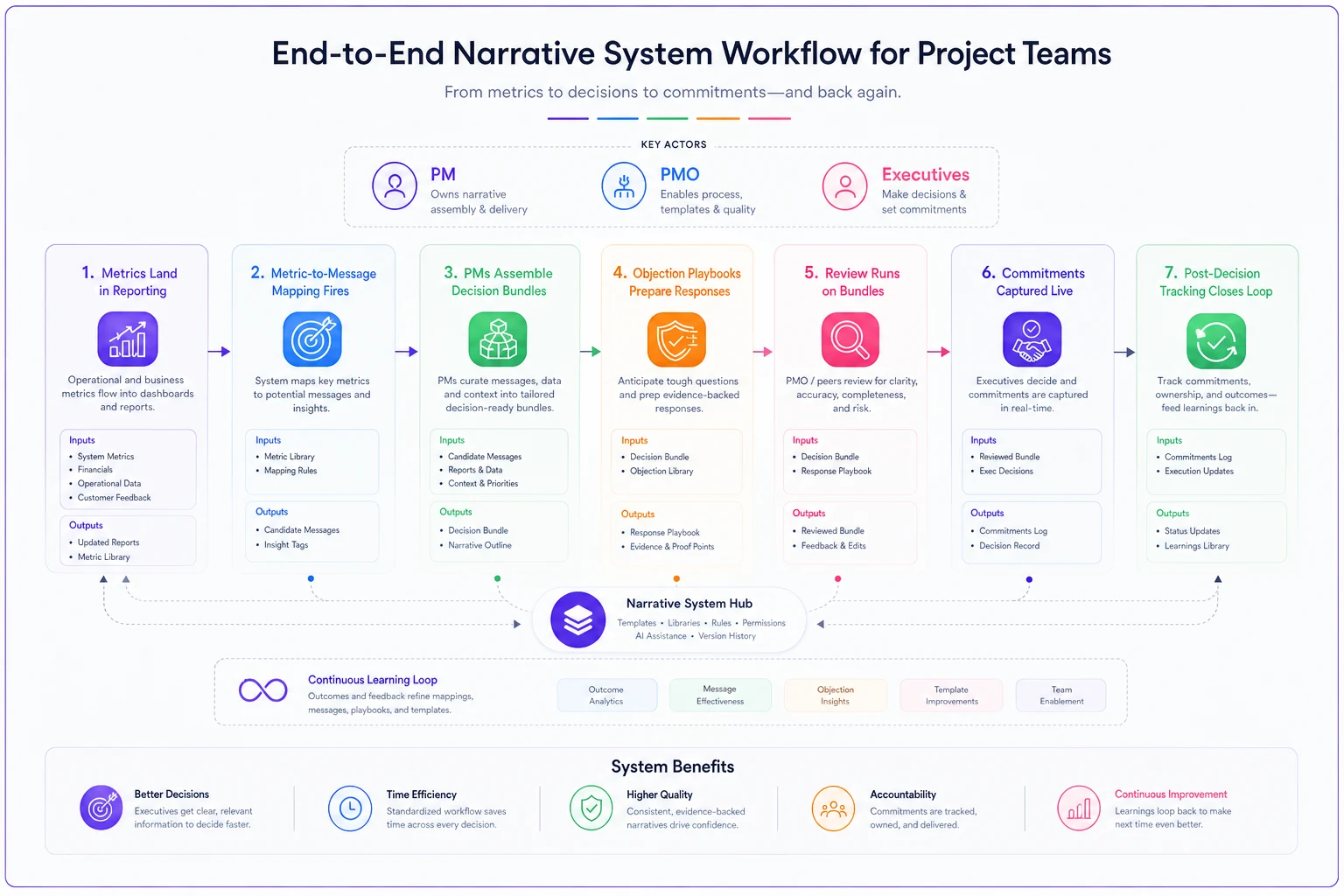
A simple flow visual of these stages helps teams align on handoffs and who owns each gate.
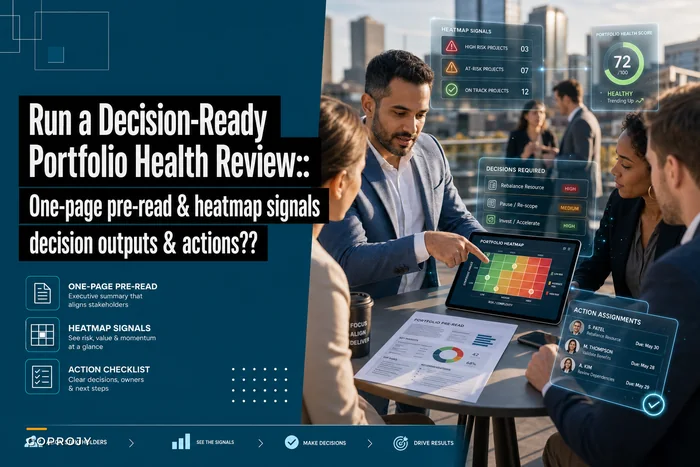
This pairs naturally with a well-structured decision-ready portfolio health review built around a one-page pre-read and heatmap signals — the health review surfaces what needs attention, the narrative system turns each of those into a made decision.
A real scenario
A software delivery PMO at a roughly 600-person financial services firm was running monthly portfolio reviews for about 55 active projects. Their reviews averaged 90 minutes and consistently ended with a handful of items pushed to "next month" — usually three or four unresolved decisions per cycle. Decision cycle time on anything contentious was running around three to four weeks.
The core issue wasn't data quality; their KPIs were solid. It was that every PM presented differently, executives couldn't compare across projects, and objections regularly derailed the harder calls.
They built the narrative layer over about a quarter. Standardized the metric-to-message map first, then the bundle format, then documented the eight or nine objections that came up most often. They didn't buy anything new on the data side — they used their existing reporting to feed the mapping, and much of the message generation and commitment tracking now runs through their workflow platform so the same structure gets enforced for every PM without depending on individual discipline.
The shift wasn't dramatic on any single metric, but the pattern changed clearly. Reviews dropped to around 55–60 minutes because green items stopped consuming airtime. The number of items deferred per meeting fell to roughly one, sometimes zero. Contentious decisions that used to take three-plus weeks were mostly getting resolved in the room. And because commitments were captured live, the "wait, what did we actually decide?" follow-up threads largely disappeared.
Nothing about their analytics got better. The bridge from metric to decision got built, and that was the whole difference.
When this makes sense — and when it doesn't
This kind of system earns its overhead at a certain scale and not before.
When it makes sense:
-
You have enough projects and enough presenters that narrative inconsistency is causing real decision latency.
-
Your data is already reasonably reliable — a narrative system on top of bad data just packages bad decisions faster.
-
Executives are complaining about not being able to compare across projects, or decisions are chronically deferred.
When it's a bad idea:
-
You're running fewer than roughly 15 projects with one or two presenters. Relationships and hallway conversations will outperform a formal system at that size, and the overhead isn't worth it yet.
-
Your metrics aren't trustworthy. Fix the data foundation first; a polished narrative on shaky numbers is actively dangerous because it makes wrong decisions look confident.
-
Leadership doesn't actually want to decide in the room. No narrative system can force decisions on executives who prefer to defer — that's a governance problem, not a communication one.
One group that should probably not bother with this: organizations where the real blocker is unclear decision rights. If nobody in the room is authorized to make the call, the cleanest bundle in the world won't help. You'll just have a beautifully packaged decision with no owner. Sort out who decides what before you build the machinery to feed them.
The part everyone underweights
The most valuable output of a narrative system isn't the individual decisions — it's what accumulates over time.
After a year of post-decision tracking, you know things about your portfolio that no dashboard shows: which decision types your executives make well, which recommendations you tend to get right, where your framing consistently fails to land. That's the compounding asset most PMOs never build because they stop at the decision itself.
A PMO that can say "we've made this class of decision eleven times and here's our hit rate" operates from a completely different position than one that shows up each month with fresh metrics and hopes for the best. The metrics were always there. The system is what turns them, reliably and at scale, into decisions the organization actually acts on — and then learns from.
The most valuable output of a narrative system isn't the individual decisions — it's what accumulates over time.
A PMO that can say "we've made this class of decision eleven times and here's our hit rate" operates from a completely different position than one that shows up each month with fresh metrics and hopes for the best. The metrics were always there. The system is what turns them, reliably and at scale, into decisions the organization actually acts on — and then learns from.
Ready to elevate your project delivery?
Join over 2,500 project teams using GoProjy to optimize resources, reduce risks, and drive portfolio success.