

Nobody tells you that the hard part of executive decision-making isn't the decision. It's the 11 days of calendar Tetris, Slack nudges, and "let's take this offline" purgatory that happens before anyone actually decides anything. By the time three VPs finally sit in the same room, half the context is stale, someone's reopening a question that was settled two weeks ago, and the sponsor who holds the budget is dialing in from an airport lounge with 40% battery.
For a PMO, this is where portfolio velocity dies. You can have flawless intake, clean dependency maps, and a forecast finance would frame on the wall — and still lose six weeks because one reallocation decision kept getting bumped to "next steering committee." The executive decision sprint approach exists to kill that gap. Not more meetings. Tighter, scripted, outcome-locked ones, sized to the weight of the decision.
This is how these actually work when built as a system, where they tend to fall apart, and what changes once you're running dozens of them a quarter instead of one a month.
Why executive decisions stall (and it's rarely the executives)
When a funding call or a scope trade-off sits unresolved, PMs tend to blame the executives. "They won't commit." "They keep kicking it down the road." In practice, the stall is almost always upstream of the room.
The pattern that shows up again and again: the decision arrives under-shaped. Three options are on the table but none have a clear recommendation. The risks are listed but not ranked. Two of the five people in the room are hearing the context for the first time. So the group does the only rational thing — it defers, because deferring is cheaper than deciding badly.
The second pattern is format mismatch. A 2-minute "yes, proceed" decision gets jammed into a 60-minute monthly governance slot, and a genuinely complex $2M reallocation gets 7 minutes at the tail end of a packed agenda. Nobody calibrates the container to the weight of the call. Big decisions get rushed, small ones get bloated, and the committee loses trust that any of it is a good use of time.
The third — and this is the quiet killer — is that nobody owns what happens after "we agreed." The decision gets made verbally, the meeting ends, and three weeks later two people have completely different memories of what was actually approved. No decision record, no owner, no trigger date. The velocity you fought for in the room evaporates in the ambiguity afterward.
So the system has to solve three things at once: shape the decision before anyone walks in, size the session to the stakes, and lock the outcome so it can't quietly dissolve.
The three formats, and when each one fits
The core idea is simple: you don't run one kind of executive session. You run three, and you choose deliberately based on reversibility, dollar size, and how many functions the decision touches.
Stop losing track of critical projects.
GoProjy helps you monitor, prioritize, and deliver projects on time—seamlessly.
- Unified portfolio visibility
- Real-time resource tracking
- Milestone & risk alerts
No credit card required
| Format | Duration | Best for | Typical decision size | People in room |
|---|---|---|---|---|
| Lightning | 10 min | Reversible calls, unblocking, go/no-go on pre-aligned items | Under ~$150k or low-reversibility-cost | 2–3 deciders |
| Trade-off | 20 min | Choosing between 2–3 shaped options, minor reallocations | ~$150k–$750k | 3–4 deciders + 1 presenter |
| Deep call | 45 min | Strategic bets, hard-to-reverse scope cuts, cross-portfolio reprioritization | $750k+ or irreversible | 4–6 deciders + presenter + note owner |
The durations aren't arbitrary. Ten minutes is long enough to confirm alignment and record a decision, too short to reopen a debate. If a Lightning session needs to become a debate, that's a signal it was mis-sized — you bump it up, you don't blow the timebox.
A detail people miss: the format is chosen by the PMO when the item enters the queue, not by the executive in the room. The moment you let the room decide how long to spend, you're back to agenda bloat. The PMO's job is to look at the item, check it against the sizing rules, and schedule the right container.
When Lightning actually makes sense
Lightning works when the real work already happened. Two leaders have aligned async, the numbers are agreed, and all that's left is a formal "yes" on the record. It also works for unblocking — a dependency is stuck because nobody will say whether Team A or Team B owns the integration, and you need a 10-minute ruling, not a workshop.
Where it goes wrong: people try to use Lightning to create alignment that doesn't exist yet. If two of the three deciders disagree on the premise, 10 minutes guarantees either a bad call or a deferral. Lightning ratifies; it doesn't build consensus.
When the 45-minute deep call is worth it
The deep call earns its length when the decision is genuinely hard to walk back — killing a program, committing a quarter of annual capacity to one bet, reordering the top five portfolio priorities. These need room for a real back-and-forth, a chance to pressure-test assumptions, and time to actually sit with the trade-off.
Who should not run a 45-minute session: anyone trying to make a reversible decision feel important. Padding a simple call into a long one trains your executives to disengage. The length should map to the cost of being wrong, nothing else.
The pre-read is the whole game
If you take one thing from this: the quality of a decision sprint is determined before the meeting starts. A 10-minute session with a sharp pre-read beats a 90-minute session with no prep every single time.
The pre-read templates are sized to match the format, and they're deliberately short:
-
Lightning pre-read (half a page) the single decision being asked, the recommendation, two sentences of why, the one risk worth naming, and what happens if we don't decide today.
-
Trade-off pre-read (one page) the 2–3 options as a compact comparison, the recommended option flagged, the key assumption each option rests on, and the reversibility cost of each.
-
Deep-call pre-read (two pages max) the above plus the dependency and capacity impact, the finance view, and the decision's lineage — what prior decisions and assumptions it's built on.
Two things make or break these. First, every pre-read must state the recommendation, not just the options. A pre-read that lists choices without a point of view forces the room to do the analysis live, which is exactly what blows the timebox. Second, the pre-read goes out with a hard read-by time, and the session opens on the assumption that everyone read it. If someone didn't, that's on them — you don't re-present the whole thing. This norm takes a few cycles to stick, but once it does, sessions get dramatically faster.
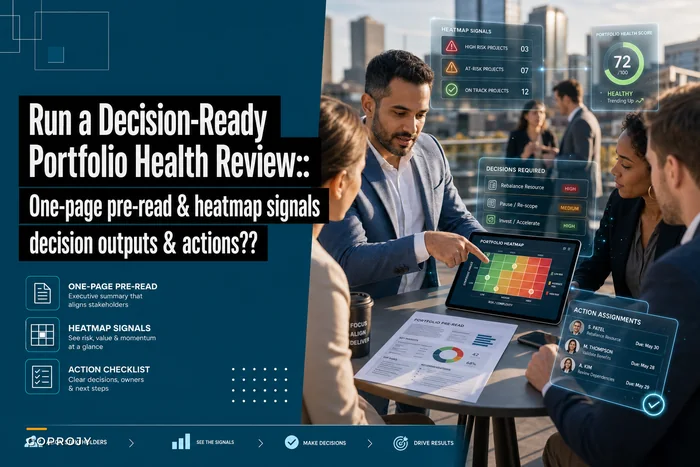
If you've already built strong one-page pre-reads for portfolio health reviews, the decision-sprint pre-reads are a close cousin — same discipline of forcing signal over narrative, just pointed at a single call instead of the whole portfolio.
Role scripts: who says what, and in what order
Scripts sound rigid until you've watched an unscripted 20-minute session spend 14 minutes on throat-clearing. The point isn't to make people robotic — it's to protect the timebox so the actual decision gets air.
Here's the role breakdown for a 20-minute Trade-off session:
-
Facilitator (0
00–0:30):
"We're here to decide [X]. Recommendation on the table is [Y]. We have 20 minutes. Everyone's read the pre-read. Any factual corrections before we discuss?" -
Presenter (0
30–3:00):
Not a re-read of the pre-read. Just the delta — anything that changed since it went out, and the sharpest version of the recommendation. Two and a half minutes, hard stop. -
Open discussion (3
00–14:00):
Facilitator runs it, pulls in quieter deciders by name, cuts off tangents with "let's park that." The job here is to surface genuine disagreement fast, not to let everyone narrate their thinking. -
Objection handling (as needed, inside the discussion) this is where the objection playbook earns its keep — more below.
-
Decision (14
00–18:00):
Facilitator states the proposed decision in one sentence and asks each decider directly: approve, approve-with-condition, or object. No shrugs, no "I guess so." A named position from each person. -
Lock it (18
00–20:00):
Note owner reads back the decision, the owner, the trigger date, and any conditions. Everyone confirms. Done.
The facilitator and the presenter should almost never be the same person — the presenter has a point of view to defend, and the facilitator has to stay neutral on the clock. In smaller PMOs this gets collapsed out of necessity, but it's worth protecting the split whenever you can. A facilitator who's also advocating loses the authority to cut people off.
One pattern worth naming: the "silent senior." The most senior person in the room stays quiet through the discussion, then drops a game-changing concern at minute 18. The script defends against this by forcing a named position from every decider before the lock. If the senior person has a concern, the script makes them voice it at the decision point, not after.
Visual workflow for a 20-minute Trade-off session:
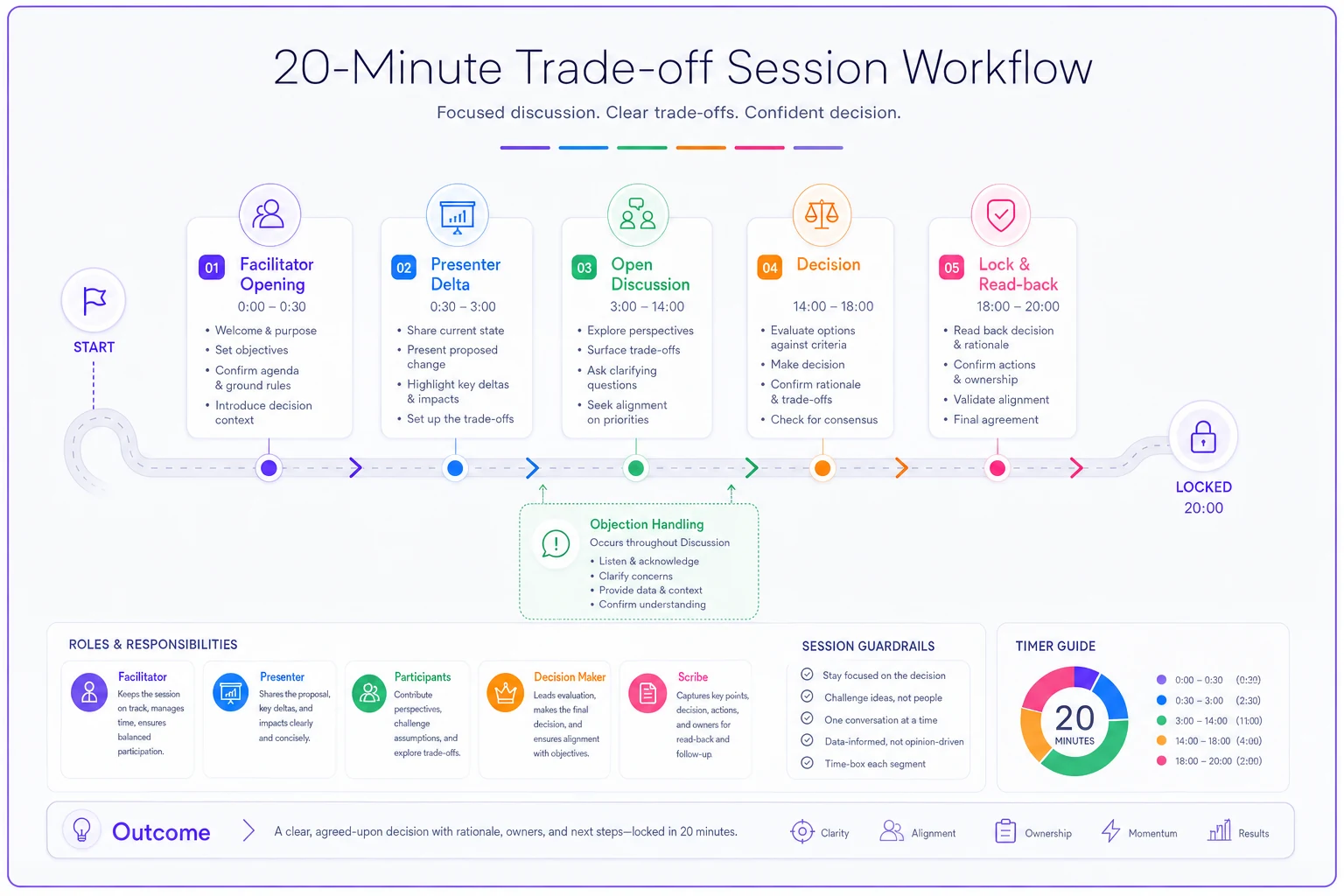
The facilitator should stay neutral and own the clock; the presenter defends the recommendation; the note owner confirms the record.
The objection playbook
Most executive stalls come from a small set of recurring objections, and if you've pre-written the response, you don't lose the room to them. The playbook isn't about winning arguments — it's about routing each objection to the fastest legitimate resolution.
-
"We don't have enough data." Response
name exactly what data would change the decision and whether it's obtainable before the real deadline. If yes, convert to a time-boxed follow-up with a hard date. If no, the decision stands on current info. This stops "more data" from being an infinite deferral.
-
"Let's wait for [other initiative] to land." Response
make the dependency explicit and attach a cost to waiting. If waiting costs more than deciding now, that's the answer.
-
"I'm not comfortable with the risk." Response
move from vague discomfort to a named risk with a mitigation or a trigger. "Comfortable" isn't a decision input; a named risk with a response plan is.
-
"This should go to [higher body]." Response
check it against the decision-rights map before the session, not during. If it legitimately belongs higher, it shouldn't have been scheduled here in the first place.
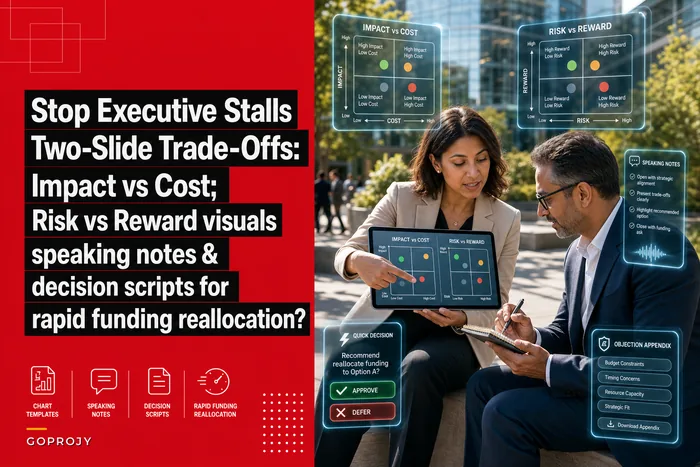
Objections are mostly predictable per decision type. A funding reallocation draws the "wait and see" objection almost every time. A scope cut draws "but we promised the customer." Once your PMO has run a few dozen sprints, you'll have a short library of objections mapped to each decision category, and your facilitators can prep the room against them. For reallocation calls specifically, pairing the sprint with two-slide trade-off visuals and speaking notes takes a lot of the heat out of that reflex, because the cost of waiting is already drawn on the page.
Post-decision tracking: where velocity usually dies
Getting the "yes" is only half the job. The decision has to survive contact with the next three weeks, and that's where most PMOs quietly lose everything they gained.
-
What was decided (one sentence, unambiguous)
-
Who owns the next action (a person, not a team)
-
Trigger or due date (when the first action happens or when the decision takes effect)
-
Conditions (if it was approve-with-condition, what the condition is)
-
Reversal trigger (what would cause us to revisit this)
Push the decision record entry directly into the owner's task queue with a trigger date so it can't be ignored.
That last field matters more than people expect. A lot of decisions should be revisited under certain conditions, and if you don't write the reversal trigger down, you either revisit everything constantly or never revisit anything. Naming the trigger up front — "revisit if vendor cost comes in over 15% above estimate" — keeps the decision stable without making it permanent.
The workflow after the session is where this connects to the rest of the portfolio machinery. The decision record should flow directly into wherever your actions and owners already live — the same place your dependencies, capacity reservations, and forecast updates get tracked. When a sprint approves a reallocation, that should immediately update the capacity plan and the forecast, not sit in a separate meeting-notes doc that nobody opens again. The whole value of the sprint is velocity, and velocity breaks if the output lands in a dead inbox.
This is where having decision records, action owners, and portfolio data in one connected system actually pays off — not because the tooling is magic, but because a decision that automatically shows up in the owner's queue with a trigger date is a decision that doesn't get forgotten. The failure mode is always the same: great decision, no follow-through, because the record lived somewhere nobody looked.
A real scenario: a mid-size PMO drowning in deferrals
Picture a PMO running about 40 active projects across a roughly 600-person org. Their monthly steering committee was a 90-minute slog, and in a typical month maybe two real decisions came out of it. Everything else got "tabled for next month." The portfolio carried a backlog of around 15 open decisions at any given time, some of them weeks old, and the average time from "decision needed" to "decision made" was sitting somewhere around five to six weeks.
The specific pain: a mid-sized vendor reallocation, worth somewhere around $400k, had been deferred three steering committees in a row. Each time, the context got re-explained from scratch, someone asked a new question, and it bumped again. Three months of a funded team working at half-utilization while the call sat open.
They split the single monthly meeting into sized sprints. The two-minute ratifications became Lightning sessions scheduled ad hoc, often same-week. The reallocations became 20-minute Trade-off sprints with a one-page pre-read and a fixed read-by time. Only genuinely strategic calls stayed in a longer format.
The shift over the following quarter wasn't dramatic in some headline way — it was more that the backlog stopped growing. Open decisions dropped from the mid-teens down to a handful, and most of those were deliberately waiting on something external, not stuck. Time-to-decision on routine items fell from weeks to days. The $400k reallocation that had been bouncing for three months got resolved in a single 20-minute Trade-off session, because for the first time it arrived shaped — one recommendation, the cost of waiting spelled out, every decider forced to state a position before the room cleared.
The part the PMO lead flagged as the real win wasn't speed. It was that decisions stopped quietly unraveling. Because every call now left the room with an owner, a trigger date, and a read-back on record, the "wait, what did we actually agree?" conversations basically disappeared.
When this system is a bad fit
It's worth being honest about where this doesn't work.
If your executives genuinely won't read a half-page pre-read, the sprint model struggles — the whole thing assumes prep happened. You can try to force the norm with a few rounds of "we're not re-presenting, the pre-read was the prep," but if the culture won't support basic preparation, you'll spend your 10 minutes re-explaining and you're no better off.
It's also a poor fit for decisions that are fundamentally political rather than analytical. Some calls stall not because they're under-shaped but because two senior people are in a turf fight, and no amount of tight facilitation resolves that. Those need to be handled before they ever hit a sprint; forcing them into a timeboxed room just produces a public standoff.
And don't over-apply it. Not every decision needs a formal sprint. A lot of operational calls should just be made by whoever owns them, no meeting at all. The sprint system is for decisions that genuinely need multiple deciders aligned on the record. Start sprinting everything and you've just invented a new flavor of meeting bloat.
Pulling it together
The executive decision sprint isn't really about meetings being shorter. It's about treating executive decision-making as an operational process with inputs, roles, and outputs — the same way you'd treat intake or forecasting — instead of hoping that putting busy people in a room produces clarity.
The three pieces reinforce each other. The pre-read shapes the decision so the room isn't doing analysis live. The role scripts and objection playbook protect the timebox so the actual call gets made. The post-decision record keeps the velocity from leaking out the back the moment the meeting ends. Drop any one of them and the system sags — a great pre-read with no decision lock still produces decisions that dissolve; a tight script with no pre-read still produces deferrals.
Start with your most chronically-deferred decision type. Size it, build the one-page pre-read, script the 20 minutes, and insist on an in-room decision record. Run it a handful of times, tune the objection responses as you learn which ones keep coming up, and let the evidence of faster, cleaner calls do the convincing. The executives who complain about "another process" at the start are usually the first to ask why not every decision gets handled this way.
The executive decision sprint isn't really about meetings being shorter. It's about treating executive decision-making as an operational process with inputs, roles, and outputs — the same way you'd treat intake or forecasting — instead of hoping that putting busy people in a room produces clarity.
Start with your most chronically-deferred decision type. Size it, build the one-page pre-read, script the 20 minutes, and insist on an in-room decision record. Run it a handful of times, tune the objection responses as you learn which ones keep coming up, and let the evidence of faster, cleaner calls do the convincing. The executives who complain about "another process" at the start are usually the first to ask why not every decision gets handled this way.
Ready to elevate your project delivery?
Join over 2,500 project teams using GoProjy to optimize resources, reduce risks, and drive portfolio success.