


Most PMOs handle ESG the same way they handle a fire drill: everyone knows it exists, there's a binder somewhere, and nobody actually practices until something goes wrong. Then a regulator asks a question, or a board member reads a headline, and suddenly ESG becomes a scramble of spreadsheets and after-the-fact justifications that nobody can trace back to a real decision.
The gap isn't intent. Most portfolio leaders genuinely want sustainability and compliance baked into their funding choices. The gap is mechanics. ESG lives in policy language — "we will prioritize low-emission suppliers," "we will meet accessibility standards" — and policy language doesn't fund or kill projects. Scores do. Gates do. Rebalancing rules do. Until someone translates the policy into those three things, ESG stays decorative.
This is about that translation layer: how you take soft constraints and convert them into enforceable, auditable inputs that actually change which projects get money. Not a values statement. A scoring mechanic.
Why ESG keeps falling out of the funding conversation
There's a pattern that shows up repeatedly. A portfolio has a prioritization model — probably weighted scoring across strategic fit, ROI, risk, maybe effort. ESG gets bolted on as a seventh or eighth criterion, weighted at something like 5%. Then in the actual ranking, a project with great financials and terrible environmental impact still floats to the top because the ESG weight is too small to move anything.
So ESG exists in the model, technically. It just never changes an outcome. And a criterion that never changes an outcome is theater.
The second failure is subtler. ESG often isn't the kind of thing that should be averaged against other scores at all. Some ESG constraints are regulatory floors — you either meet the accessibility standard or you can't ship, full stop. You can't buy your way past a legal requirement by scoring high on ROI. But most scoring models treat every criterion as tradeable, which means a hard regulatory constraint gets quietly averaged into mush.
What breaks at scale is traceability. With ten projects, someone remembers why the renewable-sourcing project got funded over the cheaper alternative. With two hundred projects across four business units, nobody remembers, and when an auditor or regulator asks "show me how your ESG commitments influenced capital allocation," the honest answer is a shrug. The decisions happened. The evidence of ESG's role in them didn't.
The three mechanics that actually do the work
To embed ESG in portfolio prioritization in a way that holds up, you need three distinct mechanics. The mistake almost everyone makes is collapsing them into one. They do different jobs.
Stop losing track of critical projects.
GoProjy helps you monitor, prioritize, and deliver projects on time—seamlessly.
- Unified portfolio visibility
- Real-time resource tracking
- Milestone & risk alerts
No credit card required
Multipliers shape ranking. They adjust a project's priority score up or down based on ESG performance — a sustainability bonus, a carbon penalty. These are for the ESG factors that are genuinely tradeable, where more is better but less isn't disqualifying.
Gates are pass/fail. They sit before the scoring model, not inside it. A gate asks a binary question — does this project meet the regulatory floor? — and anything that fails doesn't get scored at all. It gets routed to remediation or rejected. Gates are where hard constraints live, the ones you can't average away.
Rebalancing triggers are the time dimension. ESG conditions change — a new regulation lands, a supplier's emissions profile shifts, a reporting threshold moves. Triggers define when the portfolio gets re-evaluated against ESG inputs mid-cycle, instead of waiting for the annual planning ritual.
Here's how they split:
| Mechanic | What it does | Applies to | Failure mode if misused |
|---|---|---|---|
| Multiplier | Adjusts priority score up/down | Tradeable ESG factors (emissions, social impact scale) | Weight too small to change rankings |
| Gate | Pass/fail before scoring | Hard regulatory/legal floors | Treating a legal floor as "worth points" |
| Rebalancing trigger | Forces mid-cycle re-score | Conditions that change over time | Only re-evaluating annually, missing new rules |
The clean rule: if failing the criterion should ever be survivable because the project scores well elsewhere, it's a multiplier. If failing should never be survivable, it's a gate. Confusing the two is the single most common ESG scoring error.
Building the gate layer first
Gates come before scoring because the whole point is to stop disqualified work from consuming evaluation effort. Run the binary checks first, then score only what passes.
A workable gating flow looks like this:
-
Intake tags the regulatory scope. When a project enters the pipeline, it's tagged with which regulatory domains apply — accessibility, data residency, emissions reporting, labor-standards exposure in the supply chain. Not every gate applies to every project, so you need to know which ones to run.
-
Each applicable gate runs as pass/fail with evidence attached. "Meets accessibility standard" isn't a vibe — it's a documented check with a named owner and a timestamp. The evidence requirement is what makes it auditable later.
-
Fails route to one of three outcomes remediate-and-resubmit (fixable before a deadline), conditional-pass-with-timeline (can proceed if remediation lands by a committed date), or hard-reject (can't be funded as scoped).
-
Only passes and conditional-passes enter the scoring model. Everything else is out before multipliers ever touch it.
-
The gate decision gets logged with its rationale, so the audit trail shows not just what passed but why, and who signed off.
Here's a simple gating flow diagram.
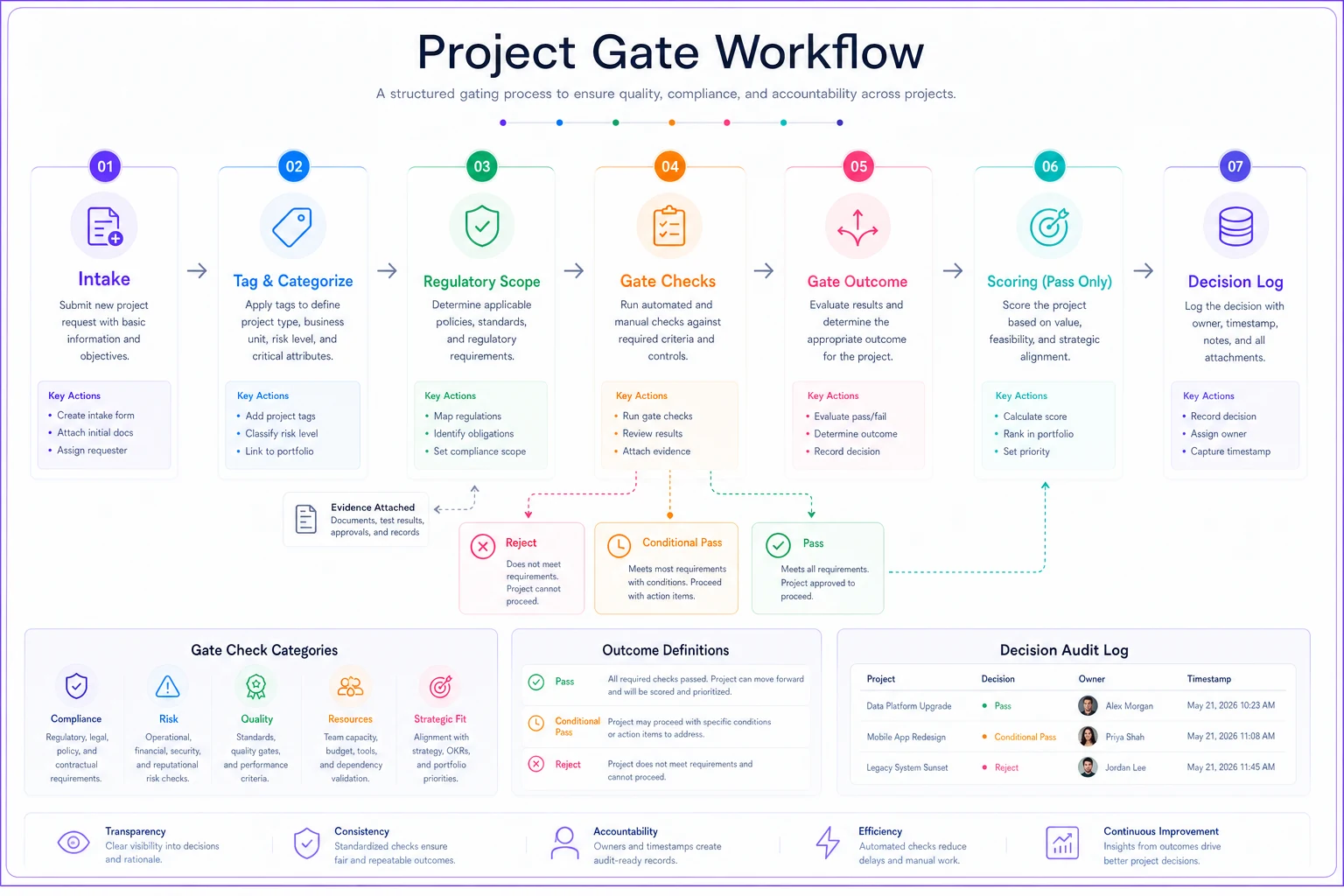
The diagram maps intake, gate checks, outcomes, and logging so it's clear what gets scored and why.
What people consistently underestimate is the conditional-pass lane. In real operations, most projects don't cleanly pass or fail a regulatory gate on day one — they're fixable with a few weeks of work. If your only options are pass or kill, you end up either rejecting viable projects or quietly waving through non-compliant ones. The conditional lane with a committed remediation date is where most of the actual decisions live.
Making multipliers move rankings without breaking the model
Once you're past the gates, multipliers handle the tradeable ESG factors. The design question is magnitude: how much should ESG performance be allowed to shift a project's rank?
A multiplier that swings a score by 2% is cosmetic. One that can swing it by 40% is a hidden override that'll produce rankings nobody trusts. In most portfolios, the sweet spot is enough to break ties and reorder adjacent projects — but not enough to vault a weak project over a strong one on ESG grounds alone.
A worked example. Say your base priority score runs 0–100, built from strategic fit, financial return, and delivery risk. You layer an ESG multiplier between 0.85 and 1.15:
-
A project with a base score of 72 and strong ESG performance (1.12) lands at ~81.
-
A project with a base score of 76 and poor-but-passing ESG performance (0.88) lands at ~67.
A project that started four points behind ends up fourteen points ahead after ESG. That's a meaningful reorder — it changed the ranking — but it didn't let a 40-point project leapfrog a 90-point one. The multiplier band does the shaping without becoming a backdoor veto. Vetoes are what gates are for.
Expressing this as a multiplier rather than added points matters because it scales with the base score. A fixed +10 ESG bonus matters enormously to a weak project and barely at all to a strong one, which is backwards. A multiplier applies proportionally. This connects directly to the broader logic in a portfolio decision-economics and optimization framework — ESG multipliers are one more input into the same optimization math, not a separate universe.
Rebalancing triggers: the part everyone skips
Gates and multipliers set up the portfolio at planning time. But ESG conditions don't hold still, and a portfolio locked in for twelve months against last year's regulatory reality is a liability waiting to surface.
Rebalancing triggers define the specific conditions that force a mid-cycle ESG re-evaluation. The point is to make the re-score rule-based rather than reactive — it happens on a signal, not a panic.
Useful trigger types:
-
Regulatory change triggers — a new rule enters force, or a reporting threshold drops, pulling previously-exempt projects into scope.
-
Supplier/input drift triggers — a vendor's emissions or labor profile moves past a defined threshold, changing the ESG math on every project depending on them.
-
Threshold-breach triggers — the portfolio's aggregate ESG position (total carbon exposure, percentage of spend with non-compliant suppliers) crosses a committed board-level limit.
-
Reporting-cycle triggers — ahead of a mandatory disclosure, re-run the ESG inputs so what you report matches what you actually funded.
When a trigger fires, it doesn't necessarily reshuffle everything. It forces a review against the ESG layer, and the review decides whether anything moves. The discipline is in defining the triggers ahead of time so that when a regulation lands, you already know which projects to re-gate instead of improvising.
When this makes sense — and when it's overkill
When it's overkill: a small portfolio with low regulatory exposure and no external disclosure pressure. Bolting a full gate-multiplier-trigger system onto fifteen internal IT projects with no ESG footprint is process for its own sake, and it'll get ignored, which is worse than not having it.
Who should NOT do this: teams that haven't yet gotten their base prioritization model trustworthy. If your core scoring is already contested and nobody believes the rankings, layering ESG on top just adds another disputed variable. Fix the foundation first, then add the ESG layer.
A real scenario
A mid-sized infrastructure services firm — around 400 people, running somewhere between 60 and 70 active projects across a couple of regions — had an ESG commitment in its investor materials and essentially no mechanism connecting it to funding. ESG was a 5% criterion in a weighted model, and in two years it had never changed a single funding decision. They knew it, and they were uncomfortable heading into an upcoming disclosure requirement.
They split ESG into the three mechanics. Three hard regulatory checks became gates sitting before the scoring model. The tradeable factors — emissions intensity, local-community impact — became a multiplier band of roughly 0.9 to 1.15. And they defined four rebalancing triggers tied to specific regulatory and supplier conditions.
The first run surfaced the uncomfortable part: four projects that had been cruising through on strong financials failed a regulatory gate they'd never been explicitly checked against. Two were fixable in the conditional lane with a few weeks of remediation. Two got reshaped. Nothing catastrophic — but these were projects that, under the old model, would've been funded as-is and discovered to be non-compliant somewhere downstream. That's the expensive way to find out.
The outcome that mattered wasn't a number. It was that when the disclosure question came, they could show a traceable line from ESG policy to gate to funded decision, with evidence attached to each gate. The audit conversation took an afternoon instead of three weeks of reconstructing rationale from memory and email threads.
Where the evidence trail actually lives
The mechanics only hold up if the evidence travels with the decisions. A gate pass that nobody can later point to is functionally the same as no gate at all, from an auditor's perspective. Each gate decision, each multiplier applied, and each trigger-driven re-score needs to be logged at the moment it happens — owner, rationale, timestamp, supporting documents — not reconstructed after the fact.
Manual tracking collapses at scale. With a handful of projects, a shared spreadsheet and decent discipline can hold the line. Past fifty or sixty active projects across multiple units, the evidence trail fragments across tools and people, and reconstructing "why did ESG move this decision" becomes genuinely impossible. Portfolio platforms that capture gate outcomes, scoring adjustments, and the rationale behind them as structured, timestamped records are what make the ESG layer auditable rather than merely well-intentioned — the difference between having a policy and being able to prove the policy shaped where money went.
Pro-tip: Store gate evidence in a centralized, timestamped system to simplify audits.
This connects directly into measuring whether ESG-weighted choices delivered what they promised. The same discipline that runs benefits realization from intake hypothesis through to finance reconciliation applies to ESG outcomes — a project funded partly on its sustainability profile should have that profile tracked through to realized impact, not just asserted at approval and forgotten.
The shift that actually matters
The real change isn't adding ESG to a scorecard. Almost every portfolio has technically done that already, and almost nobody's ESG criterion changes outcomes. The shift is recognizing that ESG isn't one mechanic — it's three, each doing a different job.
Hard constraints belong in gates, before scoring, where no amount of ROI can buy past a legal floor. Tradeable factors belong in multipliers sized to actually reorder adjacent projects. And the whole thing needs rebalancing triggers because regulations and suppliers don't hold still for a planning cycle. Get those three separated and evidenced, and ESG stops being the binder nobody opens and starts being an input that genuinely shapes which work gets funded — in a way you can defend to anyone who asks.
Hard constraints belong in gates, before scoring, where no amount of ROI can buy past a legal floor. Tradeable factors belong in multipliers sized to actually reorder adjacent projects. And the whole thing needs rebalancing triggers because regulations and suppliers don't hold still for a planning cycle. Get those three separated and evidenced, and ESG stops being the binder nobody opens and starts being an input that genuinely shapes which work gets funded — in a way you can defend to anyone who asks.
Ready to elevate your project delivery?
Join over 2,500 project teams using GoProjy to optimize resources, reduce risks, and drive portfolio success.