

Your organization runs on specialist expertise. The problem isn't finding these people—it's that once you have them, every project wants a piece of them. Without proper on-call rotation management and interrupt budgets, your specialist pools become a revolving door of burnout and attrition.
Most PMOs track specialist availability wrong. They look at allocation percentages, assume 80% means the person has bandwidth, then wonder why their lead architect quits after six months of constant context switching between twelve different projects.
The real issue runs deeper than simple overallocation. When specialists operate across multiple projects without structured on-call rotations or interrupt budgets, they face a unique type of operational chaos. A data engineer supporting eight projects doesn't just work on eight things—they field dozens of daily interruptions, emergency escalations, and "quick questions" that destroy focus and compound fatigue.
Why traditional resource allocation fails specialist pools
Standard PMO resource models treat specialists like regular team members. Allocate 20% here, 30% there, maybe leave 10% for "admin time." This approach ignores the fundamental difference between dedicated project work and specialist support work.
Specialists operate differently from embedded team members. They provide burst expertise, architectural reviews, critical problem-solving, and knowledge transfer across multiple initiatives. Their value comes from deep focus on complex problems, not from attending every standup across eight projects.
When you manage specialist pools using standard allocation models, several problems emerge fast. Projects hoard specialist time defensively, padding estimates because they know availability is scarce. Specialists get pulled into low-value meetings because project managers want them "looped in." Critical deep work gets fragmented into useless fifteen-minute blocks scattered across the day.
The interrupt problem makes everything worse. Without clear boundaries, specialists become the default escalation point for every technical question. A security architect allocated to strategic framework design ends up answering basic compliance questions all day. Your best data engineer is debugging simple SQL queries instead of designing the architecture that would've prevented those issues in the first place.
Resource allocation models built for dedicated teams simply don't work for shared specialist pools. You need a fundamentally different approach—one that protects deep work, manages interruptions systematically, and creates sustainable on-call rotation patterns.
Building interrupt budgets that actually protect focus time
An interrupt budget isn't just a time allocation—it's a commitment mechanism that forces projects to prioritize their specialist interactions. Think of it as giving each project a limited number of chips they can cash in for specialist time.
Stop losing track of critical projects.
GoProjy helps you monitor, prioritize, and deliver projects on time—seamlessly.
- Unified portfolio visibility
- Real-time resource tracking
- Milestone & risk alerts
No credit card required
Here's how a working interrupt budget model operates across a portfolio with shared specialist pools:
Monthly Interrupt Allocation by Project Tier:
| Project Tier | Monthly Interrupt Credits | Max Duration per Interrupt | Escalation Override Credits |
|---|---|---|---|
| Strategic (Tier 1) | 12 credits | 2 hours | 3 emergency credits |
| Critical (Tier 2) | 8 credits | 1 hour | 1 emergency credit |
| Standard (Tier 3) | 4 credits | 30 minutes | 0 emergency credits |
| Maintenance | 2 credits | 30 minutes | 0 emergency credits |
Credits don't roll over. Use them or lose them. This prevents hoarding and encourages projects to batch questions and prepare properly before engaging specialists.
The duration limits matter as much as the credit counts. A Tier 1 project can use one of their twelve monthly credits for a two-hour architecture review. A maintenance project gets thirty minutes max, which forces them to show up with focused questions rather than an open-ended brain dump.
Emergency override credits handle true crises but require executive approval to activate. This stops every delay from becoming an "emergency" that disrupts specialist focus time.
But interrupt budgets alone don't solve the problem. You also need structured availability windows. A specialist might dedicate Tuesday and Thursday afternoons to interrupt availability, with other times blocked for deep work. Projects learn to batch their questions for these windows rather than expecting instant responses.
The enforcement mechanism makes or breaks the system. Specialists need explicit permission to decline or defer requests that exceed budgets, and the PMO needs to back them up when project managers push back. Without that protection, interrupt budgets are just suggestions that collapse under the first deadline pressure.
Specialists need explicit permission to decline or defer requests that exceed budgets, and the PMO needs to back them up when project managers push back.
Here's a simple visual of how an interrupt budget workflow routes requests based on credits, availability windows, and emergency overrides.
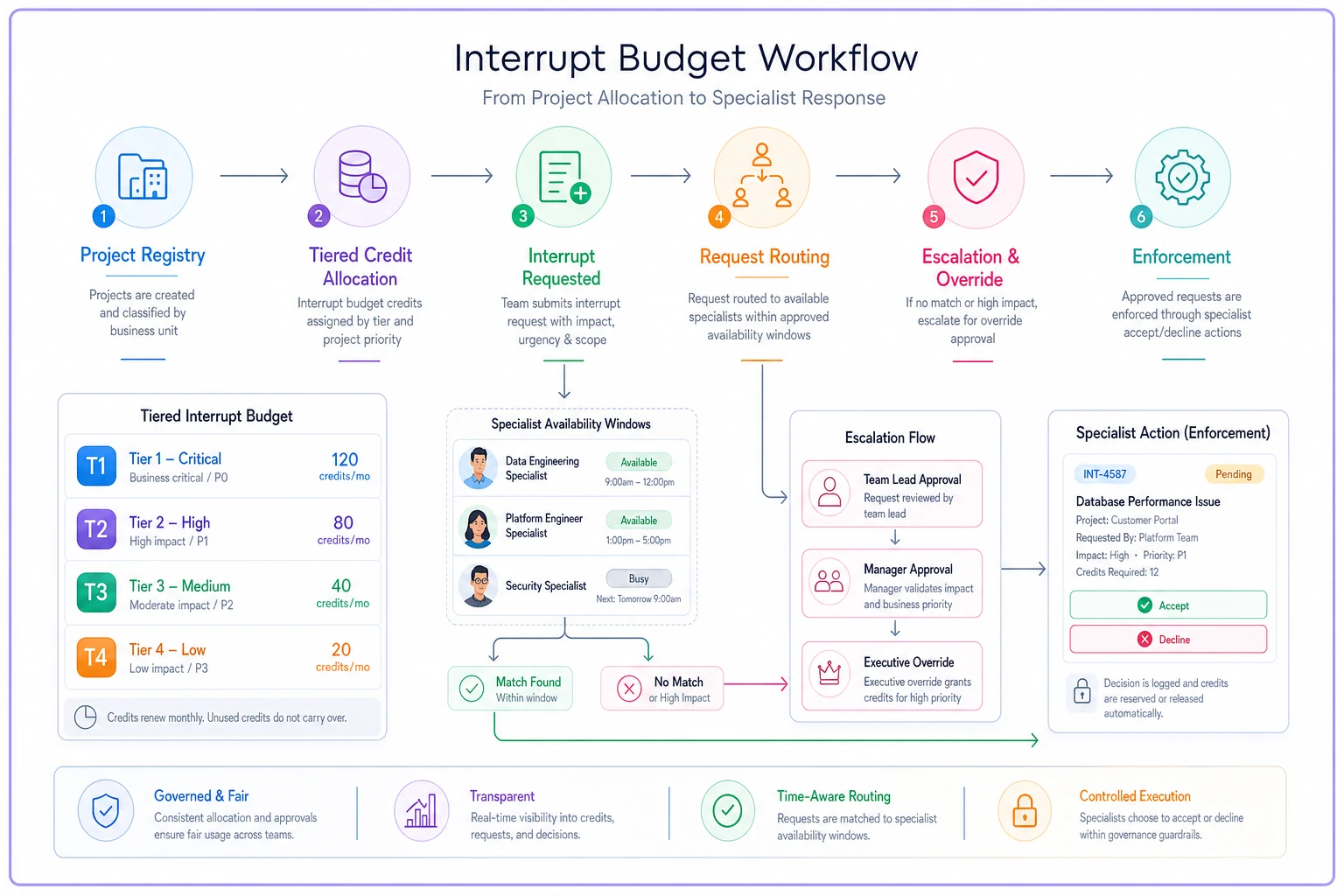
Enforcement combined with clear schedules is what makes the budget meaningful in practice.
SLA rules that balance responsiveness with sustainability
Service level agreements for specialist pools need more nuance than simple response time targets. The complexity of the request, the project tier, and the specialist's current interrupt load all factor into what's actually realistic.
Critical Production Issues (P1):
-
Initial response
1 hour
-
Specialist engaged
2 hours
-
Resolution or workaround
8 hours
-
Triggers on-call rotation override
Architecture Reviews (Planned):
-
Acknowledgment
2 business days
-
Review scheduled
Within 5 business days
-
Feedback delivered
3 business days post-review
-
Uses standard interrupt budget
Technical Questions (Ad-hoc):
-
Response
3 business days
-
Resolution
5 business days
-
May redirect to documentation or other resources
-
Consumes interrupt credits based on complexity
Knowledge Transfer Requests:
-
Initial response
5 business days
-
Session scheduled
Within 10 business days
-
Follow-up documentation
5 business days post-session
The key distinction: not every request gets the same SLA. Production issues trigger immediate response through on-call rotations. Planned work follows interrupt budgets. Knowledge requests go to the back of the queue.
These SLAs need teeth. Projects that chronically game the system—disguising regular questions as emergencies, blowing past their interrupt budgets, or demanding immediate responses for non-critical issues—face real consequences. Their interrupt budget gets reduced. Their requests get deprioritized. In extreme cases, they lose direct access and must route through PMO triage.
The SLA structure also protects specialists from implicit pressure. When everyone knows the expected response time for different request types, specialists don't feel obligated to drop everything for a routine question. Projects learn to plan ahead instead of manufacturing urgency.
Substitution policies and escalation paths
Not every specialist request actually needs the senior specialist. Many interrupts could be handled by junior team members, documented procedures, or peer support from other projects. Substitution policies create systematic alternatives that prevent burning specialist time unnecessarily.
A working substitution model uses progressive triage before requests reach the specialist pool. Start with self-service resources—documentation, recorded training sessions, architectural decision records. Roughly 40% of so-called "specialist" questions have answers in existing documentation that nobody checked.
Next comes peer support. Projects dealing with similar technical challenges can often help each other, reducing specialist load significantly. A project that just implemented OAuth authentication can walk another team through the same process. This peer network develops naturally when you create the right forums and some basic incentives.
Junior specialists or technical leads form the next substitution tier. They handle routine questions, standard reviews, and known issues. Senior specialists focus on novel problems, critical decisions, and architectural evolution. This isn't gatekeeping—it's just using expertise efficiently.
Here's a real substitution workflow for a data engineering pool:
Level 1 - Self-Service (No specialist time):
-
Check data dictionary
-
Review existing query templates
-
Consult pipeline documentation
-
Use automated data quality tools
Level 2 - Peer Support (No specialist time):
-
Post in data community Slack channel
-
Attend weekly data office hours
-
Review similar project implementations
-
Leverage project data steward network
Level 3 - Junior Data Engineer (Uses team budget, not specialist):
-
Standard SQL optimization
-
Routine pipeline modifications
-
Basic data model questions
-
Known issue resolution
Level 4 - Senior Data Engineer (Consumes interrupt budget):
-
Novel data architecture design
-
Complex performance problems
-
Strategic technology decisions
-
Production incident resolution
The escalation triggers need to be explicit, not dependent on judgment calls. If Level 3 can't resolve within 4 hours, automatic escalation to Level 4. P1 production issue? Skip straight to Level 4. The specificity matters—vague escalation criteria get ignored when things get stressful.
Mapping on-call rotations to specialist availability patterns
Standard on-call rotation models assume relatively uniform availability and workload. Specialist pools face irregular demand spikes, deep work requirements, and varying expertise levels. Your rotation model has to account for these realities.
A baseline rotation might run weekly shifts with primary and backup coverage, but specialist pools need more sophistication. Consider this rotation structure for a pool of five security architects:
-
Week 1-2
Deep Work Rotation
-
Primary
Alice (0% interrupt availability)
-
Secondary
Bob (25% interrupt availability)
-
On-call
Carlos (75% interrupt availability)
-
Backup
Diana (25% interrupt availability)
-
Training
Edwin (shadowing Carlos)
-
Week 3-4
Balanced Rotation
-
Primary
Bob (0% interrupt availability)
-
Secondary
Carlos (25% interrupt availability)
-
On-call
Diana (75% interrupt availability)
-
Backup
Edwin (25% interrupt availability)
-
Training
Alice (knowledge transfer with Diana)
The model protects at least one specialist for uninterrupted deep work while maintaining coverage for critical issues. Secondary and backup roles handle overflow but with limited availability, so they're not just absorbing the same interrupt chaos from a different angle.
Rotation frequency matters more than most PMOs realize. Weekly rotations create too much context switching. Monthly rotations lead to sustained interrupt burnout. Two-week cycles tend to balance coverage continuity with manageable workload.
Geographic distribution complicates rotations further. Global organizations need follow-the-sun coverage, but not every specialist request warrants 24/7 availability. Define clearly which scenarios trigger after-hours escalation versus waiting for normal business hours.
And this part gets overlooked almost every time: on-call rotations need protected recovery time. After a heavy on-call shift with multiple P1 incidents, specialists need a lighter week to catch up on delayed work and recover. Build that into the rotation cycle explicitly or it won't happen.
Real-world example: Managing a shared data platform team
Consider a mid-size financial services company with around 200 ongoing projects sharing a pool of eight data platform specialists. Before implementing structured on-call rotation and interrupt budgets, the team had roughly 70% annual turnover.
The problem started innocently. As the company grew from 50 to 200 projects over eighteen months, the data platform team became the default technical escalation point for everything. Every project assumed direct access to platform specialists for questions ranging from basic SQL syntax to complex distributed system design.
By month six, senior specialists were fielding 15-20 interrupts daily. A typical day included multiple "emergency" production issues (most weren't), a string of "quick questions" (none were quick), and a constant stream of Slack messages. Deep work became nearly impossible. Platform improvements stalled while specialists fought daily fires.
The PMO implemented a three-tier interrupt budget system:
Tier 1 - Revenue-generating products (20 projects):
-
10 interrupt credits monthly
-
2-hour maximum duration
-
Access to senior specialists
Tier 2 - Internal platforms (45 projects):
-
6 interrupt credits monthly
-
1-hour maximum duration
-
Junior specialist first, escalation available
Tier 3 - Everything else (135 projects):
-
3 interrupt credits monthly
-
30-minute maximum duration
-
Self-service first, junior specialist if needed
They also established formal on-call rotations with one primary on-call specialist handling all interrupts for two-week periods. Everyone else could focus on platform improvements, architecture work, and proactive support.
The first month was rough. Projects complained about "artificial barriers" and "bureaucracy." Some tried end-runs around the system. The PMO held firm, backing specialists who declined out-of-budget requests.
By month three, behavior started shifting. Projects began batching questions, preparing better before engaging specialists, and actually using self-service resources. The data platform team published better documentation because they knew it would reduce their interrupt load.
Six months in, interrupt volume dropped from 15-20 daily per specialist to 3-4 daily for the on-call specialist only. Platform deployment frequency increased from monthly to weekly. Specialist turnover dropped to near zero.
The key wasn't the specific credit numbers or rotation schedule. It was creating a structure that made interrupt costs visible and gave specialists genuine permission to protect their time.
Common failure patterns in specialist pool management
Even well-designed on-call rotation models fail when implementation misses critical details. The most common failure: creating elaborate policies without enforcement mechanisms.
Many PMOs develop interrupt budget frameworks, document them carefully, then watch them collapse under the first project deadline pressure. A panicking project manager escalates to an executive, who overrides the system "just this once." After three or four overrides, specialists figure out the policies are meaningless.
Another failure pattern appears when on-call rotations lack clear handoff procedures. The outgoing specialist dumps a list of open issues on the incoming one without context. Issues get dropped, response times slip, and projects lose confidence in the rotation model altogether.
Substitution policies fail when alternative resources aren't genuinely capable of handling redirected requests. Pointing projects to outdated documentation or an unresponsive peer support channel just creates frustration. They learn to bypass the system and go straight to senior specialists anyway.
Some organizations implement interrupt budgets but make them too generous. If every project gets enough credits to maintain their current interrupt rate, nothing changes. The budgets need to force real prioritization and behavior change—otherwise they're just paperwork.
The emergency escape hatch is another common failure point. Without strict criteria for overrides, everything becomes an emergency. One organization required VP approval for override activation—until VPs started rubber-stamping every request without reviewing the details.
Geographic distribution creates its own failure modes. Follow-the-sun rotation models look good on paper but fail when specialists in different regions have significantly different expertise levels or communication styles. Projects quickly learn which timezone gets them better support and time their requests accordingly.
Technology enablement for sustainable specialist operations
Manual tracking of interrupt budgets and on-call schedules works for small teams but falls apart at scale. When you're managing specialist pools across dozens or hundreds of projects, you need operational software that enforces policies automatically rather than relying on people to remember the rules under pressure.
Modern PMO platforms with AI automation can track interrupt consumption in real-time, automatically declining requests that exceed budgets and routing requests to appropriate substitution resources. The specialist bottleneck management systems need integration with interrupt tracking to provide complete visibility.
The technology stack for specialist pool management should handle several core workflows: request routing based on type, urgency, and available budget; automatic escalation when SLA thresholds approach; capacity forecasting that accounts for on-call rotations and interrupt patterns; and knowledge capture from specialist interactions to build self-service resources over time.
AI automation works well for initial request triage—determining whether a request genuinely needs specialist attention or could be handled through documentation, peer support, or junior resources. It can also identify patterns in interrupt requests that point to systemic issues needing proactive intervention.
A typical AI-enhanced platform might handle a specialist request flow like this: a project submits a data architecture question, the system checks their interrupt budget balance and current month usage, scans existing documentation and previous similar requests to suggest self-service resources, and if the project proceeds, routes to the appropriate specialist tier based on complexity and generates a structured request format that speeds resolution.
The platform tracks every interaction, building a knowledge base that reduces future interrupt load. When several projects ask similar questions, it triggers documentation creation. When interrupt patterns spike around specific technologies or processes, it flags training needs.
This isn't about replacing human specialists with AI—it's about using AI-powered operational software to protect specialist time for high-value work. Specialists focus on complex problems while automation handles routine request routing, budget tracking, and knowledge management.
Measurement frameworks for specialist pool health
Traditional utilization metrics miss the reality of specialist work. A specialist at 100% utilization isn't productive—they're drowning. Effective measurement frameworks track interrupt burden, focus time, and value delivery, not just time allocation.
Key metrics for on-call rotation health include interrupt density (interrupts per on-call day), resolution velocity (time from request to resolution), and escalation rate (percentage requiring senior specialist involvement). Track these by project tier, request type, and specialist to identify patterns.
Interrupt budget metrics go beyond simple consumption rates. Monitor which projects consistently max out their budgets versus those that rarely engage specialists. High consumption might indicate capability gaps that training could address. Low consumption might mean projects are struggling without needed support.
Specialist retention and satisfaction metrics provide lagging indicators of system health. Exit interview data, internal transfer requests, and engagement scores reveal whether your on-call rotation and interrupt management systems are actually creating sustainable working conditions.
The portfolio capacity management frameworks should incorporate specialist pool metrics as a distinct category. Specialist availability differs fundamentally from general resource capacity and needs separate tracking and forecasting.
Balance metrics matter as much as absolute numbers. Track the ratio of planned versus interrupt work, strategic versus tactical engagement, and deep work versus context switching. These ratios reveal whether specialists are operating in their highest-value capacity.
Quality metrics get overlooked but matter enormously. Track rework rates on specialist-reviewed designs, production incidents traced to architectural decisions, and knowledge transfer effectiveness. These indicate whether interrupt budgets and on-call rotations provide sufficient time for thorough work.
Creating sustainable specialist pools for portfolio scale
The path from ad-hoc specialist support to structured on-call rotation with interrupt budgets isn't smooth, but the alternative is worse. Without systematic management, specialist pools become revolving doors of burnout and turnover that ultimately throttle portfolio delivery capacity.
Start with one specialist pool and basic interrupt budgets. Your cloud architects or data engineers are probably facing the highest interrupt burden—start there. Implement simple credit systems and two-week rotations. Learn what works in your organization's culture before expanding.
Expect resistance. Projects accustomed to unlimited specialist access will push back against budgets and formal request processes. Stand firm. The short-term friction pays off in long-term sustainability and better specialist availability for critical work.
Focus on making interrupt costs visible first, then optimize the specific mechanisms. When projects see how their "quick questions" aggregate into specialist overload, behavior changes naturally. When specialists have real permission to protect focus time, quality improves.
Don't over-engineer the measurement systems in the early stages. Track basic interrupt volumes, budget consumption, and on-call burden. Add sophistication as the model matures and you understand which metrics actually drive behavior change.
On-call rotation models and interrupt budgets aren't about restricting access—they're about sustainable operations. Projects get better specialist support when specialists aren't burned out. Specialists deliver higher value when they have time for deep work. The entire portfolio benefits from specialist pools that remain stable and engaged.
The companies getting this right treat specialist pool management as a critical operational capability, not administrative overhead. They invest in the processes, tools, and cultural changes needed to protect these scarce resources. In a world where technical expertise drives competitive advantage, burning out your specialists is a cost most organizations can't absorb.
The path from ad-hoc specialist support to structured on-call rotation with interrupt budgets isn't smooth, but the alternative is worse. Without systematic management, specialist pools become revolving doors of burnout and turnover that ultimately throttle portfolio delivery capacity.
Ready to elevate your project delivery?
Join over 2,500 project teams using GoProjy to optimize resources, reduce risks, and drive portfolio success.