

Most PMO reorganizations don't fail because leaders picked the wrong model. They fail because the model got rolled out everywhere at once, roles shifted before anyone understood the funding consequences, and three months in nobody could tell you who approved the last $400k reallocation. The centralize-vs-federated debate gets framed as a philosophy argument when it's really a sequencing and consequence-mapping problem.
So we'll skip the "what is a PMO" part. If you're reading this you already run one, or you're about to be asked to restructure one. What's actually hard is deciding which parts to centralize, in what order, and understanding what breaks in reporting lines, budget authority, and delivery tempo each time you move a lever. This piece treats the decision as an operational migration, not a one-time choice on a slide.
Why the "pick one model" framing is wrong
The clean version of this question — centralized command-and-control PMO versus federated team-level autonomy — almost never survives contact with a real org chart. Across portfolios, organizations reliably end up federated in some functions and centralized in others, often without anyone deciding that on purpose.
The pattern is pretty consistent. A company grows from a handful of projects to a few dozen. Someone stands up a central PMO to get visibility. It works for standards and reporting. Then delivery teams start complaining that the central group slows them down, so individual business units quietly build their own mini-PMOs. Now you have a central PMO that owns reporting but not delivery, business-unit PMOs that own delivery but not standards, and a funding process that still routes through finance as if the central group controls everything.
That hybrid isn't inherently bad. The problem is nobody mapped it. Decision rights drift, two groups think they own prioritization, and the same project gets scored differently depending on which intake it lands in. The question isn't "centralized or federated." It's "which capabilities live where, and does everyone agree on the handoffs."
A useful reframe: stop treating the PMO as one thing. It's really five separable capabilities.
-
Standards and methodology (templates, gates, definitions of done)
-
Prioritization and intake (what gets funded, in what order)
-
Resource and capacity control (who allocates scarce people)
-
Reporting and portfolio visibility (the single source of truth)
-
Delivery execution (the actual PMs running projects)
You can centralize any subset of these independently. Standards centralized with delivery federated is extremely common and usually works fine. Prioritization federated with funding centralized is a recipe for constant friction. Once you see the five capabilities as separate dials, the migration becomes a sequencing exercise instead of an all-or-nothing bet.
The decision matrix: which capability goes where
Before sequencing anything, you need a defensible position on each dial. The matrix below is a useful starting point when working through this. The point isn't the exact scoring — it's forcing an explicit decision per capability instead of letting it drift.
Stop losing track of critical projects.
GoProjy helps you monitor, prioritize, and deliver projects on time—seamlessly.
- Unified portfolio visibility
- Real-time resource tracking
- Milestone & risk alerts
No credit card required
| Capability | Centralize when… | Federate when… | What breaks if you get it wrong |
|---|---|---|---|
| Standards & methodology | Audit/compliance exposure is high; teams reinvent templates | Teams work in genuinely different modalities (hardware vs SaaS) | Fragmented reporting, re-work at gates, audit gaps |
| Prioritization & intake | Funding is pooled; cross-unit dependencies are heavy | Business units have ring-fenced budgets and distinct customers | Duplicate work, political scoring, funding confusion |
| Capacity & resource control | Specialists are scarce and shared across units | Teams are fully staffed and rarely borrow | Bottlenecks hidden until they're critical |
| Reporting & visibility | Executives need one portfolio view; finance roll-ups required | Almost never federate this | Blind spots, surprise overruns, mistrusted KPIs |
| Delivery execution | Rarely centralize past ~40 projects | Teams need local speed and domain context | Central group becomes a throughput bottleneck |
Notice the asymmetry. Reporting almost always wants to be centralized — you cannot run a finance-ready roll-up on five incompatible status models. Delivery almost always wants to be federated past a certain scale, because a central delivery pool becomes the constraint on everything. The interesting decisions live in the middle three rows.
A mistake worth calling out directly: teams often centralize prioritization while leaving funding authority with business units. On paper the central PMO ranks the portfolio; in practice each unit funds whatever it wants from its own pocket. The ranking becomes theater. If you centralize prioritization, the money has to follow it, or don't bother.
Sequencing the migration into waves
The single biggest failure mode is the big-bang cutover. Flipping all five dials in one quarter means every reporting line, every budget conversation, and every PM's daily workflow changes at once. Nobody has a stable reference point, so when something breaks you can't isolate the cause.
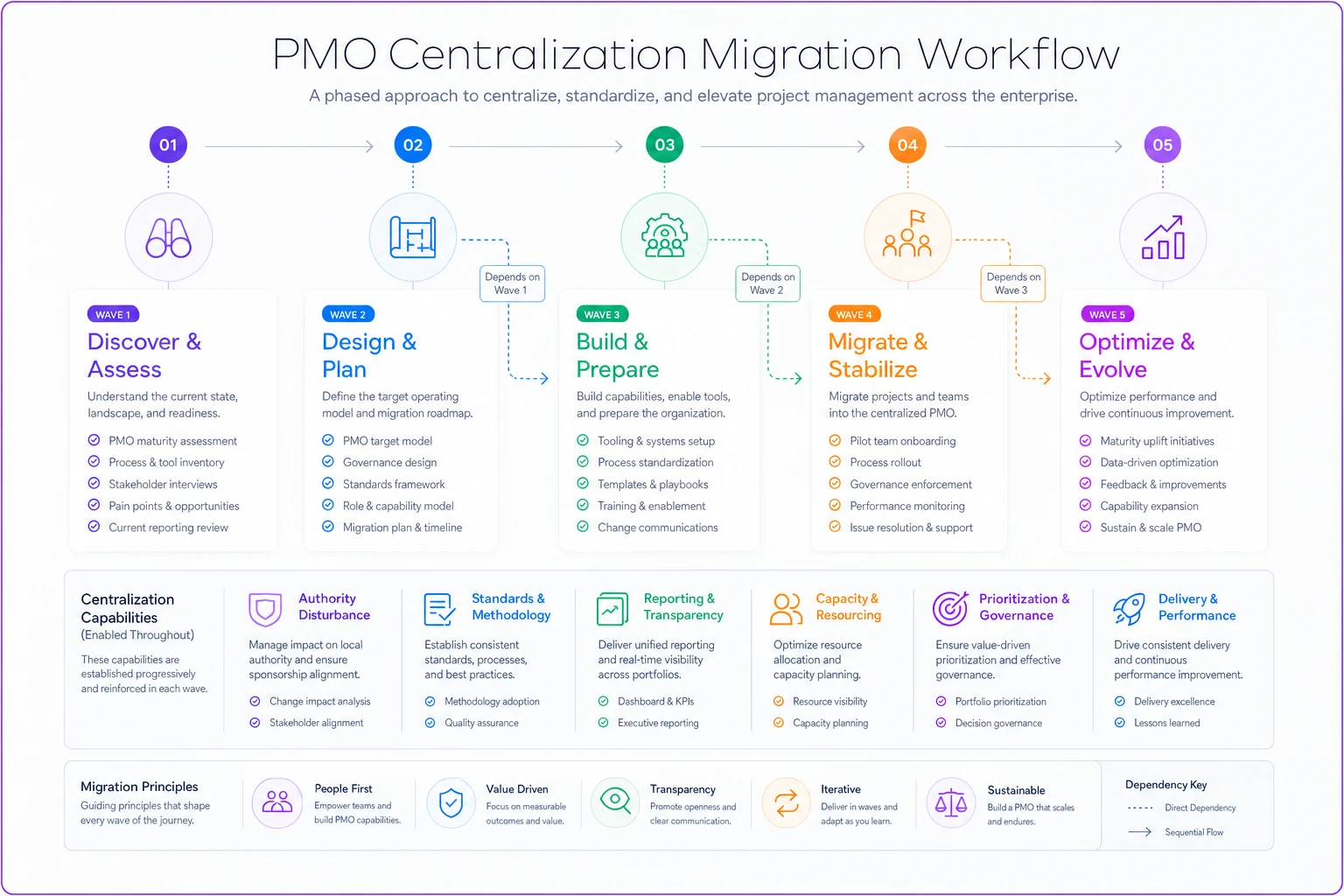
Sequence it instead. Here's the wave order that tends to cause the least disruption:
-
Wave 1 — Reporting and visibility. Centralize the data model first. Get everyone onto a common status taxonomy and one portfolio view before you touch anyone's authority. This wave changes almost no one's decision rights, which is exactly why it's safe to go first. It also gives you the baseline you'll need to measure every later wave against.
-
Wave 2 — Standards and methodology. Once visibility exists, standardize gates and templates. This is where you'll hit the first real resistance, because teams feel their autonomy threatened. Doing it after reporting helps — you can point to concrete inconsistencies in the data to justify the standard.
-
Wave 3 — Capacity and resource control. Now move shared-specialist allocation to a central function, or formalize the federated version. This wave has real headcount and reporting-line consequences, so it needs the standards and visibility from waves 1 and 2 to function.
-
Wave 4 — Prioritization and funding. The heaviest wave. Decision rights and money move together. Never run this before reporting and standards are stable, because you'll be reallocating funds based on numbers nobody trusts.
-
Wave 5 — Delivery model adjustments. Usually the lightest touch and often not needed at all. If you've sequenced the first four well, delivery stays mostly federated and you're just tuning edges.
The non-obvious part: the waves are ordered by how much authority they disturb. Low-disturbance first. Each wave builds the infrastructure the next one depends on. If you find yourself wanting to start with prioritization because that's where the pain is, that's usually a sign you're chasing symptoms instead of building the foundation that makes the prioritization fix stick.
For a broader view of how the whole operating model evolves as you scale, the operating-model blueprint for scaling from a handful to hundreds of projects pairs well with this sequencing logic.
Mapping role and funding consequences before you move
Every dial you turn reshapes someone's job and someone's budget line. The migrations that go sideways skip this mapping and discover the consequences after the reorg announcement.
A short checklist to run before each wave:
-
Who loses decision authority? Name them. A business-unit lead who currently approves their own prioritization will feel wave 4 personally.
-
Who gains a reporting line? Centralizing capacity means specialists now take allocation direction from a central function, even if they still sit in a business unit.
-
Where does the budget line move? If prioritization centralizes but the cost center stays in the unit, your chargeback model has to change or finance can't reconcile.
-
What's the new escalation path? When a federated team and a central function disagree, who breaks the tie — and is that documented before the first conflict?
-
Which roles become redundant or need redefinition? Business-unit PMO coordinators often need a new remit once standards and reporting centralize.
Document the new escalation path and the person who breaks ties before announcing the wave.
The funding piece deserves extra attention because it's the one that quietly sinks these efforts. When prioritization centralizes but funding stays distributed, you get a two-headed system where the central ranking says "fund project A" and the unit's budget says "fund project B." Everyone's technically following their own rules. The portfolio drifts anyway.
Getting decision rights explicit — not as a checklist but as an operational system with real escalation paths — is foundational here. The approach in treating decision rights as an operational governance framework rather than a checklist is essentially what makes a federated model survive; without clear decision matrices, federation degrades into "everyone does what they want."
Worked example: SaaS company, ~60 projects
A mid-size SaaS org, roughly 250 people in product and engineering, running somewhere around 55–60 active initiatives across six squads. Each squad had grown its own lightweight process over time. Reporting was a nightmare — the exec team got six differently-shaped status decks and couldn't compare anything across them.
Their instinct was to centralize everything under a new PMO director. That would have been a mistake. Squads in SaaS move fast and local context matters; a central delivery function would have throttled them.
-
Wave 1 Common status model and one portfolio dashboard. Took about six weeks. No authority moved. Resistance was low because nobody lost anything.
-
Wave 2 Standardized two gates only — a funding gate and a pre-release readiness gate. They deliberately kept gates light to preserve squad speed.
-
Wave 3 Centralized allocation of two scarce roles (a staff security engineer and a data platform specialist) who'd been informally pulled across squads. Before this, those two were double-booked constantly and nobody could see it.
-
Wave 4 Moved prioritization and roughly 70% of discretionary budget to a central intake, leaving each squad a small ring-fenced "local bets" budget.
Delivery stayed fully federated. After about two quarters, the specialist double-booking problem that had been causing three-to-four-week slips on security-dependent features mostly disappeared, and the exec decision cadence tightened because they were finally comparing like with like. Nothing dramatic in the revenue numbers — this was an internal coordination fix — but the "where is this project, actually" question stopped eating meetings.
Worked example: regulated finance
Different world entirely. A regulated financial services firm has audit and compliance exposure on nearly every project, which pushes standards and reporting hard toward centralized by default. The dial you don't want to over-centralize here is delivery, because domain teams in payments, lending, and risk carry regulatory context a central pool can't replicate.
The trap in regulated environments is over-centralizing prioritization in a way that ignores regulatory deadlines. A central intake that scores everything on business value will under-rank a mandatory compliance project that has no "value" in the traditional sense but carries a hard regulatory date. Portfolios where a compliance remediation sat at rank 14 because the scoring model didn't weight regulatory mandates correctly — that's how firms nearly miss filing deadlines.
The fix in the sequencing: when you reach wave 4 for a regulated org, prioritization centralizes but with a mandatory-work carve-out that bypasses normal scoring. Regulatory and compliance items get an automatic funded lane. Standards and reporting go fully central because audit demands a single source of truth. Capacity control centralizes for scarce compliance and risk specialists, who are almost always the bottleneck. Delivery stays federated by regulatory domain.
One funding consequence worth flagging: in regulated firms the CapEx/OpEx classification of compliance work often differs from discretionary work, so centralizing the budget without sorting the classification first creates a reconciliation mess. That one needs to go into the pre-wave checklist.
Worked example: distributed engineering org
A geographically distributed engineering organization — multiple time zones, a dozen or so teams across three or four regions — has a problem the other two don't: coordination cost scales with distance. Centralizing delivery in this context is almost comically bad, because a central function in one time zone can't run daily decisions for teams eight hours away.
What distributed orgs must centralize is the reporting and data layer, precisely because you can't walk over to someone's desk to reconcile a status. The single portfolio view isn't a nice-to-have; it's the only shared reality across time zones. Standards centralize too, but with regional flexibility on cadence — a team shouldn't be expected to attend a central gate review at 3 a.m.
The capacity dial is the interesting one. In distributed orgs, specialist scarcity is often regional — you have plenty of a skill in one region and none in another. Pure central allocation ignores the follow-the-sun reality. A better pattern is a federated capacity model with a central visibility layer: regions manage their own pools, but the central portfolio view surfaces cross-region borrowing opportunities. That way the central function informs without becoming a blocking approval that stalls work overnight waiting for a sign-off somewhere else.
Sequencing note: for distributed orgs, wave 1 is even more critical to nail first, and wave 3 usually lands as "federated with central visibility" rather than full centralization.
When each model actually makes sense
Centralize more aggressively when: funding is genuinely pooled, you have heavy cross-unit dependencies, audit or compliance exposure is high, or scarce specialists are shared across many teams. The more interdependent the work, the more central coordination earns its keep.
Federate more when: business units serve distinct customers with ring-fenced budgets, teams work in genuinely different modalities, speed-to-local-decision is a competitive edge, or geographic distance makes central daily decisions impractical.
Who should NOT run a big centralization push: an organization that hasn't yet fixed its data model. If your status reporting is inconsistent today, centralizing authority on top of bad data just makes the bad data authoritative. Do wave 1 and stop there until the numbers are trustworthy. Plenty of orgs get real value from only centralizing reporting and standards and leaving everything else federated — that's a legitimate end state, not a half-measure.
When a hybrid is the honest answer: most of the time. The five-dial model exists precisely because the right answer is usually "centralize three, federate two." The failure isn't the hybrid — it's the undeclared hybrid where nobody wrote down which dial sits where.
The quiet infrastructure problem underneath all of this
One thread runs through every example: none of the waves work without a reliable, shared view of the portfolio. Wave 1 exists because you can't sequence anything on top of six incompatible status models. The regulated carve-out needs visible scoring. The distributed capacity model is entirely a visibility play.
This is where operational tooling earns its place — not as the point of the exercise, but as the thing that makes the harder waves survivable. When prioritization and funding move in wave 4, having a platform where intake scoring, capacity allocation, and finance roll-ups live in one connected model means the decision rights you mapped actually get enforced in the workflow instead of living in a document nobody reads. AI-assisted operational platforms help most in the unglamorous middle: flagging the specialist who's quietly double-booked across three squads, catching when a project's funding and its priority ranking have drifted apart, surfacing the cross-region borrow before a deadline slips. The goal isn't automation for its own sake — it's removing the manual reconciliation work that makes a federated model collapse back into chaos.
But the tooling is second. The sequencing and consequence-mapping come first.
Pulling it together
The centralize vs federated PMO decision isn't a model you pick — it's five capability dials you set independently and migrate in a deliberate order, lowest-authority-disturbance first. Reporting almost always centralizes. Delivery almost always federates past scale. The real work lives in standards, capacity, and prioritization, and the real failure is turning those dials without first mapping who loses authority and where the budget line moves.
Run the waves in sequence. Map the role and funding consequences before each one. Let the worked examples guide you toward your industry's natural shape — but build your own matrix, because a SaaS squad model, a regulated carve-out, and a distributed follow-the-sun org genuinely need different dial settings. Declare the hybrid out loud. The organizations that struggle aren't the ones that chose wrong — they're the ones that never actually decided.
Ready to elevate your project delivery?
Join over 2,500 project teams using GoProjy to optimize resources, reduce risks, and drive portfolio success.