



Prioritization scoring looks objective right up until someone asks you to defend it. A sponsor whose project landed in the "deferred" tier wants to know why. Finance wants to understand why two projects with similar business cases got funded differently. And once someone senior enough asks the question, "the model said so" stops being an acceptable answer.
That's when most PMOs discover their scoring process has no memory. The weights got tweaked three quarters ago and nobody wrote down why. A strategic-alignment rating of 8 versus 6 came down to who was in the room. The high-visibility projects consistently score better on "urgency" not because they're more urgent, but because loud sponsors are good at making things feel urgent.
None of that is fraud. It's drift. Scoring systems accumulate small, undocumented biases the same way a spreadsheet accumulates broken formulas — quietly, over time, until the output no longer means what everyone assumes it means. And the tricky part is that biased prioritization doesn't feel biased from the inside. It feels like judgment.
This is a systems problem, not a formula problem. Building bias controls into portfolio prioritization means treating fairness as something you can test, evidence you can retrieve, and a set of routines that run on a cadence — not a one-time model calibration you set and forget.
Where bias actually enters the pipeline
If you only look at the scoring math, you'll miss most of the problem. Bias enters at several points across the prioritization workflow, and each one leaves a different fingerprint.
Intake framing. How a request is written shapes how it scores before anyone touches a rubric. A project from a well-resourced department arrives with a polished business case, clean financials, and a confident benefit estimate. A request from an under-resourced team shows up thin. The rubric then rewards the polish, not the underlying value. Two ideas of equal merit enter with unequal armor.
Rater behavior. When humans assign scores on criteria like "strategic fit" or "risk," halo effects follow. A project championed by a respected leader gets the benefit of the doubt on every criterion. Recency matters too — whatever crisis happened last month inflates the "urgency" scores of anything vaguely related to it.
Weight design. Weights encode priorities, and they're rarely revisited. A weighting scheme built when the company was chasing growth will keep favoring growth bets long after the strategy shifted to margin protection. The model isn't wrong; it's stale — which produces the same biased outcome.
Aggregation and tie-breaking. When scores cluster, tie-breakers decide funding. And tie-breakers are almost never documented. "We went with the one that was further along" sounds reasonable until you notice that "further along" systematically favors the teams that already had budget.
The pattern across all four: bias rarely comes from one bad decision. It comes from many small, defensible-in-isolation choices that lean the same direction. That's exactly why it's hard to catch by eye, and why you need routines that look at the whole distribution — not individual scores.
What breaks as the portfolio scales
At 15 projects, prioritization bias is manageable. A few people can hold the whole picture in their heads. They know the context behind each score. They remember why the weights are set the way they are.
Stop losing track of critical projects.
GoProjy helps you monitor, prioritize, and deliver projects on time—seamlessly.
- Unified portfolio visibility
- Real-time resource tracking
- Milestone & risk alerts
No credit card required
At 120 projects across eight business units, that memory disappears. Different intake teams score differently. Regional groups interpret the same rubric in incompatible ways. Nobody can eyeball the portfolio and say "wait, why do the transformation projects always beat the maintenance ones?" The bias is still there — it's just invisible, spread across too many decisions for any one person to notice.
-
Inconsistent rater calibration. A "7" from the Americas team doesn't mean the same thing as a "7" from the EMEA team, so cross-unit rankings are quietly comparing apples to a different fruit.
-
No baseline to detect drift. Without a recorded distribution from last cycle, you can't tell whether this cycle's outcomes shifted for legitimate reasons or because something crept in.
-
Undocumented overrides. Executives override rankings — that's fine and often correct — but if overrides aren't logged with reasons, they become an unauditable back channel that erodes trust in the whole system.
-
Untraceable lineage. When someone challenges a decision made two quarters ago, you can't reconstruct which data, which assumptions, and which rater inputs produced it.
That last point is the killer at audit time. If you can't trace a prioritization outcome back to the evidence that produced it, you can't defend it and you can't fix it. This is where a disciplined decision-evidence lineage approach stops being nice-to-have and becomes the backbone of everything else. Fairness testing is meaningless if you can't tie a test result to the specific decision record it came from.
A fairness-testing layer that sits on top of scoring
The goal isn't a perfectly unbiased model — that doesn't exist. The goal is to make bias visible, measurable, and correctable, and to keep evidence of the checks you ran. Think of it as a testing layer that runs against your prioritization output every cycle.
After scoring completes but before funding decisions lock, the fairness layer runs a battery of tests against the score distribution. Anything that trips a threshold routes to review with a required explanation. Reviewed items either get accepted with a logged rationale or trigger a mitigation. Every step writes to the decision record. Nothing about the funding outcome is final until the fairness checks have a recorded disposition.
The core test battery
| Test | What it checks | What tripping it suggests |
|---|---|---|
| Group parity | Whether score/funding rates differ across groups (business unit, project type, sponsor level) beyond an expected range | Structural favoritism baked into rubric or raters |
| Rater consistency | Variance between raters scoring the same items | Uncalibrated raters or halo effects |
| Weight sensitivity | How much rankings shift under small weight perturbations | Over-reliance on one criterion; fragile ordering |
| Distribution drift | This cycle's score distribution vs. prior baseline | Undocumented process change or creeping bias |
| Override rate | Frequency and direction of manual overrides by group | A back channel systematically helping certain projects |
| Tie-break audit | Whether tie-breakers consistently favor one attribute | Hidden bias in the least-documented step |
You don't need all six on day one. Most PMOs get the biggest early return from rater consistency and group parity — those two catch the most common and most defensible-looking forms of drift.
Start with conservative thresholds so you surface more potential issues early — it's easier to tune false positives than to miss systemic drift.
A quick note on "groups." This isn't compliance theater. You're checking that project type, funding history, and sponsor seniority aren't secretly acting as scoring criteria they were never meant to be. When maintenance projects lose to transformation projects 90% of the time regardless of business case quality, that's worth understanding — even if the answer turns out to be legitimate strategy.
Running the routine: a defensible cycle
Here's the sequence that turns fairness testing from a concept into a repeatable, audit-ready routine:
-
Freeze the scoring inputs. Snapshot the rubric, weights, and raw rater scores at cycle close. This snapshot is what you'll test against and, later, what an auditor examines.
-
Run the test battery. Execute the parity, consistency, sensitivity, and drift checks against the frozen snapshot. Record every result, including the passes — a clean test you can prove you ran is worth as much as a failed one you caught.
-
Route exceptions with mandatory explanations. Any tripped threshold goes to a named reviewer who must record a disposition: accept-with-rationale, recalibrate, or mitigate. No silent dismissals.
-
Apply the mitigation playbook. If a test fails, pull the matching mitigation (below), apply it, and re-run the affected test.
-
Write the disposition into the decision record. Link each test result and each mitigation to the specific prioritization decision it affected, so the lineage is intact end to end.
-
Roll a baseline forward. Store this cycle's distributions as next cycle's comparison point, so drift detection actually has something to detect against.
A simple flowchart captures the sequence so reviewers can see the steps at a glance.
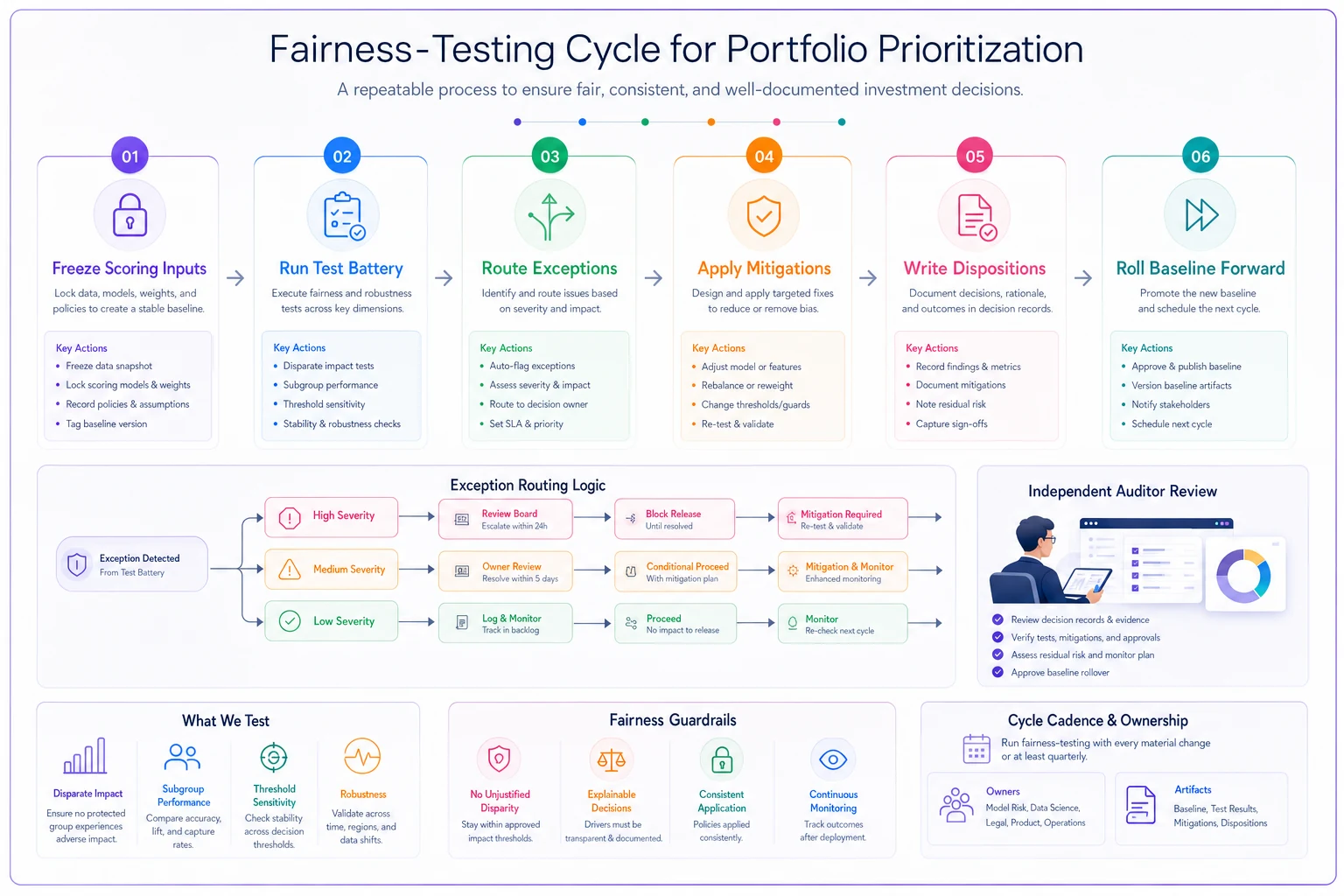
The discipline that makes this hold up under scrutiny is step 5. A fairness test floating in a separate spreadsheet proves nothing. A fairness test attached to the exact decision it validated is evidence.
Mitigation playbooks tied to what actually failed
Detecting bias is worthless without a pre-agreed response. Otherwise every failed test turns into an argument, and arguments get resolved by whoever's most senior — which reintroduces the exact bias you were testing for.
-
Rater inconsistency trips → Run a calibration pass. Pull the items with the widest rater spread, have raters re-score with a discussion of the rubric anchors, and log the before/after. Persistent outlier raters get retrained or removed from that criterion.
-
Group parity trips → Investigate before you adjust. Sometimes the disparity reflects legitimate strategy. If it doesn't, the fix usually sits at intake framing or weight design — not at the individual score level. Document which conclusion you reached and why.
-
Weight sensitivity trips → If small weight changes reshuffle the top tier, your ordering is fragile. Widen the "review band" — treat near-tie projects as genuinely tied and route them to explicit human trade-off review rather than pretending the decimal points are meaningful.
-
Drift trips → Reconcile against known changes. Did the strategy shift? Did a rater team change? If you can explain the drift, log the explanation. If you can't, that's your investigation flag.
-
Override rate trips → Surface the pattern to governance. Overrides aren't the problem; unexamined overrides are. Require the same rationale standard for overrides that you require for scores.
The connective tissue here is that mitigations feed back into the portfolio decision-economics and rebalancing framework — fairness corrections change rankings, and changed rankings change funding allocation. If your bias controls live in a silo separate from your allocation logic, corrections never actually reach the money.
A real scenario
A mid-sized insurer's PMO ran a weighted scorecard across roughly 90 projects per annual cycle, spread over four divisions. Prioritization felt fine internally until an internal audit flagged that one division's projects had captured a disproportionate share of discretionary funding two years running — around 40% of the pool for a division representing about a quarter of the request volume.
When they went back to explain it, they couldn't. The scores existed, but the reasoning behind rater ratings, weight choices, and a handful of executive overrides was gone. It took a small team the better part of two weeks to partially reconstruct a defense, and even then it was thin.
They put a fairness layer in for the following cycle. Two findings surfaced quickly. First, rater consistency was poor on the "strategic alignment" criterion — the spread between raters on identical projects was wide enough that a project's score depended heavily on who scored it. Second, the well-funded division's projects consistently arrived with far more complete business cases, which inflated their "readiness" sub-score. Neither was malicious. Both were fixable.
After a calibration pass on strategic alignment and an intake-template change that standardized business-case completeness, the funding distribution the next cycle landed much closer to request volume. Not because they forced parity, but because they removed two structural advantages that had nothing to do with project merit. More importantly, when the audit came back around, the reconstruction that took two weeks the first time took about an afternoon — because every test and disposition was already sitting in the decision record.
When this is worth it, and when it isn't
When it makes sense: You're running enough projects across enough units that no single person can hold the context, you're making discretionary funding decisions that get challenged, and you operate somewhere that "defend your prioritization" is a real request — regulated industries, board-scrutinized capital plans, or any PMO where sponsors have the leverage to relitigate outcomes.
When it's overkill: A small portfolio where a few people share full context and decisions are rarely contested doesn't need a six-test battery. Start with documented weights, logged overrides, and a simple rater-consistency check. Adding heavy machinery to a portfolio that doesn't generate disputes just creates process nobody respects.
Who should be careful: PMOs that adopt fairness testing purely to look rigorous, without the lineage discipline to back it up, end up worse off. A fairness test you ran but can't tie to a decision is a liability — it proves you knew to check and didn't keep the evidence. Either commit to the lineage or don't start.
Where tooling fits, honestly
You can run the first version of this in spreadsheets, and plenty of PMOs should — just to prove the routine is worth keeping before investing in anything. The place manual approaches break is repetition and traceability at scale. Re-running six tests across 120 projects every cycle, maintaining baselines, and tying each result to the right decision record is exactly the kind of work that decays the moment someone's busy.
That's the point where portfolio platforms with built-in scoring, override logging, and decision-lineage records earn their place. Not because they make you unbiased, but because they make the checks automatic and the evidence retrievable without someone remembering to save the right file. The value is straightforward: the routine still runs when everyone's slammed, and the audit trail assembles itself instead of getting reconstructed after the fact.
The point
Prioritization bias isn't a moral failure and it usually isn't caused by one bad actor. It's the accumulated weight of small, individually reasonable choices that all lean the same way — hidden by scale, invisible until someone forces you to defend an outcome. The PMOs that handle it well don't chase a perfect model. They build a testing layer that runs on a cadence, match failures to pre-agreed mitigations, and — above all — keep the evidence attached to the decisions it justifies. Do that, and "why did this score the way it did?" stops being a two-week fire drill and becomes a question you can answer before it's even asked.
Ready to elevate your project delivery?
Join over 2,500 project teams using GoProjy to optimize resources, reduce risks, and drive portfolio success.