

The most expensive compliance failure isn't a failed audit. It's the one that surfaces at your final gate, when a project that's been running for four months can't ship because nobody ran a data privacy impact assessment back when it would've taken two hours.
That's late rework. And it's almost always a design flaw in how compliance gets attached to work — not a discipline problem with the teams doing the work.
PMOs tend to treat security and compliance as a review event — something that happens near the end, performed by a separate group, often with vague criteria. The result is predictable: things get caught late, remediation collides with launch deadlines, and project managers end up negotiating exceptions under pressure instead of following a process. A portfolio security compliance checklist only works if it's minimal enough to actually enforce and wired into the moments where decisions already happen.
Below is how this breaks, and how to fix it without building a 60-page policy nobody reads.
Why compliance gets caught late (and it's not the teams' fault)
There's a pattern that shows up constantly. A project moves through intake with a one-line note like "no significant compliance impact." Nobody challenges it because intake is focused on scope, budget, and sponsor. The project builds for months. Then at the pre-launch gate, someone on the security side asks whether the new feature touches customer PII, whether vendor data processing agreements are signed, whether the pen test was scheduled.
Suddenly you've got three unfinished artifacts and eleven days before launch.
The reason this happens is structural. Compliance requirements usually live in a separate document, owned by a separate team, surfaced at a separate checkpoint. The intake form and the compliance requirements never talk to each other. So the obligation to produce a data flow diagram or a vendor risk assessment doesn't get attached to the project when the project is created — it gets discovered later.
A second reason: requirements aren't tied to project class. Every project gets treated the same, which means either everything drowns in paperwork or nothing does. A small internal reporting tweak and a customer-facing payments integration both get the "fill out the security questionnaire" treatment — so teams either over-document trivial work or skip the questionnaire on the thing that actually matters.
The fix isn't more rigor everywhere. It's precision about which artifacts matter for which kind of work, and enforcing those few things at the right gates.
Classify first, then require
The foundation of an enforceable pack is a small set of project classes, each with a defined list of mandatory artifacts. Keep the classes few — three or four is usually enough. If you have eight, nobody will remember which is which.
Stop losing track of critical projects.
GoProjy helps you monitor, prioritize, and deliver projects on time—seamlessly.
- Unified portfolio visibility
- Real-time resource tracking
- Milestone & risk alerts
No credit card required
A workable classification looks like this:
| Project class | Trigger characteristics | Required artifacts | Remediation window if missing at gate |
|---|---|---|---|
| Class A — Sensitive data / external | Handles PII, payment data, health data, or exposes a public-facing surface | Data flow diagram, DPIA, vendor DPA, pen test booking, access review | 5 business days (hard stop) |
| Class B — Internal / integrated | Internal tool touching production systems or employee data | Data classification note, access review, dependency security scan | 10 business days |
| Class C — Low-risk internal | Reporting, config, documentation, no new data surface | Self-attestation checkbox, sponsor sign-off | N/A — attested at intake |
| Class D — Vendor-delivered | Third party builds or hosts the capability | Vendor security questionnaire, SLA security clauses, breach-notification terms | 7 business days |
The point of this table isn't the specific categories — your risk profile will shift the lines. The point is that a project gets classified at intake, and classification automatically pulls the matching artifact list onto the project's record. No one decides later whether a DPIA is needed. The class decides.
One pattern worth flagging: teams game classification downward when the lighter class saves them work. A payments integration quietly labeled "internal tool." The guard against this is making class triggers objective and reviewable — "touches payment data" is a yes/no, not a judgment call — and spot-checking a sample of Class C intakes each quarter.
Make the gate binary, with a remediation clock attached
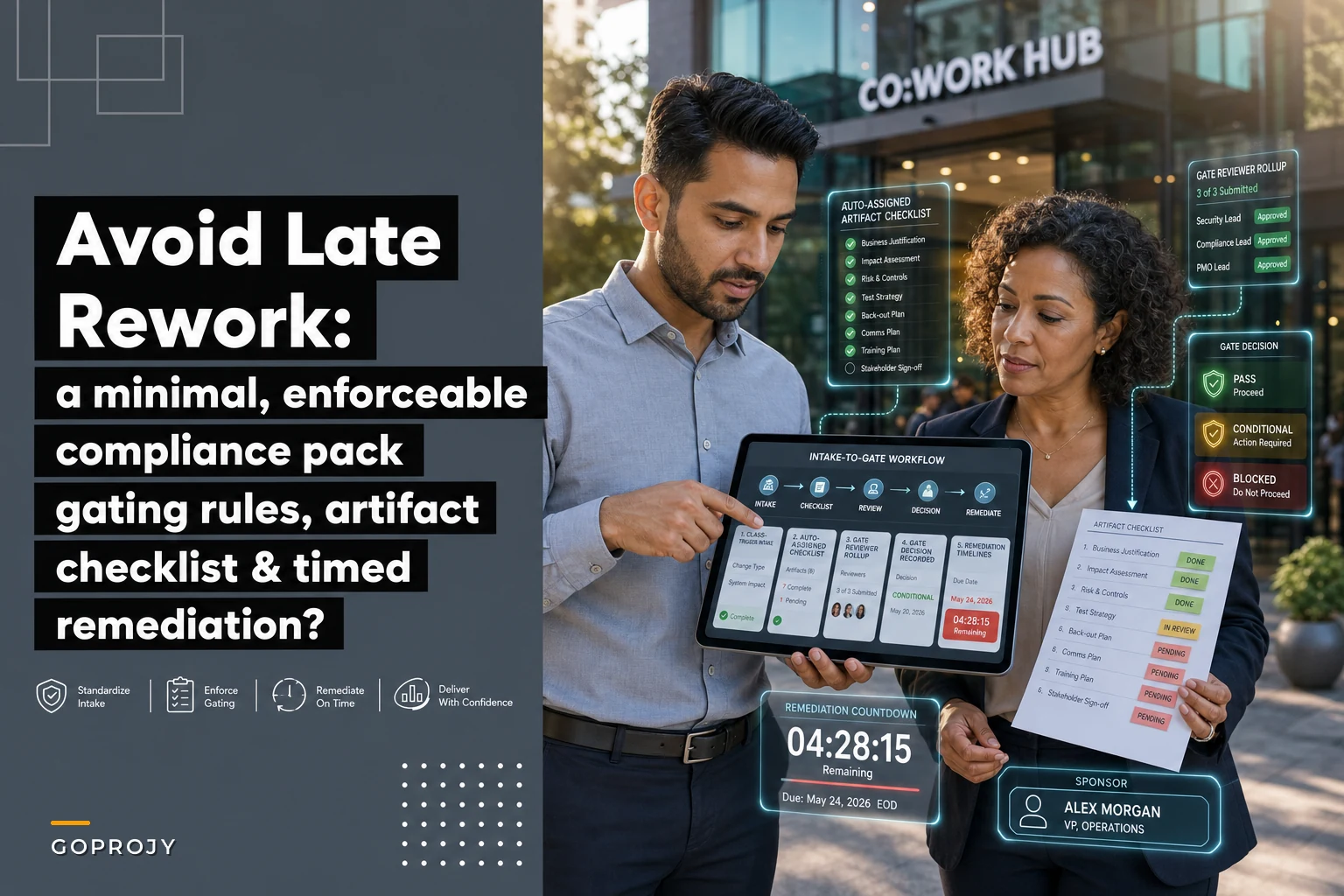
A gate that allows "we'll finish the pen test after launch" isn't a gate. It's a suggestion. The whole value of gating is that it's enforceable, which means the answer at the gate is one of three states, not a negotiation:
-
All required artifacts present and valid → pass.
-
Artifacts missing but within remediation window → conditional pass with a dated remediation commitment.
-
Artifacts missing beyond the window, or a hard-stop artifact absent → blocked.
The remediation window is what keeps this humane instead of brutal. You're not saying "every artifact must exist before any work proceeds." You're saying: if something's missing at the gate, here's exactly how many days you have to close it, and here's what happens if you don't.
For Class A, the pen test booking is a hard stop — not the completed test, but proof it's scheduled before launch. That distinction matters. Requiring a finished pen test at the gate is unrealistic for tight timelines; requiring a confirmed booking is enforceable and still protects you.
The remediation clock should start at the gate decision and be visible to the sponsor. What kills late rework isn't the window itself — it's that the window is dated and owned. A remediation item with no owner and no date is just a note that resurfaces at the next crisis.
This connects directly to how decision rights work across your portfolio. If your gates don't have clear owners empowered to block, you'll get override-by-seniority every time a deadline looms. It's worth reading how to treat decision rights as an operational framework rather than a checklist — because a compliance gate with no real authority behind it is theater.
The minimal artifact set — what actually earns its place
The instinct when building a compliance pack is to require everything that might ever be useful. Resist it. Every artifact you require is something a human has to produce, review, and store. The cost compounds across a portfolio.
Here's the test for whether an artifact belongs in the required set:
-
Does its absence create real downstream rework or risk? A data flow diagram prevents the "wait, where does this data go" scramble at launch. It earns its place.
-
Can someone produce it in hours, not weeks? If an artifact takes three weeks to generate, it's not a gate check — it's a project of its own, and it needs to be scheduled as work, not demanded at a checkpoint.
-
Will a reviewer actually read it? If nobody reads the 40-page security architecture doc, it's not a control. It's shelf-ware that creates false comfort.
If an artifact takes weeks to produce, make it scheduled work rather than a gate requirement.
A lean Class A pack usually comes down to five things a reviewer can check in under an hour: data flow diagram, DPIA, signed vendor DPA, pen test booking confirmation, and a current access review. Not forty artifacts. Five that actually get looked at.
PMOs confuse volume of documentation with strength of control more often than you'd think. A portfolio with fifteen required artifacts per project, half of them unread, is weaker than one with five that every reviewer genuinely checks. More paperwork just means more places to hide a gap.
Wiring it into intake — the workflow that prevents the whole problem
The entire mechanism only works if classification and artifact assignment happen at intake, not later. Here's the workflow in plain terms:
[New request enters intake] ↓ [Intake form asks objective class-trigger questions] (PII? Payment data? Public surface? Vendor-delivered?) ↓ [Project auto-assigned a class based on answers] ↓ [Matching artifact checklist pulled onto project record] (Status per artifact: not started / in progress / submitted / validated) ↓ [Artifacts visible as obligations from day one] ↓ [Gate reviewer sees rollup: validated / outstanding / hard stop?] ↓ [Gate decision recorded: Pass / Conditional with dated owners / Blocked]
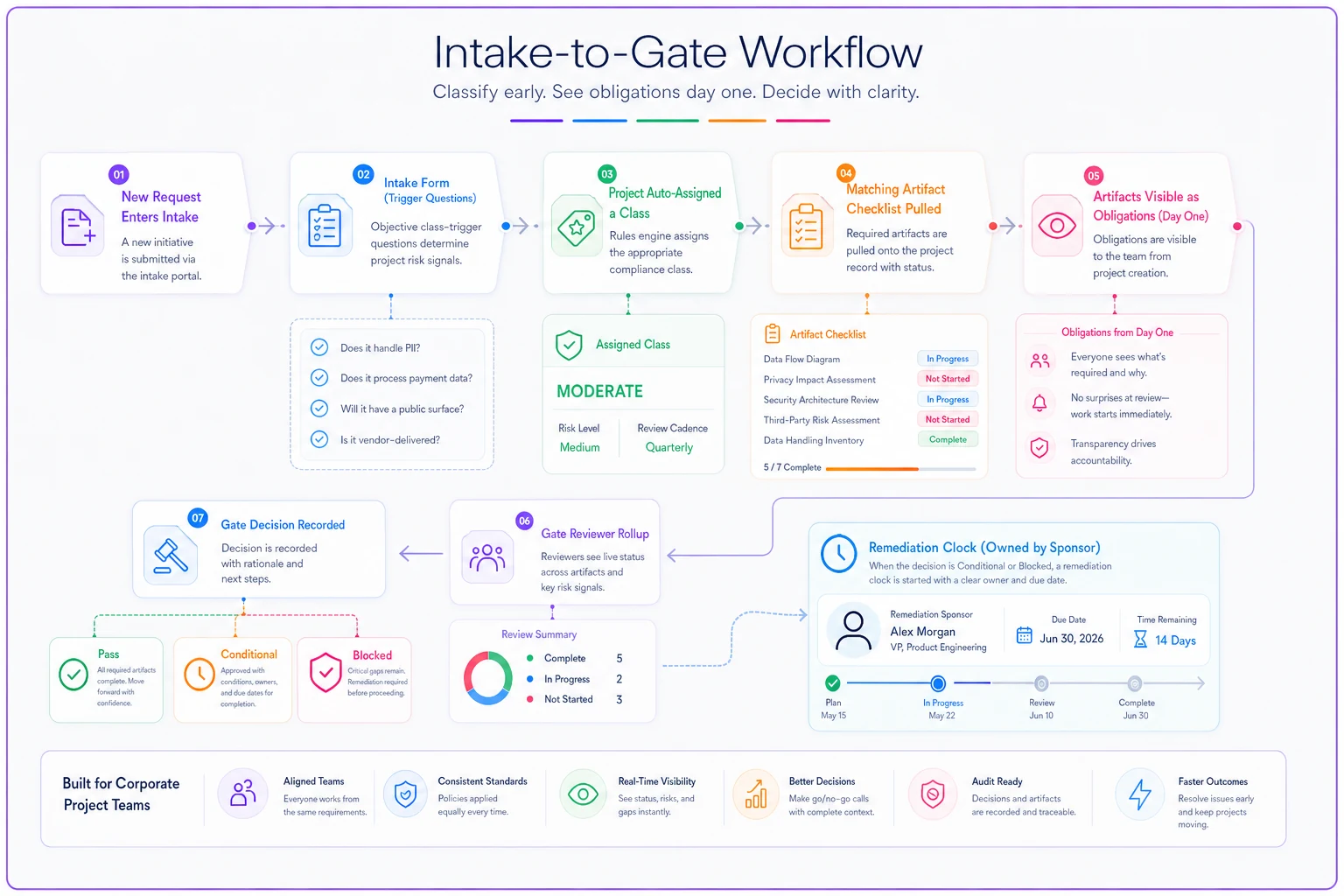
This visual maps the intake-to-gate flow so obligations are visible from day one.
From the moment the class is assigned, the required artifacts are visible as obligations. Project managers see them in the same view as scope and milestones. They can schedule the DPIA when it's cheap to do — early — instead of discovering it when it's expensive.
This is where operational software helps without needing to be the star of the show. The value isn't the tool — it's that the tool makes the obligation unavoidable and visible. When intake answers automatically drive the artifact list, and the artifact list automatically feeds the gate, there's no gap for things to fall through. AI-assisted intake can flag likely misclassifications too — a project description mentioning "customer records" that someone filed as Class C gets a quiet nudge for review. That's automation reducing a real failure mode, not automation for its own sake.
The compliance pack stops being a separate process a team has to remember. It rides along with the work from the first intake answer through the final gate.
When this approach makes sense — and when it's overkill
This structure is worth building when you're running enough projects that ad-hoc compliance review has started failing. If you're managing a handful of projects and your security lead personally knows every one, you may not need formal gating yet. The overhead won't pay back.
It makes clear sense when:
-
You've had at least one late-stage compliance scramble that delayed a launch.
-
Projects span multiple teams and no single person sees all the risk.
-
You have genuine regulatory exposure — payment, health, personal data — where a miss has real consequences.
It's the wrong move when the organization is small enough that a checklist in a shared doc genuinely works, or when you'd build the gates but have no one with authority to enforce a block. A gate nobody can enforce is worse than no gate — it trains teams that the rules are optional.
One group that should not do this: teams that would use the pack as a reason to slow everything down. The remediation windows exist precisely so velocity survives. If your culture turns every conditional pass into a six-week freeze, fix the culture first, or the pack becomes a weapon against delivery.
A real scenario: the integration that almost shipped blind
A mid-sized financial services firm — roughly 40 active projects in the portfolio — ran a customer data integration that moved account information to a new analytics vendor. At intake it was logged as a routine internal project. No class triggers were asked. No DPA requirement surfaced.
The gap showed up eleven days before launch when legal happened to ask about the vendor contract. The vendor DPA wasn't signed, the data flow hadn't been mapped, and the access scope was wider than anyone realized. Remediation jammed up against the launch date. The project slipped about three weeks, and the scramble pulled two senior people off other work for most of that stretch — a meaningful chunk of capacity lost across the team.
After that, they rebuilt intake around class triggers. The next vendor integration got auto-classified Class D at intake, pulled the vendor questionnaire and DPA onto the record on day one, and the DPA was signed weeks ahead of the gate. No slip. The difference wasn't more effort — it was the obligation showing up at the start instead of the end.
Late rework is almost always early omission wearing a disguise.
The enforceable checklist
Use this to pressure-test your own pack. If you can't answer yes to most of these, late rework is still built into your process:
-
Does intake ask explicit, objective class-trigger questions (PII, payment, health, public surface, vendor-delivered) rather than relying on a judgment call?
-
Does classification automatically assign the required artifact list to the project record at creation?
-
Is the required artifact set minimal — five or fewer per class — and does every artifact get genuinely reviewed?
-
Are gate outcomes binary-plus-remediation (pass / conditional with dated commitment / blocked), not open negotiations?
-
Does every remediation item have a window, an owner, and a date visible to the sponsor?
-
Is at least one artifact per high-risk class a hard stop that can't be deferred past launch?
-
Do you spot-check low-risk classifications to catch downward gaming?
-
Can your gate owners actually block, with decision rights that survive deadline pressure?
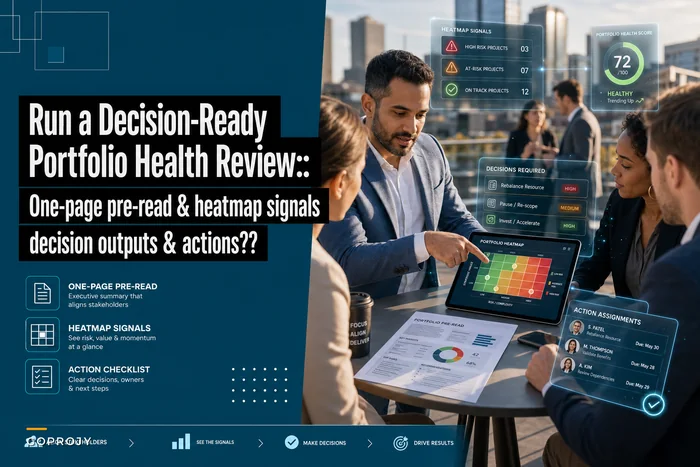
That last point ties back to the broader habit of making portfolio reviews decision-ready rather than status theater. A compliance rollup is most useful when it feeds the same review rhythm as everything else — the kind of structure laid out in running a decision-ready portfolio health review. Compliance shouldn't live in its own lonely checkpoint; it should show up on the heatmap alongside schedule and budget.
Closing thought
Compliance packs fail when they're big, separate, and late. They work when they're small, embedded, and enforced from intake.
The win isn't a thicker policy binder. It's that the handful of artifacts that actually matter get attached to a project the moment it's born, and the gate has the authority and the remediation clock to hold the line without freezing delivery. Get the classification right at intake, keep the required set brutally minimal, and give every missing artifact a dated owner. Do that consistently, and the compliance surprise three days before launch stops being a recurring feature of your portfolio.
Ready to elevate your project delivery?
Join over 2,500 project teams using GoProjy to optimize resources, reduce risks, and drive portfolio success.