


Most funding fights in a portfolio aren't really about how much money a project gets. They're about how the money is classified. The same $400k of work can land in two completely different worlds depending on whether finance calls it CapEx or OpEx — and those two worlds come with different approval chains, different reporting rhythms, and very different ideas about who's on the hook when something drifts.
The problem is that most PMOs treat funding classification as an accounting afterthought. Someone in finance stamps it during budgeting season, and the project team finds out months later that the way they're building doesn't match how it's being funded. Then you get the awkward conversation where a chunk of spend can't be capitalized, and suddenly a "green" project is over its OpEx line by six figures.
This is about wiring those decisions together on purpose — mapping funding model to governance consequence to accounting treatment, with actual funding windows and accountability contracts attached. Not theory. The stuff that determines whether your quarter-close is calm or chaotic.
The real reason funding classification breaks down
The pattern that shows up again and again: funding is decided by capacity — what budget bucket has room — instead of by the nature of the work. A team needs money, OpEx is tight this quarter, CapEx has slack, so the work gets shoved into CapEx with a loose justification. Six months later an auditor asks why ongoing maintenance labor got capitalized, and the whole thing unwinds.
-
CapEx creates an asset on the balance sheet. It gets depreciated over years. It usually attracts heavier upfront governance — business cases, stage gates, board thresholds — because you're committing to a multi-year asset.
-
OpEx hits the P&L now. It's cheaper to approve, easier to cut mid-year, and tends to get lighter governance. But it's also the first thing squeezed when someone needs to protect margin.
So the same work, funded two ways, gives you two totally different accountability profiles. CapEx funding tends to make people cautious and slow. OpEx funding tends to make people fast and disposable. Neither is inherently wrong — but if the model doesn't match the work, you get friction that looks like a people problem and is actually a structural one.
Where the confusion peaks is when SaaS and cloud spend enters the picture. Old rules said "software you build = CapEx, software you rent = OpEx." Modern delivery blurs that. Agile teams doing continuous development on a subscription platform generate spend that's partly capitalizable — new feature development — and partly not — running the service. If nobody splits that at the work level, finance ends up guessing at year-end, and the guess is rarely in your favor.
A decision matrix: funding model → governance → accounting → accountability
The point of a matrix is to stop arguing case by case. You decide the rules once, then classify work against them. Here's a working version you can adapt.
Stop losing track of critical projects.
GoProjy helps you monitor, prioritize, and deliver projects on time—seamlessly.
- Unified portfolio visibility
- Real-time resource tracking
- Milestone & risk alerts
No credit card required
| Funding model | Best fit for | Governance consequence | Accounting treatment | Owner accountability |
|---|---|---|---|---|
| Pure CapEx | Net-new build, defined asset, 2+ year life | Full business case, stage gates, board sign-off above threshold | Capitalize dev labor + license buildout; depreciate over useful life | Sponsor owns benefit realization; PM owns capitalization evidence |
| Pure OpEx | Run-the-business, maintenance, short-lived experiments | Lightweight approval, quarterly review, easy to stop | Expensed as incurred | Cost-center owner owns the spend line; PM owns burn rate |
| Hybrid (split-funded) | Continuous development on a platform, feature work + run cost | Gate the CapEx portion, monitor the OpEx portion continuously | Split at activity level: capitalize qualifying dev, expense the rest | PM owns the split log; finance validates monthly |
| Chargeback / showback | Shared platforms, multi-BU consumption | Consumption governance, allocation disputes escalate to portfolio | Cost recovered from consuming units; classification follows source | Consuming BU owns their allocated cost; platform owner owns the model |
The column people consistently skip is the last one. A funding model isn't complete until you've named who is accountable for what specifically — not "the sponsor is accountable," but "the sponsor owns whether the depreciated asset delivers the benefit, and the PM owns whether the capitalization evidence survives an audit." Those are different jobs and they fail differently.
One thing worth sitting with: the tighter your governance on CapEx, the more people will try to move work into OpEx to avoid the gates. If your CapEx process is genuinely painful, you've built an incentive to misclassify. The fix isn't more controls — it's making the CapEx path proportionate so people stop routing around it.
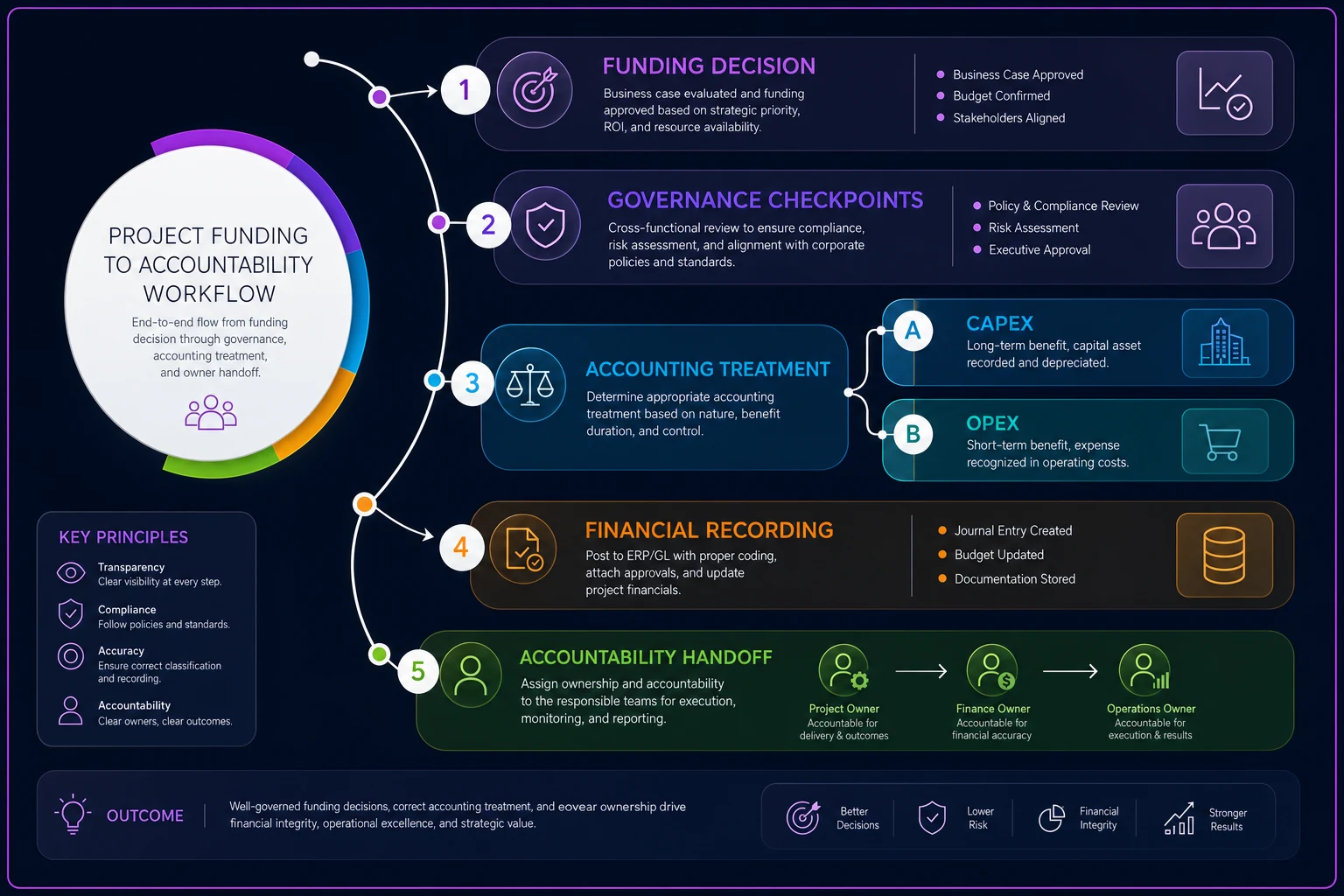
A simple workflow like this clarifies who does what when a funding decision is made.
Sample funding windows (and why "annual budget" quietly kills you)
Annual funding is the default and it's usually the wrong shape for how work actually moves. If a project can only get money once a year, you get two failure modes: teams over-ask upfront to avoid being stranded, or promising work stalls for months waiting for the next cycle.
-
Seed window (0–8 weeks). Small OpEx allocation, roughly $20k–$50k, to prove the hypothesis. No CapEx here — you don't capitalize things that might not exist. Governance is light: one page, one approver.
-
Build window (quarterly). Once a concept clears its threshold, it enters a quarterly funding slot where CapEx becomes available for qualifying build work. This is where stage gates kick in.
-
Continuation windows (quarterly re-confirm). Funding isn't renewed automatically. Each quarter the work re-earns its slot against its score. This is the discipline most portfolios lack — money keeps flowing to yesterday's priorities because nobody made continuation an actual decision.
-
Run window (annual OpEx). Once something is live and stable, it moves to a steady-state OpEx line reviewed annually, because run cost is predictable and doesn't need quarterly drama.
Linking windows to score rather than the calendar forces reallocation to be routine instead of political. If you want the deeper mechanics of connecting scores to slices and when to pull money back, we covered that in our framework for linking prioritization scores to funding slices.
Decide re-classification rules for seed-to-build transitions upfront to avoid surprise non-capitalizable spend at close.
A mistake worth flagging: people set the seed window as OpEx, the build window as CapEx, and then forget to re-classify when work moves between windows. Seed spend that later becomes part of a capitalized asset sometimes qualifies retroactively, sometimes doesn't, depending on your standard and jurisdiction. Decide the rule before you start, not at close.
Chargeback and accountability: where funding models actually get tested
Chargeback is where funding governance either works or collapses, because it's the one model that makes another team feel the cost. Showback — just showing consumption — is polite and mostly toothless. Chargeback actually moves the cost to the consuming unit, which changes behavior and starts arguments.
The predictable dispute: a business unit consumes 40% of a shared platform, gets billed for it, and immediately argues the allocation model is unfair. This usually happens when the allocation basis is opaque. If you charge back on a metric people can't see or influence — like "share of total compute" with no dashboard — they'll fight every invoice. Charge back on something visible and controllable, like number of active users or transactions processed, and the arguing mostly stops because the bill maps to something they recognize.
-
Publish the allocation basis before the period, not after. No retroactive metric changes.
-
Give consuming units a way to reduce their bill. If they can't influence the cost, it's a tax — and taxes get resented and gamed.
-
Set a dispute threshold. Allocation disagreements under, say, 5% of the line get absorbed; anything larger escalates to the portfolio level with evidence.
-
Tie the chargeback to a named owner in each consuming unit. "The BU" can't own a cost. A person can.
-
Reconcile monthly, not annually. A drip of small corrections is manageable. A year-end surprise is a fight.
The accountability contract underneath chargeback is the thing people forget to write down. It should state, in plain language: who owns the platform cost model, who owns each consuming unit's allocated spend, what the escalation path is when the two disagree, and how often the numbers get trued up. Without that contract, the platform owner ends up eating variance nobody agreed to, and the model quietly dies.
A worked example: mapping score to funding treatment
Say you're running a mid-size portfolio and a data-platform initiative scores well enough to clear the build threshold. Here's how the pieces connect in practice.
-
New pipeline development — roughly $260k of engineering labor over two quarters. Net-new asset creation, so it's CapEx, gated, depreciated over the platform's useful life.
-
Migration of existing data — about $90k. Depending on your standard, migration labor often can't be capitalized because you're not creating new capability, just moving what exists. So this goes OpEx, and the team is told upfront so they don't assume it's all capitalizable.
-
Ongoing platform run cost — around $8k–$11k a month once live. Pure OpEx, moves to the annual run window after go-live.
Before this got structured, the whole thing was requested as a single CapEx number. At close, finance disallowed the migration portion, and the project blew its capitalization plan by roughly $90k — which then hit the P&L unexpectedly and turned a healthy-looking initiative into a variance problem the sponsor had to explain.
After splitting at the activity level and attaching the treatment to each stream upfront, there were no surprises at close. The CapEx portion was clean and defensible, the OpEx portion was planned for, and the run cost slid into steady state without a fight. Nothing about the work changed. Only the classification discipline did.
This kind of clean handoff to finance depends on your reporting cadence and the shape of your cost-to-complete data. If your roll-ups aren't finance-ready, the split above looks great on paper and falls apart in the actuals. We walked through building that finance-ready muscle — cadence, data contracts, and multi-project roll-ups — in our piece on making portfolio forecasts finance-ready.
When each model actually makes sense
Pure CapEx makes sense for genuine net-new capability with a multi-year life, where heavier governance is proportionate to the commitment. If you're building something you'll depend on for years, the gates are worth it.
Pure OpEx makes sense for experiments, maintenance, and anything you might kill in six months. Don't capitalize things you're not sure will survive. OpEx keeps optionality cheap.
Hybrid split-funding is now the default for most modern software delivery, even though a lot of PMOs still treat funding as a binary choice. It fits continuous development on a living platform, where some work creates new capability and some just keeps the lights on.
Chargeback makes sense for shared platforms consumed by multiple units, where cost discipline only appears once consumers feel the bill. If everyone treats a platform as free, everyone over-consumes it.
When these models are a bad idea
Chargeback is a bad idea when your allocation data is weak. If you can't measure consumption accurately and transparently, chargeback will generate more political cost than it recovers. Start with showback, fix the measurement, then switch.
Hybrid split-funding is a bad idea when your teams can't — or won't — track activity at the level needed to defend the split. If nobody's logging which hours went to new capability versus maintenance, your split is a guess, and a guessed split fails audit. Either build the tracking habit first or keep it simple.
Pure CapEx is a bad idea for anything experimental. Capitalizing an experiment that dies means you've got an impaired asset to write off and an awkward explanation for it. Fast, uncertain work belongs in OpEx where stopping is cheap and boring.
Who should NOT run a chargeback model
If your portfolio has just a few consuming units, chargeback overhead usually isn't worth it — the disputes cost more attention than the model recovers. Showback is enough to change behavior at small scale.
If your finance function can't reconcile monthly, don't attempt chargeback. The whole model depends on frequent, small corrections. Annual reconciliation turns it into an annual war.
And if you don't have a named owner in each consuming unit who can actually influence their consumption, skip it. Charging back to someone who can't reduce the cost just breeds resentment and creative accounting.
What breaks as you scale
At a handful of projects, you can run all this in a spreadsheet and someone in finance remembers the context. At fifty or a hundred, the context evaporates. Split logs live in different places, chargeback metrics drift, continuation decisions get skipped because nobody has bandwidth, and money keeps flowing to work that stopped mattering two quarters ago.
The structural failure at scale is almost always the same: the funding classification and the actual work drift apart. Work that was CapEx-justified becomes maintenance and nobody re-classifies it. Chargeback metrics stay frozen while consumption patterns shift. Continuation windows become rubber stamps.
The teams that hold this together at scale tend to do a few specific things. They keep classification decisions attached to the work item, not buried in a budget doc. They make continuation an actual decision every quarter instead of a default. They reconcile chargeback often enough that corrections stay small. And they write accountability down as named-person contracts, so when something drifts, there's a specific person to talk to rather than a committee to convene.
None of that requires exotic tooling. It requires that the money model, the governance rhythm, and the accountability all point at the same reality — and that you revisit the mapping when the work changes, because it always does. Funding confusion isn't caused by finance being difficult or PMs being careless. It's caused by three systems that were supposed to line up quietly drifting out of sync, one uncontested classification at a time.
None of that requires exotic tooling. It requires that the money model, the governance rhythm, and the accountability all point at the same reality — and that you revisit the mapping when the work changes, because it always does. Funding confusion isn't caused by finance being difficult or PMs being careless. It's caused by three systems that were supposed to line up quietly drifting out of sync, one uncontested classification at a time.
Ready to elevate your project delivery?
Join over 2,500 project teams using GoProjy to optimize resources, reduce risks, and drive portfolio success.