


Most PMO onboarding plans are useless because they measure the wrong thing. They track whether the new person "completed system training" or "met the stakeholders" — activities that feel productive but tell you nothing about whether governance is actually sticking. A PMO exists to change how decisions get made. So the only onboarding plan worth writing is one that measures governance adoption, not orientation attendance.
The difference matters because a PMO has a very short credibility window. If project managers and sponsors don't see the new governance adding value by roughly day 45, they quietly route around it. By day 90, you're not onboarding a PMO anymore — you're defending one that already lost the room.
What follows is a PMO onboarding 30-60-90 built around adoption milestones, the specific artifacts each phase has to produce, the handoffs that make those artifacts real, and the rubrics you use to decide whether a milestone actually passed. It assumes you already know what a RAID log and a stage gate are. The focus here is sequencing and proof.
Why most PMO onboarding plans quietly fail
The failure pattern is almost always the same, and it shows up in the artifacts.
A new PMO lead spends the first month reading. They interview sponsors, review the portfolio, build a beautiful current-state assessment deck. Month two, they introduce a new intake form, a revised status template, maybe a steering cadence. Month three, they report "adoption in progress" to whoever hired them.
Nothing in that sequence ever forces a governance decision to run through the new standard. Reading the portfolio is not governance. Publishing a template is not adoption. Adoption only happens the first time a real funding or scope decision is made using the new rubric — and someone feels the friction of it and complies anyway.
If the onboarding plan never schedules that first real decision, the PMO stays theoretical. And theoretical PMOs get cut in the first budget squeeze.
The second failure mode is confusing standardization with adoption. You can standardize every template in the org and still have zero adoption if PMs fill them out as compliance theater. What you're really onboarding is a set of decision rights and the evidence trail behind them. That's much closer to the work in a real operational portfolio governance framework with decision matrices than to a document rollout.
The three phases, framed as adoption, not activity
Each 30-day block has one job:
Stop losing track of critical projects.
GoProjy helps you monitor, prioritize, and deliver projects on time—seamlessly.
- Unified portfolio visibility
- Real-time resource tracking
- Milestone & risk alerts
No credit card required
| Phase | Primary goal | What "done" means | Biggest risk |
|---|---|---|---|
| Days 0–30 | Diagnose and anchor | You know the real decision flow (not the documented one) and have one governance standard agreed in writing | Spending all 30 days reading instead of testing |
| Days 31–60 | Run live decisions through governance | At least 2–3 real portfolio decisions have gone through the new rubric, with evidence | Publishing templates nobody uses on a real decision |
| Days 61–90 | Prove adoption and hand off ownership | PMs run the cadence without you driving every meeting; rubrics are producing repeatable outputs | You stay the single point of failure forever |
Notice the middle phase isn't "build the framework." It's "use it on something that matters." That ordering is the whole point.
Build-then-adopt almost always stalls; adopt-on-a-small-real-thing then scale works far more often.
Days 0–30: Diagnose the real governance, don't just document the official one
The first month's output is not a maturity assessment. It's a map of how decisions actually happen versus how they're supposed to happen, plus one anchored standard you'll use as the wedge.
What you're actually hunting for
Every portfolio has a gap between the documented gate process and the shadow process. The shadow process is where the real decisions live — the Slack thread where a VP greenlights a project, the hallway conversation that reprioritizes a sprint, the finance spreadsheet that overrides the official scorecard. Your month one job is to find those and write them down, because that's what you're actually going to govern.
A useful early exercise: take the three largest active projects and trace, for each, who actually approved the last major scope or budget change and what evidence they looked at. In a lot of orgs you'll find the answer is "nobody can say" or "a verbal yes in a meeting with no record." That gap is your opening.
Artifacts to deliver by day 30
-
Decision-flow map — the real vs. documented approval paths for intake, funding changes, and gate transitions
-
Portfolio baseline snapshot — active projects, rough spend, status confidence (not a deep audit, just a defensible starting line)
-
One anchored governance standard — a single, agreed-in-writing rubric you'll pilot. Usually intake scoring or the funding-change gate. Pick the one with the most pain.
-
Stakeholder decision-rights draft — who decides, who's consulted, who just needs to know, for the anchored standard only
The day-30 handoff
The handoff here is to your sponsor, and it's a specific one: you walk them through the decision-flow map and get explicit sign-off on the one standard you're going to enforce next month. Not twelve standards. One. If the sponsor won't commit to backing enforcement of a single standard, you've learned something critical about whether this PMO has air cover — better to know on day 30 than day 80.
Day-30 evaluation rubric
-
Can you describe the real decision flow for the top three projects, including who actually approves changes? (pass = yes, with names)
-
Is there one governance standard documented and sponsor-endorsed for enforcement? (pass = written sign-off)
-
Do you have a baseline you could defend in a steering meeting? (pass = numbers plus confidence caveats)
If you can't hit all three at pass or strong-partial, don't move to phase two. Extend phase one. Moving forward on a shaky anchor is the single most common reason the 60-day mark collapses.
Days 31–60: Force real decisions through the standard
This is the phase everything hinges on. Your job is no longer to build — it's to make real portfolio decisions flow through the anchored standard and capture the evidence that they did.
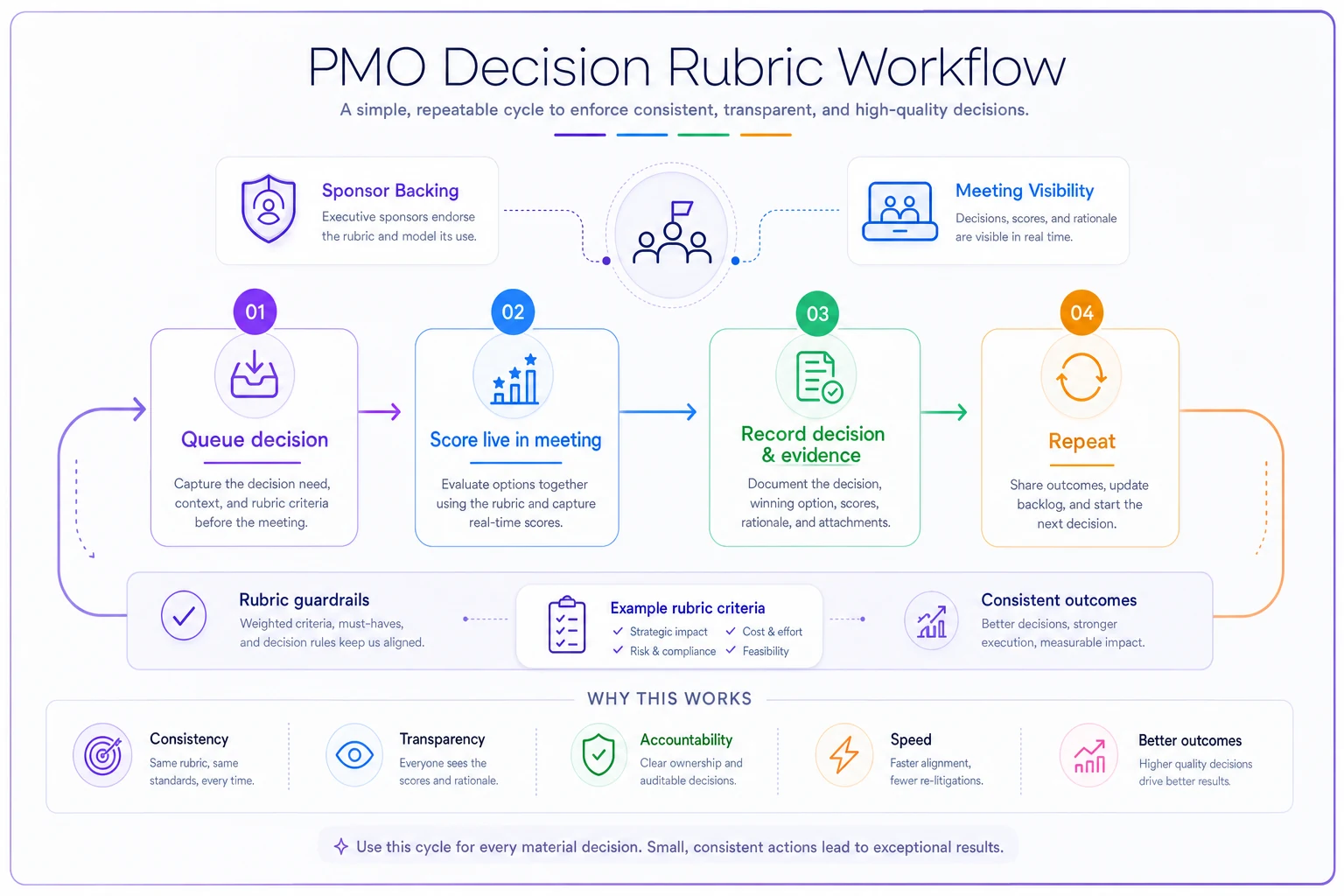
The workflow that creates actual adoption
Here's the sequence that works, in order:
-
Queue a real decision. Wait for (or surface) an actual intake request or funding change that matters. Don't invent a fake one — people smell it immediately.
-
Run it through the rubric publicly. In the steering or review meeting, score it live using the new standard. Make the scoring visible, including the parts that feel awkward.
-
Let the friction happen. Someone will push back when the rubric says no to their pet project or flags their favorite initiative. This is the moment adoption is won or lost. The sponsor endorsement from day 30 is what you spend here.
-
Record the decision and its evidence. Capture what was decided, the score, the inputs, and who approved. This record is the artifact — not the template, the filled-in instance.
-
Repeat twice more. Two or three live decisions through the standard is roughly the threshold where PMs stop treating it as a one-off and start assuming it's how things work now.
The common mistake in this phase is going wide instead of deep. New PMO leads often introduce five new templates in month two because they feel pressure to show output. Don't. One standard, applied to three real decisions with visible teeth, beats five templates nobody has been forced to use.
One standard, applied to three real decisions with visible teeth, beats five templates nobody has been forced to use.
A realistic example
A mid-sized firm stood up a PMO to get control of a portfolio of roughly 40 active projects where funding changes were happening through email approvals with no scoring. The new lead resisted the urge to roll out a full gate system. Instead, in month two, they enforced a single funding-change rubric on the next four change requests that came through.
The first one was contested hard — a director wanted an extra ~$60k for a project that scored poorly on the rubric. The sponsor backed the rubric, the request got reshaped instead of rubber-stamped, and somewhere around $35k–$40k got redirected to a higher-scoring initiative. That single visible decision did more for adoption than the previous PMO's entire template library. By the end of the month, PMs were pre-scoring their own change requests before bringing them, because they knew unscored ones would get bounced.
Artifacts to deliver by day 60
-
2–3 completed decision records using the anchored standard, with scores and evidence
-
A refined rubric adjusted for whatever broke during live use (it always needs adjusting)
-
A second standard, drafted — now that one is sticking, you queue the next
-
An adoption signal log — who's using it voluntarily, who's resisting, where the friction clusters
The day-60 handoff
This handoff goes to the PMs, not the sponsor. You start transferring the scoring itself — in the next decision, a PM runs the rubric while you observe. If you're still the only person who can operate the standard at day 60, you've built a dependency, not a capability.
Day-60 evaluation rubric
-
Have 2+ real decisions actually changed outcome or shape because of the rubric? (If the rubric only ever confirmed what people already wanted, it has no teeth — that's a fail disguised as a pass.)
-
Can at least one PM run the scoring without you? (pass/fail)
-
Is there a visible example where governance said "no" or "not like that" and it held? (This is the single best adoption signal.)
If these aren't true, iterate in month three rather than expanding scope prematurely.
Days 61–90: Prove it runs without you
The final phase isn't about adding more governance. It's about proving the governance survives your absence from the room, and documenting it so the next reorg doesn't reset everything.
A PMO that only functions when its lead personally drives every meeting hasn't been adopted — it's been tolerated. The test of phase three is deliberately stepping back and watching whether the cadence holds.
How to actually test it
Pick one governance meeting in the 61–90 window and don't run it. Have a PM run it using the rubrics and templates. Sit in the back. Watch what breaks. Where the process falls apart without you is exactly where your documentation and training are still too thin. Fix those specific gaps rather than re-training everything.
This is also where you connect the onboarding to the broader operating model. A single adopted standard is a start, but it only compounds if it fits into how the whole portfolio is run — the sequencing, roles, and scaling patterns covered in the operating-model blueprint for scaling from a handful to hundreds of projects. Phase three is where your onboarding stops being personal and becomes institutional.
Artifacts to deliver by day 90
-
A governance operating record — the standards now in use, who owns each, and the cadence they run on
-
Decision evidence trail — a running log of decisions made through governance since day 31, enough to show a pattern not a one-off
-
A short "what breaks without me" list — honest gaps where the PMO still depends on you personally
-
The next-90-days plan — which standards to add, which to retire, based on what actually got traction
Day-90 evaluation rubric
| Dimension | Fail | Partial | Pass |
|---|---|---|---|
| Decisions through governance | 0–1 total | 2–4 total | 5+ with a clear pattern |
| PM independence | Only you can run it | PMs run it with heavy support | PMs run cadence; you advise |
| Enforcement held | Governance got overridden quietly | Held once under pressure | Held multiple times, including a hard "no" |
| Evidence trail | Nothing recorded | Some records, inconsistent | Consistent decision records with inputs |
If you're at pass across all four, the PMO is real. Partial across the board means you have a working pilot that needs another cycle. A fail on enforcement specifically is the one that matters most — nothing else you built will hold if the air cover problem isn't fixed first.
When this plan makes sense — and when it doesn't
This works well when you have genuine sponsor backing, a portfolio with real decision pain, and permission to enforce at least one standard with teeth. The adopt-on-a-small-real-thing approach is specifically designed for environments where credibility has to be earned fast.
This is a bad idea when leadership wants a PMO for optics but won't back a single enforced decision. If your day-30 handoff can't secure sponsor sign-off on enforcing one standard, running the full 90-day plan just burns your credibility on governance nobody will defend. Better to scope down to pure reporting and visibility until the mandate is real.
Who should not run this as written: PMOs standing up in a pure crisis — a failing flagship program, a post-breach scramble — where you don't have the luxury of a diagnose-first month. In those cases the sequencing inverts: you enforce first and document later. This plan assumes you have 30 days to think.
Where tooling quietly helps — and where it doesn't
A lot of onboarding failures get blamed on tools when they're really enforcement failures. No platform will make a sponsor back a hard "no." But once you have the mandate, the artifacts this plan produces — decision records, evidence trails, rubric scores against real requests — are exactly the kind of thing that decays fast when they live in scattered spreadsheets and email threads.
Keeping the decision records, scoring inputs, and the evidence trail in one place where PMs can run the rubric themselves and the history stays intact is what makes the day-61-to-90 handoff actually possible. That's where a workflow platform earns its keep — not by generating governance, but by making the governance you adopted durable enough to survive the next reorg. The tooling should follow the adopted standard, never lead it.
The one thing to get right
Onboarding a PMO is not about how much you build in 90 days — it's about how many real decisions you can force through governance and have it hold.
A single contested funding call that the rubric reshaped, with the sponsor backing it, teaches the organization more than a quarter of template rollouts. Build the diagnosis in month one. Spend your credibility on live decisions in month two. Prove it runs without you in month three. Measure adoption by decisions changed, not meetings attended — and you'll end the first 90 days with a PMO people route through instead of around.
A single contested funding call that the rubric reshaped, with the sponsor backing it, teaches the organization more than a quarter of template rollouts. Build the diagnosis in month one. Spend your credibility on live decisions in month two. Prove it runs without you in month three. Measure adoption by decisions changed, not meetings attended — and you'll end the first 90 days with a PMO people route through instead of around.
Ready to elevate your project delivery?
Join over 2,500 project teams using GoProjy to optimize resources, reduce risks, and drive portfolio success.