

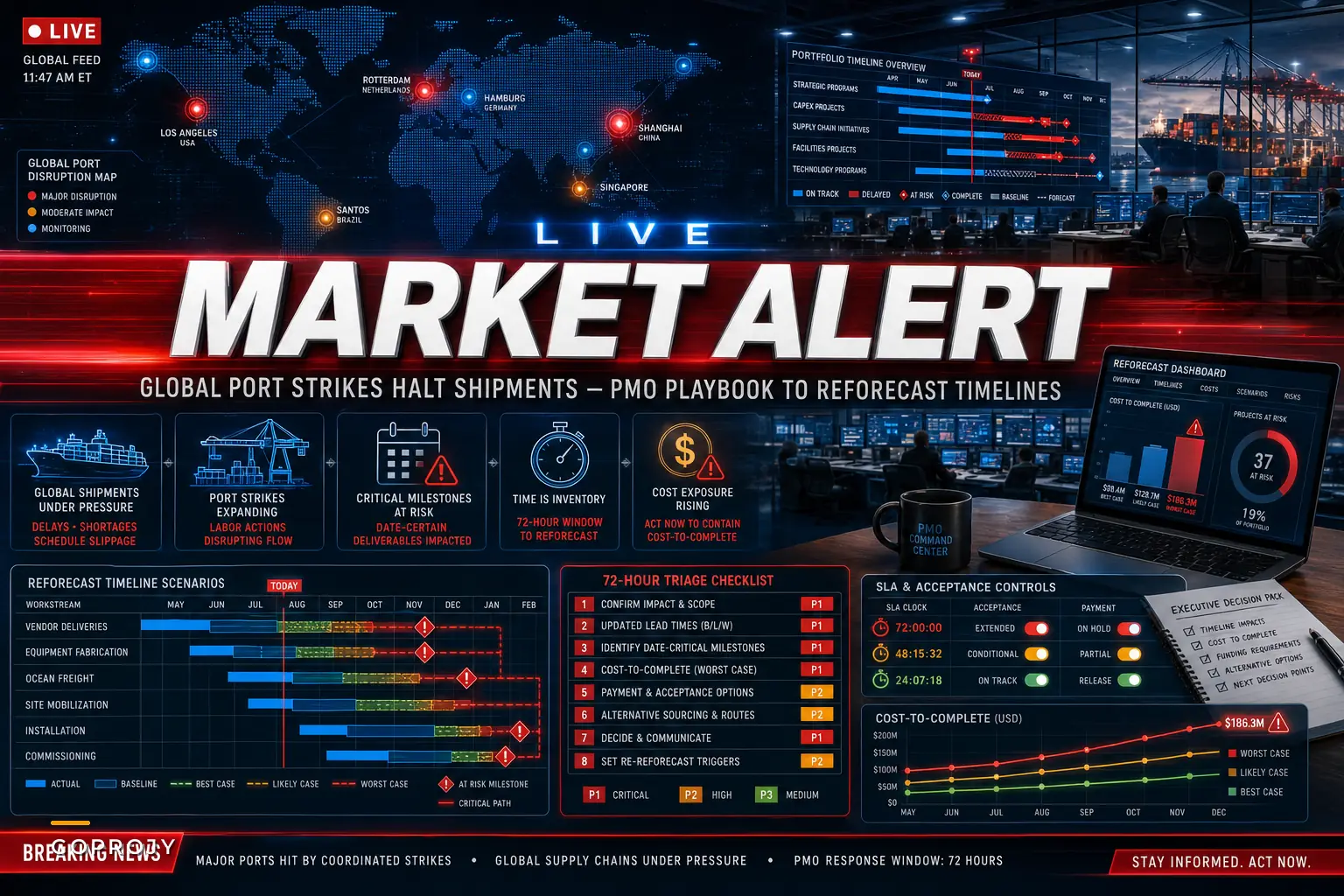

A single day of coordinated action at the ports doesn't sound like much on paper. Twenty-four hours. One news cycle. But if you run a portfolio that depends on imported hardware, containerized components, or vendor-delivered services tied to physical goods, you already know the math doesn't work that way. The strike lasts a day; the congestion lasts weeks.
On October 30, 2026, dockworkers staged coordinated strikes across 113 ports in 22 countries in a 24-hour international day of action, disrupting container flows, ferry operations, and cargo handling. As Reuters reported, the action spanned Europe and beyond, and the immediate effect wasn't just idle cranes — it was the backlog that forms the moment they start moving again. Ships queue. Terminals congest. Rerouted cargo lands at ports that weren't planned for and clears customs on a different schedule than anyone forecasted.
For a PMO, this isn't a logistics story. It's a reforecasting event. And the organizations that handle it badly are usually the ones treating the strike as the problem instead of their own forecast fragility.
The part that actually hurts: lead-time variance, not the delay itself
There's a distinction that gets lost in the scramble. A known, fixed delay is annoying but manageable. If someone tells you "your container lands 11 days late, guaranteed," you can replan around it cleanly. One adjustment, done.
What a port disruption actually injects is variance. You don't get a new date — you get a probability cloud. The container might clear in 6 days or 19 days depending on which port it reroutes through, how deep the backlog runs, and where your freight sits in the queue. Every milestone downstream of that container now inherits that uncertainty.
In real operations, this is where portfolios quietly break. A project team gets a vague "it's delayed" signal, picks a single optimistic replacement date to avoid looking like they're panicking, and rebaselines around it. Three weeks later the hardware still hasn't cleared, and now you've burned three weeks of float pretending the problem was smaller than it was.
The pattern repeats: teams reforecast once, treat the new date as firm, and don't account for the fact that supply-chain recovery is itself unpredictable. One reforecast is almost never enough for an event like this.
Map your exposure before you touch any dates
Before you reforecast anything, figure out which projects are actually exposed. Not everyone thinks they are until they trace the dependency chain, and most of the surprises hide two or three layers down.
Stop losing track of critical projects.
GoProjy helps you monitor, prioritize, and deliver projects on time—seamlessly.
- Unified portfolio visibility
- Real-time resource tracking
- Milestone & risk alerts
No credit card required
A quick exposure sweep usually sorts your portfolio into four buckets:
-
Direct physical dependency — the project is waiting on a specific shipment (servers, networking gear, lab equipment, machinery).
-
Indirect component dependency — a vendor's deliverable depends on parts they import, and their SLA to you is only as strong as their supply chain.
-
Services-with-hardware — "software" or "integration" work that quietly assumes on-site equipment arrives on time.
-
Clean — genuinely no physical supply exposure.
That third bucket is where PMOs get burned most often. A vendor-delivered services contract looks safe because it's framed as labor, but the acceptance milestone depends on appliances, sensors, or endpoint devices sitting in a container somewhere. The SLA says the vendor delivers by a date; it doesn't say what happens when their supplier can't.
| Exposure type | What you're really tracking | First action |
|---|---|---|
| Direct physical | Specific container / PO landing date | Confirm reroute port + customs status |
| Indirect component | Vendor's upstream supply health | Request vendor's own contingency plan |
| Services-with-hardware | Hidden equipment dependency in scope | Flag acceptance criteria tied to goods |
| Clean | Nothing — but verify | Confirm and move on |
The sweep itself shouldn't take more than a day or two if your dependency data is reasonably current. If it takes a week because nobody can tell you what's tied to physical delivery, that's not a port problem — that's a visibility problem you had before the strike, and it'll bite you on the next one too.
A reforecasting sequence that holds up under uncertainty
Once you know who's exposed, resist the urge to immediately redraw the Gantt. The goal isn't a prettier schedule — it's a forecast that survives contact with reality.
-
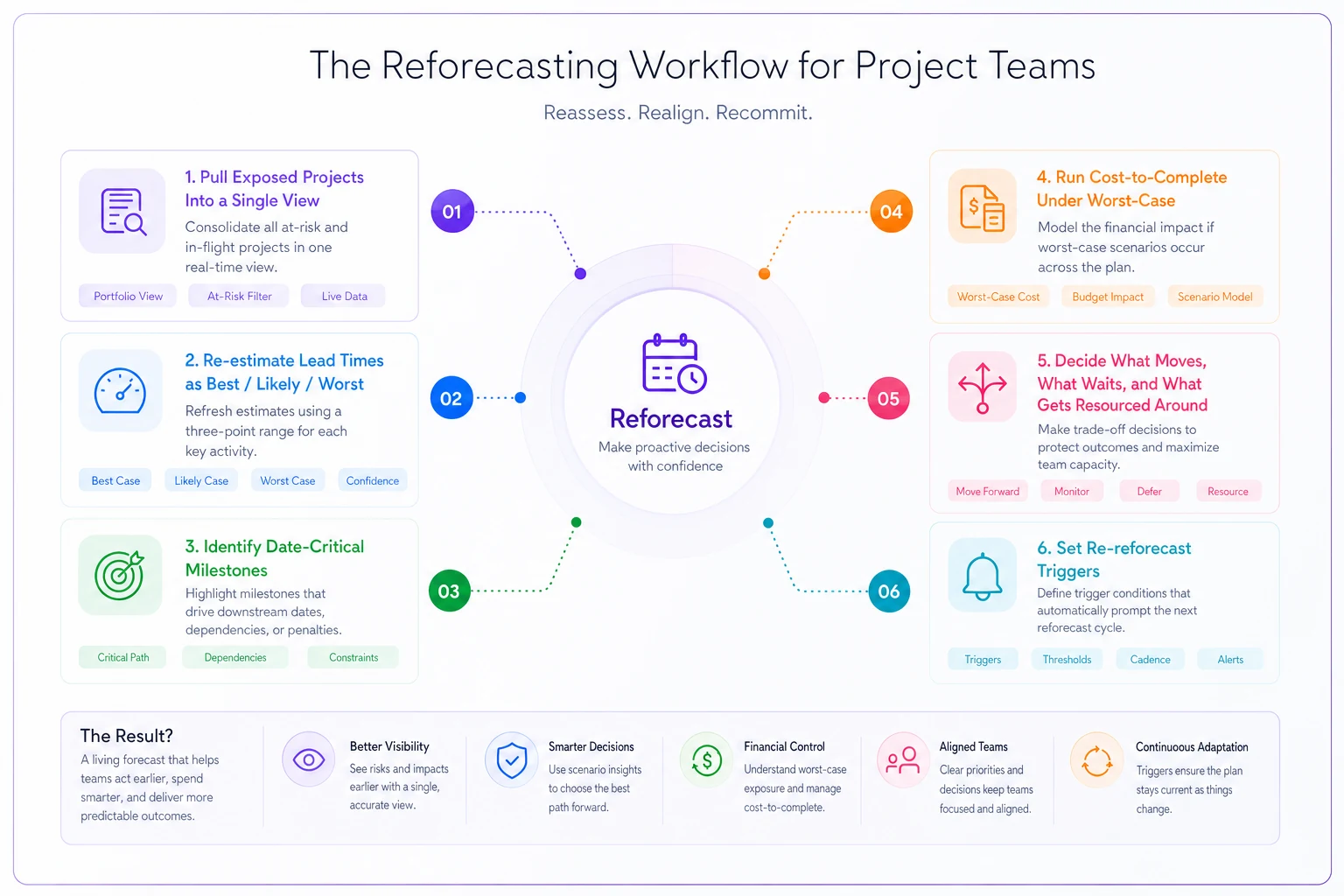
Pull the exposed projects into a single working view. You want them side by side, because the decisions interact. Two projects competing for the same install crew after their hardware lands is a conflict you can only see when they're together.
-
Re-estimate lead times as ranges, not dates. For each exposed shipment, record a best case, likely, and worst case based on current port and customs conditions. If you force a single number this early, you're guessing, and everyone downstream will treat your guess as a commitment.
-
Identify which milestones are truly date-critical. Regulatory deadlines, contractual go-lives, seasonal windows — these can't slip. Everything else has more give than people admit. Separate the two ruthlessly.
-
Run cost-to-complete under the worst-case lead time, not the likely one. This is the step teams skip. If you only cost the "likely" scenario, your contingency ask is too small, and you'll be back for more money in three weeks — which is a far worse conversation to have with finance a second time.
-
Decide what moves, what waits, and what gets resourced around. Some projects you simply slip. Some you protect by pulling float from elsewhere. Some justify paying for alternative sourcing or expedited freight.
-
Set a re-reforecast trigger. Pick a condition — "if the container hasn't cleared customs by the 12th" — that automatically forces a second look. This is what prevents the single-optimistic-date trap.
Use this sequence as a repeatable workflow rather than a one-off reaction.
Add the re-reforecast trigger to your team's calendar so it doesn't get missed.
That last step matters more than it looks. The difference between portfolios that recover cleanly and portfolios that lurch from crisis to crisis is usually whether they built in a scheduled re-check or just hoped the first reforecast would hold.
Tightening SLAs when the delay isn't your vendor's fault — technically
This is the awkward part. Most supply-dependent SLAs have force majeure language, and a coordinated multi-country strike is exactly the kind of event that triggers it. So your vendor isn't in breach, and the usual milestone-linked penalty levers don't fire the way they would for ordinary slippage.
That doesn't mean you have no leverage. It means you shift from penalty to information and prioritization.
What actually works in these situations:
-
Demand delivery transparency, not just a new date. Require the vendor to share which port their goods rerouted through and the customs status. A vendor who can't answer that doesn't actually know their own timeline — and that tells you something.
-
Negotiate priority allocation. If a vendor is serving multiple clients from a constrained inventory pool, where you sit in their allocation queue is often negotiable — especially if you're willing to adjust payment timing or commit to future volume.
-
Convert fixed-date SLAs to conditional ones with checkpoints. Instead of "deliver by the 20th," agree to "confirmed reroute port by the 5th, customs clearance update by the 12th, revised delivery window by the 14th." You're buying visibility into their recovery, which is worth more than a penalty clause you'll never enforce anyway.
-
Separate the goods-dependent milestones from the labor-dependent ones. If a vendor can proceed with configuration or prep work that doesn't require the physical hardware, pull those forward so the only thing waiting on the container is the container.
The mistake is treating force majeure as a dead end. It caps your penalty options; it doesn't cap your ability to get prioritized, informed, and partially unblocked.
A real scenario: mid-market infrastructure refresh
Consider a mid-sized financial services firm running a data-center hardware refresh — roughly a dozen projects in flight, about four of them waiting on imported networking and storage gear routed through ports hit by the action.
Before reforecasting, their status reports all said the same thing: "monitoring supply chain." No dates moved, because nobody wanted to be the one to call the slip. The PMO ran an exposure sweep and found a fifth project they'd classified as clean — a branch rollout whose install depended on edge appliances from the same vendor. Hidden dependency, second layer down.
When they re-costed under worst-case lead times instead of the optimistic single date, the contingency ask came out to somewhere in the $180k–$220k range across the exposed projects — materially higher than the $90k they'd have requested on a likely-case assumption. More importantly, they set a customs-clearance trigger date on each shipment and pulled all vendor configuration work forward by about two weeks.
Two projects still slipped. But because they'd requested contingency against the worst case up front, they didn't have to go back to finance a second time. The branch rollout — which had a contractual go-live — got protected by expediting freight on just the appliances that fed it, instead of panicking across everything. Executives stopped asking "are we going to be okay" because the PMO had already shown them the range and the plan for each end of it.
When expedited sourcing makes sense — and when it's a waste
Alternative sourcing and expedited freight feel like the obvious heroic move, but they're often applied in the wrong places.
When it makes sense:
-
The blocked milestone is genuinely date-critical (regulatory, contractual, seasonal).
-
The expedite cost is small relative to the cost of the slip — late penalties, idle teams, missed revenue windows.
-
A credible alternative supplier or freight route actually exists and can beat the delay meaningfully.
When it's a bad idea:
-
You're expediting to protect a milestone that has real downstream float and only feels urgent.
-
The alternative source is unproven and you're trading a delay risk for a quality risk you understand even less.
-
You're expediting the whole shipment when only one component actually gates the critical path.
That last one is the common waste. Teams pay premium freight on a full container when only a fraction of its contents sits on the critical path. Split the shipment, expedite the gating items, let the rest ride the normal recovery.
The deeper problem this exposes
Strip away the specifics and what a port disruption really tests is whether your portfolio was ever supply-aware to begin with. Most aren't. Dependency maps capture internal sequencing — this task before that task — but they rarely model external physical dependencies with real lead-time ranges attached. So when the external world moves, the whole portfolio has to be re-derived by hand, project by project, under time pressure, which is exactly when mistakes multiply.
The organizations that ride these events out calmly aren't luckier. They built the muscle to reforecast quickly because their dependency data, contingency bands, and surge roles were defined before the crisis, not improvised during it. That's the whole premise behind building a portfolio resilience playbook for continuity and surge operations — having the triggers, roles, and reforecasting cadence pre-agreed so a 24-hour strike doesn't turn into a three-week scramble to figure out who's even affected.
There's something uncomfortable in how these events get reported. The AP coverage of the strikes framed them as a labor and political story, which they are — but the operational ripple through downstream organizations barely registers in the headlines. The companies feeling it most aren't the ports; they're the firms three links down the chain who assumed their imported hardware would just show up.
A short checklist for the first 72 hours
Getting through the first three days without making the problem worse is mostly about not jumping to conclusions before you've mapped the actual exposure. Here's what that looks like in practice.
-
[ ] Run an exposure sweep; sort projects into direct / indirect / services-with-hardware / clean.
-
[ ] Hunt specifically for hidden second-layer dependencies in "clean" projects.
-
[ ] Re-estimate affected lead times as best/likely/worst ranges, not single dates.
-
[ ] Cost-to-complete against the worst case before requesting contingency.
-
[ ] Request vendor transparency
reroute port, customs status, allocation priority.
-
[ ] Pull forward any vendor work that doesn't require the physical goods.
-
[ ] Protect only truly date-critical milestones with expedite; split shipments to expedite gating items only.
-
[ ] Set explicit re-reforecast trigger dates per shipment.
-
[ ] Update the risk register and give stakeholders ranges, not false precision.
Work through the list in order. The exposure sweep informs everything else, and skipping it to go straight to vendor calls is how you end up negotiating on the wrong shipments.
Bringing it together
A strike at the docks is a reminder, not a surprise. Supply-sensitive portfolios have always carried this exposure; most just didn't price it until a container stopped moving. The PMOs that come through these events with critical milestones intact are the ones that reforecast against ranges instead of hopeful single dates, that distinguish genuinely date-critical work from work that only feels urgent, and that treat vendor SLAs as a source of information and prioritization once penalties go off the table.
Do the exposure sweep first. Cost the worst case. Set the trigger for the second look. The organizations that do those three things calmly are usually the ones that built the reflex before they needed it — and that's the part worth fixing now, while the next disruption is still hypothetical.
Do the exposure sweep first. Cost the worst case. Set the trigger for the second look. The organizations that do those three things calmly are usually the ones that built the reflex before they needed it — and that's the part worth fixing now, while the next disruption is still hypothetical.
Ready to elevate your project delivery?
Join over 2,500 project teams using GoProjy to optimize resources, reduce risks, and drive portfolio success.