



Last week's Fed signals made it clear—those rate cuts everyone expected aren't coming. CNBC's coverage painted the picture: inflation's still running hot, jobs data remains strong, and the Fed's keeping rates elevated through at least 2026. Some market watchers are even pricing in another hike.
For PMO leaders running portfolios built on 2023's budget assumptions, this creates an immediate problem. Your cost of capital just went from temporary headwind to permanent operating reality. Every project approved six months ago now costs more to finance, takes longer to pay back, and competes for shrinking budget dollars.
What makes this particularly brutal for project portfolios: unlike operational expenses you can trim monthly, project commitments lock you in. That ERP migration halfway through phase two? The warehouse automation project with vendors already contracted? These aren't expenses you can simply pause when borrowing costs spike.
Why Traditional Portfolio Adjustment Breaks Under Sustained Rate Pressure
Most PMOs handle budget pressure the same way—freeze new projects, extend timelines, maybe cut some contractors. Works fine for a quarter or two. But sustained high rates create cascading problems that basic belt-tightening can't solve.
The math gets ugly fast. A typical mid-market company running 40–50 active projects sees their weighted average cost of capital jump from maybe 7% to 11%. Sounds manageable until you realize that shifts every single project's NPV calculation. Projects that made sense at 7% suddenly show negative returns at 11%. Your entire portfolio valuation just dropped by roughly 30%.
The projects most vulnerable to rate changes tend to be your strategic initiatives—the three-year digital transformation, the multi-phase market expansion, anything with delayed payback periods. These drive competitive advantage, yet they're first on the chopping block when finance recalculates hurdle rates.
Meanwhile, your operational reality hasn't changed. Teams are still allocated, contractors still billing, systems half-migrated. You can't just ctrl+z a portfolio because interest rates shifted. The organizational friction of stopping and restarting projects often costs more than pushing through.
The Hidden Capacity Trap Nobody's Talking About
When budgets tighten, most PMOs try to preserve capacity by slowing project velocity. Spread the same work across more time, reduce monthly burn, everyone stays busy. Seems logical.
Stop losing track of critical projects.
GoProjy helps you monitor, prioritize, and deliver projects on time—seamlessly.
- Unified portfolio visibility
- Real-time resource tracking
- Milestone & risk alerts
No credit card required
Except this creates what I call the zombie portfolio problem. Projects that should take six months stretch to fourteen. Resources get spread across more concurrent initiatives. Context switching increases. Quality drops. Rework spikes.
Watched this happen at a manufacturing company last year. They had 12 major projects running when rates first jumped. Instead of killing anything, they reduced each project's monthly allocation by 40%. Smart move on paper—kept all initiatives alive, preserved team capacity, reduced immediate cash burn.
Eight months later, not a single project had delivered meaningful value. Teams were juggling too many priorities. Dependencies created constant blocks. The few projects that did complete came in so late their business cases had evaporated. They burned through $4.2 million protecting capacity that produced nothing.
The correct move? Should have killed 8 projects immediately, doubled down on the 4 with fastest payback, and redeployed those resources. Would have delivered actual value while rates were high rather than spreading failure across the entire portfolio.
A Different Reforecast Framework for Sustained Rate Environments
Forget the traditional NPV recalculation exercise. When rates stay elevated for 18+ months, you need a completely different evaluation framework. Start with time-to-value, not total return.
Map every project on two dimensions: months to first value delivery and financing sensitivity. High-debt projects with 24+ month paybacks go immediately. Doesn't matter how strategic they seem. In sustained high-rate environments, long payback equals dead money.
Next, identify projects you can restructure for earlier value capture. That three-phase customer portal project? Can phase one deliver 60% of the value in 30% of the time? Usually yes. Most project phases exist for organizational comfort, not technical necessity.
Look for natural break points in every initiative. Just helped a healthcare PMO restructure 22 projects this way. Original portfolio had average time-to-value of 16 months. After restructuring for early delivery, average dropped to 7 months. Same eventual outcomes, but cash flow positive nine months earlier.
Your reforecast should separate must-complete from nice-to-have. Must-complete means regulatory, critical system failure, or immediate revenue protection. Everything else gets reworked for minimal viable delivery.
The Surgical Approach to Capacity Preservation
Capacity preservation in high-rate environments requires precision cuts, not across-the-board reductions. Start by mapping actual utilization, not allocated time. Most PMOs discover their "fully allocated" resources operate at 55–65% real utilization. The rest disappears into meetings about meetings, context switching, and administrative overhead.
Kill the overhead first. One financial services PMO I worked with eliminated 14 hours of weekly status meetings across their portfolio. Replaced them with async updates in their project platform. Instantly recovered 20% capacity without touching headcount or contractor spend.
Next, consolidate project teams. Instead of 15 projects with 15 part-time leads, run 5 projects with 5 full-time leads. Seems obvious but the politics usually prevent it. High rates give you the burning platform to force consolidation.
In sustained high-rate environments, keeping your best people slightly underutilized actually saves money. Why? Because when critical issues arise—and they will—you need surge capacity without hiring contractors at premium rates. That 85% utilized architect who can jump on urgent problems saves you from $400/hour emergency consultants.
| Resource Strategy | Traditional Approach | High-Rate Approach |
|---|---|---|
| Utilization Target | 95-100% | 80-85% |
| Team Structure | Matrixed across many projects | Dedicated to fewer projects |
| Contractor Usage | Fill gaps as needed | Eliminate except specialized skills |
| Meeting Load | Whatever it takes | Ruthlessly minimized |
| Admin Overhead | Accepted as necessary | Actively eliminated |
Kill the overhead first—replace status meetings with async updates to recover capacity quickly without cutting headcount.
One financial services PMO I worked with eliminated 14 hours of weekly status meetings across their portfolio. Replaced them with async updates in their project platform. Instantly recovered 20% capacity without touching headcount or contractor spend.
Creating Your Interest Rate Scenario Playbook
Most PMOs run their reforecasting as a one-time exercise when rates change. That's like steering a ship by looking at yesterday's weather. You need dynamic scenarios that trigger specific actions at defined thresholds.
Build three rate scenarios: current state, 50 basis points higher, 100+ basis points higher. For each scenario, predefine exactly which projects pause, which accelerate, and which die. No committee meetings when triggers hit—decisions are pre-made.
-
current state
-
50 basis points higher
-
100+ basis points higher
A technology PMO I advised created triggers tied to their company's borrowing rate. When rates crossed 9%, four specific projects automatically paused. When they hit 10%, another six entered "minimum viable" mode. Clear, predetermined, no debate required.
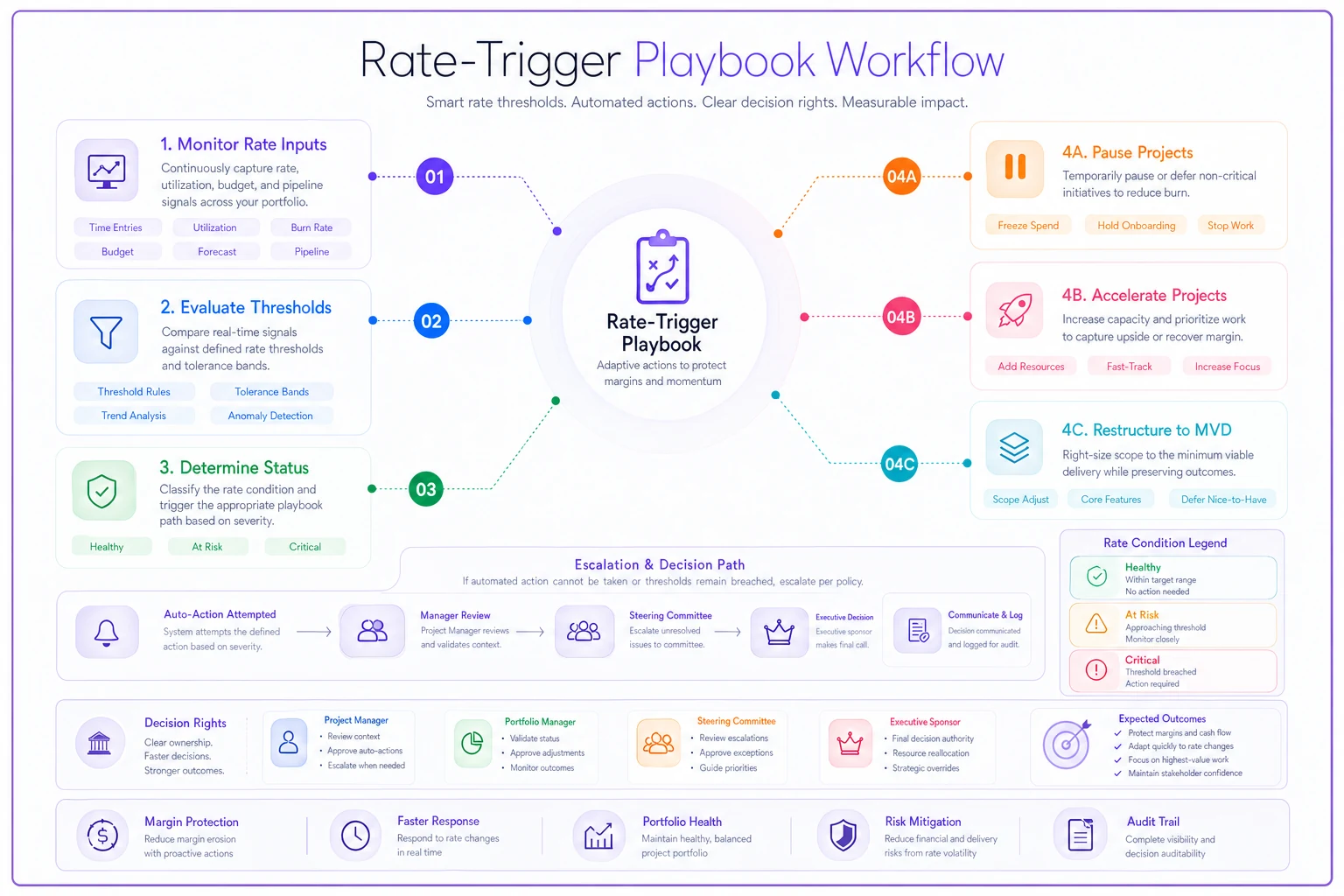
Your playbook needs escalation protocols. Which projects get CEO protection no matter what? Usually 2–3 maximum. Which portfolio segments take the first cuts? Often shared services and infrastructure upgrades. Which resources absolutely cannot be touched? Your technical architects and key vendor relationships.
Document decision rights explicitly. When rates trigger portfolio changes, who approves project kills? Who decides resource reallocation? Who communicates to stakeholders? High-rate environments move fast. You can't afford consensus-building when every week of delay costs thousands in additional interest.
Why Most PMO Software Breaks During Portfolio Compressions
Traditional project management platforms assume a stable state—projects start, progress linearly, complete. But portfolio compression creates chaos that static tools can't handle. Projects merge mid-flight. Resources shift weekly. Priorities change faster than you can update Gantt charts.
The real problem isn't tracking—it's decision support. When you're juggling 40 projects through rapid replanning, you need to see impact scenarios instantly. What happens if we pause Project A but accelerate Project B? How does killing these three initiatives affect our Q3 deliverables? Which resources become available when?
Most PMOs end up running shadow systems in spreadsheets because their enterprise tools can't model dynamic scenarios. Seen teams waste 30+ hours weekly just maintaining parallel tracking systems during portfolio compressions.
Modern AI-powered portfolio platforms handle this differently. Instead of rigid project hierarchies, they model work as fluid capacity that can be rapidly redistributed. An AI automation layer continuously recalculates resource availability, dependency impacts, and delivery timelines as you adjust priorities. No manual spreadsheet gymnastics required.
The automation particularly helps with the mundane but critical tasks—notifying teams of priority changes, updating stakeholder dashboards, flagging resource conflicts before they become blockers.
The Delicate Art of Stakeholder Communication During Portfolio Cuts
Nobody wants to hear their project got killed because interest rates stayed high. But that's exactly what you need to communicate, clearly and quickly. The longer you delay bad news, the more resources get wasted and relationships get damaged.
Start with data, not apologies. Show the specific NPV calculation changes. Display the borrowing cost increases in real dollars. Make it crystal clear this isn't about project quality—it's about mathematical reality. Projects with negative returns at current rates simply cannot proceed.
Create a simple classification system everyone understands. Green projects continue unchanged. Yellow projects get restructured for faster delivery. Red projects pause indefinitely. No ambiguity, no "we'll revisit next quarter" false hope.
For paused projects, always provide a specific restart trigger. "When rates drop below 8%" or "When we achieve $2M quarterly free cash flow." This transforms indefinite delays into conditional delays. Teams can plan around conditions rather than wondering in limbo.
One logistics PMO handled this brilliantly. They created a monthly portfolio dashboard showing every project's status relative to rate thresholds. Everyone could see exactly where their project stood and what would trigger changes. Eliminated 90% of the "what about my project?" conversations.
Building Institutional Resilience Against Future Rate Volatility
This won't be the last time rates disrupt your portfolio. The era of predictable 2% fed funds might be over permanently. PMOs need structural changes that create rate resilience, not just tactical responses to current conditions.
Start by shortening your standard project durations. If your typical project runs 18 months, redesign for 9-month deliverables with optional extensions. Shorter projects mean less rate exposure, faster pivots, and quicker value realization.
Establish portfolio reserves explicitly for rate volatility. Most PMOs run at 100% allocation, leaving no buffer for disruption. Build in 15–20% unallocated capacity that can either accelerate critical projects or absorb cuts without destroying team structure. Think of it as portfolio insurance against rate shocks.
Consider how operational software can reduce your structural overhead. Every manual process in your PMO—status collection, resource scheduling, progress reporting—burns capacity that could deliver projects. An AI-assisted platform that automates these workflows frees up 10–15% capacity instantly. That's pure buffer against future compressions.
The Path Forward When Rates Stay Higher for Longer
The next 18 months will separate adaptive PMOs from those still hoping for rate cuts that aren't coming. Forbes analysis suggests the Fed might even remove easing language entirely, signaling rates could go higher still. Your portfolio strategy needs to assume current rates are the new floor, not the ceiling.
Focus on building what I call an interest rate-agnostic portfolio. Projects that deliver value at 7% or 11%. Initiatives structured for rapid partial delivery. Teams organized for quick pivots rather than long marches.
The PMOs that thrive won't be those with the best spreadsheets or the most sophisticated NPV models. They'll be the ones who restructure fast, communicate clearly, and maintain team cohesion through the chaos. When everyone else is still debating which projects to cut, you'll already be delivering value from your streamlined portfolio.
This is an opportunity disguised as a crisis. Forced portfolio compression eliminates zombie projects that should have died years ago. Resource constraints drive innovation in delivery approaches. Rate pressure creates the burning platform for operational improvements everyone knew were needed but never prioritized.
The organizations that master capacity and demand management during this period won't just survive high rates—they'll emerge with leaner, faster, more resilient project delivery capabilities. When rates eventually normalize, you'll be operating at a level competitors can't match because you learned to thrive when capital was expensive and resources were scarce.
Your portfolio's interest rate project portfolio management challenge isn't going away. Time to stop waiting for different Fed signals and start building the PMO that succeeds in the economy we actually have, not the one we wish we had.
Ready to elevate your project delivery?
Join over 2,500 project teams using GoProjy to optimize resources, reduce risks, and drive portfolio success.