

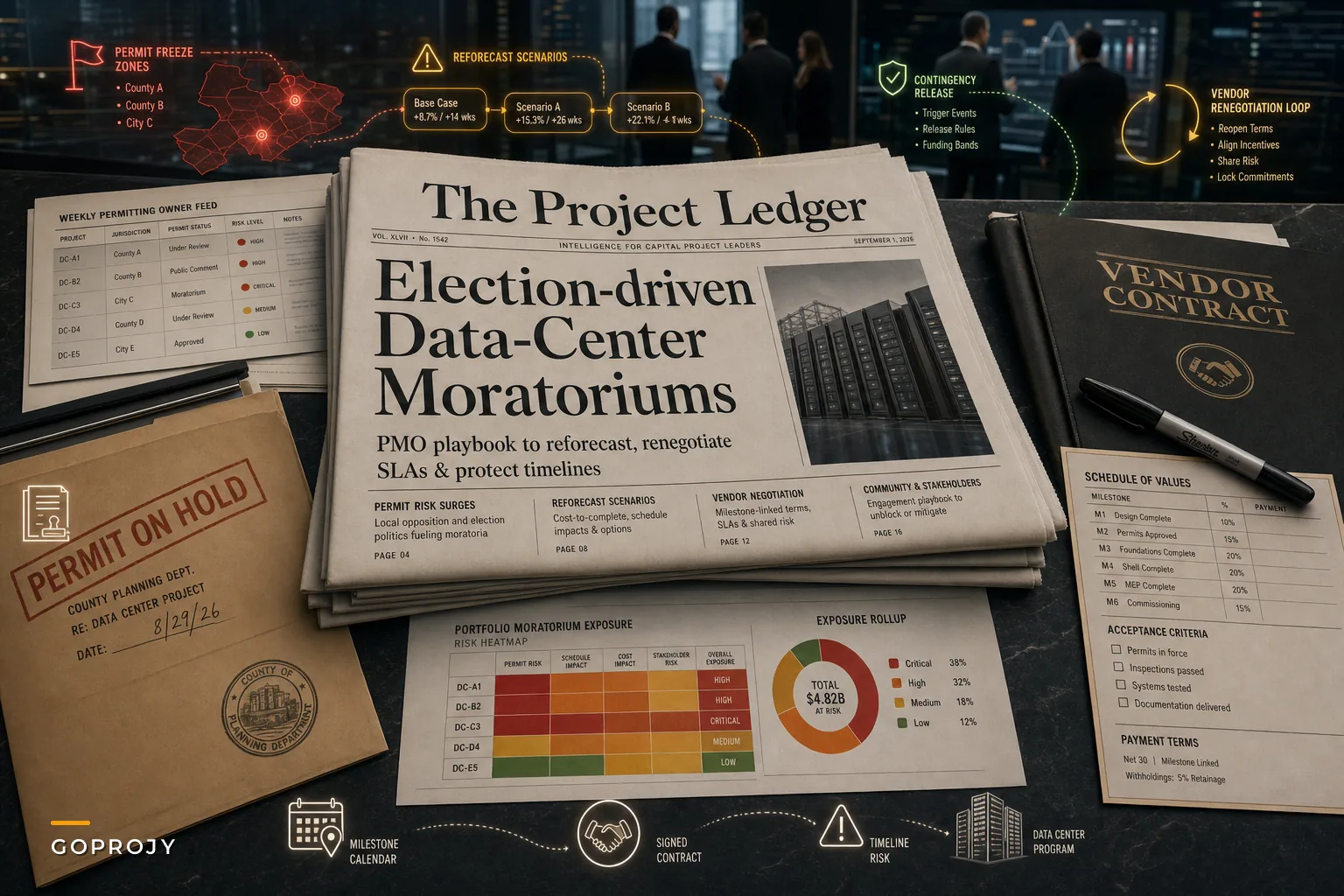

What catches most PMOs off guard isn't the moratorium itself. It's the timing gap between when a municipality signals it might pause a project and when the pause actually becomes official. That gray zone — sometimes three weeks, sometimes three months — is where portfolios quietly rot. Vendors keep billing against a schedule nobody believes anymore, contingency stays locked, and your reforecast lags reality by a full quarter.
Local and state opposition to AI data centers has been building into a genuine planning constraint. CNBC's late-August reporting on the tech backlash reaching a fever pitch ahead of the midterms described communities, officials, and candidates pushing moratoriums, audits, and tighter zoning controls. Brookings framed the same dynamic in its piece on why data centers became a top 2026 midterm issue — utility load, water usage, and local tax fights all colliding at once.
Not going to relitigate the politics here. What matters for a PMO is narrow and practical: if any project in your portfolio depends on a physical build, a power interconnect, a colocation contract, or a cloud region tied to a contested site, you now carry permitting and community risk you probably weren't pricing six months ago. This is a playbook for absorbing that shock without freezing your whole portfolio.
Start by separating "delayed" from "structurally at risk"
The first mistake is treating every affected project the same. A permitting delay on a phase-2 expansion is a scheduling problem. A moratorium that kills your primary interconnection point is a scope problem. Those get very different responses, and lumping them together produces a reforecast nobody trusts.
Run a fast triage across every project touching the exposed infrastructure. You're sorting into three buckets, and you want this done in days, not weeks:
-
Timeline-only exposure — the work still happens, just later. Power, permits, or site access slip but the fundamental design holds.
-
Rescope exposure — you can deliver, but only by changing the region, the vendor, the power source, or the physical footprint.
-
Structural kill risk — if the moratorium sticks, this project has no viable path and needs a decommission or full pivot decision.
The middle bucket is the dangerous one. Teams either overreact — rescoping something that would've cleared in six weeks — or underreact, waiting on a rescope that was never going to be avoidable. Getting the sort right is worth more than any downstream reforecast precision.
A quick way to pressure-test your sort: for each project, ask "what specific external event unblocks this, and who controls it?" If the answer is a named permitting board decision on a known date, it's timeline-only. If the answer is "we don't know, it depends on how the ordinance is written," you're already in rescope territory.
Reforecast the impacted slice, not the whole portfolio
When an external shock hits, there's a temptation to blow up the entire portfolio forecast and rebuild from scratch. Resist it. You'll burn two weeks and lose the confidence of your finance partners, who mostly want to know one thing: how much of my committed spend is now at risk, and when do I get a real number?
Stop losing track of critical projects.
GoProjy helps you monitor, prioritize, and deliver projects on time—seamlessly.
- Unified portfolio visibility
- Real-time resource tracking
- Milestone & risk alerts
No credit card required
-
Freeze the baseline on unaffected projects so you have a stable reference point. Don't touch them.
-
Build three schedule scenarios per affected project — moratorium clears in 90 days, clears in 180 days, or becomes permanent. Keep it to three. More scenarios feels rigorous but produces analysis paralysis.
-
Attach a cost-to-complete range to each scenario, not a point estimate. The honest answer is a band, and pretending otherwise erodes trust when the number moves.
-
Recompute contingency drawdown against the middle scenario, then flag the tail risk of the permanent case separately.
-
Roll the delta into the portfolio view as a single, clearly labeled "moratorium exposure" line so executives can see it without it contaminating your clean baselines.
The reason to isolate the exposure line rather than smearing it across the portfolio is accountability. When the situation resolves — and most of these do resolve one way or another — you want to reverse a clean entry, not untangle assumptions baked into forty projects.
Vendor contracts are where the real bleeding happens
The uncomfortable part: when a data-center-linked project stalls, your vendors don't stall with it automatically. Contractors staged for a build, specialist consultants ramped for a migration, hardware on order against a delivery date — all of that keeps moving on its own momentum unless someone actively intervenes.
A realistic pattern worth knowing: a mid-sized firm had roughly $2.4M committed across two vendors for a regional buildout. When the county signaled a six-month permitting review, the PMO assumed the vendors would "just pause." They didn't. Standby fees, already-provisioned hardware, and a specialist retainer kept running for about seven weeks before anyone renegotiated — burning somewhere north of $180k against a project that hadn't moved an inch. That money was avoidable. The loss was entirely a coordination failure, not a market one.
The lever most PMOs underuse is the difference between a hard pause and a soft hold with reduced-rate standby. A full stop often triggers demobilization and remobilization costs that dwarf the standby fee. But an open-ended standby with no ceiling is worse. The move is a time-boxed standby with a hard review trigger.
| Contract posture | When it fits | Main risk | Cost profile |
|---|---|---|---|
| Full pause / demobilize | Structural kill risk, or delay >6 months | Remobilization cost + losing the specialist team | Low run-rate, high restart cost |
| Time-boxed standby | Timeline-only exposure, clears in 90–180 days | Standby fees accumulate if no ceiling | Moderate, predictable if capped |
| Rescope-in-place | You can pivot region/vendor while keeping the team | Scope creep, unclear acceptance criteria | Variable, needs tight governance |
| Milestone re-anchor | Delivery still viable, dates shift | Vendor games the new milestones | Neutral if acceptance tests hold |
The renegotiation itself lives or dies on how your payment terms are structured before the crisis. If your milestones are tied to calendar dates rather than verifiable deliverables, you have almost no leverage — the vendor is owed money for time passing, not work completed. This is exactly why milestone-linked governance matters, and it's worth revisiting the mechanics in our breakdown on stopping vendor delays with milestone-linked governance, acceptance tests and payment knobs.
Time-boxed standbys with hard review triggers reduce remobilization costs.
The short version: acceptance-gated payments give you a natural pause point that calendar-gated payments never will.
Contingency release rules built for external freezes
Most contingency policies are written for internal overruns — a task ran long, scope grew, an estimate was wrong. A moratorium is a different animal, and applying overrun logic to it produces two failure modes: either you release contingency too fast to "keep things moving" on a project that's actually stalled, or you lock it so hard that legitimate rescope work starves.
For externally-driven freezes, tie release to a specific trigger set rather than to burn rate:
-
Standby cost containment — release contingency to fund a reduced-rate vendor standby, but only against a capped ceiling and a defined review date.
-
Rescope feasibility work — release a small tranche to actually investigate the alternative region, vendor, or power path. "We should rescope" is worthless without costed options.
-
Community and permitting engagement — this one gets forgotten. Sometimes the fastest unblock is funding proper engagement with the permitting process, not waiting it out.
What you should not do is release contingency to accelerate downstream work on a project whose upstream is frozen. That's throwing money at a dependency you don't control, and it's one of the more common ways portfolios quietly overspend during a delay.
Permitting and community risk is now a PMO tracking item
This is the genuinely new part, and it's where a lot of PMOs are underbuilt. Permitting used to be a checkbox owned by a real-estate or facilities function, invisible to the portfolio until it was done. That model breaks the moment permitting becomes contested and politically visible.
-
A named owner for the permitting relationship on each affected project — someone who actually attends the hearings and reads the ordinance drafts, not a status-report relay.
-
A leading indicator, not a lagging one. "Permit denied" is a lagging indicator; "council added the item to a review agenda" is a leading one. Track the leading signals.
-
A community-sentiment read for sites where local opposition is organized. You don't need a poll — you need to know whether a project is quietly proceeding or drawing active resistance, because those have very different timelines.
The workflow that tends to work: the permitting owner feeds a weekly one-line status into the portfolio — "interconnect study on track, no local opposition surfaced" versus "moratorium motion filed, hearing set for the 14th" — the PMO tags it to the affected projects, and any shift from green triggers the triage-and-reforecast loop.
The point is catching the gray-zone signal early enough that you're renegotiating vendors and adjusting forecasts before the official pause, not three weeks after.
Visualizing this workflow helps the PMO act faster.
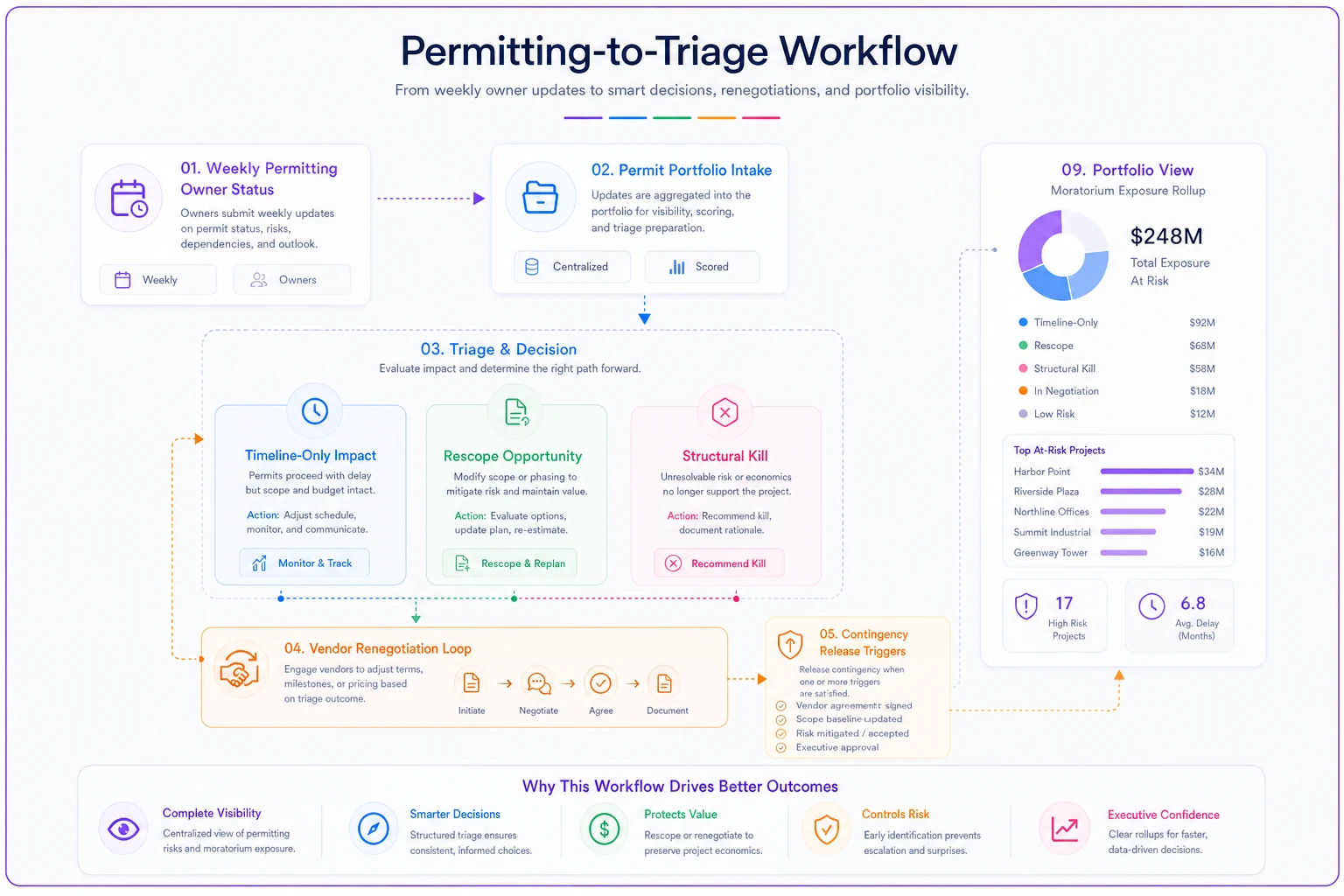
Embed the workflow so the triage loop triggers instead of getting lost in email.
When to hold, when to rescope, when to walk
The decision most PMO leaders agonize over is whether to wait a moratorium out or pivot immediately. No universal answer, but the signals are fairly clear.
Holding makes sense when the delay is bounded — there's a real decision date, the standby cost is capped and tolerable, and demobilizing your team would cost more than the wait. If you've got a specialist team that's genuinely hard to reassemble, holding at reduced rate often beats a full teardown.
Rescoping makes sense when you have a viable alternative — another region, another power path, another vendor — and the moratorium timeline is genuinely uncertain. Uncertainty is the trigger, not duration. A definite six-month wait is easier to plan around than an indefinite "we'll see."
Walking away makes sense when the project's core value depended on that specific site or timeline, and the structural kill risk is real. The mistake here is sunk-cost paralysis — pouring standby fees into a project because of what's already been spent, rather than because it still pays off. Set a decision date up front and honor it.
Worth saying plainly: don't let a single loud project distort the whole portfolio. When one build gets contentious, it absorbs disproportionate leadership attention, and three healthy projects quietly drift while everyone is heads-down on the one on fire. Contain the exposure. Ring-fence it. Keep the rest running on its clean baseline.
The underlying problem this exposes
Strip away the current events and what's actually being tested is whether your portfolio can absorb an external, uncontrollable dependency shock without seizing up. Most PMOs are decent at managing risks they own and poor at managing risks imposed from outside — a regulator, a utility, a community process.
The tell is in how information moves. In portfolios that handle these shocks well, the permitting signal, the vendor commitment, the contingency band, and the reforecast all live in one connected view — a change in one propagates to the others within a cycle. In portfolios that handle it badly, those four things live in four different spreadsheets owned by four different people, and by the time they reconcile, you've already burned the standby fees and missed the renegotiation window.
You don't need a heavy platform to fix that, but you do need the connective tissue — a place where permitting status, vendor posture, and forecast exposure sit against the same project record, so the triage loop actually triggers instead of getting lost in email. Whether that's a proper portfolio system or a well-disciplined shared model matters less than the discipline itself. External shocks don't wait for your monthly reporting cadence, and the portfolios that survive them are the ones where a signal in one corner reaches the reforecast fast enough to still be useful.
Bottom line for the next 30 days
If you have infrastructure projects exposed to the current wave of moratoriums and delays, the sequence is straightforward even if the execution isn't: triage into timeline / rescope / kill, ring-fence the exposure and reforecast only the affected slice, renegotiate vendor standby this week rather than assuming things paused on their own, tie contingency release to specific triggers instead of burn rate, and start tracking permitting as a live portfolio signal with a named owner.
None of this makes the moratorium go away. What it does is stop a policy delay you don't control from turning into a cost overrun and a credibility hit that you absolutely could have controlled. The projects that come through these delays in good shape aren't the ones that guessed right about the politics — they're the ones that moved fast on the operational levers they actually held.
None of this makes the moratorium go away. What it does is stop a policy delay you don't control from turning into a cost overrun and a credibility hit that you absolutely could have controlled. The projects that come through these delays in good shape aren't the ones that guessed right about the politics — they're the ones that moved fast on the operational levers they actually held.
Ready to elevate your project delivery?
Join over 2,500 project teams using GoProjy to optimize resources, reduce risks, and drive portfolio success.