

Most PMOs are surprisingly good at running post-implementation reviews and surprisingly bad at doing anything with them afterward. The review happens, someone writes up five lessons learned, the deck gets filed in a shared drive, and three months later a different team repeats the exact same mistake on a different project. The learning existed. It just never went anywhere.
That gap — between what a review discovers and what the organization actually does differently — is the real problem with continuous improvement PMO processes. It's not that teams don't reflect. It's that reflection isn't connected to the systems that decide what gets built, how it's estimated, or which risks get funded. A lesson that doesn't change a prioritization score or an estimation assumption is just a feeling.
This article is about closing that loop as a system. Not "write better lessons learned." The whole machinery: how a PIR finding becomes a weighted input on the next scoring sheet, how recurring findings become tracked experiments instead of vague intentions, and how you keep that flow alive with ownership and SLA rules so it doesn't quietly die after the second quarter.
Why PIR lessons evaporate — a structural problem, not a discipline problem
The usual explanation is that people are rushed, so lessons don't get captured well. That's mostly wrong. In practice the capture is fine. What's missing is a conversion path. A PIR produces a narrative artifact — prose, context, nuance. Prioritization and estimation run on structured inputs — numbers, categories, weights. There's no translator between them, so the lesson stays trapped in the format it was born in.
Here's what that looks like concretely. A review on an integration project concludes: "We underestimated vendor onboarding because their security review added six weeks." Genuinely useful. But where does it go? The next integration project's estimate is built by someone who wasn't in that room, using a template that has no field for "vendor security review lead time." The lesson had nowhere to land, so it didn't.
-
Lessons are written as stories, consumed as search results. Nobody scrolls a 14-page retro doc while scoping a new project. If the insight isn't attached to the artifact they're actually filling out, it's invisible.
-
No distinction between one-off and systemic. A fluke caused by a single bad contractor gets logged identically to a structural flaw in how you estimate regulatory work. They demand completely different responses, but the review format flattens them.
-
Ownership ends at the review. The facilitator's job is to run the session and publish the notes. Nobody owns turning finding #3 into a changed estimation default. So it doesn't happen.
The deeper issue is that improvement is treated as an event (the review) rather than a flow (finding → classification → input change → verification). When improvement is an event, it competes with delivery work and loses every time. Teams that make this stick tend to already have decent review mechanics — if yours don't, it's worth getting that foundation right first. The work on scaling post-implementation reviews with lightweight evidence packs and routing rules covers that upstream piece well.
The conversion layer: turning a narrative finding into a structured input
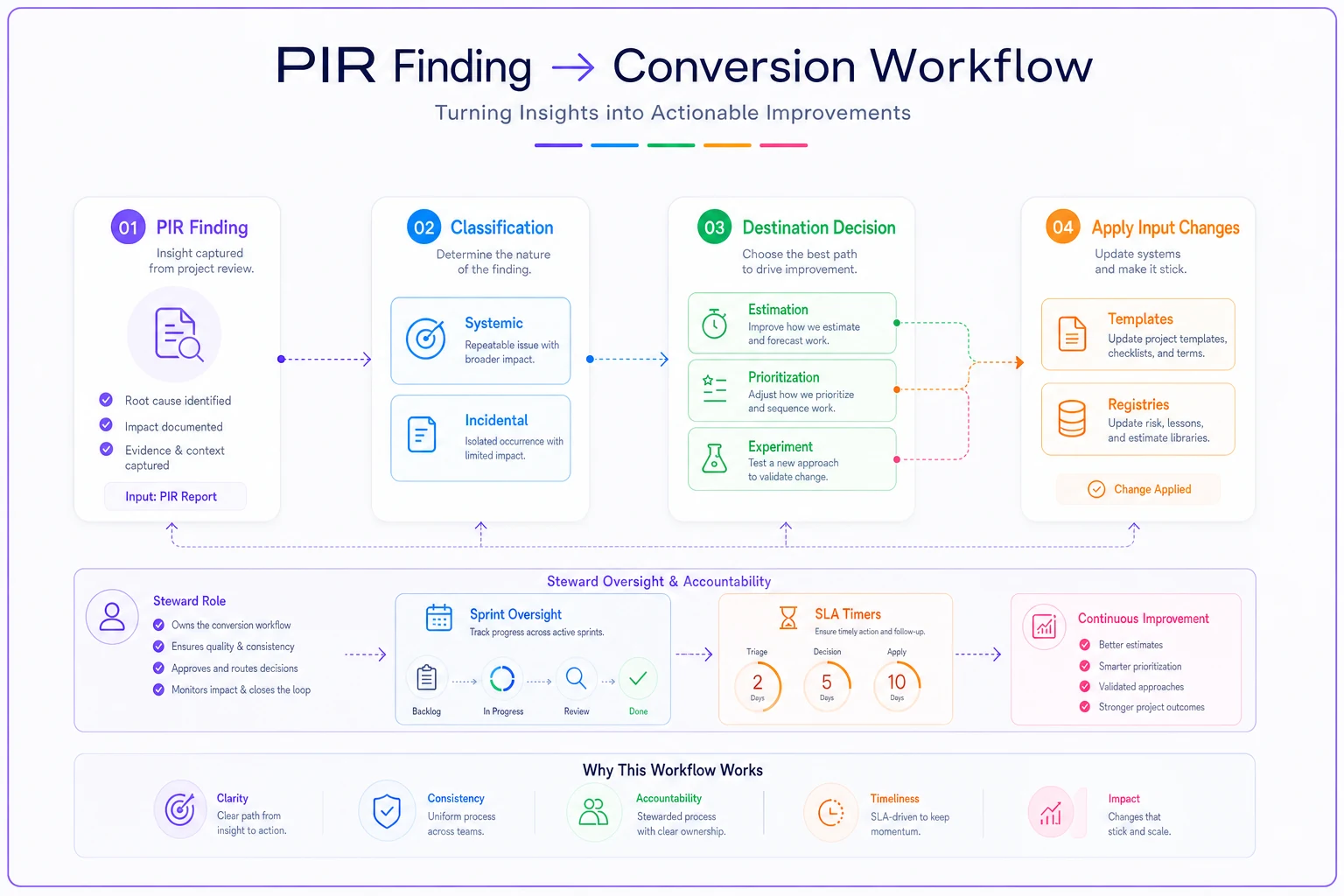
The missing piece is a deliberate translation step. Every PIR finding should exit the review already classified into one of a handful of destinations, each with its own format and owner. This is the part most teams skip, and it's the part that makes everything else work.
Stop losing track of critical projects.
GoProjy helps you monitor, prioritize, and deliver projects on time—seamlessly.
- Unified portfolio visibility
- Real-time resource tracking
- Milestone & risk alerts
No credit card required
Each finding passes through three questions:
-
Is this systemic or incidental? Incidental findings (one vendor, one unusual client, one personnel gap) get logged for pattern-watching but don't change defaults yet. Systemic findings — anything that would recur under normal conditions — are candidates for a real input change.
-
Does this change what we estimate or what we prioritize? Estimation findings alter assumptions, buffers, or lead-time tables. Prioritization findings alter risk weights, scoring criteria, or disqualifiers. A single finding can touch both, but naming the destination forces specificity.
-
Is the fix known or uncertain? If you know the correct adjustment, apply it. If you only suspect it, it becomes an experiment — a tracked hypothesis rather than an immediate policy change.
Below is a conversion table showing how raw findings map to concrete inputs. This is the artifact worth maintaining, because it makes the translation visible instead of leaving it to someone's memory.
| Raw PIR finding | Classification | Destination | Concrete input change |
|---|---|---|---|
| Vendor security review added ~6 weeks, unplanned | Systemic, estimation, known | Estimation assumption table | Add "external security review" lead-time default of 4–6 wks for any project with new-vendor integration |
| Scope grew 30% after a mid-project exec request | Systemic, prioritization, uncertain | Experiment registry | Test: does adding an "exec-sponsor volatility" risk weight improve scoring accuracy? |
| One contractor's rework caused a 2-wk slip | Incidental | Pattern log only | None yet — watch for repeats across 3+ projects |
| Benefits came in ~40% below the intake estimate | Systemic, prioritization, known | Scoring model | Discount optimistic benefit claims by a calibration factor until benefits realization data confirms |
| Cross-team handoff stalled waiting on approvals | Systemic, both, uncertain | Experiment registry | Test shortened approval SLA on a subset of projects, measure handoff cycle time |
Notice what the table does.
It refuses to let "lessons learned" stay as prose. Every row ends in something a future estimator or scorer will actually touch. The incidental one deliberately changes nothing — resisting the urge to over-react to a single data point is itself a discipline, and most PMOs don't have it.
The experiment registry: where uncertain lessons go to be proven
The "uncertain" bucket is where things get interesting, and it's the part almost nobody builds. A lot of PIR findings aren't facts — they're hypotheses dressed as conclusions. "We should have involved security earlier" might be right, or it might be hindsight bias from one painful project. If you convert every strong feeling directly into a permanent process change, your methodology bloats into a hundred rules nobody follows.
An experiment registry gives uncertain lessons a probationary home. Each entry is a small, testable claim with a defined measurement window and a decision rule for what happens next. Not a committee. A rule written in advance.
-
Hypothesis — "Adding a security-review lead-time buffer reduces integration-project slip."
-
Source finding — which PIR(s) this came from.
-
Change being tested — the specific input modification.
-
Scope — which projects it applies to during the trial (usually a subset, not the whole portfolio).
-
Measurement — what you'll compare, and against what baseline.
-
Decision date — when you'll rule on it.
-
Default outcome — what happens if nobody actively decides (usually: revert).
That last field matters more than it looks. Experiments without a default outcome become permanent by neglect — the test never formally ends, the change just silently stays. Writing "reverts unless confirmed" forces an actual decision and keeps your process from accumulating untested cruft.
A realistic example: a mid-sized PMO running maybe 40–50 projects a year noticed across three reviews that estimates for anything touching their compliance team ran long. Instead of adding a blanket buffer, they registered an experiment — a lead-time assumption for compliance-dependent work, applied only to new projects over the next two quarters. After about eight projects went through, estimation variance on that work dropped from roughly ±35% to something closer to ±15%. Then it graduated into a standing assumption. The ones that don't pan out get reverted without drama, because the revert was the pre-agreed default.
Stewarded improvement sprints: giving the flow an owner and a cadence
Conversion tables and experiment registries don't maintain themselves. The single most common reason continuous improvement dies is that it belongs to everyone, which means it belongs to no one. The fix is boring but non-negotiable: a named steward and a recurring, time-boxed sprint.
A steward isn't a full-time role. It's an accountability. The steward owns the flow of findings through the pipeline — making sure new PIR findings get classified, experiments have live decision dates, and graduated changes actually appear in the templates estimators use. One person, a few hours a week, with the authority to say "this finding is now a scoring-model change."
The sprint is where batched findings get processed. Running improvement continuously-but-informally doesn't work; it gets starved by delivery. A short, scheduled sprint — every four to six weeks — where the steward and a small group work through the backlog of unclassified findings, review experiments hitting their decision dates, and promote or kill changes gives improvement a protected slot it doesn't have to fight for.
-
Triage new findings from recent PIRs into the conversion table (systemic vs incidental, estimation vs prioritization).
-
Review experiments at their decision date — confirm, extend once, or revert per the pre-written rule.
-
Promote confirmed experiments into standing estimation assumptions or scoring weights, and update the live templates.
-
Scan the pattern log for incidental findings that have now recurred enough to become systemic.
-
Check the SLA board — anything stuck, anything past due, anything with no owner.
The discipline that separates sprints that work from sprints that become status meetings: every sprint must end with at least one template or scoring input actually modified, or an explicit decision that nothing needs to change. A sprint that only discusses is a failed sprint. The output is always a change to a system future projects will touch — otherwise you're back to filing lessons in a drawer.
Routable templates and SLA rules: keeping findings from going stale
Even with a steward and sprints, findings rot if there's no clock on them. Routing and SLA rules aren't bureaucracy — they're what keeps a finding moving instead of parking in a backlog forever.
Routing means every finding has a defined next stop based on its classification. An estimation finding routes to whoever owns the assumption tables. A prioritization finding routes to whoever owns the scoring model. An uncertain finding routes into the experiment registry with a default owner. The point is that "where does this go?" is answered by a rule, not a hallway conversation.
SLA rules put time boundaries on each hop:
-
A new PIR finding must be classified within one sprint cycle of the review. Unclassified findings older than that get flagged.
-
A registered experiment must have a decision date no more than two quarters out. No open-ended experiments.
-
A confirmed change must be reflected in the live template before the next intake round, so the very next project estimated actually benefits.
-
Anything past due with no owner escalates to the steward automatically.
Give experiments a default "revert unless confirmed" outcome so tests don't silently become permanent changes.
The quieter benefit here: SLA rules make the health of your improvement process measurable. You can look at a board and see how many findings are stuck in classification, how many experiments are overdue for a decision, how long it takes a finding to become a template change. That turns "are we actually improving?" from a vibe into a metric — exactly the kind of signal that belongs alongside your other operational dashboards. If you're already building structured KPI governance, folding improvement-flow health into a portfolio KPI data model that turns status noise into decision-ready insights keeps it from living on a separate, forgotten spreadsheet.
On tooling: most PMOs try to run this in a mix of docs, a spreadsheet, and someone's memory, and it works until volume grows. Once you're converting findings from dozens of reviews a year, routing and SLA enforcement is where lightweight automation earns its keep — auto-flagging stale findings, nudging owners before decision dates, keeping the conversion table and live templates in sync so a promoted change is actually in the estimator's artifact, not just agreed to in a meeting. The tooling isn't the system. The system is the conversion flow, the registry, the steward, and the SLAs. The tooling just stops the plumbing from leaking as you scale.
When this heavier system makes sense — and when it's overkill
This full apparatus — conversion tables, experiment registries, stewarded sprints, SLA routing — is not free. Worth being honest about when it's justified.
It makes sense when you're running enough projects that the same mistakes recur across teams who don't talk to each other. Somewhere around 30–40 projects a year, informal learning breaks down because no single person sees enough of the pattern. It also makes sense when your estimates are consistently wrong in the same direction on the same kind of work — that's a signal your estimation inputs are missing something that reviews already know.
It's overkill when you're a small shop running a handful of projects with a stable team. If the same five people see every review, the conversion happens in their heads and formalizing it adds ceremony without benefit. Don't build an experiment registry to manage three lessons a quarter among people who already share context.
Who should not do this: a PMO that hasn't fixed its actual review mechanics yet. If your PIRs are inconsistent, skipped on hard projects, or purely blame-oriented, building a conversion layer on top just routes garbage faster. Fix the input quality first. The conversion system amplifies whatever your reviews produce — which is great if they produce real findings and genuinely counterproductive if they produce politics.
A short real scenario
A regional PMO supporting internal IT and operations work — roughly 45 projects a year, four project managers — kept hitting the same wall. Reviews were run diligently, but estimation accuracy wasn't improving year over year, and benefit claims at intake routinely came in optimistic.
They introduced a conversion step onto their existing reviews: every finding classified as systemic or incidental and routed to estimation, prioritization, or the experiment registry. A lead PM took the steward role for about three hours a week. Sprints ran every five weeks.
In the first two quarters, they converted a backlog of findings into a handful of concrete input changes — a compliance lead-time default, a benefits-discount factor applied to optimistic intake claims, and two registered experiments on risk weighting. Nothing dramatic in isolation. But estimation variance on their recurring work types tightened noticeably, and the benefits-discount factor meant their prioritization scores stopped rewarding projects that overpromised.
The clearest signal was simpler: the same vendor-onboarding mistake that had shown up in three separate reviews the prior year didn't appear once after the lead-time default went into the template. The lesson had finally become an input.
The real shift
Continuous improvement isn't a review habit — it's a conversion pipeline. The value of a PIR isn't in the quality of the discussion; it's in whether that discussion changes a number on a future scoring sheet or an assumption in a future estimate.
Most PMOs already do the hard part — they run the reviews and surface genuine insight. What they're missing is the boring connective tissue: classification, routing, experiments with decision rules, a steward who owns the flow, and SLAs that keep findings from going stale. Build that connective tissue and your reviews stop being a ritual of acknowledgment and start being an actual feedback loop. That's the whole difference between a PMO that reflects and one that compounds.
Ready to elevate your project delivery?
Join over 2,500 project teams using GoProjy to optimize resources, reduce risks, and drive portfolio success.