

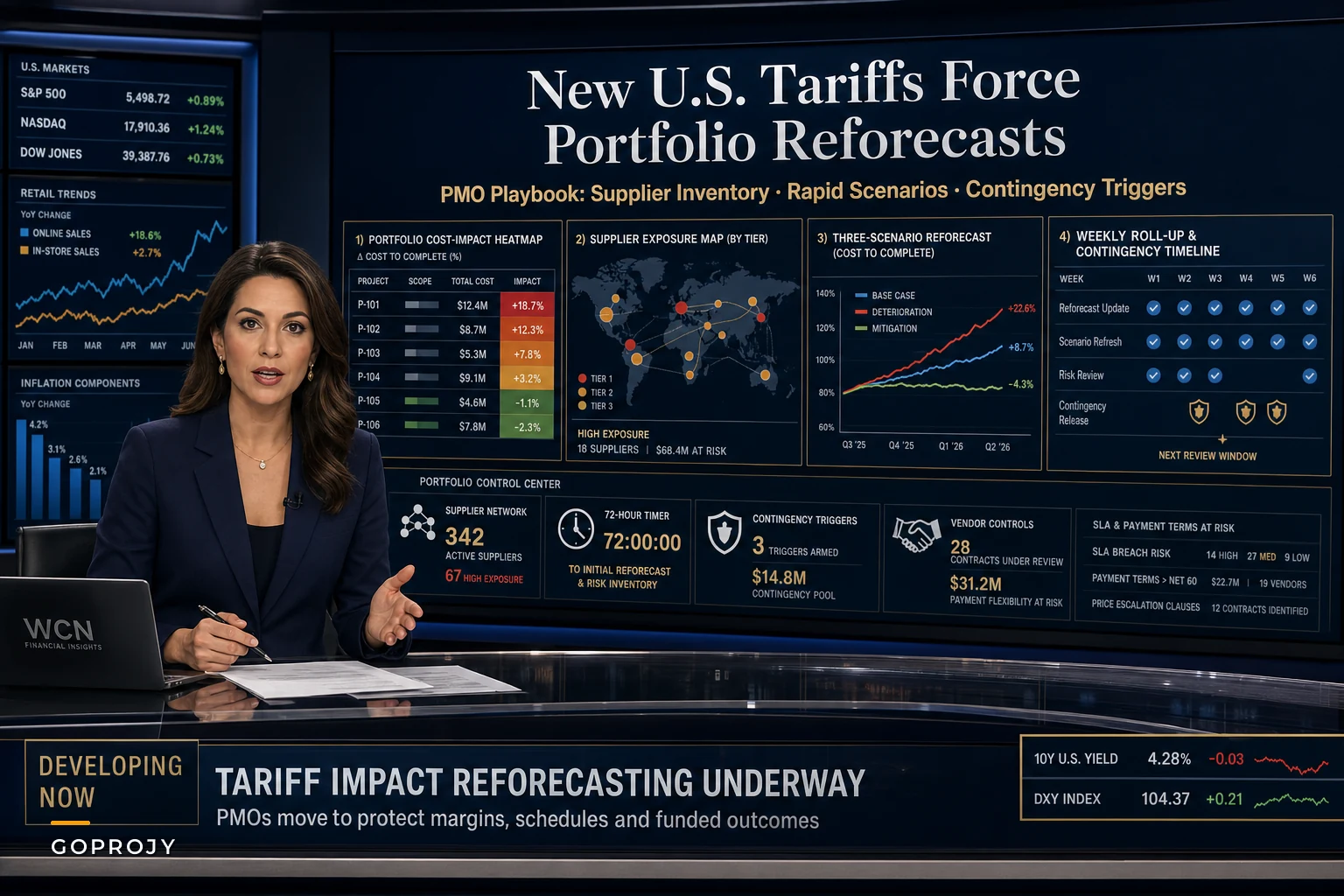

The new Section 301 tariffs announced last week hit fast. On July 24th, U.S. companies woke up to 10-12.5% levies on imports from 60 trading partners. No phase-in. No grace period for projects already mid-execution.
For PMOs managing portfolios with international suppliers, this creates immediate pressure. Your Q3 project budgets locked in three weeks ago? Those procurement assumptions just broke. The vendor contracts negotiated in June? They're getting renegotiated right now, whether you're ready or not.
I watched this exact scenario play out during the 2018 tariff waves. A manufacturing PMO had 42 active projects when steel tariffs hit. Within 72 hours, eleven vendors had requested contract modifications. Their carefully planned portfolio turned into a reforecasting scramble that took weeks to resolve—and by then, three critical path projects had already slipped.
This time the scope is wider. Not just steel or aluminum, but potentially thousands of product categories across your supply chain. PMOs need a systematic approach to identify exposure, reforecast costs, and make rapid portfolio adjustments before schedule impacts start cascading.
The Hidden Multiplier Effect Across Your Portfolio
Most organizations understand the direct cost hit—if you're paying 12.5% more for imported components, your procurement budget takes a hit. What catches PMOs off guard is how tariff shocks amplify across a portfolio.
Think about what happens when multiple projects share the same affected suppliers. A construction portfolio might have eight projects buying structural steel from the same vendor. When that vendor raises prices 15% (12.5% tariff plus their margin adjustment), you're not dealing with eight separate cost overruns. You're dealing with a systematic budget failure that threatens your entire capital allocation model.
Schedule impacts tend to hit harder than cost impacts too. Vendors facing tariff pressure don't just raise prices—they renegotiate delivery terms, consolidate orders to hit new minimum thresholds, and prioritize customers willing to absorb the full pass-through. That project sitting seventh in their production queue just dropped to fifteenth.
Then there's the substitution scramble. When import costs spike, procurement teams hunt for domestic alternatives. But everyone else is hunting at the same time. A medical device PMO tried switching from Chinese to Mexican suppliers during the 2019 tariffs. The Mexican vendors were immediately overwhelmed, pushing lead times from 8 weeks to 20. The "solution" created worse delays than the original problem.
Contingency drain happens quietly. Projects start drawing from management reserves to cover cost increases. Individually, each draw seems manageable—3% here, 5% there. Aggregate those draws across 30 projects and suddenly your portfolio-level contingency drops from a comfortable 15% to a dangerous 6%. You've lost the buffer to absorb anything else that goes wrong.
Building Your Tariff Impact Inventory
The first 48 hours after tariff announcements are critical. You need a rapid exposure assessment across your entire portfolio—not a perfect one. Speed beats precision here.
Stop losing track of critical projects.
GoProjy helps you monitor, prioritize, and deliver projects on time—seamlessly.
- Unified portfolio visibility
- Real-time resource tracking
- Milestone & risk alerts
No credit card required
Start with a supplier concentration analysis. Pull your vendor master data and tag every international supplier. Don't rely solely on procurement's country-of-origin tracking; it's usually incomplete. Cross-reference vendor addresses, DUNS numbers, and payment routing. Then map those vendors to active projects—and this isn't as simple as running a purchase order report. You need to identify both direct relationships and indirect ones, where the vendor is a tier-2 or tier-3 supplier to someone else you're already contracting with. One aerospace PMO found that roughly 60% of their tariff exposure came through domestic suppliers who were themselves dependent on imported components.
Create impact bands rather than precise calculations. Trying to calculate exact tariff impacts project-by-project will paralyze your response. Group projects into exposure bands instead:
Critical exposure (>8% budget impact): Projects with direct import dependencies exceeding 65% of material costs. These need immediate intervention.
Moderate exposure (3-8% impact): Projects with mixed domestic/import suppliers or indirect import dependencies through tier-2 vendors.
Low exposure (<3% impact): Projects primarily using domestic suppliers or with locked-in pricing agreements.
Track both cost and schedule vulnerability separately. A project might have low cost exposure but high schedule vulnerability if it depends on a single-source imported component with no ready substitute. Those are your hidden risks.
Vendor Contract Triage and Renegotiation Triggers
Your vendor contracts just became your most important risk documents. Most PMOs don't even know what protections they have—or don't have—buried in their procurement agreements.
Force majeure clauses are where vendors will look first. Standard language often includes "government action" or "regulatory changes" as qualifying events. If your contracts have this language, vendors can legally walk away from pricing commitments. One technology PMO found that 78% of their vendor contracts had force majeure clauses that specifically mentioned tariffs—making their fixed-price agreements essentially worthless.
Price adjustment mechanisms matter more than fixed pricing. Look for contracts with transparent pass-through formulas rather than flat rates. A contract that says "base price plus documented tariff costs" gives you visibility and control. One that says "fixed price subject to market conditions" gives vendors room to inflate well beyond the actual tariff impact.
Establish renegotiation boundaries before vendors approach you. Set clear thresholds:
-
Tariff pass-through accepted up to the actual tariff rate (10-12.5%)
-
Margin adjustments above the tariff rate require executive approval
-
Schedule modifications require formal change control
-
Minimum order changes trigger a contract review
Document every vendor communication. During tariff pressure, vendors often try informal renegotiations—a phone call suggesting "slight pricing adjustments," an email mentioning "supply chain challenges." These informal exchanges can inadvertently modify your contracts if you're not paying attention. Require all pricing and schedule discussions in writing, tied to specific contract clauses.
Three-Scenario Reforecasting Templates
Static forecasts are useless during tariff volatility. Build three scenarios for every affected project:
Base scenario: Tariffs stay at announced levels, vendors pass through actual costs only, and you maintain current supplier relationships. This is your planning baseline.
Deterioration scenario: Tariff rates increase another 5%, vendors add 3-5% margin padding, and around 20% of your suppliers require substitution. This is your risk planning case.
Mitigation scenario: You successfully negotiate tariff sharing with vendors, accelerate purchases before further increases, and find domestic alternatives for critical components. This is your action planning case.
The power isn't in the scenarios themselves—it's in the gap analysis between them. A renewable energy PMO found that the delta between their base and deterioration scenarios was roughly $3.2M across their portfolio. That number justified immediate action on supplier diversification they'd been delaying for months.
Build reforecasting templates that procurement teams can actually use. Complex models requiring 50 input fields won't get updated consistently. Keep it simple:
-
Vendor impact calculator
vendor name, current spend, tariff rate, estimated pass-through
-
Project adjustment tracker
project ID, original budget, base adjustment, deterioration adjustment
-
Portfolio roll-up dashboard
total exposure, contingency draw, schedule impact days
Update scenarios weekly during the first month, then bi-weekly once patterns stabilize. The USTR's fact sheet mentioned potential exemptions for certain product categories—track those possibilities, but don't bake them into your base scenario.
Below is a simple reforecasting workflow to follow during tariff volatility.
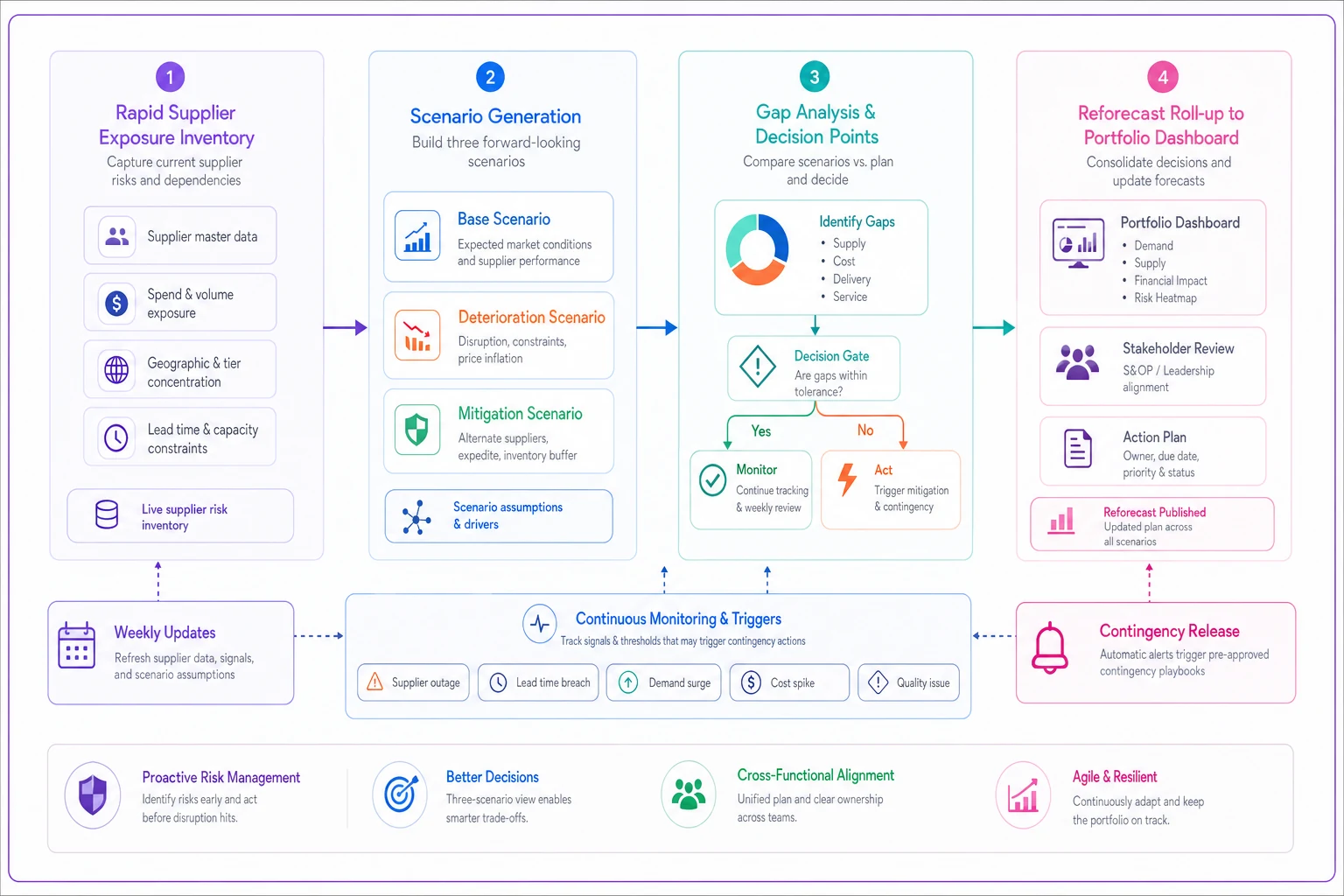
Use the workflow to standardize inputs and decision gates so teams update the same fields on the same cadence.
Contingency Release Rules and Portfolio Guardrails
Your contingency reserves are about to face serious pressure. Without clear release rules, they'll disappear into a thousand small draws that individually seem justified but collectively destroy your risk buffer.
Implement graduated release triggers based on impact verification:
Tier 1 (Immediate release, <$50K): Documented vendor price increases with tariff substantiation. Project manager approval only.
Tier 2 (48-hour release, $50K-$250K): Vendor contract modifications with legal review. PMO director approval required.
Tier 3 (Weekly review, >$250K): Strategic supplier changes or project scope modifications. Portfolio committee approval required.
The key is linking contingency draws to specific tariff impacts, not general budget overruns. A pharmaceutical PMO made the mistake of opening contingency for any "supply chain related" cost increase. Within two weeks, projects were charging everything from overtime to expedited shipping against tariff contingencies. They burned through roughly 40% of reserves on costs that had nothing to do with tariffs.
Require documented tariff substantiation before approving any contingency draw to prevent unrelated charges from draining reserves.
Portfolio-level guardrails help contain the damage:
-
No single project can draw more than 30% of portfolio contingency
-
Aggregate draws cannot exceed 10% per week
-
Contingency balance cannot drop below 8% without executive approval
-
Any draw must include a recovery plan
Consider breaking contingency into tranches instead of one pool—40% for verified tariff impacts, 30% for schedule recovery, 20% for supplier substitution costs, and 10% as untouchable reserve. This prevents early projects from draining funds that later projects might need more urgently.
Rapid Supplier Substitution Protocols
When tariff math makes imports unviable, the race for domestic alternatives begins. But substitution isn't just finding a new vendor—it's managing a complex transition that touches contracts, specifications, schedules, and quality systems.
Build your substitution decision matrix before you need it:
| Current Supplier Impact | Timeline Criticality | Substitution Action |
|---|---|---|
| >20% cost increase | Critical path | Immediate dual sourcing |
| >20% cost increase | Float available | Phased transition over 6 weeks |
| 10-20% increase | Critical path | Negotiate or accelerate purchases |
| 10-20% increase | Float available | Monitor and prepare alternatives |
| <10% increase | Any | Absorb if under budget tolerance |
Timeline criticality matters more than cost impact. A biotech PMO learned this the hard way when they prioritized substituting their highest-cost vendor (saving $400K) while ignoring a smaller vendor sitting on the critical path. That smaller vendor's three-week delay ended up costing $1.8M in portfolio-wide schedule slippage.
Establish pre-qualification requirements that can be relaxed during crisis substitution:
-
Standard
Full vendor audit, three references, sample testing, 90-day payment terms
-
Crisis
Financial verification, one reference, expedited sample review, 50% prepayment acceptable
Document every substitution decision with:
-
Original vendor impact assessment
-
Alternative vendor comparison (cost, lead time, quality score)
-
Transition costs and risks
-
Rollback plan if substitution fails
Having that documentation matters more than most teams expect—especially when auditors or executives ask why you onboarded a new vendor on a 10-day timeline.
Schedule Compression and Resequencing Options
Tariff impacts rarely distribute evenly across project phases. Smart resequencing can minimize exposure while maintaining critical milestones, but this requires thinking beyond traditional critical path analysis.
Map tariff exposure by project phase. One infrastructure PMO found that roughly 70% of their tariff exposure was concentrated in the procurement phase, while construction and commissioning used primarily domestic labor and materials. By extending design phases and compressing procurement windows, they reduced their average tariff exposure period from 8 months to 3 months.
Identify "tariff-sensitive" versus "tariff-neutral" work packages. Software implementation, training, documentation, and planning work typically have zero tariff exposure. Hardware procurement, equipment installation, and material-intensive construction carry high exposure. Pull forward the neutral packages to buy time for sensitive package negotiations.
When resequencing, maintain your dependencies:
-
Pull forward all tariff-neutral work packages
-
Batch tariff-sensitive purchases into consolidated orders
-
Delay non-critical procurement until pricing stabilizes
-
Accelerate critical procurement if further increases look likely
Watch for resequencing cascades. When multiple projects simultaneously try to pull forward their "safe" work, resource conflicts appear in areas that weren't previously constrained. A defense contractor's PMO had twelve projects accelerate their software development phases at once, which overwhelmed their integration team and created new bottlenecks nobody had anticipated.
The PMO Communication Cadence During Volatility
Tariff crises create information vacuums that fill with speculation. Your communication cadence needs to move faster than the rumor mill but stay measured enough to maintain credibility.
A twice-weekly portfolio impact briefing works well during the first month—Monday for weekend vendor communications and decisions needed, Thursday for updated scenarios and contingency status. Keep updates factual and actionable. Avoid speculating about policy changes or future tariff modifications. A manufacturing PMO lost credibility by repeatedly predicting "imminent exemptions" that never materialized. Stick to what you know: current impacts, verified vendor positions, concrete mitigation actions.
Create role-specific communication streams:
-
Project managers Daily vendor status, contract modification alerts, contingency draw approvals
-
Executives Weekly portfolio impact summary, contingency burn rate, critical decisions needed
-
Finance Bi-weekly reforecast updates, cash flow implications, budget modification requests
-
Procurement Real-time vendor response tracking, substitution priorities, negotiation boundaries
One retail PMO had different impact numbers in their executive dashboard, finance reports, and project status updates—all because each group was using different calculation methods. Establish one tariff impact model and pull all reporting from that single source.
Early Warning Indicators and Response Triggers
By the time vendor price increases show up in your invoices, most mitigation options are already off the table.
Monitor vendor communication patterns. A sudden uptick in "courtesy calls" or "relationship meetings" often precedes formal price increase notifications. When three vendors request meetings in the same week, start preparing for renegotiations.
Track peer portfolio responses. Join industry PMO forums or associations where tariff impacts get discussed. When competitors start announcing project delays or scope reductions, that's a signal the impacts are spreading beyond individual vendor relationships. Watch spot market prices for your key commodities too—even with locked-in contract prices, spot market movements predict where vendor renegotiation requests will focus. A 20% spike in spot prices typically triggers force majeure reviews within a few weeks.
Graduated response triggers give teams clear guidance:
Yellow (Prepare): Two or more vendors mention "supply chain pressures," spot prices increase 10%, peer portfolios report impacts.
Orange (Mobilize): First vendor requests price modification, spot prices increase 15%, contingency draws exceed 3% monthly.
Red (Execute): Multiple vendor modifications, spot prices increase 20%, contingency draws exceed 5% monthly.
Each trigger level activates specific protocols—yellow triggers scenario planning, orange triggers substitution analysis, red triggers portfolio rebalancing. This prevents both under-reaction and the opposite problem: panic substitution when it isn't actually warranted.
Connecting Tariff Response to Broader Vendor Governance
The tariff crisis exposes a deeper issue: most PMOs lack systematic vendor governance that can handle external shocks. This connects directly to the milestone-linked governance framework we covered earlier, where payment controls and acceptance gates provide real leverage during exactly these types of vendor negotiations.
When vendors request tariff-driven price increases, your milestone-linked payment structure becomes a negotiation tool. Instead of accepting blanket increases, tie additional payments to accelerated deliveries or enhanced specifications. A telecom PMO facing 15% vendor increases negotiated to pay the full increase only for milestones delivered ahead of schedule—vendors who held original timelines received just 7.5% increases.
Acceptance testing protocols become even more critical during supplier substitution. When you're onboarding new vendors quickly, robust acceptance criteria protect against quality degradation. Define minimum acceptable thresholds before substitution begins, not after you've already committed.
Payment timing controls also give you leverage when vendors claim immediate hardship. Instead of prepaying to help vendors manage tariff impacts, maintain your milestone-based payment schedule but offer faster payment processing upon successful acceptance. Keeps your cash flow protected while still supporting the relationship.
Technology Infrastructure for Rapid Reforecasting
Manual tariff impact tracking breaks down quickly when you're managing dozens of projects and hundreds of vendors. The reforecasting workload alone can overwhelm PMO teams that are already stretched thin.
AI-powered operational software makes a practical difference here. Instead of manually updating spreadsheets every time a vendor sends a price modification, modern platforms can automatically flag contracts with tariff exposure, calculate portfolio-wide impacts, and generate reforecast scenarios based on your defined parameters—without requiring a team of analysts to keep it current.
The real value comes from pattern recognition across the portfolio. Automated platforms can identify which projects tend to experience similar vendor impacts, which substitutions have worked historically, and which contingency draw patterns signal deeper problems. One construction PMO using automated impact tracking spotted that projects with over 60% import content consistently experienced roughly 2.5x their initial tariff impact estimate—intelligence that meaningfully improved their scenario planning accuracy.
Automated vendor communication tracking also helps during crisis periods. Instead of relying on project managers to log every vendor interaction, operational platforms can monitor email patterns, flag keywords related to pricing or delays, and surface emerging vendor issues before they turn into formal change requests. When you're dealing with 40 vendors simultaneously renegotiating terms, that kind of visibility isn't a nice-to-have.
The integration with financial systems matters too. When tariff impacts flow automatically from project tracking into portfolio dashboards and financial forecasts, you eliminate the lag between identifying an impact and executive visibility. One manufacturing PMO cut their impact-to-decision time from about 8 days to 36 hours just by automating the data flow between project and portfolio systems.
Building Portfolio Resilience Beyond the Current Crisis
Every tariff shock teaches the same lesson: portfolios optimized purely for cost efficiency are fragile when external conditions shift. Organizations that navigate tariff volatility well have built structural resilience into how they manage their portfolios—not just how they respond to individual crises.
Start with vendor diversification requirements. Instead of letting projects single-source critical components, mandate that any dependency over $500K must have a qualified alternative. Yes, this adds procurement overhead during stable periods. But it prevents the scramble for alternatives when a crisis hits.
Build tariff sensitivity into your project intake scoring. When evaluating new projects, treat import dependency as a risk factor alongside technical complexity and resource constraints. Projects with high import content need higher contingency reserves and more conservative schedules from day one.
Maintain small ongoing orders with backup suppliers even when primary suppliers are performing well. Think of it as paying insurance premiums—the small ongoing cost protects against massive switching costs during disruptions.
Consider portfolio-level hedging strategies too. If 40% of your portfolio depends on steel imports, look at financial hedging instruments or forward purchasing agreements. One energy PMO that locked in aluminum prices for 18 months avoided around $2.8M in tariff-related increases across their wind farm projects.
The Next 90 Days: Your PMO Action Checklist
The tariff impacts will clarify over the next quarter. How your PMO responds during this period determines whether your portfolio comes out stronger or spends 2026 playing catch-up.
Immediate (Next 7 days):
-
Complete supplier exposure inventory
-
Review force majeure clauses in critical vendor contracts
-
Establish contingency release rules
-
Create three-scenario reforecast templates
-
Launch twice-weekly communication cadence
Short-term (Next 30 days):
-
Negotiate tariff sharing agreements with strategic vendors
-
Identify and pre-qualify substitution vendors
-
Resequence project phases to minimize exposure periods
-
Implement early warning indicator monitoring
-
Adjust portfolio contingency reserves based on verified impacts
Medium-term (Next 90 days):
-
Complete critical vendor substitutions
-
Rebalance portfolio based on updated forecasts
-
Establish long-term supplier diversification requirements
-
Implement automated impact tracking systems
-
Document lessons learned for future shock response
Organizations that struggle will be those treating this as a temporary procurement problem to manage quietly until it passes. The ones that come through stronger will use this crisis to build better vendor governance, tighter contingency management, and more resilient portfolio structures.
The tariffs announced last week won't be the last supply chain shock your portfolio faces. The question is whether your PMO will be ready when the next one hits—and whether that readiness is baked into your operating model or just a folder of crisis response documents nobody will find in time.
Make tariff impact reforecasting a permanent capability in your PMO toolkit, not just a crisis response.
Ready to elevate your project delivery?
Join over 2,500 project teams using GoProjy to optimize resources, reduce risks, and drive portfolio success.