

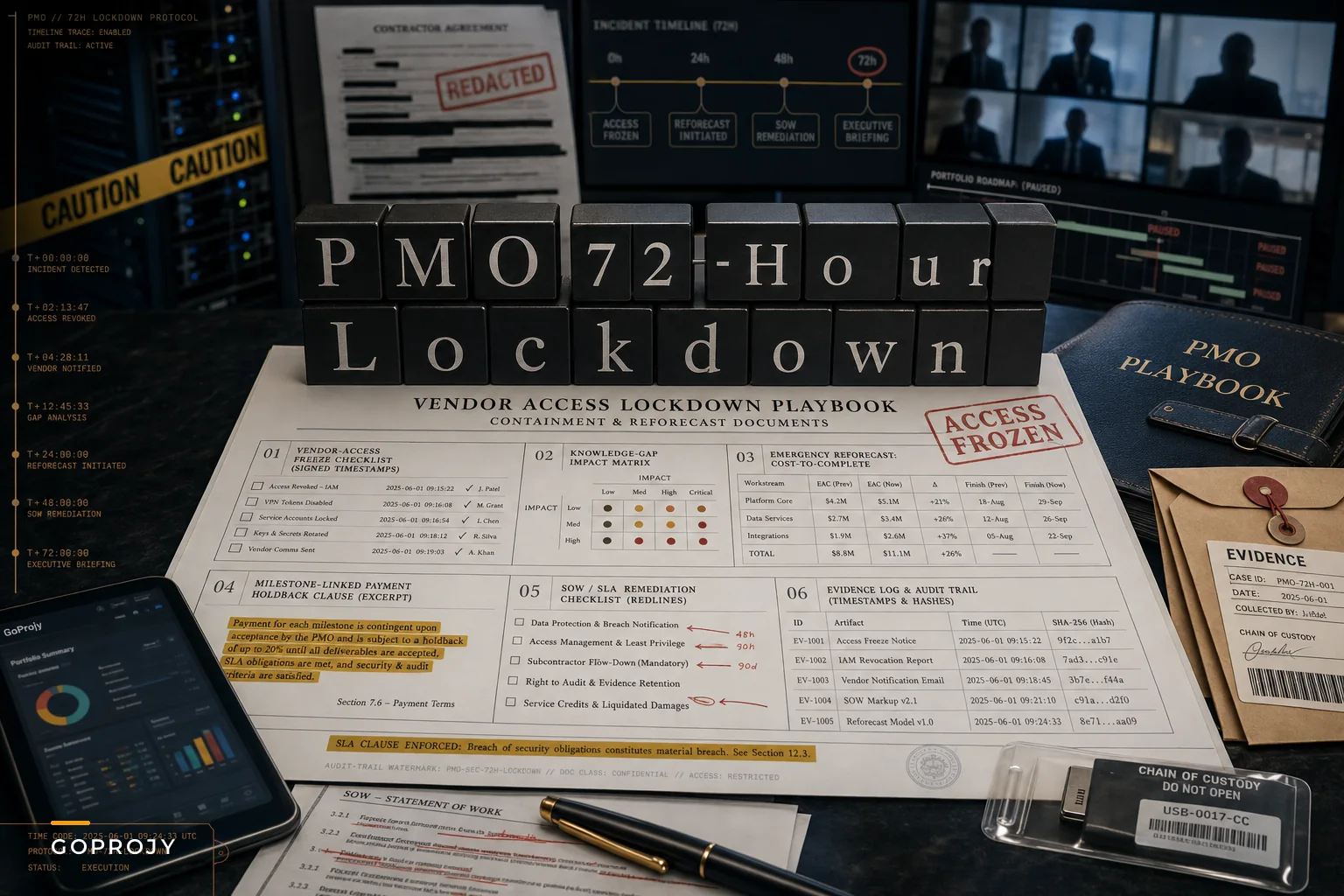

The fastest way to understand how fragile vendor dependencies really are is to watch one get severed without warning. That's effectively what happened in early October 2026, when Reuters reported that an Accenture contractor was removed from FBI access following a damaging data breach tied to an unapplied security patch. The specific details of that engagement matter less than what the pattern signals: when a vendor fails on security, client reactions now tend to be immediate and blunt. Access gets pulled first. Explanations come later.
For PMO leaders, that's the part worth sitting with. You rarely get a graceful off-ramp when a vendor relationship breaks over a security failure. You get a Monday morning where a critical contractor can no longer log in, a program that was 70% built suddenly has no one who knows the codebase, and a legal team asking whether your contract even lets you recover anything. This isn't theoretical anymore — it's a procurement reality accelerating across regulated and semi-regulated sectors alike.
So skip the hand-wringing. Here's what actually has to happen, in order, and where most PMOs lose weeks they can't afford.
Why a security-driven vendor removal is different from a normal vendor failure
A vendor slipping on delivery gives you signals. Missed standups, soft deadlines, "we're 90% there" for three sprints running. You see it coming. You can escalate, renegotiate, or swap on your own timeline.
A security-driven removal gives you none of that. The trigger isn't your decision and often isn't even your client's — it's a compliance or risk function acting to contain exposure. The practical differences stack up fast:
-
Access is revoked before handover. There's no "two weeks to transition knowledge." The badge stops working, the VPN cert is revoked, repo permissions are gone.
-
Your own access may get caught in the blast radius. If the vendor's credentials touched shared systems, your security team may freeze those environments while they assess lateral exposure.
-
The vendor becomes defensive, not collaborative. Once legal and PR are involved on their side, cooperation slows. Don't expect the friendly knowledge-transfer calls you'd get in an amicable wind-down.
-
Regulators and clients start asking about your controls. The question shifts from "did the vendor fail" to "why didn't your governance catch it."
That last point is where the real damage lives. A delayed project is a schedule problem. A breach-linked vendor removal is a schedule problem plus an evidence problem — and the evidence problem is the one that outlasts the quarter.
The underlying issue most PMOs don't want to admit
Most portfolios have one or two vendors whose knowledge is effectively uninsured. Nobody has mapped what they actually hold. The statement of work describes deliverables, not the operational dependency — the undocumented scripts, the environment configs living in one contractor's head, the access tokens set up eighteen months ago that nobody has rotated since.
Stop losing track of critical projects.
GoProjy helps you monitor, prioritize, and deliver projects on time—seamlessly.
- Unified portfolio visibility
- Real-time resource tracking
- Milestone & risk alerts
No credit card required
When that vendor disappears cleanly, you discover the dependency the hard way. In practice, this usually surfaces as a series of small "wait, who knows how to…" conversations that each add a few days, and together push a milestone out by a month.
The breach event just compresses that timeline. You find out everything you didn't document, all at once, under audit scrutiny. The teams that survive this well aren't the ones with better luck — they're the ones who treated vendor access and knowledge as a governed asset before the crisis, with acceptance records and audit trails already in place. That's less about heroics and more about having done the unglamorous work of a solid portfolio SOW playbook with templates, acceptance tests and audit trails long before anyone needed it.
The first 72 hours: a containment sequence
Speed matters, but blind speed makes the audit worse. This sequence keeps containment and evidence moving together rather than fighting each other.
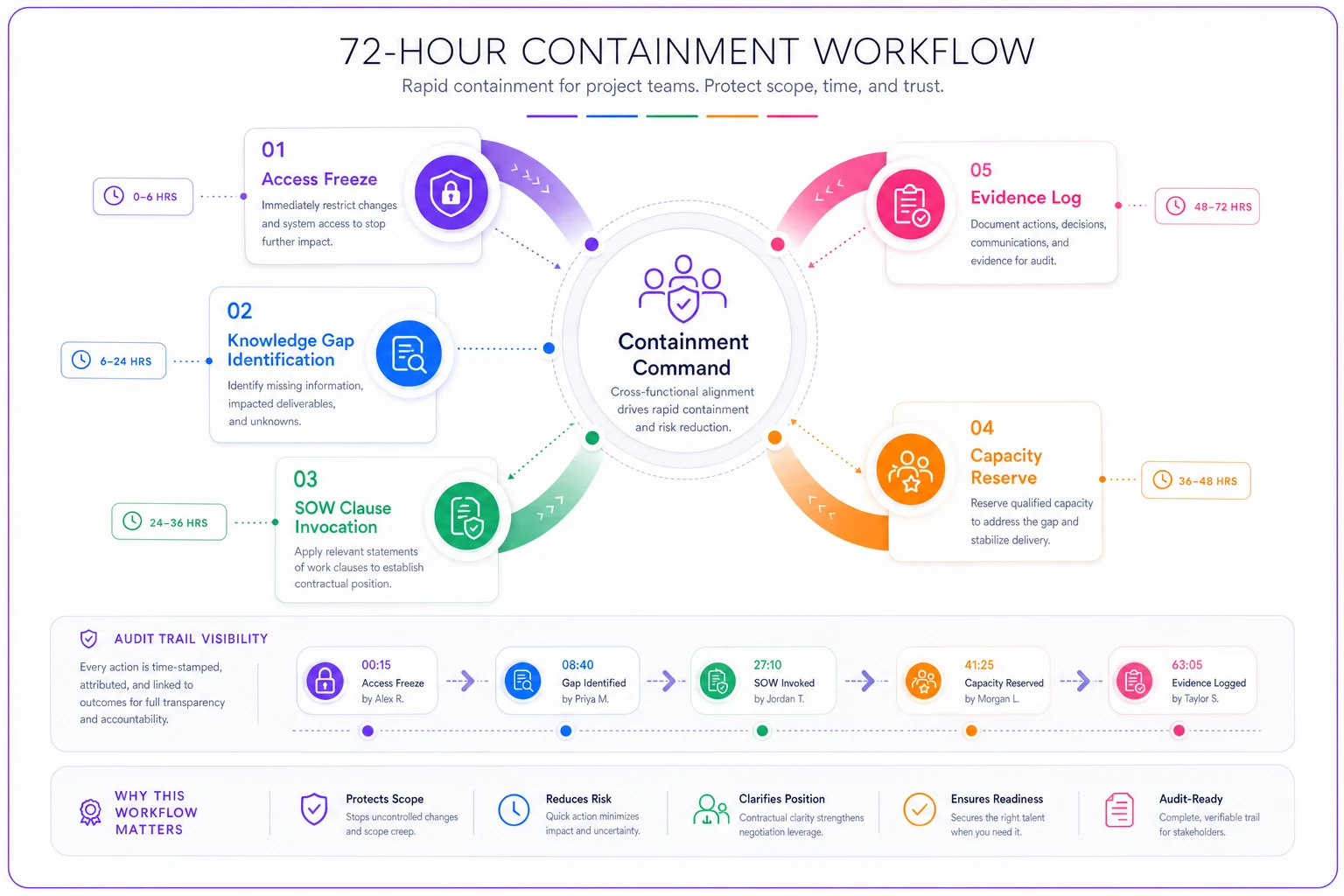
The diagram above shows the ordered flow you should follow in the first three days.
-
Freeze and inventory access, with timestamps. Within the first few hours, work with security to document exactly what the vendor could reach — repos, environments, data stores, shared service accounts. Capture when access was revoked, not just that it was. Regulators and clients will want a clean timeline, and reconstructing it from memory a month later never holds up.
-
Identify the "uninsured knowledge." List every deliverable or environment where this vendor was the only person who understood it. Be honest. This list is your real risk register for the next 30 days, not the generic one.
-
Trigger your SOW's suspension and remediation clauses — in writing. If your contract has milestone-linked acceptance and payment terms, this is when they earn their keep. Formally invoke them. Withhold payment tied to unaccepted work. Document the invocation.
-
Stand up a remediation reserve of specialist capacity. Don't release the internal people who worked alongside the vendor. You'll need them for forensic reconstruction and to brief any replacement. Reserving two or three people for three to four weeks is cheap compared to re-discovering the system from scratch.
-
Open a single evidence log for the whole incident. Every decision, access change, cost reforecast, and SLA action goes into one place with owners and timestamps. This becomes your audit artifact.
Notice that step three assumes you wrote those clauses in the first place. The PMOs scrambling hardest are the ones whose SOWs described outputs beautifully but said almost nothing about what happens when a vendor is forcibly removed.
Reforecasting when the gap is knowledge, not hours
The instinct is to reforecast by replacing headcount — the vendor had four people, so we need four people. That math is almost always wrong after a security removal, because you're not replacing labor. You're replacing labor plus ramp time to rebuild undocumented context plus forensic work to confirm nothing was compromised in the handoff.
A more realistic reforecast separates three cost buckets:
| Cost bucket | What it covers | Typical pattern after a forced removal |
|---|---|---|
| Replacement delivery | New vendor or internal team doing the remaining scope | Roughly 1.3–1.6× the original remaining cost, mostly from ramp |
| Remediation & forensics | Confirming integrity, rotating credentials, patching the original gap | Often underestimated; can run 3–5 weeks of specialist time |
| Schedule carry cost | The downstream projects waiting on this one | Varies wildly — map dependencies before quoting a date |
A typical example: a program with about four months of vendor scope remaining, originally budgeted at something like $180k to finish, gets reforecast to roughly $230k–$260k once ramp, forensic verification, and credential rotation are included — and the finish date moves out six to eight weeks, not two. Teams that lowball this early end up re-baselining twice, which destroys executive confidence far more than a single honest reforecast would have.
The cost table above is the right starting point for any executive conversation. Go in with ranges, not point estimates, and explain which bucket is driving the spread. That framing tends to land better than a single number that looks precise but isn't.
Enforcing SLAs when the vendor is already on the back foot
Enforcement feels awkward when a vendor is in crisis mode, but this is exactly when your leverage is highest and your documentation needs are greatest.
-
Separate the security failure from the commercial dispute. Mixing them invites a messy legal fight. Address the breach through your security and legal channel, enforce delivery SLAs through your commercial channel — each with its own paper trail.
-
Apply acceptance tests to anything already delivered. Before the vendor fully disengages, run acceptance on completed work while people are still available to answer questions. Unaccepted deliverables are far weaker leverage after the relationship fully breaks.
-
Document every SLA breach as it happens, not retroactively. "The vendor missed the remediation SLA by nine days" is only useful if you logged the SLA, the expectation, and the actual date in real time.
-
Hold payment against unmet security obligations, not just missed features. If the contract tied any portion of payment to maintaining security posture, that's directly relevant now.
Enforcement is only as strong as the evidence behind it. Evidence collected in the moment beats anything reconstructed later.
A quick checklist for before the next one happens
You won't prevent every vendor removal, but you can make the next one a controlled event instead of a fire. Run through this on your top vendors now:
-
[ ] Every critical vendor has a documented "what they uniquely hold" knowledge map, updated quarterly
-
[ ] All SOWs include suspension, remediation, and forced-removal clauses — not just delivery terms
-
[ ] Vendor access is inventoried, with service accounts and tokens owned by named internal people
-
[ ] Credential rotation has a defined owner and happens on a schedule, not on an incident
-
[ ] Acceptance tests exist for in-flight deliverables, so you're never accepting work blind
-
[ ] A standing incident evidence-log template is ready to open on day one
-
[ ] Reforecasting templates separate replacement, remediation, and carry costs
Keep your incident evidence-log template in a shared, versioned location so it's ready on day one.
Most of these cost very little to put in place during calm periods. They're nearly impossible to build well during a crisis.
When a fast vendor-swap is the right call — and when it isn't
When it makes sense: The remaining scope is well-documented, the new vendor can ramp without deep forensic dependency, and the schedule pressure is severe enough that remediation delay costs more than the swap. Clean, modular work transitions reasonably well.
When it's a bad idea: The departed vendor held deep undocumented context, or the breach means you can't yet trust the integrity of what was built. Rushing a replacement into an unverified environment just layers a second vendor's assumptions on top of an unresolved first problem. Pause delivery, finish forensics, then bring in the replacement.
Who should not rush this: Any PMO that can't produce a current access inventory and knowledge map within a day. If you don't know what the vendor held, you're not ready to replace them — you're ready to document them first.
The swap-versus-pause decision is one of the more consequential calls you'll make in the first week. Get it wrong in either direction and you're either burning time you don't have or introducing a second set of unknowns into an already unstable environment.
The real lesson underneath the headline
Forced vendor removals used to be rare enough to treat as edge cases. They aren't anymore. The shift toward immediate access revocation on security failures means your portfolio's resilience now depends less on vendor goodwill and more on how well you governed the relationship before anything went wrong — the clauses you wrote, the access you tracked, the knowledge you insisted on documenting, and the evidence you were already keeping.
None of that is glamorous work. It's the kind of thing that gets deprioritized because it never shows up as a win on a status report. But when a contractor's access disappears on a Monday morning, the PMOs that stay calm are the ones who did that quiet work months earlier. Everyone else spends the next quarter reconstructing a system, a timeline, and an audit trail all at once — usually with a regulator watching.
The preparation gap is what separates a bad week from a bad quarter.
The preparation gap is what separates a bad week from a bad quarter.
Ready to elevate your project delivery?
Join over 2,500 project teams using GoProjy to optimize resources, reduce risks, and drive portfolio success.