


Last month's portfolio review meeting lasted four hours. Should've been 45 minutes. The PMO director kept pulling up different spreadsheets, trying to explain why three major programs suddenly went red despite looking green just two weeks earlier.
The real kicker? Every individual project manager had flagged their risks properly. Filed them in the risk register. Assigned owners. But nobody caught how a supplier delay on Project A would trigger resource conflicts in Project B, which then pushed Project C past its regulatory deadline, ultimately threatening $4M in contracted revenue across the entire portfolio.
This happens constantly in portfolio management. Not because people aren't tracking risks — they're tracking plenty. The problem is portfolio risk aggregation breaks down when you treat each project's risks like they exist in isolation. They don't. They compound, they cascade, and they create feedback loops that turn manageable issues into portfolio-wide emergencies.
The hidden math of risk amplification
Think about your current portfolio. You've probably got somewhere between 15 and 50 active projects running.
Each project manager maintains their own risk register with maybe 8 to 12 active risks. Simple multiplication tells you that's potentially hundreds of individual risk items floating around at any given time.
But that math misses something important: risks don't add linearly. They multiply through connections most PMOs never map.
A single technical dependency slipping by three weeks doesn't just delay one project. It creates resource conflicts when teams get double-booked trying to catch up. Those conflicts force other projects to reschedule, which triggers change requests, which consume management bandwidth, which delays decisions on completely unrelated initiatives.
The amplification gets worse when you factor in shared constraints. Most portfolios run on the assumption that resources, vendors, and infrastructure can handle their planned load plus maybe 15% buffer. But when multiple projects hit snags simultaneously — which happens more often than statistical models predict — those buffers evaporate fast.
One telecommunications company had 22 projects sharing the same integration testing environment. When three of those projects slipped into the same testing window due to "unrelated" delays, the resulting bottleneck pushed 14 other projects off schedule. The total impact was roughly 10 times larger than any individual risk assessment had suggested.
Why traditional risk registers create blind spots
Every project manager knows the drill. Identify risks. Score them on probability and impact. Add some categories — technical, resource, schedule, budget. Update weekly. Review in steering committees. File away in SharePoint.
Stop losing track of critical projects.
GoProjy helps you monitor, prioritize, and deliver projects on time—seamlessly.
- Unified portfolio visibility
- Real-time resource tracking
- Milestone & risk alerts
No credit card required
This works reasonably well for individual projects. It falls apart at the portfolio level for three fairly predictable reasons.
First, risk registers use project-local scoring. A "high impact" risk for a small compliance project might mean $50k and two weeks of delay. For a major transformation program, high impact means $2M and three months. When you try to roll these up into portfolio views, you're comparing apples to bulldozers.
Second, most risk registers completely miss cross-project dependencies. They'll capture "dependency on Project X delivering Feature Y" but won't trace what happens if Project X gets delayed because Project Z pulled their best developer. The second-order effects stay invisible until they blow up.
Third, the sheer volume creates noise that drowns out the actual signals. When you're looking at 400+ risks across a portfolio, even solid PMO teams struggle to identify which combinations could trigger cascading failures. The human brain isn't wired to track that many interrelated variables simultaneously.
The Excel gymnastics required to aggregate all this usually produces either meaningless averages or overwhelming detail. Neither actually helps executives make decisions.
Building a portfolio risk appetite matrix
The first step toward real portfolio risk aggregation isn't better tracking — it's establishing clear risk appetite boundaries at the portfolio level.
Most organizations claim they have risk appetite statements. Dig a little deeper and you'll find vague principles like "we accept moderate risk for innovation projects." That's not actionable. You need specific thresholds tied to measurable impacts.
A functional risk appetite matrix maps risk categories against portfolio constraints:
Financial boundaries:
-
Single project impact threshold
>$500k requires escalation
-
Cumulative portfolio impact
>$2M triggers portfolio rebalancing
-
Quarterly budget variance tolerance
8% before CFO engagement
Schedule boundaries:
-
Critical path delays
>4 weeks requires SteerCo review
-
Milestone collision tolerance
Max 3 projects competing for same resource
-
Regulatory deadline buffer
Minimum 6 weeks maintained
Resource boundaries:
-
Specialist utilization ceiling
85% before hiring triggers
-
Vendor concentration limit
No vendor >30% of portfolio work
-
Cross-project resource conflicts
Max 2 per specialist per quarter
Technical boundaries:
-
Architecture change impact
>3 systems requires enterprise review
-
Integration complexity score
>7 requires dedicated architect
-
Technical debt accumulation rate
<15% per release cycle
The real value comes when you encode these boundaries into systematic checks rather than relying on human judgment during chaotic portfolio reviews.
The amplification check system
Once you've established appetite boundaries, you need a mechanism to detect when risks might amplify beyond them. This is where most PMOs fall short — they track individual risks but miss amplification patterns entirely.
An amplification check looks at three dimensions.
Horizontal amplification traces how risks spread across projects at the same level. You map which projects share resources, vendors, technologies, or deadlines. Then you identify trigger conditions where problems in one project automatically affect others.
Vertical amplification tracks how risks bubble up through portfolio layers. A delay in a foundational infrastructure project doesn't just affect the projects building on that infrastructure — it impacts programs depending on those projects, which affects strategic initiatives containing those programs.
Temporal amplification examines how risks compound over time. A two-week delay in January might be manageable on its own. But if it pushes work into March when you have regulatory submissions, April when you have a major release, and May when half your team is on vacation — that two-week delay becomes a two-month crisis.
The key is running these checks systematically, not just when someone happens to notice a connection.
[Project A Risk Event] | v [Horizontal Spread] --> [Projects B, C, D — shared resource/vendor conflicts] | v [Vertical Propagation] --> [Program Layer] --> [Portfolio Layer] | v [Temporal Compression] --> [Regulatory / Milestone / Capacity Collisions] | v [Aggregate Portfolio Impact Score]
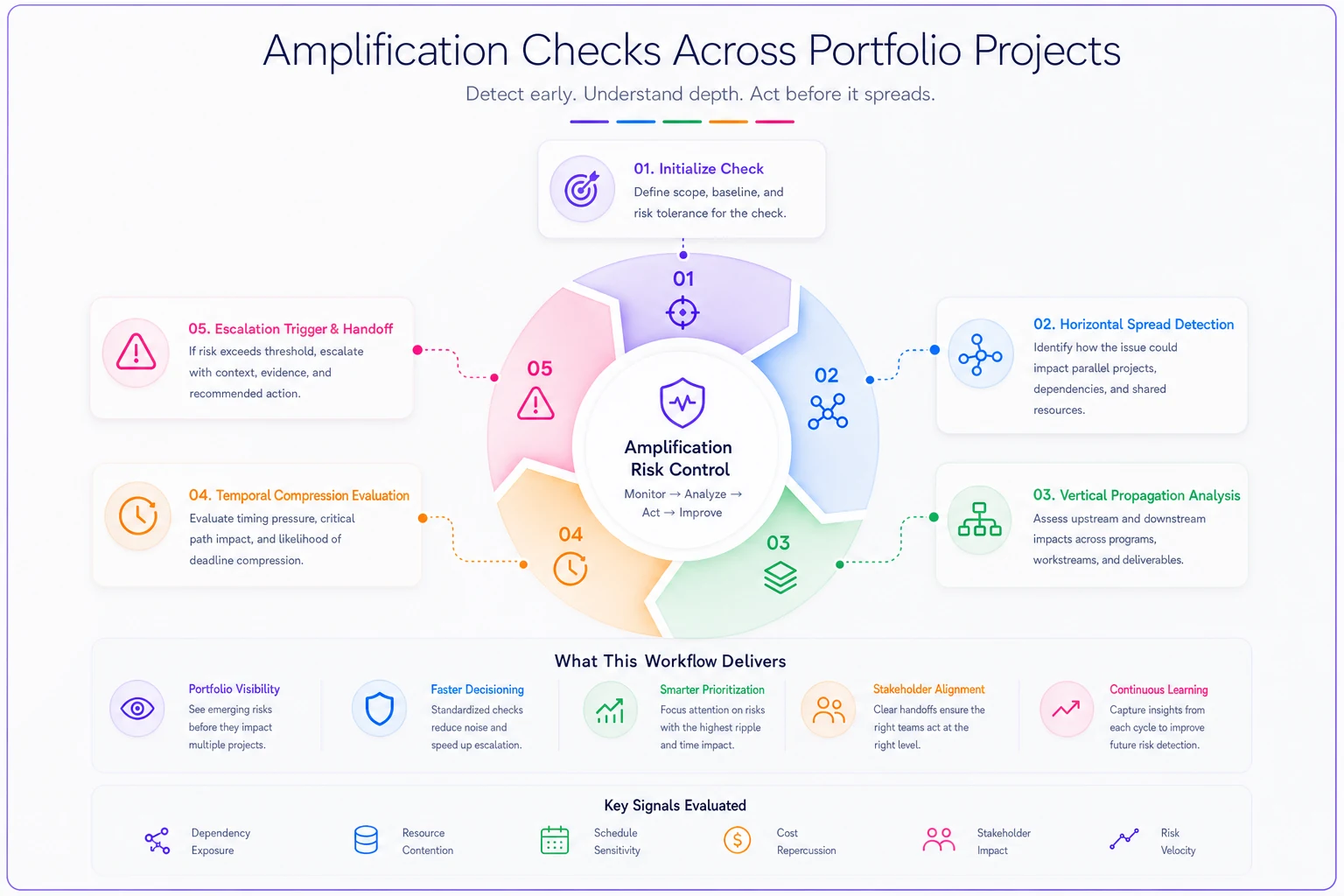
This visual maps the amplification check workflow so teams can spot where a single event may cascade and which escalation path to follow.
Scoring risks at portfolio scale
Individual project risk scores become pretty meaningless at portfolio scale. You need a scoring system that captures both individual impact and amplification potential.
The most practical approach uses a two-stage model.
Stage 1: Normalized Impact Scoring
| Dimension | Normalization Approach |
|---|---|
| Financial impact | As % of total portfolio budget |
| Schedule impact | As % of total portfolio duration |
| Resource impact | As % of total portfolio capacity |
| Strategic impact | Against defined portfolio objectives |
This normalization lets you compare a $50k risk in a small project against a $500k risk in a large program on equal footing.
Stage 2: Amplification Multipliers
| Amplification Type | Multiplier |
|---|---|
| Horizontal spread | 1.5x per affected project |
| Vertical propagation | 2x per portfolio layer |
| Temporal compression | 1.3x per conflicting milestone |
| Resource contention | 1.8x for specialist dependencies |
A risk that scores 6 individually might score 28 after amplification factors. This isn't inflating numbers for drama — it's reflecting the real portfolio impact more accurately.
Some teams worry this creates inflated scores that cause panic. In practice, the opposite tends to happen. When executives see realistic aggregate scores, they stop treating every risk as equally urgent and can actually focus on the combinations that threaten portfolio success.
Containment strategies that actually work
Containing portfolio risk requires different tactics than managing project risk. You're not just mitigating individual issues — you're preventing cascade failures.
Circuit breakers stop risk propagation between projects. Just like electrical systems, you need predetermined break points where connections get severed to prevent total system failure. Establishing "resource firewalls" where certain specialists can't be shared across more than two critical projects at once is one example. "Schedule air gaps" where dependent projects must maintain minimum buffer periods between hand-offs is another.
Risk pooling consolidates similar risks under single owners who manage them across projects. Instead of seven projects individually managing vendor risks for the same supplier, one person owns the relationship and coordinates response strategies. This seems obvious but rarely happens naturally — project managers protect their own scope, so you need formal pooling mechanisms with clear authority and escalation paths.
Pressure relief valves create predetermined scope reductions or timeline extensions that activate automatically when risk scores exceed thresholds. Rather than waiting for steering committee meetings to make these calls, you pre-negotiate the trade-offs in advance. A software portfolio might pre-agree that any project facing more than a six-week delay automatically drops enhancement features to protect core functionality. No meetings, no debates, no delays in decision-making when things get messy.
The escalation playbook
Most escalation processes are too slow for cascading portfolio risks. By the time issues work through project governance, then program governance, then portfolio governance, the damage has already spread.
You need pre-staged escalation triggers with pre-authorized responses. The following ordered structure works well in practice:
-
4-Hour Triggers — Resource conflict affecting more than three projects; vendor failure impacting critical path; technical blocker crossing project boundaries; budget overrun exceeding tier-1 contingency.
-
24-Hour Triggers — Milestone collision detected; regulatory deadline risk identified; architecture conflict discovered; specialist availability crisis.
-
72-Hour Triggers — Strategic objective at risk; portfolio budget variance exceeding 5%; multiple project amber status changes; vendor relationship degradation.
Each trigger needs a pre-assigned decision maker with pre-authorized actions they can take without additional approval. The 4-hour triggers might authorize the PMO director to reallocate resources and access contingency funds up to $250k. The 24-hour triggers might let the portfolio sponsor defer non-critical projects and engage backup vendors.
The playbook should also include filled-out templates for common scenarios. When a critical vendor fails, you don't want people crafting emails from scratch. Have the communication templates, stakeholder lists, and decision trees ready to execute.
Contingency allocation across the portfolio
Traditional project contingency sits in individual project budgets, often unused while other projects scramble for funds. Portfolio risk aggregation demands a different approach.
| Tier | Pool | Allocation | Owner | Release Requirement |
|---|---|---|---|---|
| Tier 1 | Project Level | 40% of total | Project Manager | Automatic below threshold |
| Tier 2 | Program Level | 35% of total | Program Manager | Program board approval |
| Tier 3 | Portfolio Level | 25% of total | Portfolio Sponsor | Executive authorization |
The percentages vary by risk appetite and portfolio maturity, but the tiered structure ensures funds flow where they're actually needed without bureaucratic delays.
More importantly, this structure incentivizes proper risk aggregation. Project managers can't hoard contingency while neighboring projects fail. The system forces collaborative risk management whether people feel like collaborating or not.
Early warning systems that don't cry wolf
The biggest challenge with portfolio risk monitoring isn't detection — it's filtering signal from noise. When everything is flagged as urgent, nothing actually gets treated that way.
Effective early warning systems use progressive triggers with different response requirements:
Yellow flags (Monitor): Single project risk score increase greater than 20%; resource utilization approaching 75%; vendor performance degradation trend; minor milestone shifts.
Orange flags (Investigate): Risk amplification detected across two or more projects; resource utilization exceeding 85%; vendor SLA breaches; milestone collision probability above 30%.
Red flags (Act): Cascade failure conditions met; resource utilization exceeding 95%; vendor failure imminent; milestone collision confirmed.
The key is resisting the urge to escalate everything immediately. Yellow flags might generate automated notifications but require no action. Orange flags trigger investigation but not necessarily intervention. Only red flags demand immediate response.
PMO teams that try to treat every risk with equal urgency usually end up tracking nothing effectively.
The technology stack for portfolio risk aggregation
Manual risk aggregation starts breaking down around 10 to 12 projects. Beyond that, you need systematic help to track connections, calculate amplifications, and trigger escalations consistently.
The challenge is that most project management tools excel at project-level risk tracking but struggle with portfolio aggregation. They'll show you risk registers and heat maps, but they won't detect amplification patterns or manage contingency pools across projects.
This is where AI-powered operational platforms can genuinely change how a PMO operates. Instead of humans trying to spot patterns across hundreds of risks, these platforms continuously scan for amplification conditions, identify when seemingly unrelated risks might compound, calculate more realistic aggregate scores, and trigger escalation workflows before problems cascade.
A platform monitoring resource allocation might detect that three projects are about to compete for the same database architect — even though they're currently scheduled weeks apart. It factors in that person's availability, the likelihood of upstream delays, and historical schedule accuracy to flag a probable resource collision well before it happens. The system then automatically triggers contingency planning while there's still time to do something about it.
These platforms also handle the administrative burden that usually causes risk aggregation to fall apart in practice. Maintaining risk taxonomies, normalizing scoring across projects, tracking escalation paths, managing contingency pool allocations — all of that gets systematized so the PMO team can focus on actual decisions rather than spreadsheet maintenance.
The more mature platforms also learn from patterns over time. After monitoring enough portfolio cycles, they start identifying early indicators that humans tend to miss — certain vendor communication patterns that precede delivery failures, or specific combinations of technical dependencies that historically create instability. That kind of predictive capability shifts portfolio risk management from reactive to something closer to proactive.
Making it stick: adoption and governance
The best portfolio risk aggregation system means nothing if teams don't use it consistently.
Start with making it genuinely useful for project managers, not just another reporting burden. If the aggregation system helps them secure resources, access contingency funds faster, and escalate issues more effectively, they'll actually engage with it. Show them how portfolio-level visibility protects their individual projects — not just the portfolio as an abstract concept.
Identify "risk aggregation champions" within each program. These don't need to be additional roles — they're existing team members who understand both their program's details and the portfolio connections. They become the connective tissue that makes aggregation work in practice.
The governance side matters too. Make aggregated risk assessments mandatory for phase gates, funding releases, and resource allocations. Projects that don't participate in portfolio risk aggregation don't get portfolio support when risks materialize. That tends to focus people's attention.
Regular "risk collision workshops" bring project managers together to map dependencies and identify amplification potential before it becomes a problem. These aren't status meetings — they're working sessions where teams actively trace risk connections and plan containment strategies while there's still room to maneuver.
The path forward
Portfolio risk aggregation isn't about predicting every possible failure. It's about understanding how failures propagate and building systems to contain them before they cascade into something much worse.
Start small. Pick your five most critical projects and map their risk interdependencies. Build amplification checks for just those connections. Create contingency pools they can share. Establish escalation triggers for their specific constraints. Once that core group operates smoothly, expand in waves — each wave teaches you more about your portfolio's unique amplification patterns, the specific dependencies, vendor concentrations, and resource constraints that make your portfolio vulnerable in ways a generic framework won't anticipate.
The companies that get this right don't have fewer risks than their competitors. They just prevent those risks from metastasizing. Their projects still hit snags, but those snags don't trigger avalanches.
When you can spot a cascade forming three weeks before it happens, release contingency funds in hours instead of weeks, and prevent resource conflicts before they occur — that's when portfolio management stops being crisis response and starts looking like actual strategic execution.
Your portfolio almost certainly has risks that could amplify into major failures. The question is whether you build the systems to contain them early, or explain the damage after they do.
Ready to elevate your project delivery?
Join over 2,500 project teams using GoProjy to optimize resources, reduce risks, and drive portfolio success.